Trigonometric Ratios Explained with Examples, Class 10
Learn what sine, cosine, tangent and their reciprocals mean in a right triangle, why they depend only on the angle, and how to find all six ratios when one is given, with six worked examples.
Trigonometry begins with a simple observation: in a right triangle, the shape of the triangle is fixed once you know one of its acute angles. The ratios of its sides, called the trigonometric ratios, capture that shape as numbers. Surveyors use them to find heights they cannot climb, engineers use them to set the slope of a ramp, and in Class 10 you will use them to solve heights-and-distances problems. This lesson explains the six ratios from the ground up, shows why they depend only on the angle, and teaches you how to find all six when only one is given.
Naming the sides of a right triangle
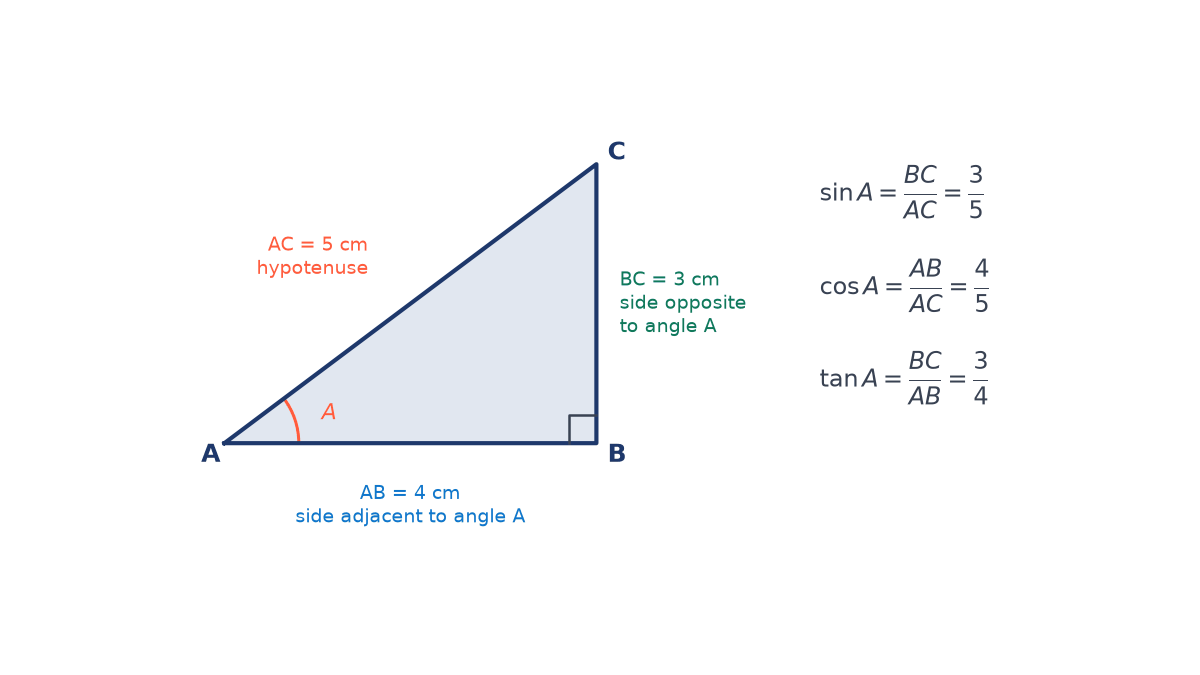
Take a triangle ABC with a right angle at B. The side opposite the right angle, AC, is the hypotenuse. It is always the longest side. The other two sides get their names from the acute angle you are looking at.
Sides relative to angle A
The side opposite to ∠A is BC (it does not touch vertex A).
The side adjacent to ∠A is AB (it touches A and is not the hypotenuse).
The hypotenuse is AC.
Sides named with respect to angle A in a right triangle with AB = 4 cm, BC = 3 cm and AC = 5 cm.
Sides relative to angle C
The names change when you switch angles. For ∠C, the opposite side is AB and the adjacent side is BC. The hypotenuse stays AC. Always ask "which angle am I working with?" before you write a ratio.
The six trigonometric ratios
Definitions
For an acute angle A in a triangle right-angled at B:
sinAcosAtanA=hypotenuseside opposite to ∠A=ACBC,=hypotenuseside adjacent to ∠A=ACAB,=side adjacent to ∠Aside opposite to ∠A=ABBC,cosecAsecAcotA=BCAC,=ABAC,=BCAB.
The names are short for sine, cosine, tangent, cosecant, secant and cotangent. In the triangle above, sinA=53, cosA=54 and tanA=43.
Reciprocal relations
The last three ratios are the first three turned upside down:
cosecA=sinA1,secA=cosA1,cotA=tanA1.
So if you know sinA, cosA and tanA, you know all six.
Tan as a quotient
Divide sinA by cosA:
cosAsinA=AB/ACBC/AC=ABBC=tanA.
Hence tanA=cosAsinA and cotA=sinAcosA. These two facts are used constantly when simplifying expressions.
Why the ratios depend only on the angle
A natural worry is that a bigger triangle with the same angle A might give a different value of sinA. It does not, and the reason is similarity.
The similar-triangles argument
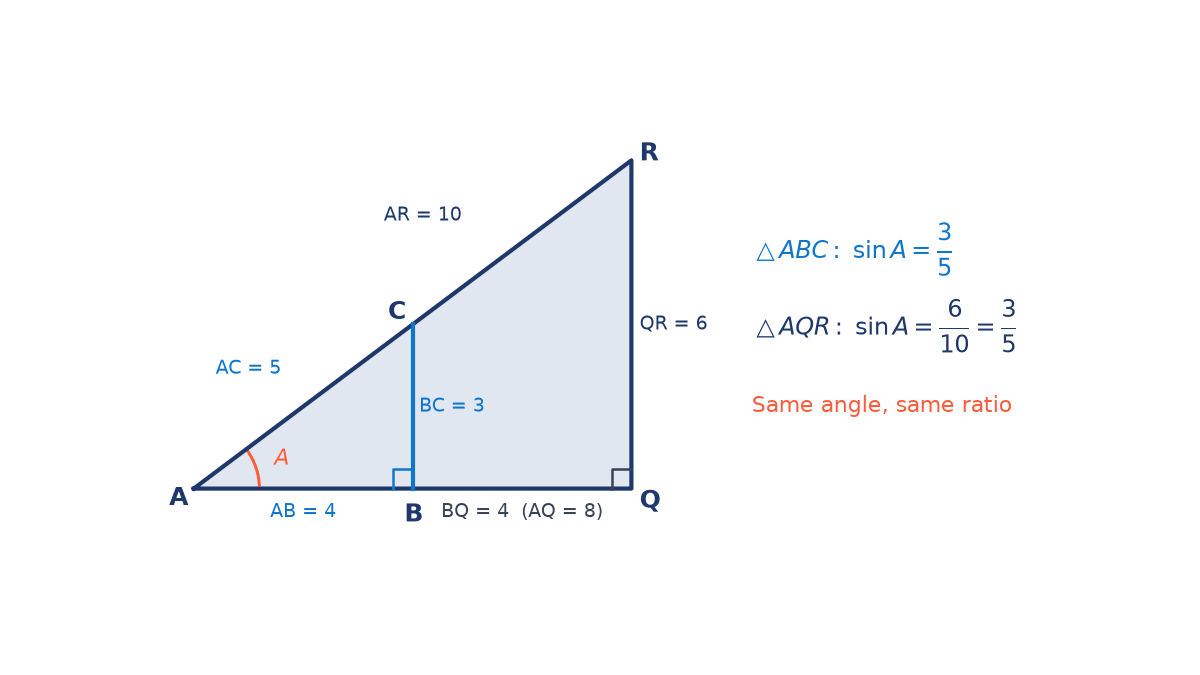
Draw a right triangle ABC (right angle at B) and extend AB to a point Q. Draw QR perpendicular to AQ, meeting AC extended at R. Triangles ABC and AQR have ∠A in common and a right angle each, so by the AA criterion △ABC∼△AQR. Corresponding sides of similar triangles are proportional:
QRBC=ARAC⟹ACBC=ARQR.
The left side is sinA worked out from the small triangle; the right side is sinA worked out from the large one. They are equal. The same argument works for every other ratio.
Doubling the triangle doubles every side, so sin A is 3/5 in both triangles.
This is why we can write sinA as a property of the angle alone. Note that sinA is a single symbol: it is not "sin" multiplied by A.
Why sin A is less than 1 and sec A is at least 1
For an acute angle A, the hypotenuse is the longest side of the right triangle, so the opposite side is shorter than it. Therefore
Taking reciprocals of positive numbers less than 1 gives numbers greater than 1, so secA>1 and cosecA>1 for every acute angle. In the next lesson you will meet A=0∘, where cos0∘=1 and sec0∘=1. Putting these together, secA≥1 whenever it is defined, and a value such as cosA=45 or secA=32 is impossible. The tangent has no such limit: tanA can be any positive number, because the opposite side can be shorter or longer than the adjacent side.
Method: given one ratio, find the others
Write the given ratio as a fraction of two sides, for example tanA=3512 means opposite : adjacent =12:35.
Let the two sides be 12k and 35k for some positive number k.
Find the third side with Pythagoras' theorem.
Read off the remaining ratios from the definitions; the k cancels in every ratio.
Use the reciprocal relations for cosec, sec and cot.
Check that sinA and cosA are both less than 1.
Worked examples
Example 1: all six ratios from the sides
In △ABC, right-angled at B, AB=12 cm and BC=5 cm. Find all six trigonometric ratios of ∠A.
Solution. By Pythagoras' theorem,
AC2=AB2+BC2=144+25=169,AC=13 cm.
For ∠A: opposite =BC=5, adjacent =AB=12, hypotenuse =13.
You can cross-check with the sides 5,12,13: cos2A−sin2A=169144−16925=169119, which agrees.
Example 5: when the sides are hidden in a condition
In △PQR, right-angled at Q, PQ=12 cm and PR+QR=18 cm. Find sinP, cosP and tanP.
Solution. By Pythagoras' theorem, PR2=PQ2+QR2, so
PR2−QR2=144⟹(PR−QR)(PR+QR)=144⟹PR−QR=18144=8.
Adding PR+QR=18 and PR−QR=8 gives 2PR=26, so PR=13 cm and QR=5 cm.
For ∠P: opposite =QR=5, adjacent =PQ=12, hypotenuse =PR=13.
sinP=135,cosP=1312,tanP=125.
Example 6: a surd in the answer
If A is acute and sinA=32, find the value of secA+tanA.
Solution. Take opposite =2k, hypotenuse =3k. The adjacent side is 9k2−4k2=5k. So
secA=53,tanA=52,secA+tanA=55=5.
Common mistakes
Naming the opposite and adjacent sides for the wrong angle. Mark the angle on your sketch first.
Using the hypotenuse as the "adjacent" side. The adjacent side is never the hypotenuse.
Treating sinA as sin×A and "cancelling" the A, as in AsinA=sin.
Forgetting the square root after Pythagoras' theorem, and writing a side as 169 instead of 13.
Accepting an answer such as cosA=1213. Sine and cosine of an acute angle are always less than 1.
Leaving 5 in a denominator when the question asks for a simplified value. Rationalise where needed.
Try these
If sinA=419, find cosA and tanA. Answer:cosA=4140, tanA=409.
The two shorter sides of a right triangle are 20 cm and 21 cm. For the angle opposite the 20 cm side, find sin, cos and tan. Answer:2920, 2921, 2120.
If cosθ=53, evaluate sinθ−cosθsinθ+cosθ. Answer:7.
If 2tanA=1, find sinAcosA. Answer:52.
In △PQR, right-angled at Q, PQ=6 cm and PR−QR=2 cm. Find sinP. Answer:54 (with PR=10 cm, QR=8 cm).
Key terms
Hypotenuse
The side opposite the right angle; the longest side of a right triangle.
Opposite side
The side of a right triangle facing the acute angle under discussion.
Adjacent side
The side that forms the acute angle together with the hypotenuse.
Sine
The ratio of the opposite side to the hypotenuse.
Cosine
The ratio of the adjacent side to the hypotenuse.
Tangent
The ratio of the opposite side to the adjacent side; also equal to sine divided by cosine.
Reciprocal ratios
Cosecant, secant and cotangent, which are the reciprocals of sine, cosine and tangent.
Similar triangles
Triangles with equal corresponding angles, whose corresponding sides are therefore in the same ratio.
Common questions
Do I need to know the actual lengths to find a ratio?
No. Only the ratio of two sides matters. That is why you may take the sides as 12k and 35k; the k cancels.
Can tan A be greater than 1?
Yes. If the opposite side is longer than the adjacent side, tanA>1. Only sine and cosine are limited to values below 1 for acute angles.
Why is cosec written instead of csc?
Both are abbreviations of cosecant. The Indian school syllabus uses cosec, so write cosec in board examinations.
Does the ratio change if the triangle is drawn in a different position?
No. Turning, flipping or enlarging the triangle keeps the angle the same, so every ratio stays the same.
What does sin² A mean?
It means (sinA)2, the square of the value of sinA. It does not mean sin(A2).
References
National Council of Educational Research and Training. Mathematics: Textbook for Class X. NCERT, New Delhi.
Loney, S. L. Plane Trigonometry. Cambridge University Press.
Aggarwal, R. S. Secondary School Mathematics for Class 10. Bharati Bhawan.