Trigonometric Identities and How to Prove Them, Class 10
Prove the three Class 10 trigonometric identities from Pythagoras theorem, express every ratio in terms of one, and learn a step-by-step strategy for proving identities through six worked proofs.
A trigonometric identity is an equation involving trigonometric ratios that holds for every angle for which both sides are defined. Class 10 uses three of them, and all three come straight from Pythagoras' theorem. They let you convert one ratio into another, simplify long expressions, and prove statements that appear in almost every board paper as 3-mark questions. This lesson proves the identities, shows how to express every ratio through a single one, and then works through proofs of increasing difficulty with a strategy you can reuse.
Identity versus equation
An equation such as 2sinA=1 is true only for particular angles (here A=30∘ among acute angles). An identity such as sin2A+cos2A=1 is true for every angle A from 0∘ to 90∘. When you "prove" an identity you show that the two sides are always equal; you do not solve for A.
The three identities and their proofs
Identity 1: sin² A + cos² A = 1
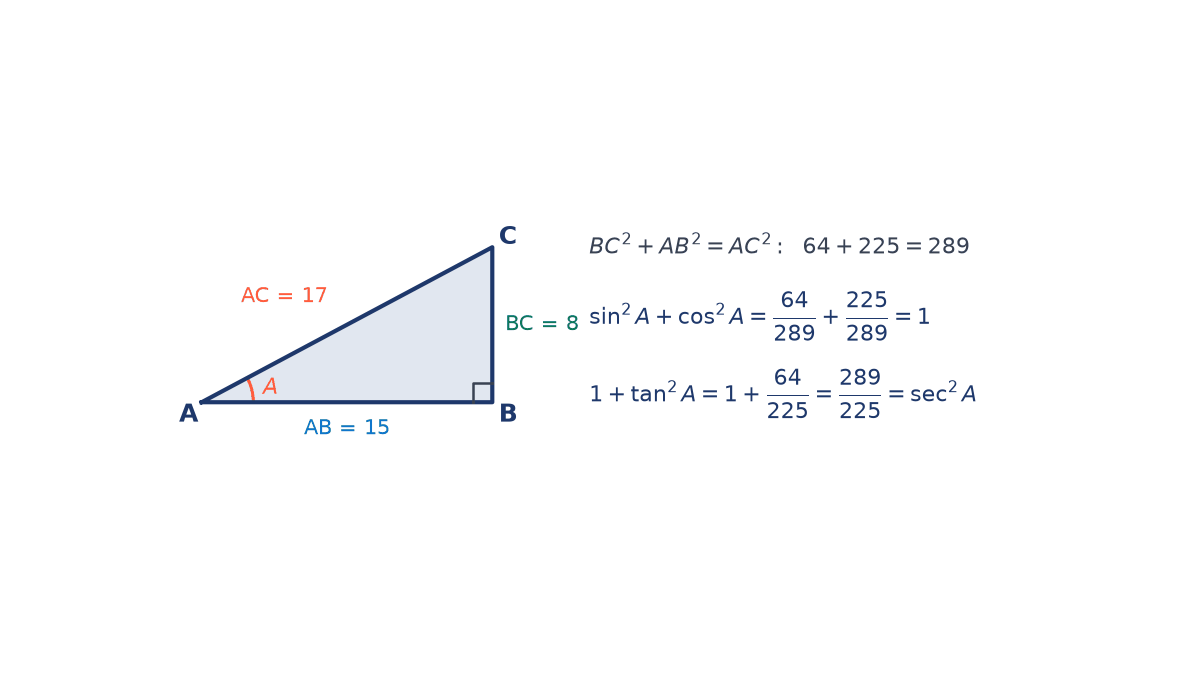
Let △ABC be right-angled at B. By Pythagoras' theorem,
AB2+BC2=AC2.
Divide every term by AC2 (which is not zero):
(ACAB)2+(ACBC)2=1⟹cos2A+sin2A=1.
This proves the identity for every acute angle A. For the end points, sin20∘+cos20∘=0+1=1 and sin290∘+cos290∘=1+0=1, so it holds for all A with 0∘≤A≤90∘.
A numerical check of the first two identities in an 8–15–17 right triangle.
Identity 2: 1 + tan² A = sec² A
Divide AB2+BC2=AC2 by AB2 instead:
1+(ABBC)2=(ABAC)2⟹1+tan2A=sec2A.
The division needs AB=0, that is cosA=0. Since tan90∘ and sec90∘ are not defined, this identity holds for 0∘≤A<90∘. At A=0∘ both sides equal 1.
Identity 3: 1 + cot² A = cosec² A
Divide AB2+BC2=AC2 by BC2:
(BCAB)2+1=(BCAC)2⟹1+cot2A=cosec2A.
This needs BC=0, that is sinA=0, so it holds for 0∘<A≤90∘. At A=90∘ both sides equal 1.
Cancelling 1+sinθ is allowed because it is at least 1, never zero. The denominator 1−sinθ is not zero because θ=90∘, which is also what makes secθ and tanθ defined.
Common mistakes
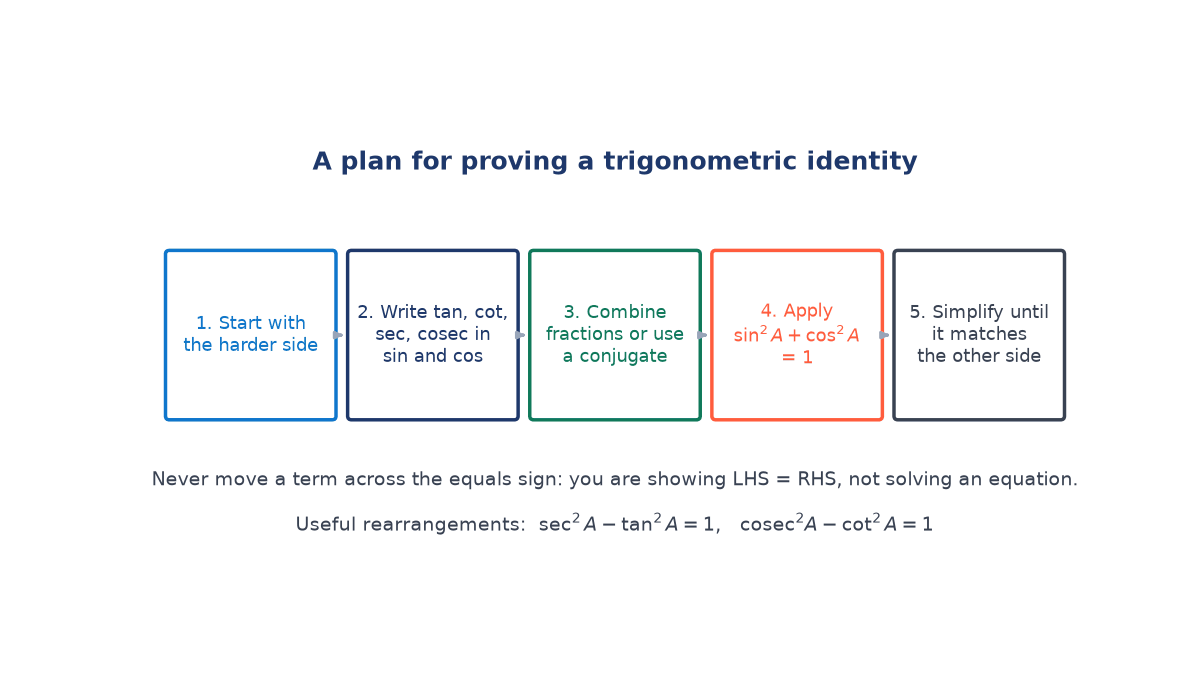
Transposing terms from one side to the other as if solving an equation. In a proof, work on one side at a time.
Writing sin2A+cos2A=1 as sinA+cosA=1. The squares matter: at 45∘, sinA+cosA=2.
Expanding (1−cosθ)2 as 1−cos2θ and losing the middle term −2cosθ.
Cancelling a term that is added, not multiplied: sinA1+sinA is not 1.
Using 1+tan2A=sec2A at A=90∘, where neither side is defined.
Stopping one step short, for example at sinθ1⋅2, without writing it in the exact form asked for.
Try these
If secA+tanA=3, find secA−tanA and sinA. Answer:secA−tanA=31, sinA=54.
Simplify 1+tan2A1+cot2A for 0∘<A<90∘. Answer:cot2A.
If sinθ=53 and θ is acute, use an identity to find secθ. Answer:45.
Find the value of 7cosec2A−7cot2A. Answer:7.
Find the value of sin225∘+cos225∘. Answer:1.
Simplify cosθtanθcosecθ. Answer:1.
Key terms
Identity
An equation that is true for every value of the angle for which both sides are defined.
Pythagorean identities
The three identities sin² A + cos² A = 1, 1 + tan² A = sec² A and 1 + cot² A = cosec² A.
LHS and RHS
The left-hand side and right-hand side of the statement being proved.
Conjugate
The partner expression, such as 1 + sin A for 1 − sin A, whose product gives a difference of squares.
Common denominator
A single denominator used to add or subtract fractions, often a product of the separate denominators.
Domain of an identity
The angles for which every ratio in it is defined, for example 0° ≤ A < 90° for 1 + tan² A = sec² A.
Common questions
Can I work on both sides at once?
Yes, as long as you simplify each side separately and show that both reach the same expression. What you must not do is move terms across the equals sign.
Why do we always convert to sin and cos?
Because sine and cosine are linked by the simplest identity, and every other ratio can be written using them. It is not the only route, but it almost always works.
Is the identity true for obtuse angles too?
Yes, but the Class 10 syllabus only defines the ratios for angles from 0° to 90°, so state and use them in that range.
How do I know when to multiply by a conjugate?
When you see 1−sinA, 1+cosA or secA−tanA in a denominator or under a root, multiplying by its conjugate creates a squared ratio that an identity can replace.
How much working should I show in a 3-mark proof?
Show every substitution and every use of an identity on its own line, and finish with "= RHS". Examiners look for the identity you used at each step.
References
National Council of Educational Research and Training. Mathematics: Textbook for Class X. NCERT, New Delhi.
Loney, S. L. Plane Trigonometry. Cambridge University Press.
Sharma, R. D. Mathematics for Class 10. Dhanpat Rai Publications.
Stewart, J., Redlin, L. and Watson, S. Precalculus: Mathematics for Calculus. Cengage Learning.