Lengths of Tangents from an External Point, Class 10
Prove that the two tangents from an external point are equal using RHS congruence, then use the result for angles between tangents, concentric circles, circumscribed quadrilaterals and triangles with an incircle.
From a point outside a circle you can draw exactly two tangents, and they always have the same length. This simple fact solves a surprising range of Class 10 problems: angles between tangents, chords of concentric circles, quadrilaterals drawn around a circle and triangles with a circle inside them. In this lesson you will prove the theorem with RHS congruence, draw out its consequences, and use them in worked examples of steadily increasing difficulty.
Throughout, you will use the result from the previous topic: the tangent at any point of a circle is perpendicular to the radius through the point of contact.
The equal tangents theorem
Setting up the picture
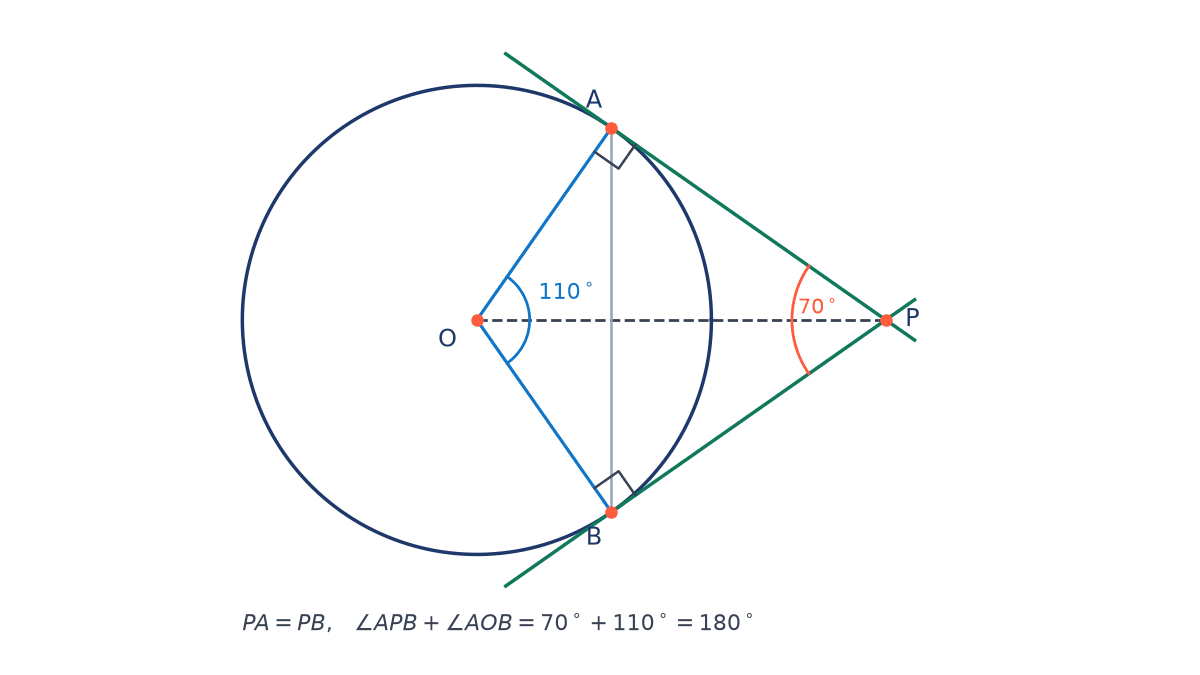
Let O be the centre of a circle and P a point outside it. The two tangents from P touch the circle at A and B. The segments PA and PB are the lengths of the tangents from P. Join OA, OB and OP. By the tangent–radius theorem, ∠OAP=∠OBP=90∘.
Statement
Theorem. The lengths of the tangents drawn from an external point to a circle are equal.
Proof
Given: A circle with centre O; PA and PB are tangents from an external point P, touching the circle at A and B.
To prove:PA=PB.
Construction: Join OA, OB and OP.
Proof: In △OAP and △OBP:
∠OAP=∠OBP=90∘ (radius is perpendicular to the tangent at the point of contact).
OP=OP (common hypotenuse).
OA=OB (radii of the same circle).
So △OAP≅△OBP by the RHS (right angle–hypotenuse–side) congruence rule. Hence, by CPCT (corresponding parts of congruent triangles), PA=PB. ■
Another way to see it. By Pythagoras' theorem in the two right triangles, PA2=OP2−OA2 and PB2=OP2−OB2. Since OA=OB, the right-hand sides are equal, so PA2=PB2 and PA=PB.
Consequences of the theorem
The line to the centre bisects the angles
From the same congruence, ∠OPA=∠OPB and ∠AOP=∠BOP (CPCT). So:
OP bisects the angle between the two tangents, ∠APB.
OP bisects the angle ∠AOB subtended at the centre by the two points of contact.
The centre therefore lies on the bisector of the angle between the two tangents.
The angle between the tangents
In quadrilateral OAPB, the four angles add up to 360∘. Two of them are right angles, so
∠APB+∠AOB=360∘−90∘−90∘=180∘.
In words: the angle between the two tangents and the angle subtended by the points of contact at the centre are supplementary.
The chord of contact
Since PA=PB, triangle PAB is isosceles, so ∠PAB=∠PBA. Also OA=OB and PA=PB, so both O and P are equidistant from A and B. Therefore OP is the perpendicular bisector of the chord AB.
Two tangents from P: PA = PB, and the angle at P (70 degrees) and the angle at O (110 degrees) add up to 180 degrees.
Method: solving tangent problems
Draw the figure and mark every point of contact.
Join the centre to each point of contact and mark the right angles.
From each external point (or vertex), write the two equal tangent lengths with the same letter, for example x.
For angles, use the right angles, the angle sum of the quadrilateral OAPB, and the isosceles triangles PAB and OAB.
For lengths, write each side as a sum of two tangent lengths and form equations; or use Pythagoras in a right triangle containing a radius.
Solve, and check that every length is positive and the pieces add up to the given sides.
Worked examples
Example 1: Angles made by two tangents
PA and PB are tangents from P to a circle with centre O, and ∠APB=70∘. Find ∠AOB, ∠OPA, ∠PAB and ∠OAB.
Answer:OP=8 cm and PA=PB=43 cm. Here △PAB is equilateral, since it is isosceles with a 60∘ apex angle, so the chord AB is also 43 cm.
Example 4: A quadrilateral circumscribing a circle
A quadrilateral ABCD is drawn to circumscribe a circle, that is, all four sides touch the circle. Prove that AB+CD=AD+BC. Hence find AD if AB=7 cm, BC=9 cm and CD=8 cm.
Proof. Let the sides AB, BC, CD and DA touch the circle at P, Q, R and S respectively. Tangents from the same external point are equal, so
A consequence. If a parallelogramABCD circumscribes a circle, then AB=CD and BC=AD, so the result gives 2AB=2BC, that is AB=BC. All four sides are equal, so the parallelogram is a rhombus.
Example 5: Triangle with an inscribed circle
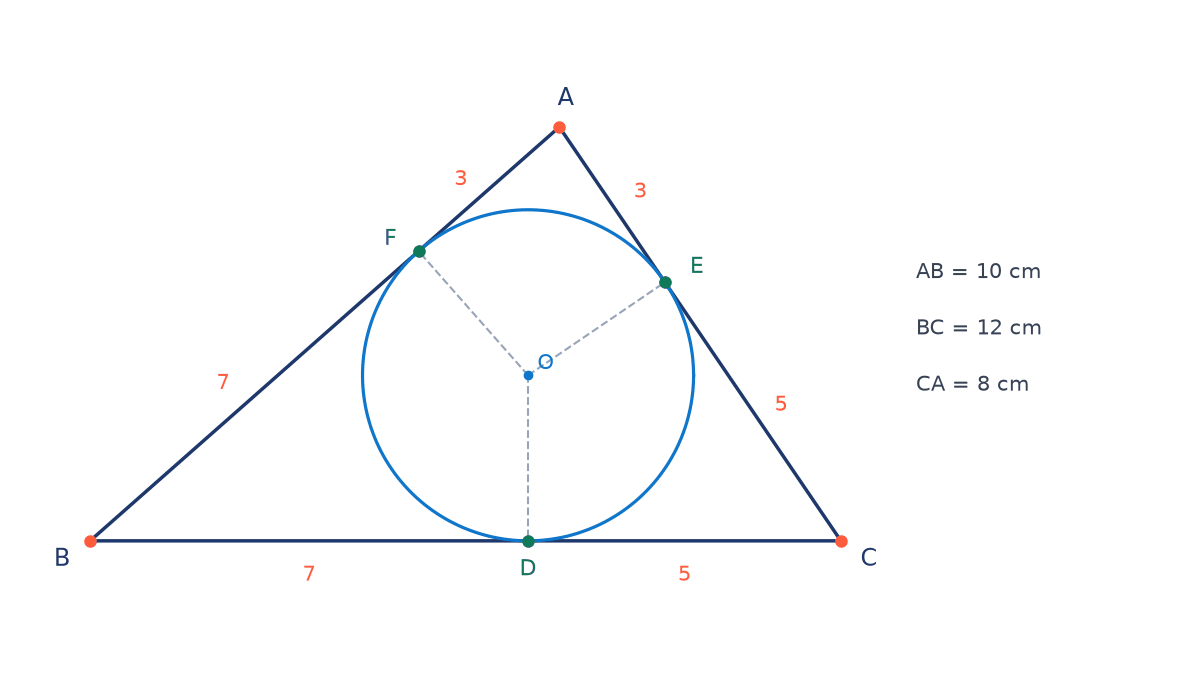
A circle is inscribed in triangle ABC with AB=10 cm, BC=12 cm and CA=8 cm. It touches BC, CA and AB at D, E and F. Find AF, BD and CE.
Solution. Tangents from each vertex are equal. Let
AF=AE=x,BF=BD=y,CD=CE=z.
Writing each side as a sum of two tangent lengths:
x+yy+zz+x=AB=10=BC=12=CA=8
Adding all three: 2(x+y+z)=30, so x+y+z=15. Then
x=15−12=3,y=15−8=7,z=15−10=5.
Check: x+y=10, y+z=12, z+x=8. All three sides agree.
Answer:AF=3 cm, BD=7 cm, CE=5 cm.
Example 5: the two tangent pieces from each vertex are equal, 3 cm from A, 7 cm from B and 5 cm from C.
Example 6: Radius of the incircle of a right triangle
Triangle ABC is right-angled at B with AB=6 cm and BC=8 cm. Find the radius of the circle inscribed in it.
Solution. By Pythagoras, AC=36+64=10 cm. Let the incircle have centre O and radius r, and let it touch AB, BC and CA at F, D and E.
OF⊥AB and OD⊥BC (radius ⊥ tangent), and ∠B=90∘. So OFBD has three right angles and is a rectangle. Its adjacent sides OF and OD are both equal to r, so it is a square, and BF=BD=r.
Tangents from A: AE=AF=6−r.
Tangents from C: CE=CD=8−r.
Since E lies on AC: AE+CE=AC.
(6−r)+(8−r)14−2rr=10=10=2 cm
Answer: The inradius is 2 cm. In general, for a right triangle with legs a, b and hypotenuse c, the same steps give r=2a+b−c.
Common mistakes
Writing "SAS" or "SSS" in the equal-tangents proof. The correct rule is RHS, because the equal right angles are not between the known sides.
Forgetting to state why ∠OAP=90∘. Write the reason "radius ⊥ tangent at the point of contact" every time.
Assuming ∠APB=∠AOB or that they add to 90∘. They are supplementary: they add up to 180∘.
In triangle problems, labelling the two tangent pieces from one vertex with different letters. Pieces from the same vertex are equal.
Using AB+BC=CD+DA for a circumscribed quadrilateral. The correct pairing is opposite sides: AB+CD=AD+BC.
In concentric circle problems, forgetting to double the half-chord at the end.
Try these
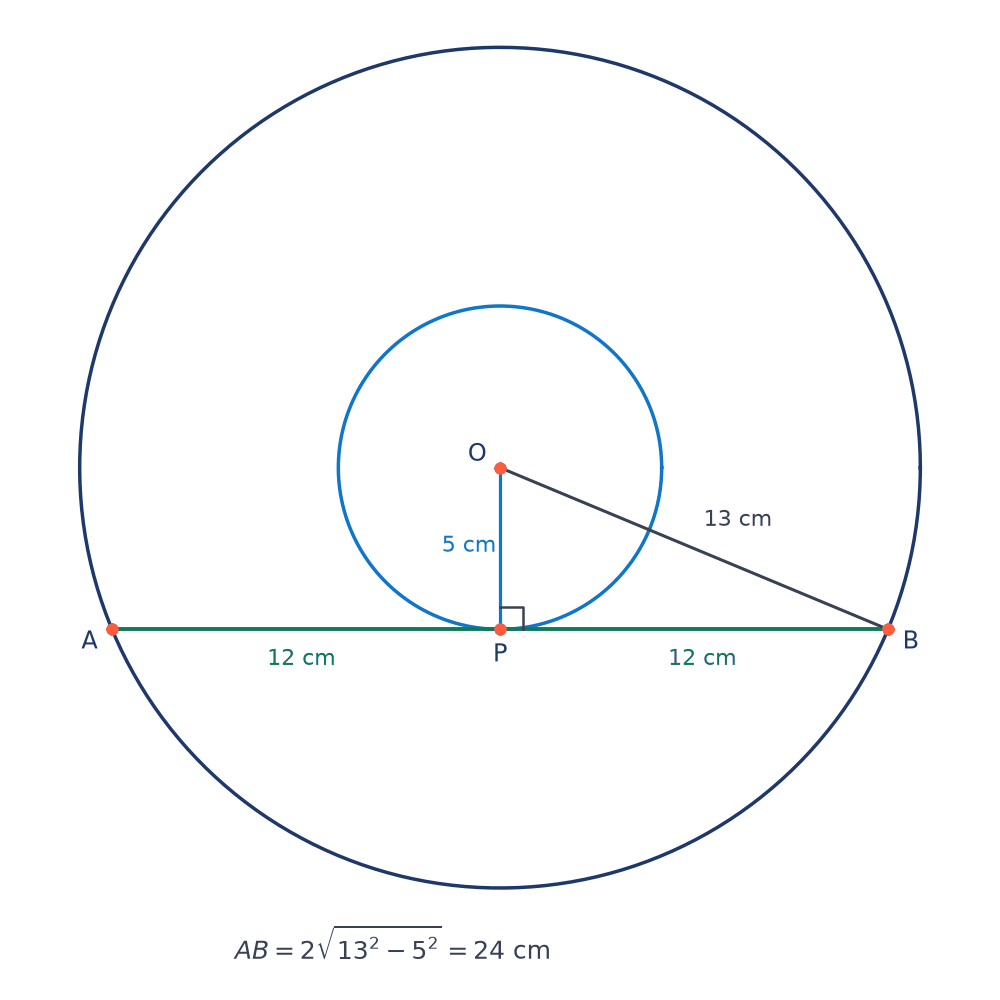
Two concentric circles have radii 6 cm and 10 cm. Find the length of the chord of the larger circle that touches the smaller circle. Answer:16 cm.
A quadrilateral ABCD circumscribes a circle, with AB=11 cm, BC=14 cm and CD=9 cm. Find AD. Answer:6 cm.
Tangents PA and PB from P touch a circle with centre O, and ∠AOB=125∘. Find ∠APB. Answer:55∘.
The incircle of triangle ABC touches BC, CA, AB at D, E, F. If AB=7 cm, BC=9 cm and CA=10 cm, find AF, BD and CE. Answer:AF=4 cm, BD=3 cm, CE=6 cm.
Find the inradius of a right triangle whose legs are 5 cm and 12 cm. Answer:2 cm.
Two tangents to a circle of radius 5 cm are perpendicular to each other. Find the length of each tangent and the distance of their meeting point from the centre. Answer:5 cm each; 52 cm.
Key terms
External point
A point outside the circle; exactly two tangents can be drawn from it.
Length of a tangent
The distance from the external point to the point of contact.
RHS congruence
Two right triangles are congruent if their hypotenuses and one pair of other sides are equal.
CPCT
Corresponding parts of congruent triangles are equal.
Concentric circles
Circles in the same plane with the same centre and different radii.
Circumscribed quadrilateral
A quadrilateral all of whose sides touch a circle drawn inside it.
Incircle
The circle inside a triangle that touches all three sides.
Chord of contact
The chord joining the two points of contact of the tangents from an external point.
Common questions
Why is the congruence rule RHS and not SAS?
The known equal parts are a right angle, the common hypotenuse OP and the radii OA=OB. The right angle is not between the hypotenuse and the radius, so SAS does not apply; RHS is exactly the rule for this situation.
Is the angle between the tangents always supplementary to the angle at the centre?
Yes. The quadrilateral OAPB has two right angles at A and B, so the remaining two angles, at P and at O, must add up to 180∘.
Does every quadrilateral have a circle touching all four sides?
No. The result AB+CD=AD+BC holds whenever such a circle exists, so a quadrilateral whose opposite sides do not have equal sums cannot circumscribe a circle. A non-square rectangle, for example, has no such circle.
How do I find tangent lengths in a triangle quickly?
Add the three sides and halve the total to get x+y+z. The tangent length from a vertex is this half-sum minus the side opposite that vertex.
Which of these proofs are most important for the exam?
Learn the equal-tangents proof, the proof that AB+CD=AD+BC for a circumscribed quadrilateral, and the result that a parallelogram circumscribing a circle is a rhombus. These appear often as 3-mark questions.
References
National Council of Educational Research and Training. Mathematics: Textbook for Class X. NCERT, New Delhi.
Kiselev, A. P. Kiselev's Geometry, Book I: Planimetry (adapted by A. Givental). Sumizdat.
Coxeter, H. S. M. and Greitzer, S. L. Geometry Revisited. Mathematical Association of America.
Sharma, R. D. Mathematics for Class 10. Dhanpat Rai Publications.