Tangent to a Circle and the Radius Theorem, Class 10
Learn what secants and tangents are, prove that a tangent is perpendicular to the radius at the point of contact, count tangents from a point, and find tangent lengths with Pythagoras through worked examples.
A tangent is a straight line that just touches a circle at one point without cutting into it. Think of a bicycle wheel standing on a flat road: the road touches the tyre at exactly one point, so it behaves like a tangent to the wheel. This chapter of Class 10 Mathematics is about one central fact: a tangent is always perpendicular to the radius drawn to the point where it touches the circle. With that fact and Pythagoras' theorem, you can find the length of a tangent, the radius of a circle or the distance of a point from the centre.
In this lesson you will learn the three ways a line can sit relative to a circle, prove the tangent–radius theorem step by step, count how many tangents can be drawn from a point, and work through numerical examples of the kind that appear in board exams.
Take a circle and a straight line drawn in the same plane. Slide the line across the page and watch how many points it shares with the circle. Only three things can happen.
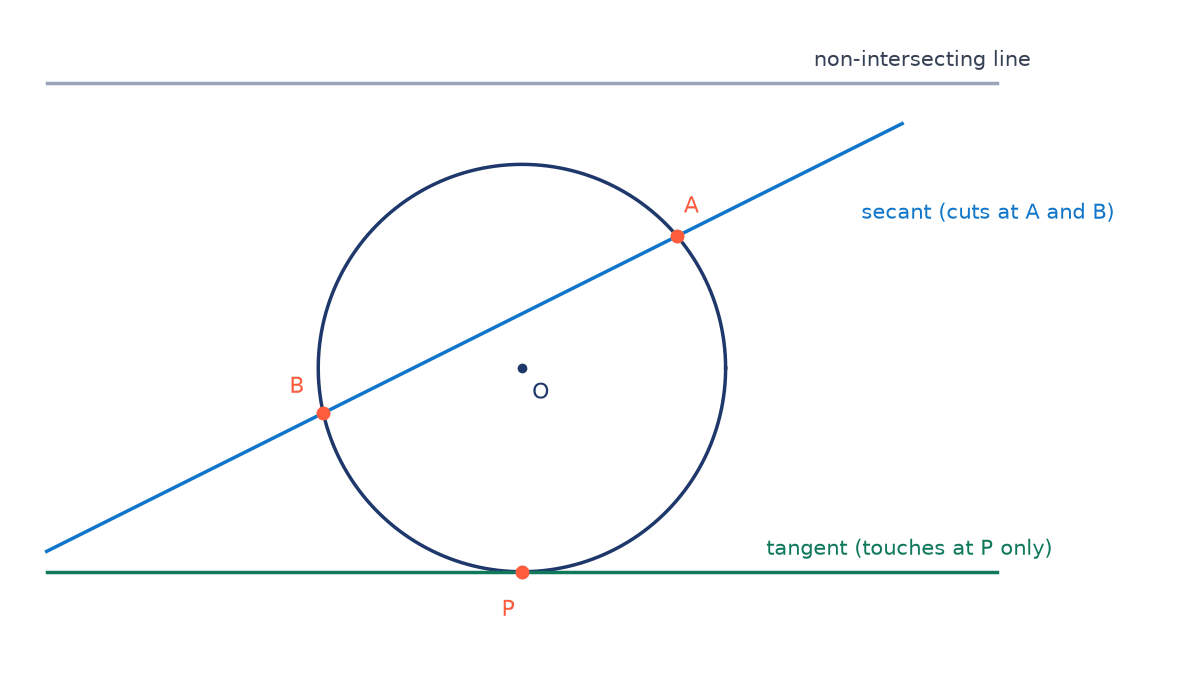
The line meets the circle at two distinct points, say A and B. Such a line is called a secant. The part AB that lies inside the circle is a chord. The distance of a secant from the centre is less than the radius.
The line meets the circle at exactly one point, say P. Such a line is called a tangent to the circle, and P is called the point of contact. The word comes from the Latin word for "touching". The distance of a tangent from the centre is exactly equal to the radius.
The three positions of a line with respect to a circle: non-intersecting, secant and tangent.
Imagine a secant through A and B that you slowly move parallel to itself, away from the centre. The two points A and B come closer and closer. At one position they merge into a single point. At that moment the secant has become a tangent. So a tangent can be thought of as the special case of a secant whose two points of intersection coincide.
At any given point on a circle there is one and only one tangent. You can check this with a thread and a coin: however you try, only one straight line touches the coin at a chosen point on its rim without cutting across it. The theorem below explains why: the tangent at P must be the line through P perpendicular to OP, and through a given point there is only one line perpendicular to a given line.
Given: A circle with centre O and a tangent XY touching it at P.
To prove:OP⊥XY.
Construction: Take any point Q on XY other than P, and join OQ.
Proof:
A tangent meets the circle at only one point, namely P. So Q, which is on the tangent but is not P, cannot lie on the circle.
Q cannot lie inside the circle either. If it did, the line XY would pass from inside the circle to outside it and would cut the circle at two points, so it would be a secant and not a tangent. Hence Q lies outside the circle.
For a point outside the circle, its distance from the centre is greater than the radius. So OQ>OP.
This holds for every point Q of XY other than P. Therefore OP is the shortest of all the segments joining O to points of the line XY.
Of all the segments that can be drawn from a point to a line, the shortest is the perpendicular one. Hence OP⊥XY.
The line drawn through the point of contact perpendicular to the tangent passes through the centre. (This line is sometimes called the normal at that point.)
The perpendicular drawn at the end of a radius, at the point where it meets the circle, is a tangent.
Tangents drawn at the two ends of a diameter are parallel. (See Example 5.)
Whenever a radius meets a tangent at its point of contact, you get a right angle, so a right-angled triangle is usually waiting to be used.
Every line through an inside point cuts the circle at two points, so it is a secant.
On the circle
1
Exactly one tangent exists at each point of the circle.
Outside the circle
2
Two lines through the point just touch the circle, one on each side of the line joining the point to the centre.
When the point P is outside the circle and the tangent from P touches the circle at Q, the segment PQ is called the length of the tangent from P.
Let O be the centre, r the radius, and P an external point with OP=d. If the tangent from P touches the circle at Q, then ∠OQP=90∘ by the theorem, so triangle OQP is right-angled at Q with hypotenuse OP. By Pythagoras' theorem,
PQ2=OP2−OQ2,soPQ=d2−r2.
The same triangle also gives r=d2−PQ2 and d=r2+PQ2. Because PQ is a real length, d>r, which agrees with the fact that P is outside the circle.
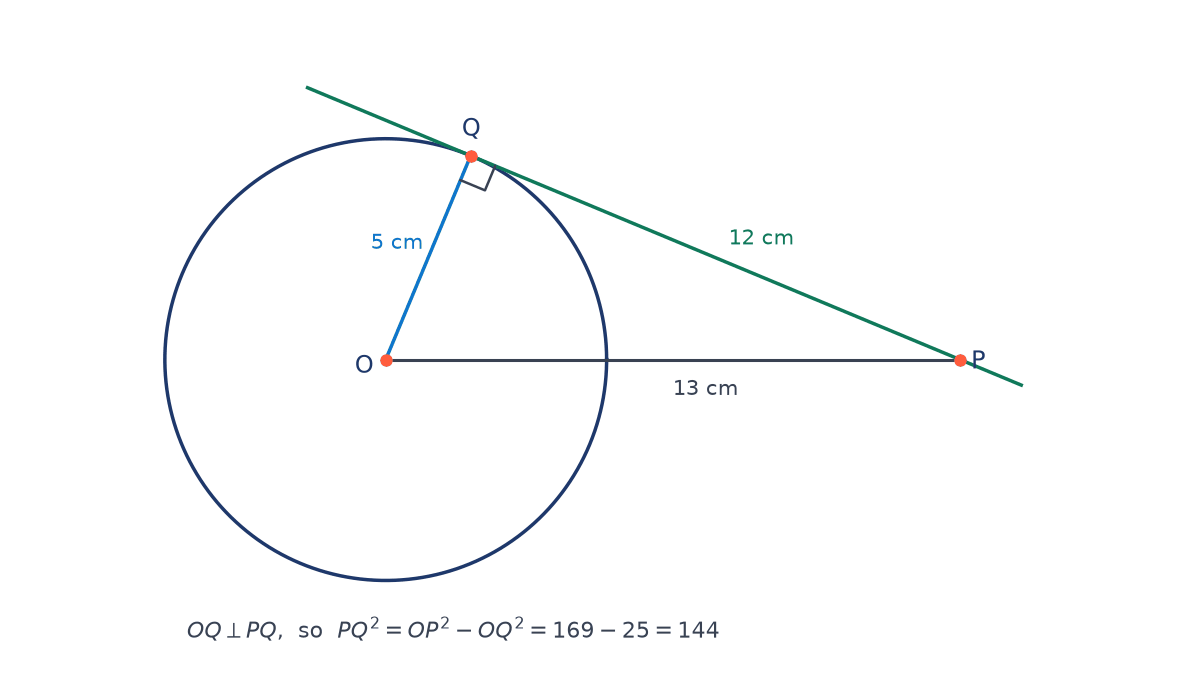
A point P is 13 cm from the centre O of a circle of radius 5 cm. Find the length of the tangent drawn from P to the circle.
Solution. Let the tangent touch the circle at Q. Then OQ=5 cm and OP=13 cm. Since the radius is perpendicular to the tangent at the point of contact, ∠OQP=90∘.
PQ2PQ=OP2−OQ2=132−52=169−25=144=12 cm
Answer: The length of the tangent is 12 cm.
Example 1: the radius OQ meets the tangent PQ at a right angle, so triangle OQP is right-angled at Q.
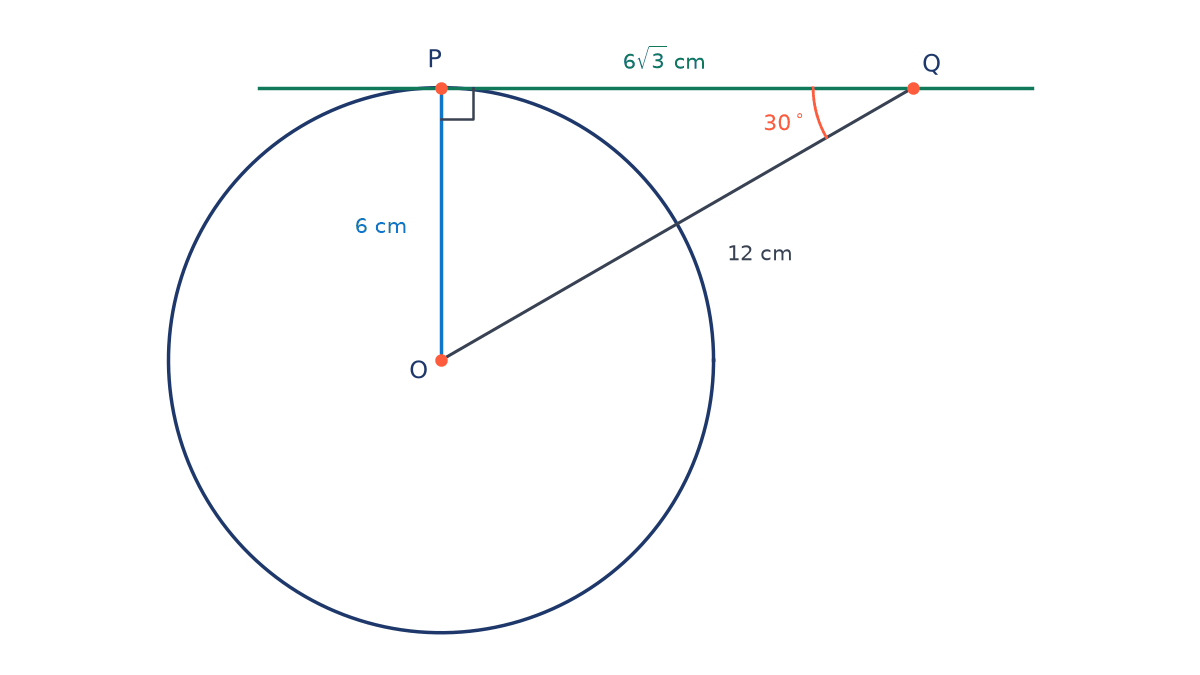
Check with Pythagoras: PQ2=122−62=144−36=108, and (63)2=36×3=108. The values agree.
Answer:OQ=12 cm and PQ=63≈10.39 cm.
Example 3: with a 30 degree angle at Q, the hypotenuse OQ is twice the radius.
Example 4: Nearest distance from a point to the circle#
The tangent from a point A to a circle of radius 15 cm has length 20 cm. Find (a) the distance of A from the centre O, and (b) the shortest distance from A to the circle.
Solution. (a) Let the tangent touch the circle at T. Then ∠OTA=90∘ and
OA=OT2+AT2=152+202=225+400=625=25 cm.
(b) The point of the circle nearest to A lies on the segment OA, at distance 15 cm from O. So the shortest distance from A to the circle is
OA−r=25−15=10 cm.
Answer: (a) 25 cm; (b) 10 cm.
Example 5: Tangents at the ends of a diameter#
Prove that the tangents drawn at the two ends of a diameter of a circle are parallel.
Solution. Let AB be a diameter of a circle with centre O. Let l be the tangent at A and m the tangent at B.
OA is a radius and l is the tangent at A, so OA⊥l. Since O lies on AB, this means AB⊥l.
Similarly OB⊥m, so AB⊥m.
Now the lines l and m are both perpendicular to the same line AB. The transversal AB makes an angle of 90∘ with each, so the two interior angles on the same side add up to 90∘+90∘=180∘.
When the interior angles on the same side of a transversal are supplementary, the lines are parallel. Hence l∥m.
Answer: The tangents at the ends of a diameter are parallel. ■
A useful follow-up: the distance between these two parallel tangents equals the diameter 2r.
Taking the tangent PQ as the hypotenuse. The right angle is at the point of contact, so the hypotenuse is always OP, the line from the centre to the external point.
Adding the squares when you should subtract. To find the tangent or the radius, subtract: PQ2=OP2−r2. Add only when you are finding OP.
Marking the right angle at the external point P or at the centre O instead of at the point of contact.
Saying that one tangent can be drawn from a point inside the circle. The correct number is zero.
Writing the shortest distance from an external point to the circle as OP. It is OP−r.
Quoting the theorem without the reason in a proof. Always write "radius is perpendicular to the tangent at the point of contact" beside the right angle.
A point is 15 cm from the centre of a circle of radius 9 cm. Find the length of the tangent from the point. Answer:12 cm.
The tangent from a point 10 cm from the centre of a circle has length 8 cm. Find the radius. Answer:6 cm.
The radius of a circle is 7 cm and the tangent from a point P is 24 cm long. How far is P from the centre? Answer:25 cm.
PQ is the tangent at P to a circle of radius 5 cm and ∠OQP=45∘. Find PQ and OQ. Answer:PQ=5 cm, OQ=52 cm.
From a point P, the tangent to a circle of radius 12 cm is 35 cm long. Find the shortest distance from P to the circle. Answer:25 cm (since OP=37 cm).
How many tangents can be drawn to a circle from a point on it, and how many from a point inside it? Answer: One and zero.
Why is the tangent perpendicular to the radius?#
Every point of the tangent other than the point of contact lies outside the circle, so it is farther from the centre than the radius. The radius to the point of contact is therefore the shortest segment from the centre to the tangent, and the shortest segment from a point to a line is the perpendicular.
Can a tangent pass through a point inside the circle?#
No. Any line through an inside point cuts the circle twice, so it is a secant. That is why no tangent can be drawn from an inside point.
Is the length of a tangent the same as the distance from the point to the circle?#
No. The length of the tangent is d2−r2, while the shortest distance from the point to the circle is d−r. For d=13 and r=5 these are 12 and 8.
Which theorems from this topic should I be able to prove in the exam?#
The two standard proofs are the tangent–radius theorem proved here and the theorem that the two tangents from an external point are equal in length. Both are frequently asked as 3-mark questions.
It is strongly recommended. A clear figure with the right angle marked at the point of contact shows the examiner your reasoning and helps you pick the correct hypotenuse.