To show from the definition that two triangles are similar, you would have to check six facts: three pairs of equal angles and three pairs of sides in the same ratio. With congruent triangles you learnt shortcuts (SSS, SAS, ASA, RHS) that need only three matching parts. Similar triangles have shortcuts too: the AA (or AAA), SSS and SAS similarity criteria. This lesson, from NCERT Class 10 Chapter 6 (Triangles), states each criterion, explains why it is true using the Basic Proportionality Theorem, and applies the criteria to angles, lengths, proofs and the shadow problem that often appears in exams.
Notation and correspondence
We write to mean the triangles are similar with , , . Then
The order of the letters matters. For the same pair of triangles, writing would claim that corresponds to and to , which is false. Always write the vertices in matching order.
AAA and AA similarity
An activity
Draw cm with angles of at and at , and let the arms meet at . Then draw a separate segment cm with the same angles, at and at , meeting at . The third angles are both , so the triangles are equiangular.
Now . Measure , , and : the ratios and also come out as . The sides take care of themselves.
Statement
Theorem 6.3 (AAA similarity criterion). If in two triangles the corresponding angles are equal, then their corresponding sides are in the same ratio (proportion), and hence the two triangles are similar.
Because the angles of a triangle add up to , two pairs of equal angles force the third pair to be equal. So in practice we only need two:
AA similarity criterion. If two angles of one triangle are respectively equal to two angles of another triangle, then the two triangles are similar.
Why it is true
Given: and with , , .
To prove: .
Construction: On mark with , and on mark with . Join . (If the triangles are congruent by ASA and there is nothing more to prove.)
Proof.
- In and : , , . So (SAS congruence).
- Hence . These are corresponding angles for the lines and with transversal , so .
- In , , so by the Basic Proportionality Theorem (whole-side form) , that is, .
- Repeating the argument at vertex (marking lengths and from ) gives .
This is what makes triangles special. For a general polygon, equal angles are not enough (a square and a rectangle have equal angles). For a triangle, fixing the angles fixes the shape completely, and only the size can change.
SSS similarity
An activity
Draw with cm, cm, cm and with cm, cm, cm. Then
Measure the angles: , and (about , and respectively).
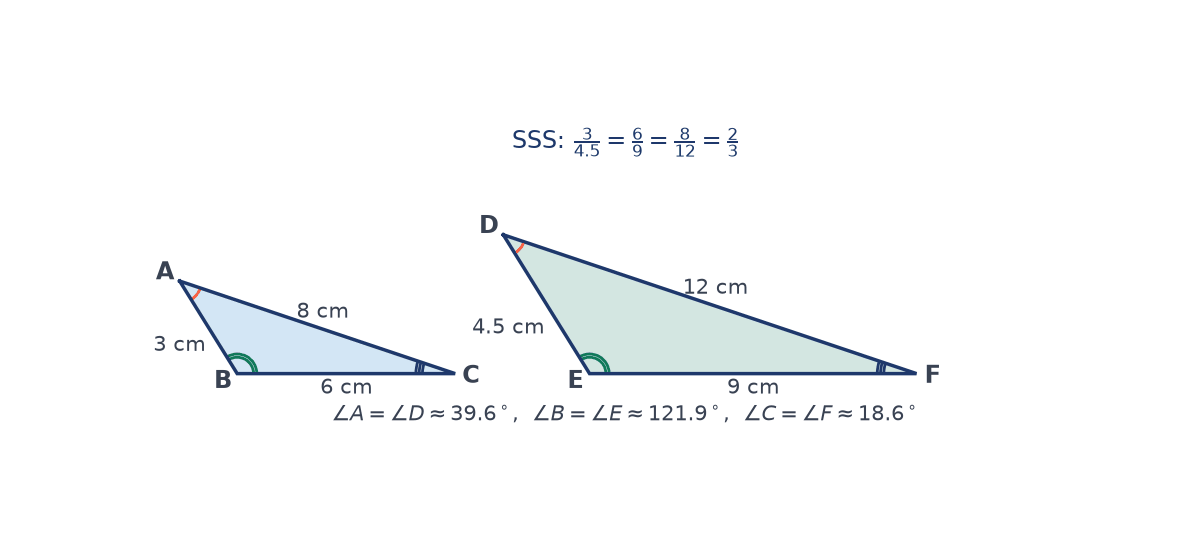
Statement
Theorem 6.4 (SSS similarity criterion). If in two triangles the sides of one triangle are proportional to (in the same ratio as) the sides of the other triangle, then their corresponding angles are equal, and hence the two triangles are similar.
Why it is true
Suppose with this common ratio less than (the case greater than is the same with the triangles swapped, and the case equal to is SSS congruence). Mark on and on with and .
- Then , which gives . By the converse of the Basic Proportionality Theorem, .
- So and (corresponding angles), and by AA.
- Hence , so .
- Now by SSS congruence, so , and .
SAS similarity
An activity
Draw with cm, cm and , and with cm, cm and . The sides that include the equal angles are in the same ratio: and . Measuring gives (about ) and (about ), so the triangles are similar.
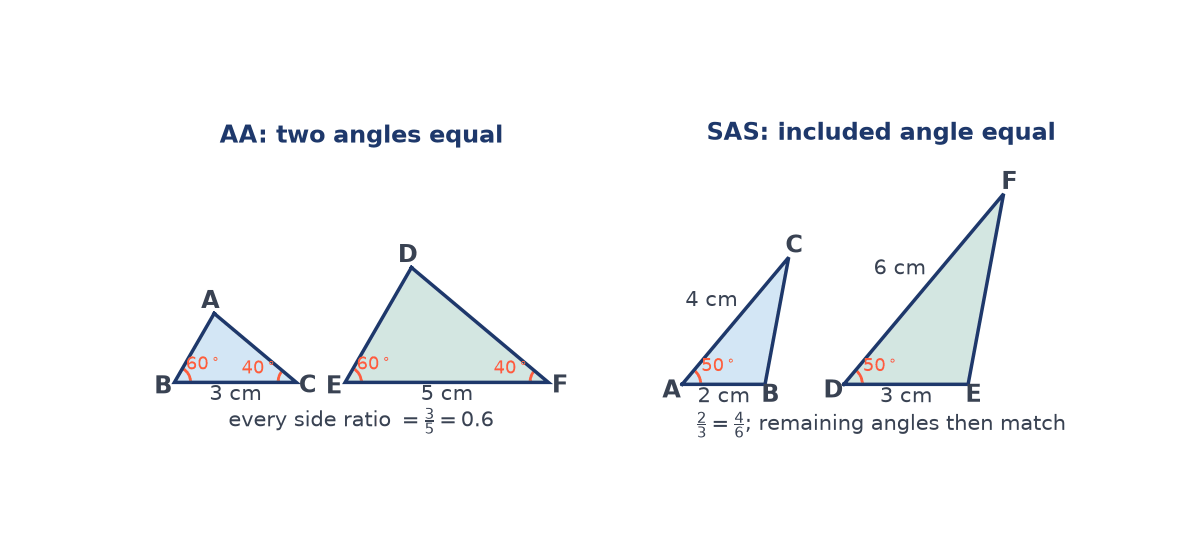
Statement
Theorem 6.5 (SAS similarity criterion). If one angle of a triangle is equal to one angle of the other triangle and the sides including these angles are proportional, then the two triangles are similar.
The equal angle must be the one between the two proportional sides, just as in SAS congruence.
Why it is true
Suppose and (less than ). Mark on and on with and . Then , so by the converse of the Basic Proportionality Theorem, and by AA. Also by SAS congruence. So has the same angles as , which has the same angles as , and .
Method: proving triangles similar
- Name the two triangles and look for information: parallel lines (alternate or corresponding angles), vertically opposite angles, a common angle, right angles, or given lengths.
- Choose the criterion: two angles known, use AA; three sides known, use SSS; one angle and its two sides known, use SAS.
- Write the correspondence carefully, with equal angles in matching positions.
- State the criterion and conclude, for example " (AA)".
- Use the similarity: equal angles, or equal ratios of corresponding sides, to finish the question.
Worked examples
Example 1: parallel lines give AA
, and the segments and intersect at (so are collinear and are collinear). Prove that .
Solution. With as transversal, (alternate angles, since ). With as transversal, (alternate angles). Two pairs of equal angles, so (AA). The third pair also matches: as vertically opposite angles.
Example 2: SSS to find an angle
In , cm, cm, cm, and . In , cm, cm and cm. Find .
Solution. Compare the sides in order of size:
All three ratios are equal, so (SSS). This gives , , , so . By the angle sum property,
Answer: .
Example 3: SAS with a product of lengths
The segments and intersect at , and . Show that and .
Solution. Dividing by gives
Consider and . The sides of the first and of the second are proportional, and the angles they include are equal: (vertically opposite angles). So (SAS), with and . Hence and .
Example 4: the girl and the lamp-post
A girl of height cm is walking away from the base of a lamp-post at a speed of m/s. The lamp is m above the ground. Find the length of her shadow after seconds.
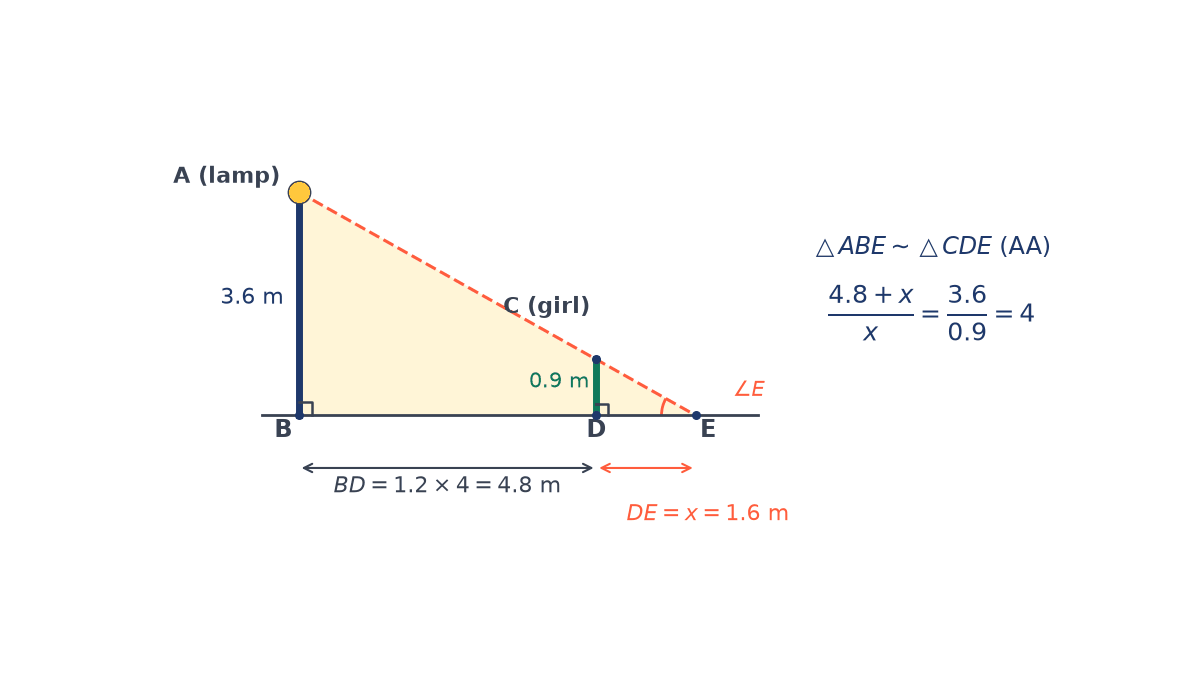
Solution. Let be the lamp-post, the girl after seconds, and m her shadow. In seconds she walks
In and : (the lamp-post and the girl both stand vertically), and is common. So (AA), and
Here , m and cm m. So
Answer: The shadow is m long after seconds.
Example 5: a length from AA
In , is on and is on with . If cm, cm and cm, find .
Solution. and (corresponding angles, ). So (AA), and
Answer: cm.
Example 6: a triangle similar to part of itself
is a point on side of such that . Show that .
Solution. Compare and . Since lies on , and are the same angle, so is common. Also (given). So (AA), with , , . Corresponding sides give
For example, if cm and cm, then and cm. Spotting a triangle similar to a piece of itself is a trick that returns again and again in geometry.
A fourth criterion for right triangles
For right triangles there is one more test: if the hypotenuse and one side of one right triangle are proportional to the hypotenuse and one side of another right triangle, the two triangles are similar. This is the RHS similarity criterion. It becomes useful once you work with Pythagoras' theorem. So the full list is AA, SSS, SAS and, for right triangles only, RHS.
Common mistakes
- Writing the vertices in the wrong order, for example when matches .
- Using SAS with an angle that is not between the two proportional sides.
- Pairing sides at random in SSS. Pair shortest with shortest, middle with middle and longest with longest.
- Mixing units, such as cm and m in the same ratio. Convert first.
- Concluding "similar" from one pair of equal angles. AA needs two pairs.
- Forgetting that the shadow problem uses the whole base , not just .
Try these
- One triangle has angles and ; another has angles and . Are they similar? Answer: Yes (AA); both have angles .
- Are triangles with sides cm and cm similar? Answer: Yes (SSS), ratio .
- Are triangles with sides cm and cm similar? Answer: No, since .
- A m stick casts a m shadow at the same time as a tree casts a m shadow. Find the height of the tree. Answer: m.
- with cm, cm and cm. Find . Answer: cm.
- In , cm, cm, ; in , cm, cm, . Are they similar? Answer: Yes (SAS), scale factor .
Key terms
- Equiangular triangles
- Triangles whose corresponding angles are all equal.
- AAA / AA criterion
- Equal corresponding angles (in practice, two pairs) make two triangles similar.
- SSS criterion
- Three pairs of sides in the same ratio make two triangles similar.
- SAS criterion
- One equal angle with the sides including it in the same ratio makes two triangles similar.
- RHS criterion
- For right triangles, hypotenuse and one side in the same ratio make the triangles similar.
- Correspondence
- The matching of vertices recorded by the order of letters in .
- Included angle
- The angle formed between two given sides of a triangle.
- Vertically opposite angles
- The equal, opposite angles formed where two straight lines cross.
Common questions
Why is there no "SSA" similarity criterion?
An angle that is not between the two proportional sides does not fix the triangle's shape: two differently shaped triangles can share such data. So, as with congruence, the angle must be the included one.
Is AA really enough, or do I need AAA?
AA is enough. The third angle is minus the other two, so it is automatically equal.
How do I find the correct correspondence?
Match equal angles first. For SSS, match sides by size: smallest to smallest, and so on. The vertex opposite a side corresponds to the vertex opposite its partner.
Are congruent triangles similar?
Yes. They satisfy every criterion with ratio .
Where are these criteria used later?
In proofs about areas and right triangles, in coordinate geometry, and in heights-and-distances problems like the lamp-post example.
References
- National Council of Educational Research and Training. Mathematics: Textbook for Class X. NCERT, New Delhi.
- Kiselev, A. P. Kiselev's Geometry, Book I: Planimetry (adapted by A. Givental). Sumizdat.
- Coxeter, H. S. M. and Greitzer, S. L. Geometry Revisited. Mathematical Association of America.
- Aggarwal, R. S. Secondary School Mathematics for Class 10. Bharati Bhawan.