Exercise 6.1 of the NCERT Class 10 textbook (Chapter 6, Triangles) practises one distinction before the chapter moves on to triangles: congruent figures have the same shape and the same size, while similar figures have the same shape but not necessarily the same size. The questions are short, but each answer should come with a reason you could write in an exam.
Quick recap of the method
Two polygons with the same number of sides are similar when both of these hold:
- their corresponding angles are equal, and
- their corresponding sides are proportional, that is, every pair gives the same ratio (the scale factor).
If either condition fails, the figures are not similar. Congruent figures are the special case . To show two figures are not similar, one failed condition is enough; to show they are similar, both conditions must be checked.
Solutions to Exercise 6.1
Question 1
Fill in the blanks using the correct word given in brackets.
Question 1 (i)
All circles are ______. (congruent, similar)
Solution. A circle is fixed completely by its radius, and every circle has exactly the same round shape. Enlarging a circle of radius cm by the factor gives a circle of radius cm, so any circle is a scaled copy of any other. But circles need not have the same size: radii of cm and cm are different, so "congruent" cannot be true of all circles.
Same shape, size may differ: that is exactly what "similar" means.
Answer: All circles are similar.
Question 1 (ii)
All squares are ______. (similar, congruent)
Solution. Take squares of side cm and cm and test both conditions.
- Angles: every angle of each square is , so all corresponding angles are equal.
- Sides: all sides of a square are equal, so every pair of corresponding sides gives the same ratio .
Both conditions hold, and the same argument works for any two squares. They are congruent only when their sides happen to be equal, so "congruent" is not true of all squares.
Answer: All squares are similar.
Question 1 (iii)
All ______ triangles are similar. (isosceles, equilateral)
Solution. Every angle of an equilateral triangle is (the three equal angles add up to , and ). So two equilateral triangles always have equal corresponding angles. Their sides are also proportional: for sides cm and cm, every ratio is . Both conditions hold.
Isosceles triangles fail. An isosceles triangle with vertex angle has angles , while one with vertex angle has angles . These angle sets do not match, so the two triangles are not similar.
Answer: All equilateral triangles are similar.
Question 1 (iv)
Two polygons of the same number of sides are similar, if (a) their corresponding angles are ______ and (b) their corresponding sides are ______. (equal, proportional)
Solution. This is the definition of similar polygons. The angles fix the shape, so they must match exactly. The sides fix the size, and for similarity they may all be scaled, but by one common factor.
The words cannot be swapped. If the sides had to be equal as well, every pair of similar figures would be congruent, which contradicts part (ii). And "proportional angles" does not work either: doubling every angle of a quadrilateral would give an angle sum of instead of , which is impossible.
Answer: (a) equal, (b) proportional.
Question 2
Give two different examples of pair of (i) similar figures, (ii) non-similar figures.
Question 2 (i)
Solution. We choose figures and check both conditions with actual numbers.
Example A: two equilateral triangles with sides cm and cm.
- Angles: in both, so corresponding angles are equal.
- Sides: every pair gives , so the sides are proportional.
Example B: two squares with sides cm and cm.
- Angles: at every corner of both, so they are equal.
- Sides: every pair gives , so the sides are proportional.
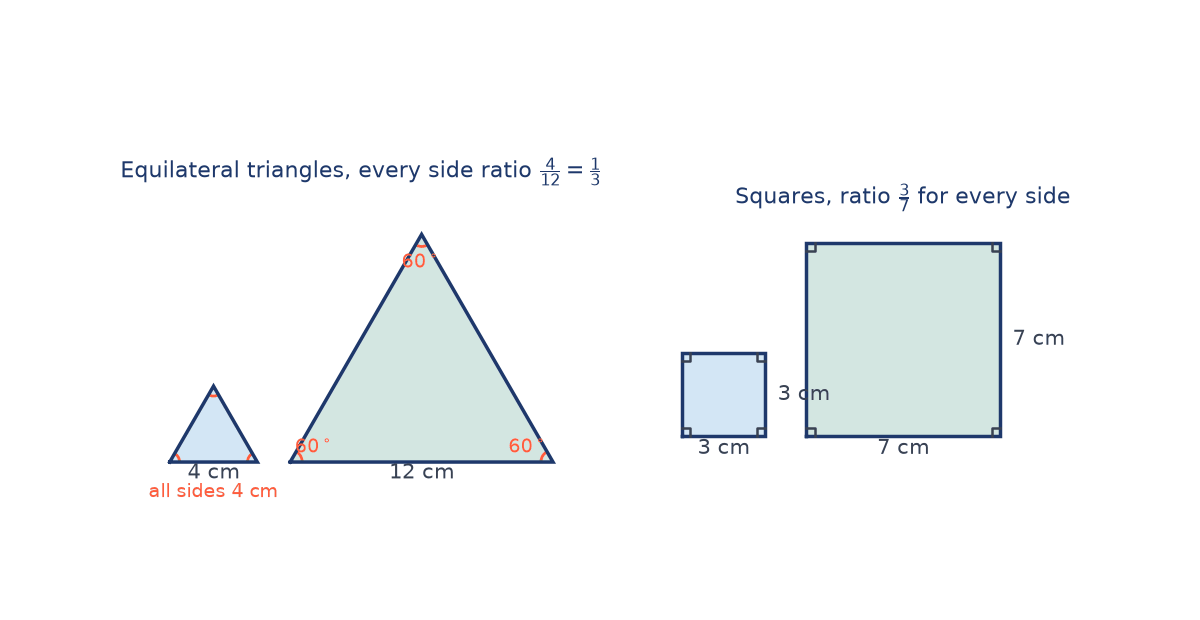
Answer: (a) two equilateral triangles of sides cm and cm; (b) two squares of sides cm and cm. (Any two circles would also do.)
Question 2 (ii)
Solution.
Example A: a square and a rectangle that is not a square, say a square of side cm and a rectangle cm by cm.
- Angles: all , so this condition holds.
- Sides: matching the cm sides gives , but matching a cm side of the square with the cm side of the rectangle gives . Since , the sides are not proportional.
The side condition fails, so the figures are not similar, even though the angles match.
Example B: an equilateral triangle and a right-angled isosceles triangle.
- Angles: against . No matching of vertices makes these equal.
The angle condition already fails, so there is no need to check the sides.
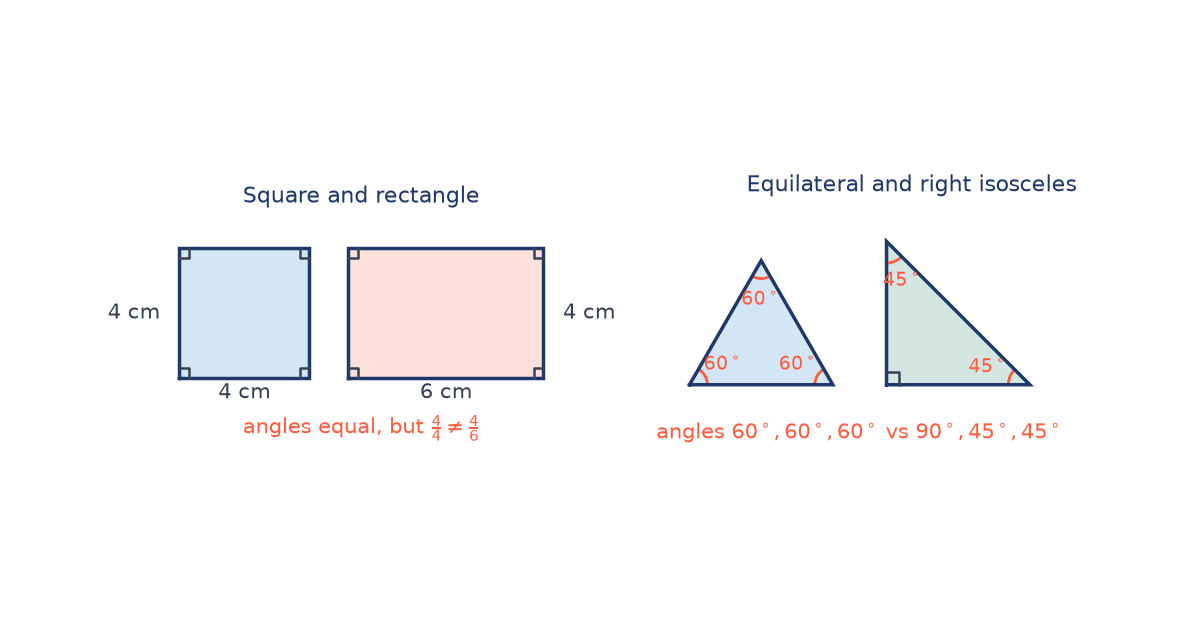
Answer: (a) a square of side cm and a cm by cm rectangle; (b) an equilateral triangle and a right-angled isosceles triangle.
Why this works: a single failed condition is enough to rule out similarity.
Question 3
State whether the following quadrilaterals are similar or not (Fig. 6.8 of the textbook: a square of side cm and a rhombus of side cm whose angles are not right angles).
Solution.
- Sides: every side of the square is cm and every side of the rhombus is cm, so every pair of corresponding sides gives . The sides are proportional.
- Angles: every angle of the square is , but the angles of the rhombus are not . So the corresponding angles are not equal.
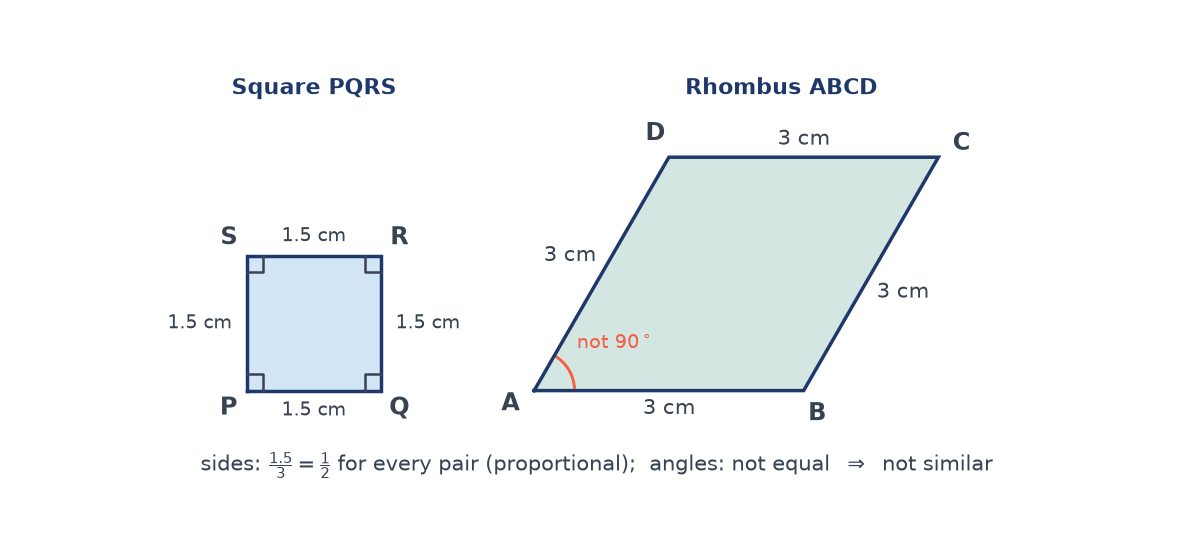
Condition (i) fails, so the quadrilaterals are not similar. This is the square and rhombus case from the lesson: proportional sides alone are not enough.
Answer: The quadrilaterals are not similar, because their corresponding angles are not equal.
Key terms
- Congruent figures
- Figures with the same shape and the same size.
- Similar figures
- Figures with the same shape, but not necessarily the same size.
- Corresponding angles
- Angles at vertices that are matched with each other when two figures are compared.
- Proportional sides
- Corresponding sides that all give the same ratio.
- Scale factor
- That common ratio; it equals exactly when similar figures are congruent.
- Equilateral triangle
- A triangle with all three sides equal, and therefore all three angles equal to .
- Rhombus
- A quadrilateral with all four sides equal; its angles need not be right angles.
Common questions
Why are all circles similar but not all ellipses?
A circle's shape is fixed and only its radius changes, so any circle is an enlargement of any other. An ellipse can be more or less stretched, so two ellipses can have different shapes.
Are all right-angled triangles similar?
No. A triangle with angles and one with angles are both right-angled, but their other angles differ.
Are congruent figures similar?
Yes. Their angles are equal and every side ratio is , so both conditions hold.
Is it enough to show one condition fails?
Yes, to prove figures are not similar. To prove they are similar, both conditions must be shown (for triangles, the criteria in the next lessons shorten this).
Can two figures with the same area fail to be similar?
Yes. A cm by cm square and a cm by cm rectangle both have area , but they are not similar.
References
- National Council of Educational Research and Training. Mathematics: Textbook for Class X. NCERT, New Delhi.
- Sharma, R. D. Mathematics for Class 10. Dhanpat Rai Publications.
- Aggarwal, R. S. Secondary School Mathematics for Class 10. Bharati Bhawan.