NCERT Class 10 Exercise 6.2 Solutions: BPT and Its Converse
By Ravindra Reddy K
·10 min read
Step-by-step solutions to every question of NCERT Class 10 Exercise 6.2, using the Basic Proportionality Theorem and its converse to find lengths, test for parallel lines and prove trapezium results.
Exercise 6.2 of the NCERT Class 10 textbook (Chapter 6, Triangles) practises two results: Theorem 6.1, the Basic Proportionality Theorem, and Theorem 6.2, its converse. You will use them to find unknown lengths, to test whether a line is parallel to a side, and to prove ratio and parallel-line statements in quadrilaterals and pairs of triangles. Every question below is solved in full, in the textbook's order.
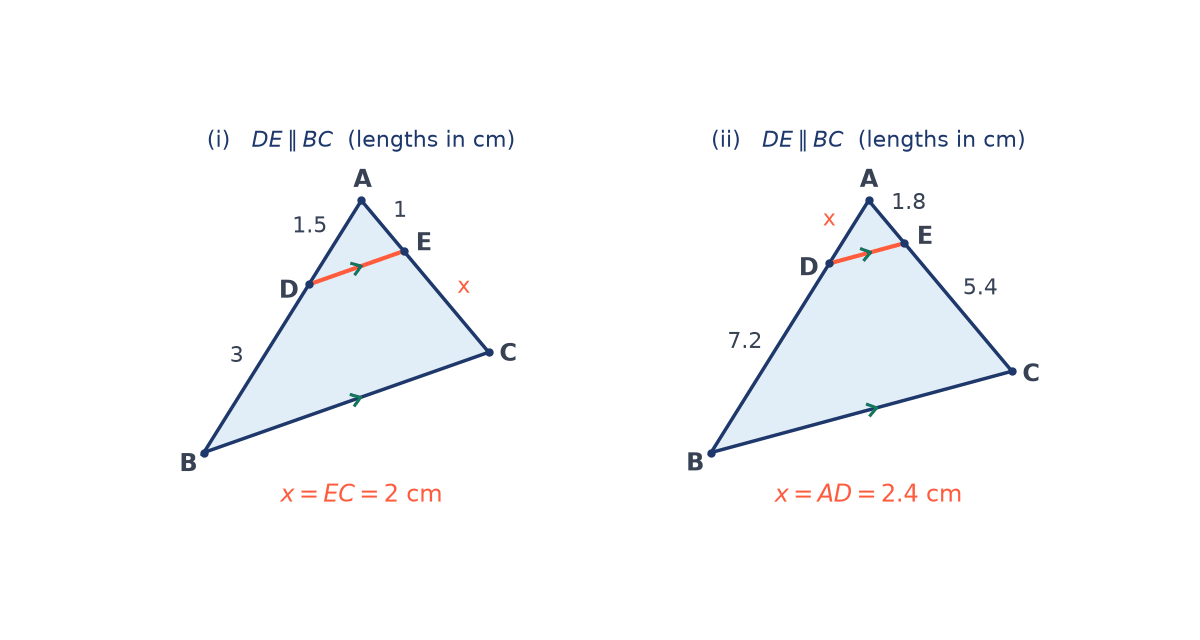
In Fig. 6.17 (i) and (ii), DE∥BC. Find EC in (i) and AD in (ii). In the textbook figure, part (i) has AD=1.5 cm, DB=3 cm and AE=1 cm; part (ii) has DB=7.2 cm, AE=1.8 cm and EC=5.4 cm.
Question 1: the unknown length is marked x. Each triangle is drawn to its own scale.
In Fig. 6.18, if LM∥CB and LN∥CD, prove that ABAM=ADAN. In the figure, ABCD is a quadrilateral with diagonal AC; L lies on AC, M on AB and N on AD.
Solution.
In △ABC: M is on AB, L is on AC and LM∥CB. By Theorem 6.1 in whole-side form,
ABAM=ACAL.(1)
In △ADC: N is on AD, L is on AC and LN∥CD. By the same theorem,
ADAN=ACAL.(2)
The right-hand sides of (1) and (2) are equal, so
ABAM=ADAN.■
Why this works: the diagonal AC belongs to both triangles, so ACAL links them.
Using Theorem 6.1, prove that a line drawn through the mid-point of one side of a triangle parallel to another side bisects the third side. (Recall that you have proved it in Class IX.)
Solution.
Given:△ABC, D is the mid-point of AB, and the line through D parallel to BC meets AC at E.
To prove:AE=EC.
Proof. Since D is the mid-point of AB, AD=DB, so DBAD=1. Since DE∥BC, Theorem 6.1 gives
ECAE=DBAD=1.
So AE=EC, that is, E is the mid-point of AC and the line bisects the third side. ■
Using Theorem 6.2, prove that the line joining the mid-points of any two sides of a triangle is parallel to the third side. (Recall that you have done it in Class IX.)
Solution.
Given:△ABC with D the mid-point of AB and E the mid-point of AC.
To prove:DE∥BC.
Proof. Since AD=DB and AE=EC,
DBAD=1=ECAE.
So DE divides AB and AC in the same ratio. By Theorem 6.2, DE∥BC. ■
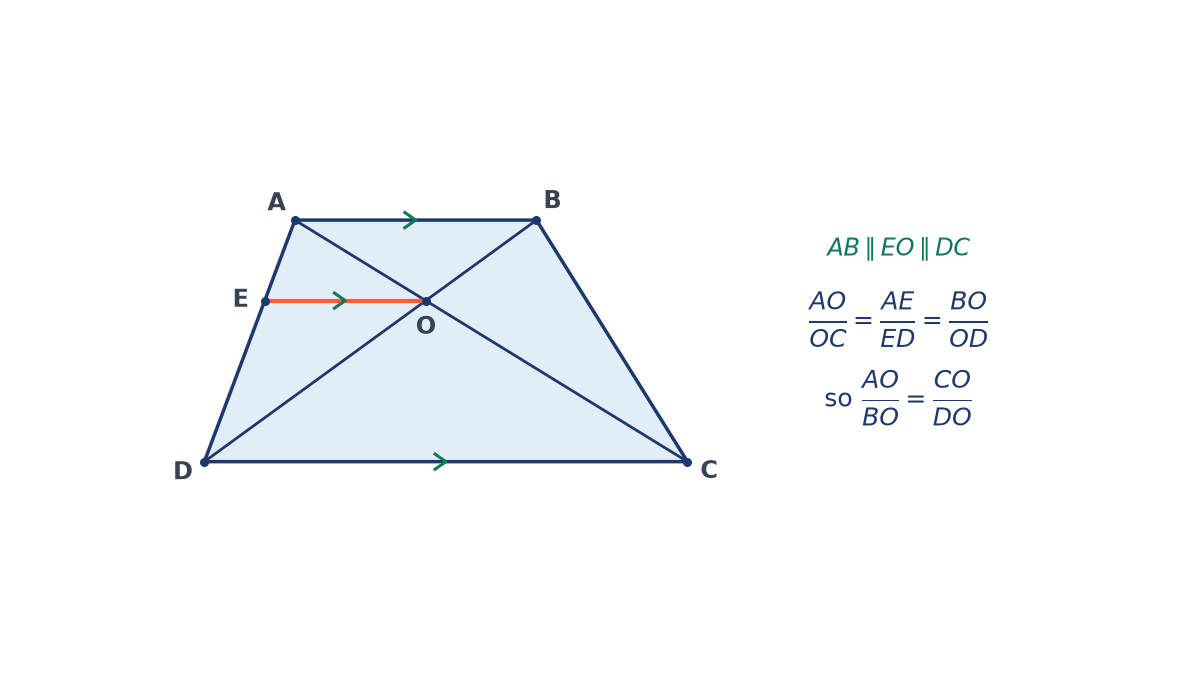
The diagonals of a quadrilateral ABCD intersect each other at the point O such that BOAO=DOCO. Show that ABCD is a trapezium.
Solution. This is the converse of Question 9, so we aim for a pair of parallel sides.
From BOAO=DOCO, cross-multiplying gives AO×DO=BO×CO. Dividing both sides by CO×DO,
COAO=DOBO.(1)
Construction: Through O draw EO∥AB, meeting AD at E.
In △DAB: E is on DA, O is on DB and EO∥AB. By Theorem 6.1,
EADE=OBDO,soEDAE=ODBO.(2)
From (1) and (2),
EDAE=OCAO.
In △ADC, E is on AD and O is on AC, and they divide these sides in the same ratio. By Theorem 6.2, EO∥DC.
Now EO∥AB (construction) and EO∥DC. Lines parallel to the same line are parallel to each other, so AB∥DC.
A quadrilateral with a pair of parallel sides is a trapezium.
Answer:AB∥DC, so ABCD is a trapezium. ■
Why this works: Questions 9 and 10 use the same construction. Question 9 goes from parallel sides to equal ratios (Theorem 6.1); Question 10 goes from equal ratios back to parallel sides (Theorem 6.2).
A line parallel to one side of a triangle, meeting the other two sides in distinct points, divides them in the same ratio.
Converse of BPT (Theorem 6.2)
A line dividing two sides of a triangle in the same ratio is parallel to the third side.
Whole-side form
The consequence ABAD=ACAE, which compares a piece with the whole side.
Mid-point theorem
The segment joining the mid-points of two sides of a triangle is parallel to the third side; Questions 7 and 8 prove it and its converse from Theorems 6.1 and 6.2.
Trapezium
A quadrilateral with a pair of parallel sides.
Construction
An extra line drawn in a proof, such as EO∥AB in Questions 9 and 10.
Cross-multiplication
Replacing ba=dc by ad=bc, useful for checking ratios without decimals.
How do I know which triangle to use in Questions 3 to 6?#
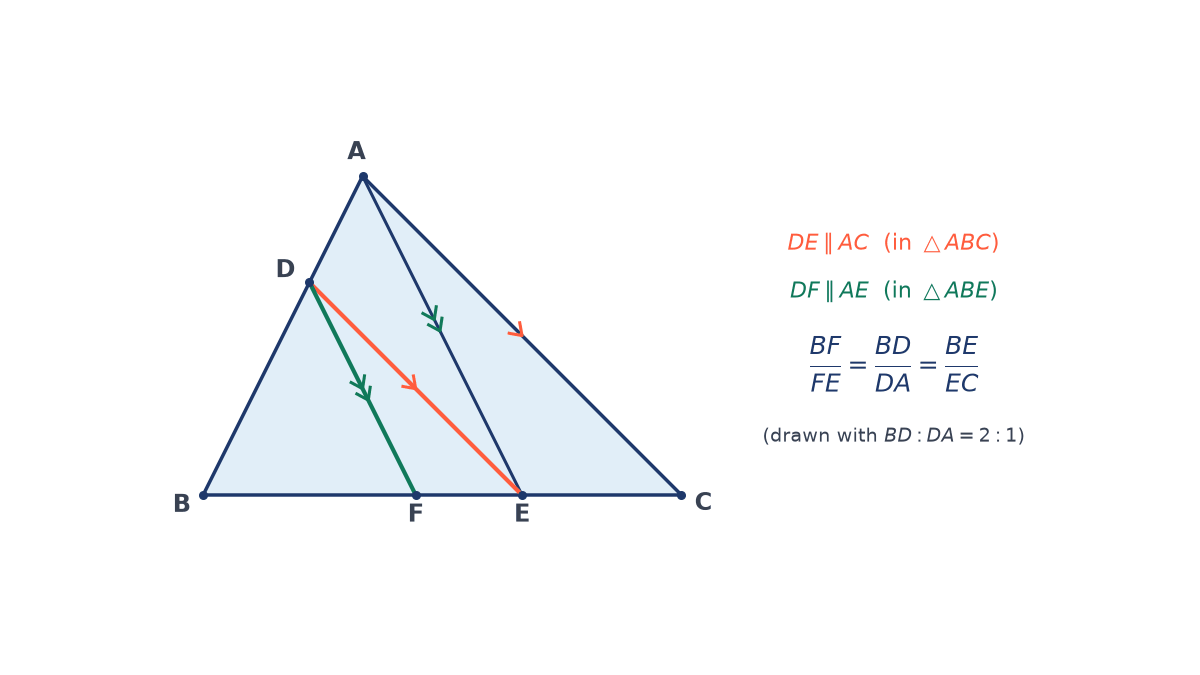
Look at each parallel pair. The triangle you need has the parallel line inside it and the other line as one of its sides. For example, DE∥AC in Question 4 points to △ABC.
Why is a construction needed in Questions 9 and 10?#
The trapezium alone contains no triangle with a line parallel to one of its sides through O. Drawing EO∥AB creates two such triangles.
In Question 2 (iii), can I compare PQPE and PRPF directly?#
Yes. Those ratios are equal exactly when EQPE=FRPF, and here both equal 649.
Which theorem do I quote when proving lines parallel?#
Theorem 6.2, the converse. Theorem 6.1 is quoted when the parallel lines are given and a ratio is required.
Is every quadrilateral with BOAO=DOCO a trapezium?#
Yes, that is what Question 10 proves. A parallelogram also satisfies the condition, since its diagonals bisect each other; a parallelogram has a pair of parallel sides.