Similar Figures in Maths: Meaning, Scale Factor and Examples
What similar figures are, how they differ from congruent ones, and the two-part test of equal angles and proportional sides, with scale factors, worked examples on rectangles, photos and maps, and practice questions.
How was the height of Mount Everest worked out without anyone climbing it with a measuring tape? How do we know the distance to the Moon without a ruler long enough to reach it? Neither was measured directly. Both were calculated using one simple but powerful idea: similarity, the idea of shapes that look exactly alike but come in different sizes.
This lesson opens Chapter 6 (Triangles) of the NCERT Class 10 textbook. It explains what "similar" means, how it differs from "congruent", and the two-part test that decides whether two polygons are similar. Maps, scale models, photo enlargements and the heights-and-distances problems you will meet later all rest on this idea.
In earlier classes you met congruent figures: two figures with exactly the same shape and exactly the same size. If you cut one out and place it on the other, they cover each other exactly, edge to edge.
Now think about circles. Take a small coin and a large dinner plate. They are not congruent, because one is bigger than the other. Yet they are clearly the same kind of shape: every circle looks like every other circle, only scaled up or down. The same is true of squares, and of equilateral triangles.
Figures that have the same shape, but not necessarily the same size, are called similar figures. So:
All circles are similar to each other.
All squares are similar to each other.
All equilateral triangles are similar to each other.
Every pair of congruent figures is also similar (same shape, and the same size as well). But similar figures need not be congruent. Similarity is the broader idea; congruence is the special case in which the scale factor is 1.
Can a circle be similar to a square? Can a triangle be similar to a square? No: their basic shapes differ however much you shrink or enlarge them. So not every pair of figures is similar, and for shapes less obvious than circles and squares (two quadrilaterals that merely look alike, say) we need a precise test.
Imagine three prints of the same photograph of the Taj Mahal: a small print, a medium one and a large poster. All three show the same monument, only enlarged or reduced. They are similar.
Now take two photographs of exactly the same size, one of a person at age 10 and one of the same person at age 40. The sizes match, but the shapes do not: a ten-year-old does not look like a smaller forty-year-old. These two photographs are not similar.
So similarity is about shape, not size. Two figures can be the same size and not similar (the two portraits), and two figures can be very different in size and still be similar (the three Taj Mahal prints).
Suppose a photographer starts with a negative 35 mm wide and enlarges it to 45 mm, or to 55 mm. Every line segment in the small picture grows in exactly the same proportion. Enlarged to 45 mm, every segment becomes 3545=79 times as long; enlarged to 55 mm, every segment becomes 3555=711 times as long. We say every segment of the smaller photograph is enlarged in the ratio 35:45 (or 35:55), and every segment of the larger one is reduced in the ratio 45:35 (or 55:35) to get back to the smaller one.
What does not change during an enlargement? The angles. A line that is tilted in the small photograph is tilted by exactly the same amount in the big one. Lengths change in one fixed proportion; angles stay exactly the same. That single observation contains the whole idea of similarity.
Two polygons with the same number of sides are similar if (i) their corresponding angles are equal, and(ii) their corresponding sides are in the same ratio (that is, proportional).
For quadrilaterals ABCD and PQRS with A↔P, B↔Q, C↔R, D↔S, this means
∠A=∠P,∠B=∠Q,∠C=∠R,∠D=∠S
ABPQ=BCQR=CDRS=DASP=k.
We then write ABCD∼PQRS. The symbol ∼ is read "is similar to", and the order of the letters shows which vertices correspond.
The common ratio k of corresponding sides is called the scale factor (map-makers call it the representative fraction). In the photograph example it is 3545 or 3555. If k>1 the second figure is an enlargement, if k<1 it is a reduction, and if k=1 the figures are congruent.
Because every side is multiplied by k, the perimeter is multiplied by k too. So the ratio of the perimeters of two similar polygons equals the scale factor.
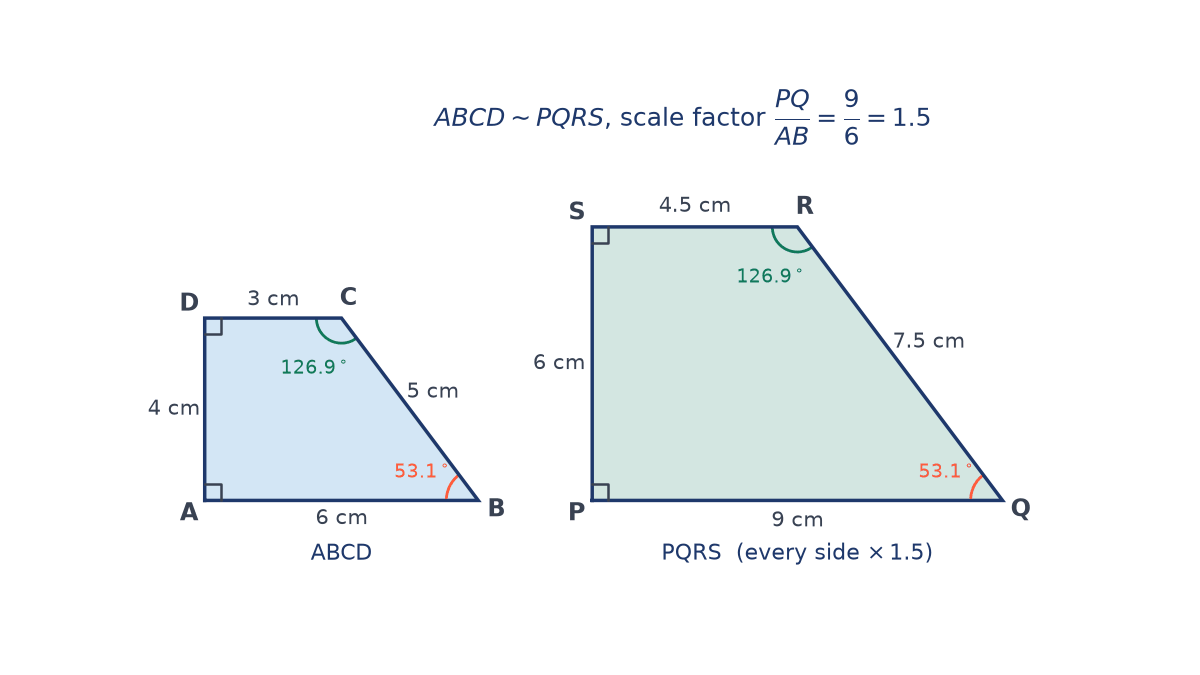
Quadrilateral PQRS is ABCD with every side multiplied by 1.5; the angles do not change. Drawn to scale.
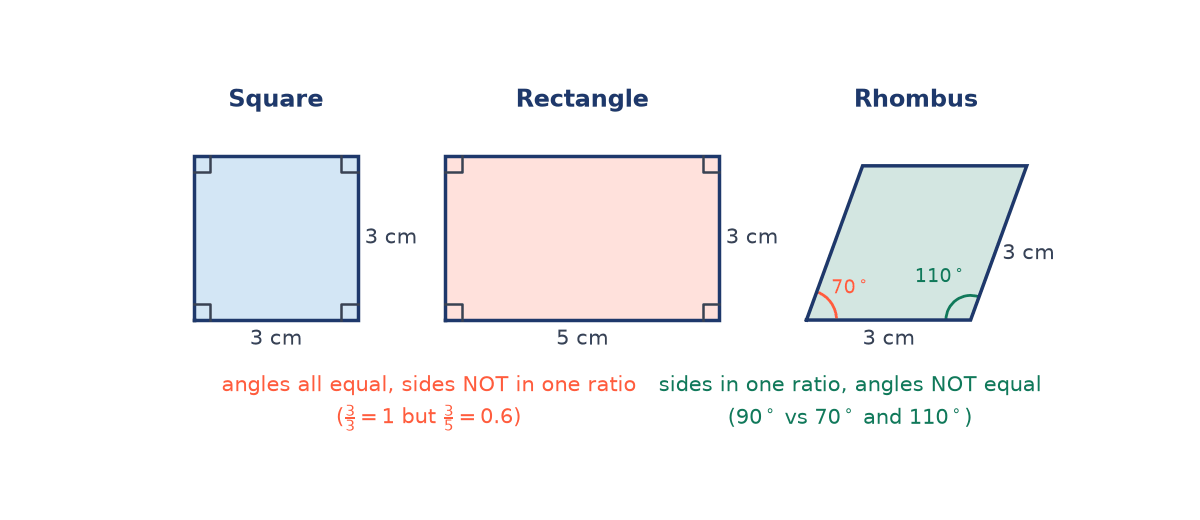
Take a square of side 3 cm and a rectangle 5 cm by 3 cm. Every angle of both shapes is 90∘, so all corresponding angles are equal. But the sides are not in one ratio: matching the 3 cm sides gives 33=1, while matching a 3 cm side of the square with the 5 cm side of the rectangle gives 53=0.6. So a square is not similar to a rectangle that is not a square, even though every angle matches.
Now take the same square and a rhombus of side 3 cm whose angles are 70∘ and 110∘. All sides of both figures are 3 cm, so every ratio of corresponding sides is 1. But the angles are 90∘ in one figure and 70∘ or 110∘ in the other. So a square is not similar to a rhombus that is not a square, even though every side ratio matches.
The rectangle fails the side test; the rhombus fails the angle test. Neither is similar to the square.
This is why the definition insists on both conditions together. For triangles, as the next lessons show, one condition automatically brings the other with it; that special property is what makes triangles so useful.
Check that the polygons have the same number of sides.
Decide the correspondence of vertices (which vertex matches which). Usually the equal angles, or the order of the letters, tell you.
Check that every pair of corresponding angles is equal.
Work out the ratio of every pair of corresponding sides, writing each ratio in the same order (second figure over first, say).
If all the angles match and all the ratios are equal, the polygons are similar and that common ratio is the scale factor. If either check fails, they are not similar.
Are a 4 cm by 6 cm rectangle and a 6 cm by 9 cm rectangle similar? What about a 4 cm by 6 cm rectangle and a 5 cm by 8 cm rectangle?
Solution. All angles of a rectangle are 90∘, so the angle condition holds in both cases. For the first pair, match short side with short side and long with long:
46=1.5,69=1.5.
The ratios are equal, so the rectangles are similar with scale factor 1.5. For the second pair, 45=1.25 but 68≈1.33. The ratios differ, so these rectangles are not similar.
Answer: the first pair is similar (k=1.5); the second pair is not.
In the figure above, ABCD∼PQRS with AB=6 cm, BC=5 cm, CD=3 cm, DA=4 cm, ∠A=∠D=90∘ and ∠B≈53.1∘. If PQ=9 cm, find the other sides and all the angles of PQRS.
Solution. The scale factor is
k=ABPQ=69=1.5.
So QR=1.5×5=7.5 cm, RS=1.5×3=4.5 cm and SP=1.5×4=6 cm. Corresponding angles are equal, so ∠P=∠S=90∘ and ∠Q=∠B≈53.1∘. The angles of a quadrilateral add up to 360∘, so
∠R=360∘−90∘−90∘−53.1∘≈126.9∘.
Answer:QR=7.5 cm, RS=4.5 cm, SP=6 cm; ∠P=∠S=90∘, ∠Q≈53.1∘, ∠R≈126.9∘.
Are a 3 cm by 5 cm rectangle and a 6 cm by 10 cm rectangle similar? Answer: Yes, scale factor 2.
Are a 2 cm by 3 cm rectangle and a 3 cm by 4 cm rectangle similar? Answer: No, since 23=34.
A quadrilateral has sides 2, 3, 4 and 5 cm. It is enlarged with scale factor 2.5. Find the new sides. Answer: 5, 7.5, 10 and 12.5 cm.
A 10 cm by 15 cm photograph is enlarged so that its shorter side becomes 25 cm. Find the longer side. Answer: 37.5 cm.
Is a rhombus of side 4 cm with angles 60∘ and 120∘ similar to a square of side 6 cm? Answer: No; the sides are proportional but the angles are not equal.
Two squares have sides 5 cm and 8 cm. Find the scale factor from the smaller to the larger. Answer: 1.6.
No. All their sides are proportional, but their angles can differ, so the angle condition can fail.
Does the order of letters matter when writing ABCD∼PQRS?#
Yes. It states that A corresponds to P, B to Q, and so on. Writing the letters in another order makes a different, possibly false, claim.
Why do triangles get special treatment later in the chapter?#
For triangles, equal angles force proportional sides and proportional sides force equal angles, so only one of the two conditions needs to be checked. The Basic Proportionality Theorem and the AA, SSS and SAS criteria build on this.