Draw a line across a triangle parallel to one of its sides, and it cuts the other two sides in exactly the same ratio. This fact is the Basic Proportionality Theorem, also called Thales' Theorem. It is the first theorem of NCERT Class 10 Chapter 6 (Triangles), and the similarity criteria, the heights-and-distances problems and many board-exam proofs all depend on it. This lesson states the theorem and its converse, proves the theorem step by step, and works through examples from simple lengths to trapezium proofs.
From similar polygons to triangles
In the previous lesson we saw that two polygons are similar when their corresponding angles are equal and their corresponding sides are in the same ratio. A triangle is a polygon with three sides, so the same rule applies:
Two triangles are similar if (i) their corresponding angles are equal, and (ii) their corresponding sides are in the same ratio.
Triangles whose corresponding angles are all equal are called equiangular triangles. The Greek mathematician Thales, who lived roughly from 640 to 546 B.C., is credited with the discovery that for two equiangular triangles the ratio of any two corresponding sides is always the same. In other words, for triangles, matching angles already guarantee matching side ratios. He is believed to have reached this through the result of this lesson, a statement about a single line drawn inside a single triangle, which is why it carries his name.
The Basic Proportionality Theorem
An activity that suggests the result
Draw an angle at a point . On one arm, mark off five equal steps and label the third and fifth marks and . Then is steps and is steps, so just by counting. Through draw any line meeting the other arm at . Through draw a line parallel to , meeting at . Measure and : you will find as well, the same ratio as .
That is no coincidence, and it gives us the theorem.
Statement
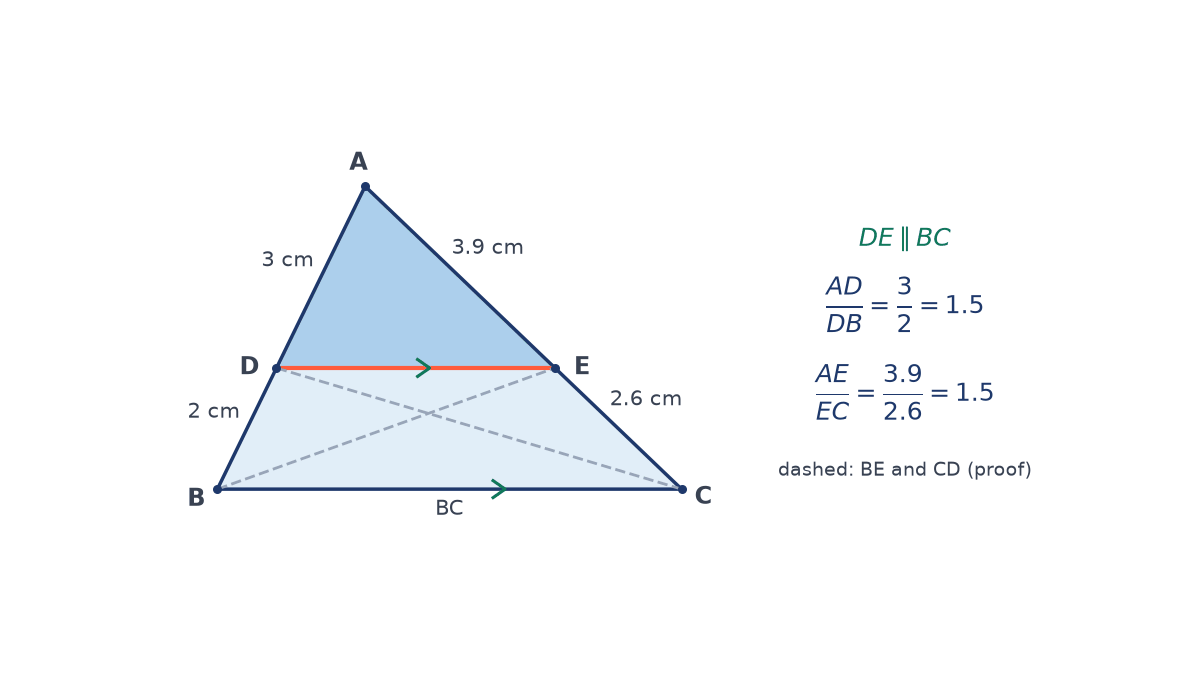
Theorem 6.1 (Basic Proportionality Theorem). If a line is drawn parallel to one side of a triangle to intersect the other two sides in distinct points, the other two sides are divided in the same ratio.
In symbols: in , if lies on , lies on and , then
Proof
Given: with on , on and .
To prove: .
Construction: Join and . Draw (with on line ) and (with on line ).
Proof. The area of a triangle is .
Step 1. Triangles and have bases and on the same line , and the same height . So
Step 2. Triangles and have bases and on the same line , and the same height . So
Step 3. Triangles and stand on the same base and lie between the same parallels and . Triangles on the same base and between the same parallels have equal areas, so
Step 4. By (3), the right-hand denominators in (1) and (2) are equal, and the numerators are the same area . So the left-hand sides of (1) and (2) are equal:
A useful rearrangement
From we can also get the "whole side" forms
Example 1 below shows how. These forms are handy when a question gives the whole side instead of the two pieces.
The converse of the theorem
Statement
If a line cuts two sides of a triangle in the same ratio, must it be parallel to the third side? An activity suggests it must. Mark off five equal steps on each arm of an angle at and join matching marks: the first mark on one arm to the first mark on the other, the second to the second, and so on. Every one of these joining lines divides the two arms in the same ratio, and every one comes out parallel to the line joining the fifth marks.
Theorem 6.2 (Converse of the Basic Proportionality Theorem). If a line divides any two sides of a triangle in the same ratio, then the line is parallel to the third side.
In symbols: in , if is on , is on and , then .
Why the converse holds
Suppose but is not parallel to . Draw with on . By Theorem 6.1, , so . Adding to both sides gives , so . Then and coincide, so is the line , which is parallel to . This contradicts our assumption, so .
Together the two theorems say: a line cutting two sides of a triangle is parallel to the third side if and only if it divides those two sides in the same ratio.
Method: using the theorem
- Find the triangle, and the line inside it that is parallel to one side (or that you want to prove parallel).
- Name the common vertex, the point where the two cut sides meet. Every ratio starts from that vertex: .
- To find a length: write , substitute the three known values, and solve.
- To test for parallel lines: compute both ratios (or cross-multiply). Equal means parallel; unequal means not parallel.
- For a proof involving two triangles: find a ratio that both triangles share, and make it the link between them.
Worked examples
Example 1: the whole-side form
A line intersects sides and of at and respectively and is parallel to . Prove that .
Solution. Since , Theorem 6.1 gives . Taking reciprocals, . Add to both sides:
since and . Taking reciprocals again, .
Check with the figure: and .
Example 2: finding a length
In , with on and on . If cm, cm and cm, find .
Solution. By Theorem 6.1,
Check: and match.
Answer: cm.
Example 3: an equation from the theorem
In , with , , and (all in cm). Find .
Solution. By Theorem 6.1,
Check: , , , , and . All lengths are positive, so the value is acceptable.
Answer: .
Example 4: is the line parallel?
and are points on sides and of . In each case, decide whether .
- cm, cm, cm, cm.
- cm, cm, cm, cm.
- cm, cm, cm, cm.
Solution. We use Theorem 6.2.
(1) and . The ratios differ, so is not parallel to .
(2) and . The ratios are equal, so .
(3) First find the pieces: cm and cm. Then
The ratios are equal (both about ), so .
Answer: (1) not parallel; (2) parallel; (3) parallel.
Example 5: a trapezium
is a trapezium with . and are points on the non-parallel sides and respectively, such that . Show that .
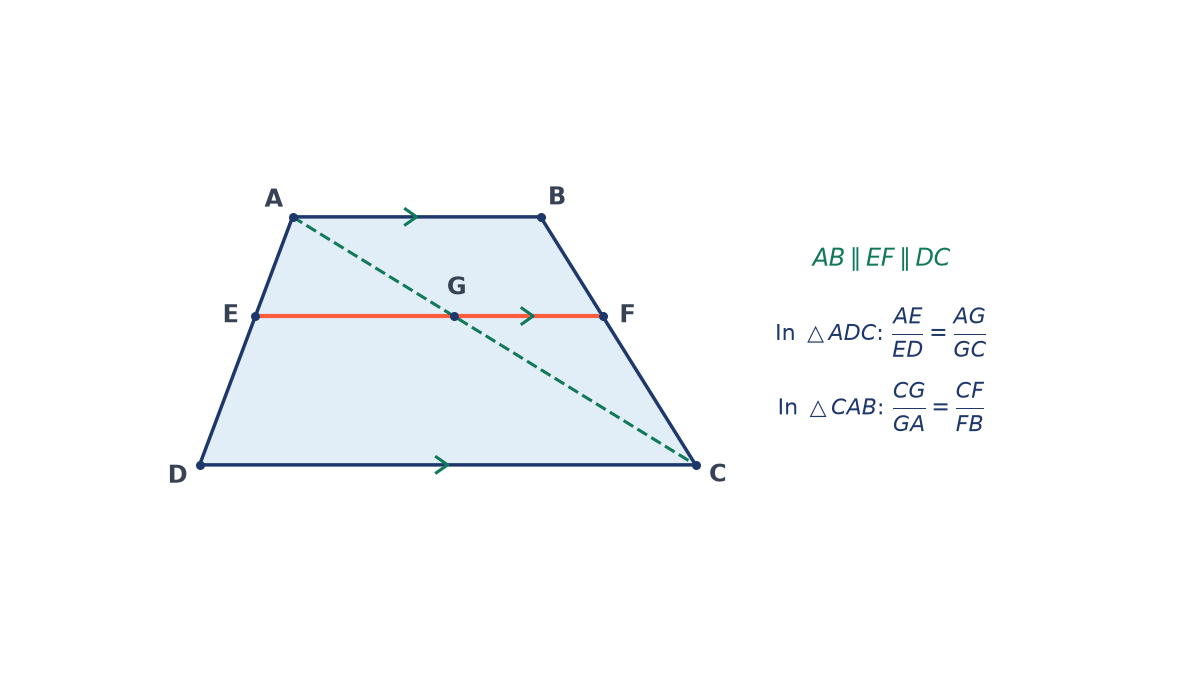
Solution. Join and let it meet at . Since and , we also have (lines parallel to the same line are parallel to each other).
In : is on , is on and . By Theorem 6.1,
In : is on , is on and . By Theorem 6.1 (ratios measured from vertex ),
From (1) and (2), .
Example 6: proving a triangle is isosceles
In , and are points on and such that and . Prove that is isosceles.
Solution. Since , Theorem 6.2 gives . With as the transversal, and are corresponding angles, so . We are also given . Therefore . Sides opposite equal angles are equal, so , and is isosceles.
Common mistakes
- Mixing up the ratio: writing . Both ratios must run the same way from the common vertex.
- Using . The theorem says nothing about and in this form; the correct statement for them is , which comes from similar triangles.
- Applying the theorem when the line is not given (or proved) to be parallel.
- Forgetting to subtract when a whole side is given, as in Example 4 (3).
- Using Theorem 6.1 when a question asks you to prove lines parallel. That needs the converse, Theorem 6.2.
- Accepting a value of that makes a length negative.
Try these
- In , , cm, cm and cm. Find . Answer: cm.
- In , , cm, cm and cm. Find . Answer: cm.
- cm, cm, cm, cm. Is ? Answer: Yes.
- cm, cm, cm, cm. Is ? Answer: No.
- In , with , , and . Find . Answer: (the other root, , gives negative lengths).
Key terms
- Basic Proportionality Theorem
- A line parallel to one side of a triangle, cutting the other two sides in distinct points, divides those sides in the same ratio.
- Thales' Theorem
- Another name for the Basic Proportionality Theorem, after Thales of Miletus.
- Converse
- The statement formed by swapping the hypothesis and the conclusion of a theorem.
- Equiangular triangles
- Triangles whose corresponding angles are all equal.
- Divide in the same ratio
- Two points cut two segments so that the part-to-part ratios are equal.
- Triangles between the same parallels
- Triangles whose bases lie on one line and whose opposite vertices lie on a parallel line; on equal bases they have equal areas.
- Trapezium
- A quadrilateral with at least one pair of parallel sides.
Common questions
Does the theorem work if the line is parallel to instead of ?
Yes. It then cuts and , and the ratios are measured from vertex . The common vertex is always the one opposite the parallel side.
Why does the proof use areas?
Areas turn a statement about lengths into one about triangles with shared heights, and the parallel lines give the key fact that .
What is the difference between Theorem 6.1 and Theorem 6.2?
Theorem 6.1 starts from parallel lines and gives equal ratios. Theorem 6.2 starts from equal ratios and gives parallel lines.
Is the mid-point theorem a special case?
Yes. If is the mid-point of and , then , so is the mid-point of .
Can I cross-multiply to test for parallel lines?
Yes. exactly when , and this often avoids awkward decimals.
References
- National Council of Educational Research and Training. Mathematics: Textbook for Class X. NCERT, New Delhi.
- Heath, T. L. (trans.) The Thirteen Books of Euclid's Elements. Dover Publications.
- Kiselev, A. P. Kiselev's Geometry, Book I: Planimetry (adapted by A. Givental). Sumizdat.
- Sharma, R. D. Mathematics for Class 10. Dhanpat Rai Publications.