Under perfect competition, price is set by the whole industry where market demand meets market supply. Here is how demand, supply and equilibrium work, with graphs.
Perfect competition refers to a market situation where there are a large number of buyers and sellers dealing in homogenous products. Moreover, under perfect competition, there are no legal, social or technological barriers to the entry or exit of firms.
In perfect competition, sellers and buyers are fully aware of the current market price, so no one buys at a higher price or sells at a lower one. As a result, the same price prevails in the market under perfect competition.
Under perfect competition, the buyers and sellers cannot influence the market price by increasing or decreasing their purchases or output, respectively. The market price of products in perfect competition is determined by the industry. This implies that in perfect competition, the market price of products is determined by taking into account two market forces, namely market demand and market supply.
In the words of Marshall, “Both the elements of demand and supply are required for the determination of price of a commodity in the same manner as both the blades of scissors are required to cut a cloth.” Market demand is the sum of the quantities demanded by all the individual consumers in the market.
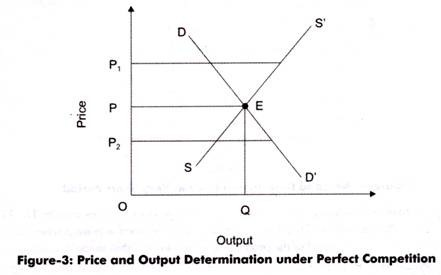
On the other hand, market supply is the sum of the quantities supplied by all the individual firms in the industry. In perfect competition, the price of a product is determined at a point at which the demand and supply curve intersect each other. This point is called the equilibrium point, and the price is the equilibrium price. In addition, at this point, the quantity demanded and supplied is called equilibrium quantity.
Demand refers to the quantity of a product that consumers are willing to purchase at a particular price, while other factors remain constant. A consumer demands more quantity at lower price and less quantity at higher price. Therefore, the demand varies at different prices.
When the price is OP, suppose the quantity demanded is OQ. When the price rises to OP1, the quantity demanded falls to OQ1. So the market demand curve (DD’) slopes downward. The figure above shows the supply side, which we turn to next.
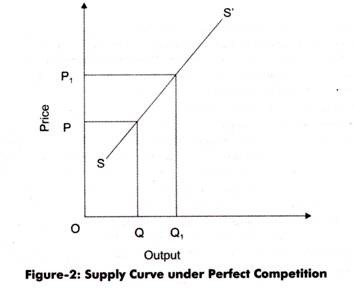
Supply refers to quantity of a product that producers are willing to supply at a particular price. Generally, the supply of a product increases at high price and decreases at low price.
In the supply curve shown earlier, the quantity supplied is OQ at price OP. When price increases to OP1, the quantity supplied increases to OQ1. This is because the producers are able to earn large profits by supplying products at higher price. Therefore, under perfect competition, the supply curve (SS’) slopes upward.
As discussed earlier, in perfect competition, the price of a product is determined at a point at which the demand and supply curve intersect each other. This point is known as equilibrium point. At this point, the quantity demanded and supplied is called equilibrium quantity.
In the figure, it can be seen that at price OP1, supply is more than the demand. So the price will fall to OP. At price OP2, demand is more than supply, so the price will rise to OP. Thus, E is the equilibrium at which equilibrium price is OP and equilibrium quantity is OQ.
Average revenue is referred to as the revenue that is earned per unit of output.
Marginal Revenue (MR)
Marginal revenue is calculated as the change in revenue divided by the change in quantity for any two given levels of sales.
Marginal Cost (MC)
In economics, the marginal cost is the change in total production cost that comes from making or producing one additional unit.
Average Variable Cost (AVC)
The average variable cost is the total variable cost per unit of output. This is found by dividing total variable cost by total output.
Kinked Demand Model (KDM)
The kinked demand curve model assumes that a business might face a dual demand curve for its product based on the likely reactions of other firms to a change in its price or another variable. The kinked demand curve suggests periods of price stability or price stickiness between rival firms.
Under perfect competition, no single firm can set the price; it is decided by market demand and supply. Price controls imposed by a government work against these market forces.
What is the advantage and disadvantage of price control on market structure?#
The main advantage is that price limits are set in order to safeguard people from exploitation and disadvantage is that price controls can impair quality and generate illegal markets.
What are the effects of price control on market structure?#
Price controls have been shown to cause scarcity, rationing, inferior-quality products, and black markets to sell price-controlled commodities through illicit means.