NCERT Class 10 Exercise 6.3 Solutions: Similar Triangles
By Ravindra Reddy K
·21 min read
Step-by-step solutions to all 16 questions of NCERT Class 10 Exercise 6.3, using the AA, SSS and SAS criteria on medians, altitudes, bisectors, a trapezium, a parallelogram and a shadow problem.
Exercise 6.3 of the NCERT Class 10 chapter Triangles is where the three similarity criteria get used on real figures. It has sixteen questions: reading similar pairs off a figure, finding angles, and proving that two triangles are similar when medians, altitudes, angle bisectors, a parallelogram or a trapezium are involved. It ends with a shadow problem. Every solution below is written out in full, the way you would set it out in an exam, and every numerical check has been worked through again.
AA (angle–angle): if two angles of one triangle are equal to two angles of another, the triangles are similar. The third angles are then equal too, because every triangle's angles add up to 180∘.
SSS (side–side–side): if all three sides of one triangle are proportional to the three sides of another, the triangles are similar.
SAS (side–angle–side): if one angle of a triangle equals one angle of another, and the sides including those angles are proportional, the triangles are similar.
Name the two triangles you will compare, and mark what you know about each on the figure.
Look for free facts: a common angle, vertically opposite angles, alternate angles between parallel lines, right angles from perpendiculars, and equal base angles of an isosceles triangle.
State the criterion (AA, SSS or SAS) and write the similarity with matching vertices in the same order, for example △ABC∼△PQR when ∠A=∠P, ∠B=∠Q and ∠C=∠R.
Read off the equal ratios of corresponding sides, and finish with the result you were asked to prove.
The order of the letters matters. In △ABC∼△PQR the side AB corresponds to PQ, BC to QR and CA to RP. If you write the letters in the wrong order, you will read off the wrong ratios.
State which pairs of triangles in Fig. 6.34 are similar. Write the similarity criterion you used and write the similar pairs in symbolic form.
The six pairs of triangles for this question are drawn in Fig. 6.34 of the NCERT textbook, and their angles and sides are marked only on that figure. Keep the textbook open and read the values for each pair from it. Then decide each pair as follows.
Step 1. Match the marked data to a test.
AA: if two angles are marked in each triangle, compare them. If two pairs are equal, the triangles are similar. If only two angles are marked, find the third angle using the angle sum of 180∘ before you compare.
SSS: if three sides are marked in each triangle, pair the shortest with the shortest, the middle with the middle and the longest with the longest, and divide. If all three ratios are equal, the triangles are similar. If even one ratio is different, they are not.
SAS: if two sides and one angle are marked in each triangle, first check that the angle lies between the two sides. Then check that the angles are equal and that the ratios of the two pairs of sides are equal. If the angle is not the included angle, SAS cannot be used.
Step 2. Write the correspondence. List the vertices in matching order, so that equal angles sit in the same position on both sides of ∼. If ∠A=∠Q, ∠B=∠R and ∠C=∠P, write △ABC∼△QRP, not △ABC∼△PQR. For SSS, the vertex opposite the shortest side matches the vertex opposite the shortest side, and so on.
Illustration (hypothetical values, not the textbook's). Suppose △XYZ has XY=3, YZ=4, ZX=5, and △KLM has KL=10, LM=6, MK=8. Sort each set of sides and divide:
LMXY=63=21,MKYZ=84=21,KLZX=105=21.
All three ratios are equal, so the triangles are similar by SSS. Side XY matches LM and side YZ matches MK, so vertex Y (common to XY and YZ) matches vertex M (common to LM and MK). Continuing the same way, X↔L and Z↔K, so we write △XYZ∼△LMK.
A second illustration, also hypothetical: if one triangle has ∠U=50∘ with sides UV=2 and VW=3, the 50∘ angle is not between those two sides. No matter what the other triangle shows, SAS cannot be applied, so you cannot conclude that the triangles are similar.
Answer: for each pair in Fig. 6.34, name the criterion whose conditions the marked data fully satisfies (AA, SSS or SAS) and write the pair with the vertices in corresponding order. If no criterion is fully satisfied, for example because one side ratio differs or the marked angle is not the included angle, write that the pair is not similar.
Diagonals AC and BD of a trapezium ABCD with AB∥DC intersect each other at O. Using a similarity criterion for two triangles, show that OCOA=ODOB.
Proof. Compare △OAB and △OCD.
∠AOB=∠COD (vertically opposite angles).
∠OAB=∠OCD (alternate angles, since AB∥DC and AC is a transversal).
So by the AA criterion,
△OAB∼△OCD.
With the correspondence O↔O, A↔C, B↔D, the corresponding sides are proportional:
OCOA=ODOB=CDAB.
Answer:OCOA=ODOB, as required.
Check with coordinates: take A(0,0), B(6,0), C(4,3), D(1,3), so AB=6 and DC=3. The diagonals meet at O(38,2), and both OCOA and ODOB come out as 2=DCAB.
Why this works: the diagonals of a trapezium divide each other in the ratio of the parallel sides.
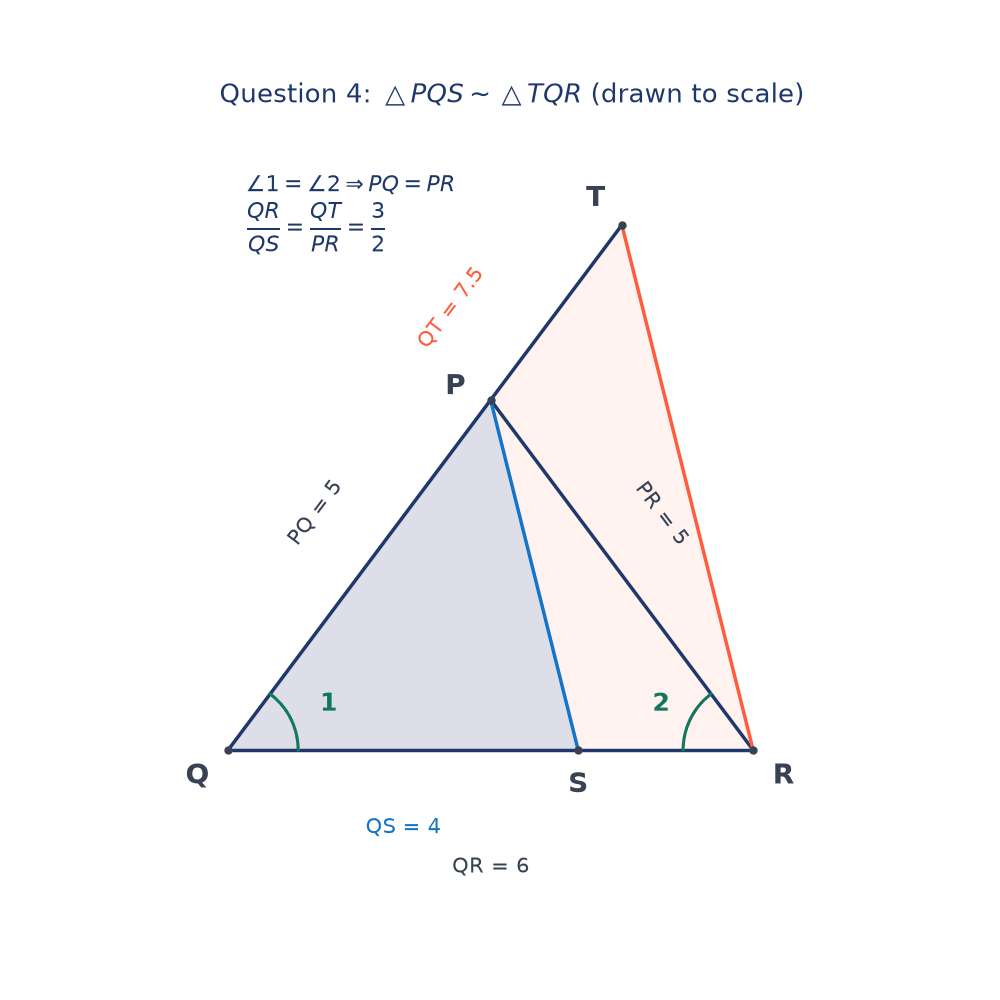
In Fig. 6.36, QSQR=PRQT and ∠1=∠2. Show that △PQS∼△TQR.
In the figure, S lies on QR, T lies on QP produced beyond P, and ∠1 and ∠2 are the angles of △PQR at Q and at R.
Question 4 drawn to scale. Because ∠1=∠2, PQ=PR, and the given ratio becomes QSQR=PQQT.
Step 1. In △PQR, ∠PQR=∠1 and ∠PRQ=∠2, and ∠1=∠2. Sides opposite equal angles are equal, so
PQ=PR.
Step 2. Replace PR by PQ in the given ratio, then take reciprocals:
QSQR=PQQT⟹QRQS=QTPQ,that is,TQPQ=QRQS.
Step 3.P lies on QT and S lies on QR, so ∠PQS and ∠TQR are the same angle:
∠PQS=∠TQR=∠Q(common angle).
Step 4. In △PQS and △TQR, the sides including ∠Q are proportional and ∠Q is common. So by the SAS criterion,
△PQS∼△TQR.
Answer:△PQS∼△TQR (SAS), with P↔T, Q↔Q, S↔R.
Check with the figure's numbers: with PQ=PR=5, QR=6, QS=4 and QT=7.5, we get QSQR=46=1.5 and PRQT=57.5=1.5. Also TQPQ=7.55=32 and QRQS=64=32, and the third sides PS and TR are in the same ratio 32.
Why this works: the given ratio mentions PR, which is not a side of △PQS. The equal angles ∠1=∠2 let you replace PR with PQ, which is a side of that triangle.
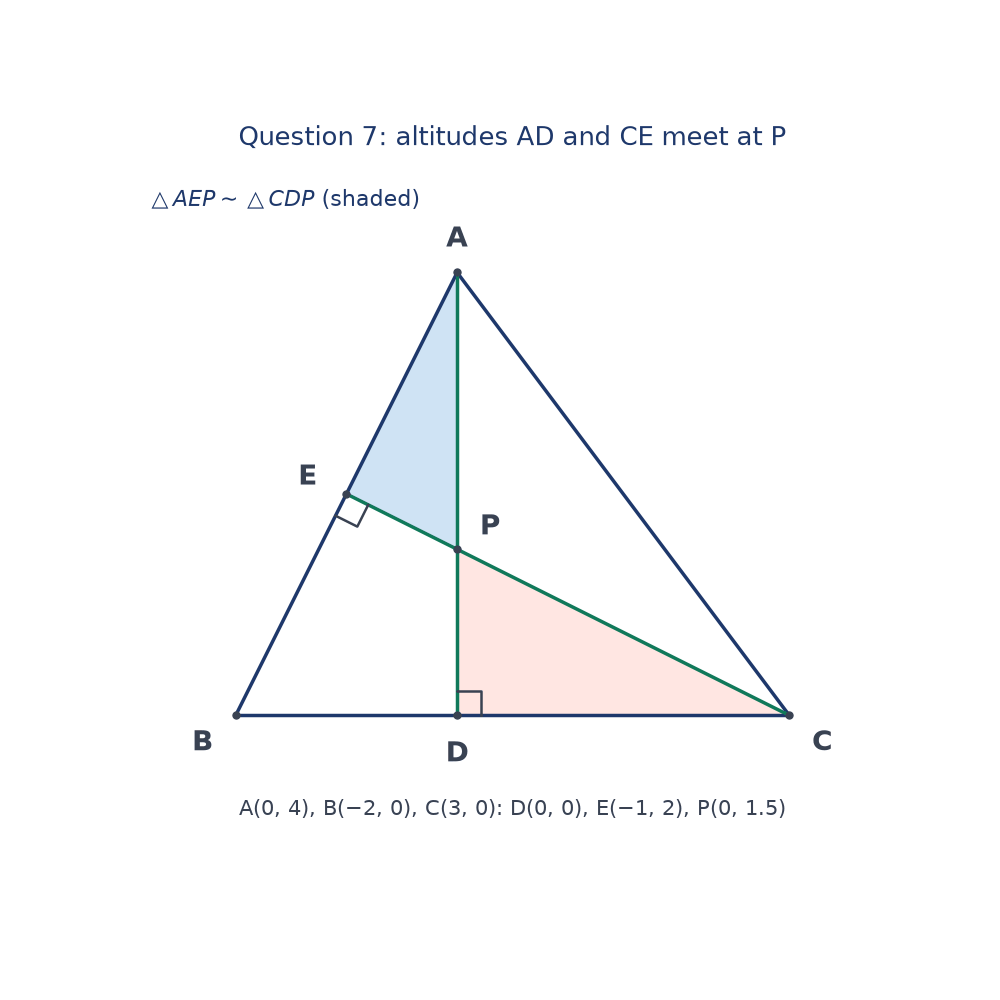
In Fig. 6.38, altitudes AD and CE of △ABC intersect each other at P. Show that: (i) △AEP∼△CDP (ii) △ABD∼△CBE (iii) △AEP∼△ADB (iv) △PDC∼△BEC.
AD⊥BC with D on BC, and CE⊥AB with E on AB. So ∠ADB=∠ADC=90∘ and ∠AEC=∠BEC=90∘.
Question 7 drawn to scale. The altitudes meet at P; the shaded triangles AEP and CDP are similar.
(i) In △AEP and △CDP:
∠AEP=∠CDP=90∘;
∠APE=∠CPD (vertically opposite angles).
By AA, △AEP∼△CDP.
(ii) In △ABD and △CBE:
∠ADB=∠CEB=90∘;
∠ABD=∠CBE (both are ∠B, a common angle).
By AA, △ABD∼△CBE.
(iii) In △AEP and △ADB:
∠AEP=∠ADB=90∘;
∠PAE=∠BAD (P lies on AD and E lies on AB, so this is a common angle).
By AA, △AEP∼△ADB.
(iv) In △PDC and △BEC:
∠PDC=∠BEC=90∘;
∠PCD=∠BCE (P lies on CE and D lies on CB, so this is a common angle).
By AA, △PDC∼△BEC.
Answer: all four similarities hold by the AA criterion, as shown above.
Check with coordinates: for A(0,4), B(−2,0), C(3,0), the feet of the altitudes are D(0,0) and E(−1,2), and the altitudes meet at P(0,1.5). This point also lies on the altitude from B, so it is the orthocentre. In every one of the four pairs, the three side ratios come out equal. In (ii), for example, CBAB=BEBD=CEAD=52≈0.894.
E is a point on side AD produced of a parallelogram ABCD, and BE intersects CD at F. Show that △ABE∼△CFB.
Step 1.E lies on AD produced, so ∠BAE=∠BAD. F lies on CD, so ∠BCF=∠BCD. Opposite angles of a parallelogram are equal, so
∠BAE=∠BAD=∠BCD=∠BCF.
Step 2.AE∥BC (the line AD is parallel to BC), and EB is a transversal. So the alternate angles are equal:
∠AEB=∠EBC=∠FBC.
Step 3. In △ABE and △CFB, ∠A=∠C and ∠E=∠B. By AA,
△ABE∼△CFB.
Answer:△ABE∼△CFB (AA), with A↔C, B↔F, E↔B.
Check with coordinates: take A(0,0), B(4,0), C(6,3), D(2,3). Produce AD to E(4,6). The line BE is x=4, and it meets DC at F(4,3). Then CFAB=24, FBBE=36 and BCEA=1352, and all three ratios equal 2.
CD and GH are respectively the bisectors of ∠ACB and ∠EGF, such that D and H lie on sides AB and FE of △ABC and △EFG respectively. If △ABC∼△FEG, show that: (i) GHCD=FGAC (ii) △DCB∼△HGE (iii) △DCA∼△HGF.
What the given similarity tells us.△ABC∼△FEG, so ∠A=∠F, ∠B=∠E and ∠ACB=∠FGE. Halving the last pair of equal angles gives
∠ACD=∠DCB=21∠ACB=21∠FGE=∠FGH=∠HGE.
(iii) In △DCA and △HGF: ∠DAC=∠HFG (since ∠A=∠F) and ∠DCA=∠HGF (shown above). By AA, △DCA∼△HGF.
(ii) In △DCB and △HGE: ∠DBC=∠HEG (since ∠B=∠E) and ∠DCB=∠HGE (shown above). By AA, △DCB∼△HGE.
(i) From (iii), with D↔H, C↔G, A↔F:
HGDC=GFCA,that is,GHCD=FGAC.
Answer: (i) GHCD=FGAC; (ii) △DCB∼△HGE (AA); (iii) △DCA∼△HGF (AA). Part (i) is easiest to prove after part (iii), so we proved (iii) first.
Check: take A(0,0), B(6,0), C(2,4) and the half-size copy F(10,0), E(13,0), G(11,2). Locating D and H with the angle bisector theorem gives CD≈4.052 and GH≈2.026. Their ratio is 2, which equals FGAC=525. In (ii) and (iii), every pair of corresponding sides is also in the ratio 2.
In Fig. 6.40, E is a point on side CB produced of an isosceles triangle ABC with AB=AC. If AD⊥BC and EF⊥AC, prove that △ABD∼△ECF.
Step 1.AB=AC, so the angles opposite these sides are equal: ∠ABC=∠ACB.
Step 2.D lies on BC, so ∠ABD=∠ABC. E lies on CB produced and F lies on CA, so ∠ECF=∠BCA. Therefore
∠ABD=∠ECF.
Step 3.∠ADB=90∘ (since AD⊥BC) and ∠EFC=90∘ (since EF⊥AC), so ∠ADB=∠EFC.
Step 4. By AA, △ABD∼△ECF.
Answer:△ABD∼△ECF (AA), with A↔E, B↔C, D↔F.
Check with coordinates: take A(0,4), B(−3,0), C(3,0), so AB=AC=5 and D=(0,0). Take E(−5,0). The foot of the perpendicular from E to AC is F(0.12,3.84). Then ECAB=85, CFBD=4.83 and EFAD=6.44, and all three ratios equal 0.625.
Sides AB and BC and median AD of a triangle ABC are respectively proportional to sides PQ and QR and median PM of △PQR (see Fig. 6.41). Show that △ABC∼△PQR.
Given:
PQAB=QRBC=PMAD.
Step 1.D and M are the midpoints of BC and QR, so BD=21BC and QM=21QR. Therefore
QMBD=21QR21BC=QRBC.
Step 2. So in △ABD and △PQM,
PQAB=QMBD=PMAD,
and by SSS, △ABD∼△PQM. Hence ∠ABD=∠PQM, which is the same as ∠ABC=∠PQR.
Step 3. In △ABC and △PQR, we have PQAB=QRBC and the included angles are equal, ∠B=∠Q. By SAS,
△ABC∼△PQR.
Answer:△ABC∼△PQR (SSS first, then SAS).
Check with numbers: take AB=6, BC=8 (so BD=4), AD=5 and PQ=9, QR=12 (so QM=6), PM=7.5. Then 96=64=7.55=32.
D is a point on side BC of a triangle ABC such that ∠ADC=∠BAC. Show that CA2=CB⋅CD.
Step 1. Compare △ADC and △BAC.
∠ADC=∠BAC (given);
∠ACD=∠BCA (common angle, since D lies on BC).
By AA, △ADC∼△BAC, with A↔B, D↔A, C↔C.
Step 2. The corresponding sides are proportional:
ACDC=BCAC.
Step 3. Cross-multiply:
CA2=CB⋅CD.
Answer:CA2=CB⋅CD, as required.
Check: if CB=8 and CD=2, the result gives CA2=16, so CA=4. A coordinate test with A(1,3), B(−4,0), C(4,0) and D chosen so that CD=CBCA2 confirms that ∠ADC=∠BAC exactly.
Sides AB and AC and median AD of a triangle ABC are respectively proportional to sides PQ and PR and median PM of another triangle PQR. Show that △ABC∼△PQR.
Given:PQAB=PRAC=PMAD.
Unlike Question 12, the side bisected by the median (BC) is not in the given ratio, so we need a construction.
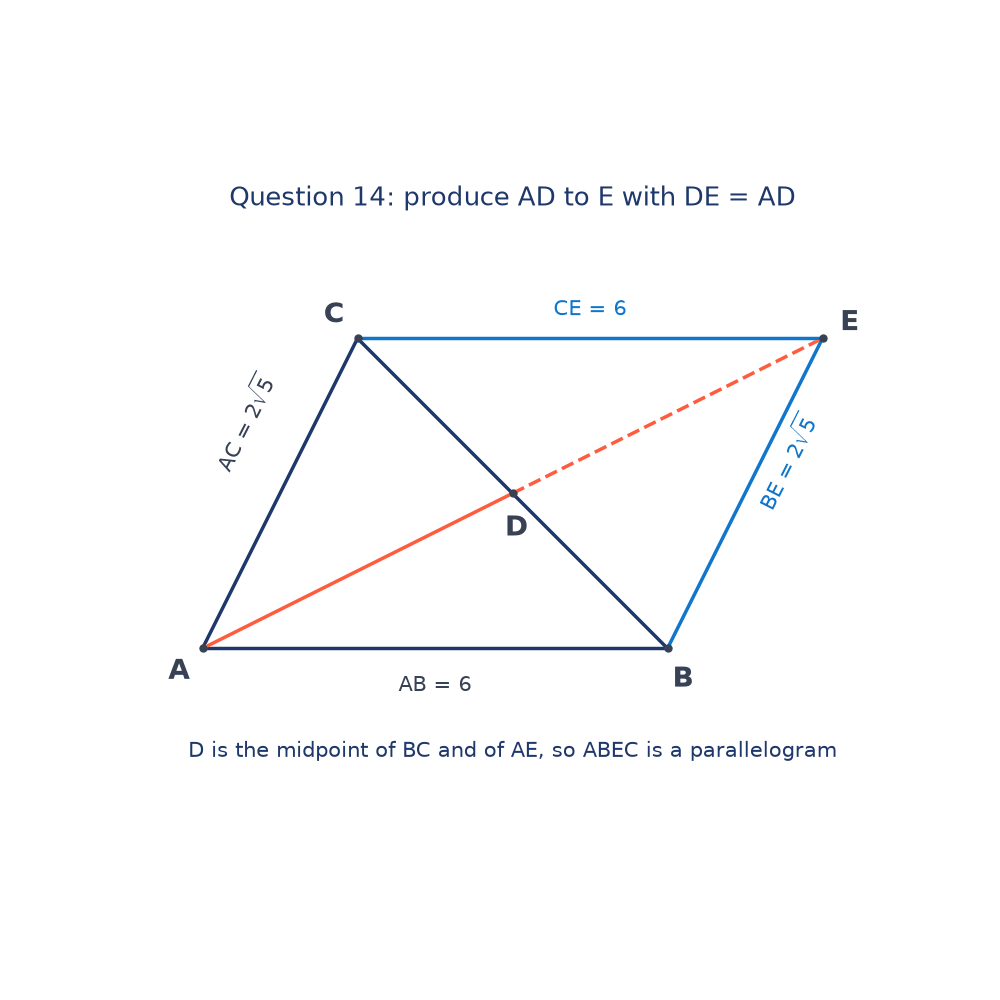
Construction. Produce AD to E so that DE=AD, and join CE and BE. Similarly, produce PM to N so that MN=PM, and join RN and QN.
Question 14: doubling the median turns ABEC into a parallelogram, so CE=AB and BE=AC.
Step 1. In quadrilateral ABEC, the diagonals AE and BC bisect each other at D. So ABEC is a parallelogram, and
CE=AB,BE=AC.
In the same way, PQNR is a parallelogram, so RN=PQ and QN=PR.
Step 2. Also AE=2AD and PN=2PM. Using the given ratios,
PQAB=PRAC=PMAD⟹QNBE=PQAB=PNAE.
By SSS, △ABE∼△PQN, so ∠BAE=∠QPN … (1)
Step 3. In the same way,
PRAC=RNCE=PNAE,
so by SSS, △ACE∼△PRN, and ∠CAE=∠RPN … (2)
Step 4. Adding (1) and (2):
∠BAE+∠CAE=∠QPN+∠RPN⟹∠BAC=∠QPR.
Step 5. In △ABC and △PQR, we have PQAB=PRAC and the included angles are equal, ∠A=∠P. By SAS, △ABC∼△PQR.
Answer:△ABC∼△PQR.
Check with coordinates: for A(0,0), B(6,0), C(2,4), the midpoint of BC is D(4,2) and E=(8,4). D is also the midpoint of AE. We get CE=AB=6 and BE=AC=25≈4.472, exactly as the construction requires.
A vertical pole of length 6 m casts a shadow 4 m long on the ground, and at the same time a tower casts a shadow 28 m long. Find the height of the tower.
Step 1. Let the tower's height be h m. The pole and the tower are both vertical, so each makes a right angle with the ground. At the same moment, the sun's rays make the same angle with the ground in both cases. So by AA, the triangle formed by the pole and its shadow is similar to the triangle formed by the tower and its shadow.
Step 2. In similar triangles, corresponding sides are proportional:
shadow of poleheight of pole=shadow of towerheight of tower⟹46=28h.
If AD and PM are medians of triangles ABC and PQR respectively, where △ABC∼△PQR, prove that PQAB=PMAD.
The same result is often written as ADAB=PMPQ, which is this equation rearranged. Both forms are proved below.
Step 1.△ABC∼△PQR, so
PQAB=QRBCand∠B=∠Q.
Step 2.D and M are midpoints, so
QMBD=21QR21BC=QRBC=PQAB.
Step 3. In △ABD and △PQM, we have PQAB=QMBD and the included angles are equal, ∠ABD=∠PQM. By SAS, △ABD∼△PQM.
Step 4. So
PQAB=PMAD,and rearranging,ADAB=PMPQ.
Answer:PQAB=PMAD (equivalently, ADAB=PMPQ).
Check with numbers: for A(0,0), B(6,0), C(2,4), we get AB=6 and AD=20≈4.472. A copy scaled by 31 has PQ=2 and PM≈1.491. Then ADAB≈1.342 and PMPQ≈1.342.
Across the whole exercise, the same idea keeps coming back: find two equal angles for AA, or a ratio together with its included angle for SAS. Questions 12 and 14 look alike, but Question 14 needs the doubled-median construction, because the side cut in half by the median does not appear in its given ratio.
SAS fails when the equal angle is not between the two proportional sides, as in the second illustration in Question 1. Two sides and a non-included angle do not prove similarity.
Look for two triangles that share a vertex, where the sides from that vertex lie along the same two rays. This happens in Questions 5, 6, 7, 9 and 13.
The given ratio does not include side BC, which the median bisects. Doubling the median creates a parallelogram, which turns the median into a side of a triangle and makes SSS possible.