Stand at the foot of a tall pole, a flagpole or a minaret and tip your head back to look at its top. Your line of sight now makes an angle with the horizontal. That one angle, together with how far away you are standing, is enough to work out the height of the whole structure, without ever putting a measuring tape on it. This is the idea behind Chapter 9 of the NCERT Class 10 textbook, Some Applications of Trigonometry: we use the trigonometric ratios you already know (sine, cosine, tangent and their reciprocals) to find heights and distances that are awkward or impossible to measure directly. Surveyors, engineers, navigators and astronomers have used exactly this method for centuries.
This lesson covers the three basic words of the chapter (line of sight, angle of elevation, angle of depression) and the simplest kind of problem: one right triangle and one known angle.
The three basic ideas
Line of sight
Picture a student standing on the ground, looking at the top of a minaret. The straight line from the student's eye to the top of the minaret is called the line of sight. In general, the line of sight is the line drawn from the eye of an observer to the point in the object being viewed.
Angle of elevation
Now draw a second line from the student's eye, straight out horizontally. The angle between this horizontal line and the line of sight is the angle of elevation of the top of the minaret. So the angle of elevation is the angle the line of sight makes with the horizontal when the point being viewed is above the horizontal level, that is, when we raise our head to look at it.
Angle of depression
Now picture a girl sitting on a balcony, looking down at a flower pot on a step below her. Her line of sight is now below the horizontal. The angle between the horizontal through her eye and the line of sight to the pot is the angle of depression of the flower pot. So the angle of depression is the angle the line of sight makes with the horizontal when the point being viewed is below the horizontal level, that is, when we lower our head to look at it.
Why the two angles are equal
These are really the same idea seen from opposite ends. Suppose a person at point on a balcony looks down at a point on the ground, and a person at looks up at . The horizontal through and the horizontal ground through are parallel lines, and the line of sight cuts both of them. The angle of depression at and the angle of elevation at are then alternate angles, so they are equal:
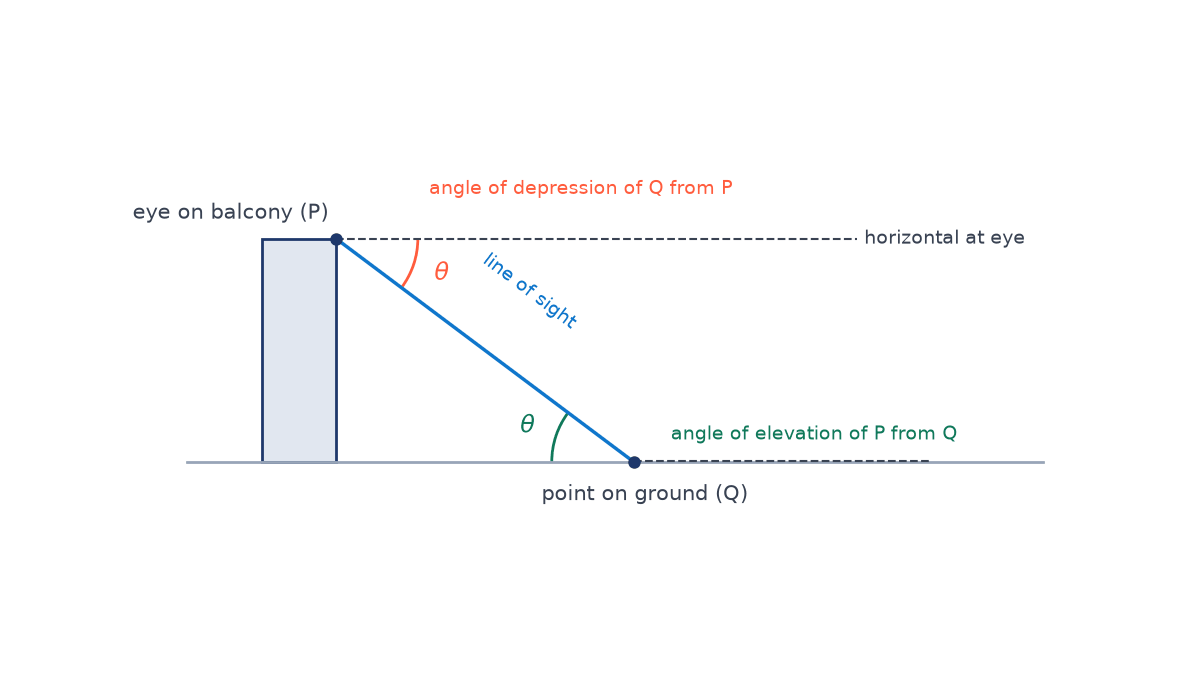
This fact is used again and again: whenever a problem gives an angle of depression, we can transfer it to the bottom of the picture and use it as an angle of elevation inside a right triangle.
Turning an angle into a height
What you need to know
To find the height of a minaret without climbing it, you need three things:
- the horizontal distance from you to the foot of the minaret;
- the angle of elevation of the top of the minaret, measured at your eye;
- the height of your eye above the ground.
Why your own height? Your eye is not at ground level. The right triangle you measure has its horizontal side at eye level, so it only gives the part of the minaret above your eye. You add your eye height at the end to get the full height from the ground. If a problem does not mention the observer's height, treat the observer as a point on the ground.
The key result
In the right triangle formed by your eye, the top of the minaret and the point on the minaret at eye level, the extra height is the side opposite the angle of elevation and the horizontal distance is the side adjacent to it. Since is opposite over adjacent,
When the side you know or want is a slanting length (a ladder, a kite string, a rope), use or instead.
Values you will use most
The method, step by step
- Draw a neat figure. Mark the horizontal, the vertical object, the observer and the line of sight.
- If an angle of depression is given, transfer it to the lower point as an equal angle of elevation (alternate angles).
- Pick out a right triangle that contains the known angle and the known side.
- Label the sides as opposite, adjacent and hypotenuse with respect to the known angle.
- Choose the one ratio that links the side you know to the side you want: or for opposite and adjacent, for opposite and hypotenuse, for adjacent and hypotenuse.
- Solve, then add or subtract any eye height, and give the answer with units (in surd form, and in decimals if the question asks).
Worked examples
Example 1: a tower and a single angle
A tower stands vertically on the ground. From a point on the ground 15 m away from the foot of the tower, the angle of elevation of the top of the tower is . Find the height of the tower.
No eye height is given, so the observer is a point on the ground. Let be the tower, with foot . In right triangle , m is adjacent to the angle and is opposite it, so we use tangent:
Since , the height is about m, a little under 26 m.
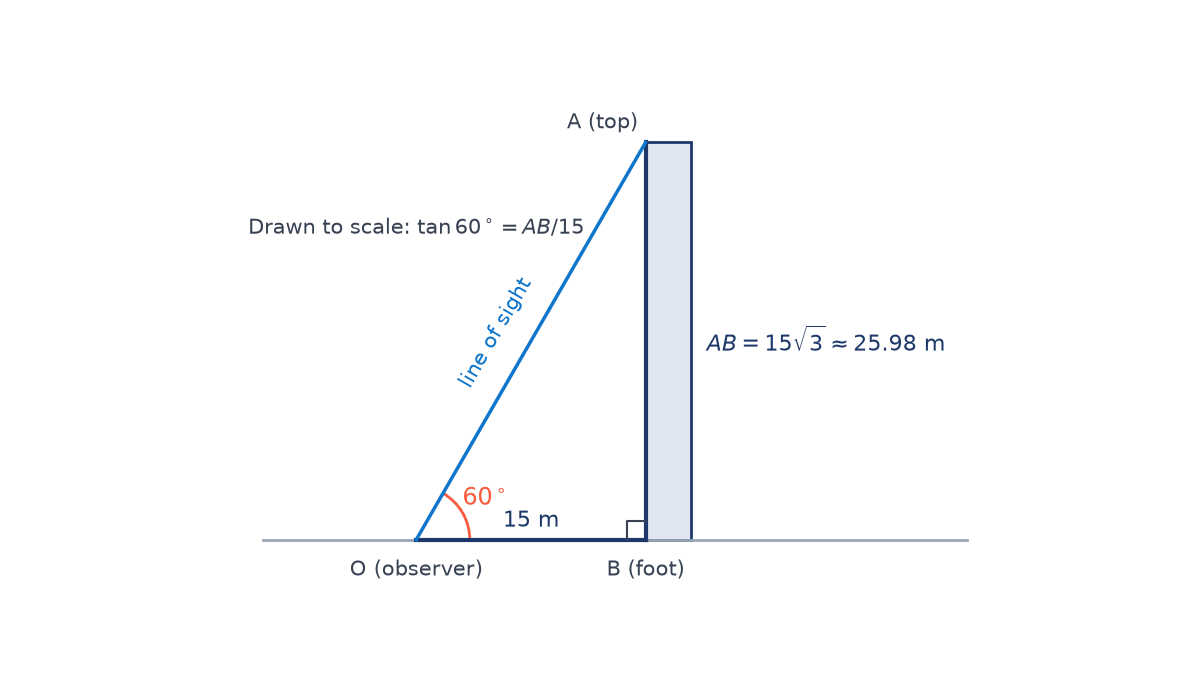
Answer: the tower is m m tall.
Example 2: how long a ladder does the electrician need?
An electrician has to repair a fault on a pole of height 5 m. She needs to reach a point 1.3 m below the top of the pole. What should be the length of the ladder she uses, which, when inclined at an angle of to the horizontal, would enable her to reach the required position? How far from the foot of the pole should she place the foot of the ladder? (Take .)
Step 1: the height to reach. m above the ground.
Step 2: the ladder. The ladder is the hypotenuse, and the height 3.7 m is opposite the angle. Opposite and hypotenuse call for sine:
Step 3: the foot of the ladder. The distance from the pole is adjacent to the angle, and we know the opposite side, so we use cotangent:
Answer: a ladder of about 4.28 m, with its foot about 2.14 m from the pole. (With the more precise the values are 4.27 m and 2.14 m; follow the value the question tells you to use.)
Example 3: a chimney, seen from eye level
An observer 1.5 m tall is 28.5 m away from a chimney. The angle of elevation of the top of the chimney from her eyes is . What is the height of the chimney?
The horizontal through her eye meets the chimney 1.5 m above the ground. In the right triangle at eye level, the horizontal distance 28.5 m is adjacent to and the height above eye level is opposite:
Now add her eye height:
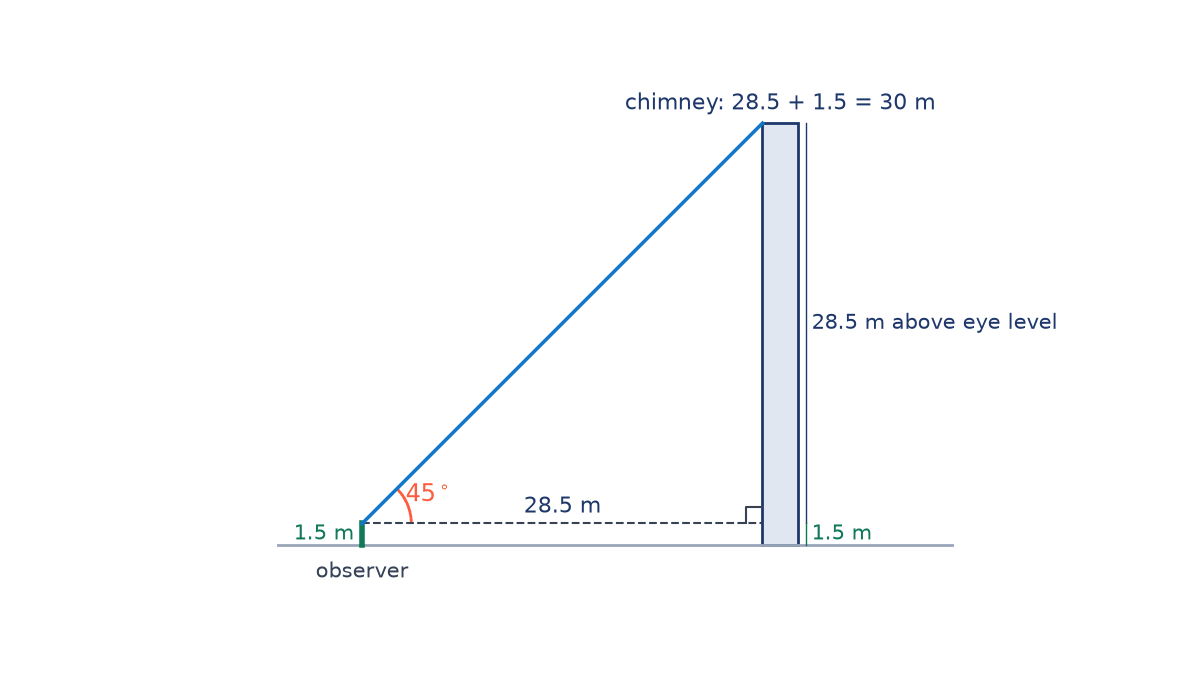
Answer: the chimney is 30 m tall.
Example 4: a boat seen from a cliff (angle of depression)
From the top of a cliff 50 m high, the angle of depression of a boat on the sea is . How far is the boat from the foot of the cliff?
By alternate angles, the angle of elevation of the top of the cliff from the boat is also . In the right triangle formed by the cliff (50 m, opposite) and the distance (adjacent):
Answer: the boat is m m from the foot of the cliff.
Example 5: the height of a kite
A kite is flying on a string 60 m long, pulled tight. The string makes an angle of with the level ground. Find the height of the kite (assume there is no slack in the string).
The string is the hypotenuse and the height is opposite the angle, so we use sine:
Answer: the kite is m m high.
The pattern to hold onto
Every problem above follows the same routine: draw the right triangle, decide which side is opposite and which is adjacent to the known angle, choose the one ratio that links the known side to the wanted side, and solve. If the observer's eye is above the ground, add that height at the end; if an angle of depression is given, move it to the lower point first. In the next lesson we meet problems with two angles, such as a flag on top of a building, or a shadow that changes length as the sun moves, where two right triangles must be handled together.
Common mistakes
- Measuring the angle of elevation or depression from the vertical instead of the horizontal.
- Placing the angle of depression inside the triangle at the top, between the line of sight and the vertical. That angle is minus the angle of depression, not the angle itself.
- Forgetting to add the observer's eye height, or adding it when the question treats the observer as a point.
- Using when the two sides involved are the opposite and adjacent sides; that pair always needs or .
- Mixing up and .
- Rounding early, or using a different value from the one given in the question.
Try these
- From a point 30 m from the foot of a tower, the angle of elevation of its top is . Find the height of the tower. Answer: m.
- A kite string 100 m long makes an angle of with the ground. Find the height of the kite. Answer: m.
- From the top of a lighthouse 75 m high, the angle of depression of a ship is . How far is the ship from the lighthouse? Answer: 75 m.
- A boy whose eyes are 1.6 m above the ground stands 20 m from a tree and sees its top at an angle of elevation of . Find the height of the tree. Answer: 21.6 m.
- A 10 m ladder leans against a wall, making an angle of with the ground. How high up the wall does it reach, and how far is its foot from the wall? Answer: m up the wall; foot 5 m from the wall.
Key terms
- Line of sight
- The straight line from the eye of the observer to the point on the object being viewed.
- Horizontal
- A line through the observer's eye parallel to the level ground.
- Angle of elevation
- The angle between the line of sight and the horizontal when the object is above eye level.
- Angle of depression
- The angle between the line of sight and the horizontal when the object is below eye level.
- Alternate angles
- Equal angles formed on opposite sides of a line that cuts two parallel lines; they make the angle of depression equal to the matching angle of elevation.
- Opposite side
- In a right triangle, the side facing the angle being used.
- Adjacent side
- In a right triangle, the side next to the angle being used, other than the hypotenuse.
- Hypotenuse
- The side opposite the right angle; the longest side, such as a ladder or kite string.
Common questions
Is the angle of elevation always equal to the angle of depression?
Between the same two points, yes. The angle of elevation of seen from equals the angle of depression of seen from , because the two horizontals are parallel and the angles are alternate angles.
Which ratio should I use in a heights and distances problem?
Look at the two sides involved. Height and horizontal distance need (or ). A slanting length with the height needs ; a slanting length with the horizontal distance needs .
When do I add the observer's height?
Only when the question gives it. The trigonometric triangle then starts at eye level, so the height it gives is the part above the eye, and you add the eye height to reach the ground.
Should I leave the answer as a surd or a decimal?
Write the exact surd form first, such as m. If the question gives a value like or , also give the decimal using exactly that value.
Can the angle of elevation be ?
Only if the object is directly overhead. Then there is no triangle, and the method cannot give a height, which is why problems always use an acute angle.
References
- National Council of Educational Research and Training. Mathematics: Textbook for Class X. NCERT, New Delhi.
- Loney, S. L. Plane Trigonometry. Cambridge University Press.
- Sharma, R. D. Mathematics for Class 10. Dhanpat Rai Publications.
- Aggarwal, R. S. Secondary School Mathematics for Class 10. Bharati Bhawan.