These are complete solutions to NCERT Class 10 Mathematics, Exercise 4.3 (Chapter 4, Quadratic Equations, Section 4.4 Nature of Roots). The exercise practises using the discriminant: first to describe the roots of given equations, then to find an unknown coefficient, and finally to decide whether three real-life situations are possible at all.
Quick recap of the method#
For a x 2 + b x + c = 0 ax^2 + bx + c = 0 a x 2 + b x + c = 0 a ≠ 0 a \neq 0 a = 0 discriminant is D = b 2 − 4 a c D = b^2 - 4ac D = b 2 − 4 a c
D > 0 D \gt 0 D > 0 x = − b ± D 2 a \displaystyle x = \frac{-b \pm \sqrt{D}}{2a} x = 2 a − b ± D D = 0 D = 0 D = 0 x = − b 2 a \displaystyle x = -\frac{b}{2a} x = − 2 a b D < 0 D \lt 0 D < 0
Write the equation in standard form and read off a a a b b b c c c
Compute D D D
If the roots are real, find them.
In a word problem, a negative D D D
Question 1#
Find the nature of the roots of the following quadratic equations. If the real roots exist, find them.
Question 1 (i)#
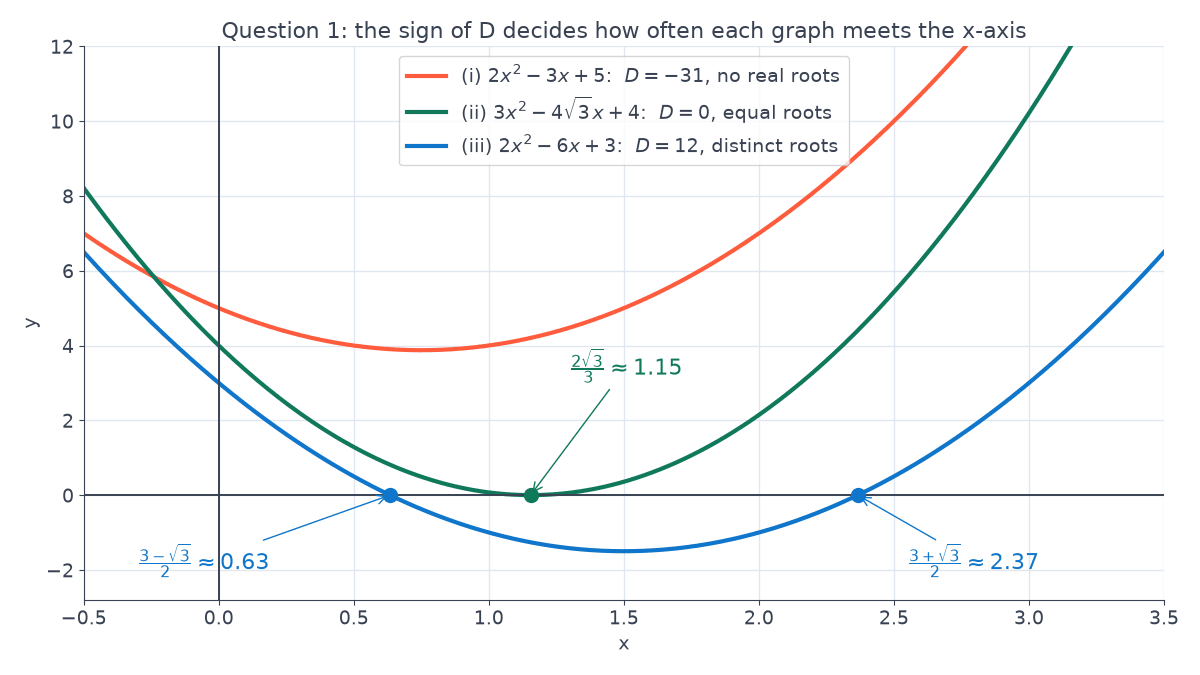
2 x 2 − 3 x + 5 = 0 2x^2 - 3x + 5 = 0 2 x 2 − 3 x + 5 = 0
Solution. Here a = 2 a = 2 a = 2 b = − 3 b = -3 b = − 3 c = 5 c = 5 c = 5
D = b 2 − 4 a c = ( − 3 ) 2 − 4 ( 2 ) ( 5 ) = 9 − 40 = − 31 D = b^2 - 4ac = (-3)^2 - 4(2)(5) = 9 - 40 = -31 D = b 2 − 4 a c = ( − 3 ) 2 − 4 ( 2 ) ( 5 ) = 9 − 40 = − 31
Since D < 0 D \lt 0 D < 0
Why this works: completing the square gives 2 x 2 − 3 x + 5 = 2 ( x − 3 4 ) 2 + 31 8 \displaystyle 2x^2 - 3x + 5 = 2\left(x - \frac{3}{4}\right)^2 + \frac{31}{8} 2 x 2 − 3 x + 5 = 2 ( x − 4 3 ) 2 + 8 31 31 8 \displaystyle \frac{31}{8} 8 31 x x x
Answer: no real roots.
Question 1 (ii)#
3 x 2 − 4 3 x + 4 = 0 3x^2 - 4\sqrt{3}\,x + 4 = 0 3 x 2 − 4 3 x + 4 = 0
Solution. Here a = 3 a = 3 a = 3 b = − 4 3 b = -4\sqrt{3} b = − 4 3 c = 4 c = 4 c = 4
D = ( − 4 3 ) 2 − 4 ( 3 ) ( 4 ) = 16 × 3 − 48 = 48 − 48 = 0 D = \left(-4\sqrt{3}\right)^2 - 4(3)(4) = 16 \times 3 - 48 = 48 - 48 = 0 D = ( − 4 3 ) 2 − 4 ( 3 ) ( 4 ) = 16 × 3 − 48 = 48 − 48 = 0
Since D = 0 D = 0 D = 0
x = − b 2 a = 4 3 2 × 3 = 2 3 3 = 2 3 \displaystyle x = -\frac{b}{2a} = \frac{4\sqrt{3}}{2 \times 3} = \frac{2\sqrt{3}}{3} = \frac{2}{\sqrt{3}} x = − 2 a b = 2 × 3 4 3 = 3 2 3 = 3 2
Check: with x = 2 3 3 \displaystyle x = \frac{2\sqrt{3}}{3} x = 3 2 3 x 2 = 12 9 = 4 3 \displaystyle x^2 = \frac{12}{9} = \frac{4}{3} x 2 = 9 12 = 3 4 3 x 2 = 4 3x^2 = 4 3 x 2 = 4 4 3 x = 8 × 3 3 = 8 \displaystyle 4\sqrt{3}\,x = \frac{8 \times 3}{3} = 8 4 3 x = 3 8 × 3 = 8 4 − 8 + 4 = 0 4 - 8 + 4 = 0 4 − 8 + 4 = 0
Answer: two equal real roots, 2 3 \displaystyle \frac{2}{\sqrt{3}} 3 2 2 3 \displaystyle \frac{2}{\sqrt{3}} 3 2 2 3 3 \displaystyle \frac{2\sqrt{3}}{3} 3 2 3
Question 1 (iii)#
2 x 2 − 6 x + 3 = 0 2x^2 - 6x + 3 = 0 2 x 2 − 6 x + 3 = 0
Solution. Here a = 2 a = 2 a = 2 b = − 6 b = -6 b = − 6 c = 3 c = 3 c = 3
D = ( − 6 ) 2 − 4 ( 2 ) ( 3 ) = 36 − 24 = 12 D = (-6)^2 - 4(2)(3) = 36 - 24 = 12 D = ( − 6 ) 2 − 4 ( 2 ) ( 3 ) = 36 − 24 = 12
Since D > 0 D \gt 0 D > 0 12 = 2 3 \sqrt{12} = 2\sqrt{3} 12 = 2 3
x = − b ± D 2 a = 6 ± 2 3 4 = 3 ± 3 2 \displaystyle x = \frac{-b \pm \sqrt{D}}{2a} = \frac{6 \pm 2\sqrt{3}}{4} = \frac{3 \pm \sqrt{3}}{2} x = 2 a − b ± D = 4 6 ± 2 3 = 2 3 ± 3
Check: the sum of the roots is 3 + 3 2 + 3 − 3 2 = 3 = − b a \displaystyle \frac{3 + \sqrt{3}}{2} + \frac{3 - \sqrt{3}}{2} = 3 = -\frac{b}{a} 2 3 + 3 + 2 3 − 3 = 3 = − a b ( 3 + 3 ) ( 3 − 3 ) 4 = 9 − 3 4 = 3 2 = c a \displaystyle \frac{(3 + \sqrt{3})(3 - \sqrt{3})}{4} = \frac{9 - 3}{4} = \frac{3}{2} = \frac{c}{a} 4 ( 3 + 3 ) ( 3 − 3 ) = 4 9 − 3 = 2 3 = a c
Answer: two distinct real roots, x = 3 + 3 2 \displaystyle x = \frac{3 + \sqrt{3}}{2} x = 2 3 + 3 x = 3 − 3 2 \displaystyle x = \frac{3 - \sqrt{3}}{2} x = 2 3 − 3 3 ≈ 1.732 \sqrt{3} \approx 1.732 3 ≈ 1.732
Question 1: D = − 31 D = -31 D = − 31 D = 0 D = 0 D = 0 2 3 3 \displaystyle \frac{2\sqrt{3}}{3} 3 2 3 D = 12 D = 12 D = 12 3 ± 3 2 \displaystyle \frac{3 \pm \sqrt{3}}{2} 2 3 ± 3 Question 2#
Find the values of k k k
Question 2 (i)#
2 x 2 + k x + 3 = 0 2x^2 + kx + 3 = 0 2 x 2 + k x + 3 = 0
Solution. Here a = 2 a = 2 a = 2 b = k b = k b = k c = 3 c = 3 c = 3 D = 0 D = 0 D = 0
k 2 − 4 ( 2 ) ( 3 ) = 0 k 2 = 24 k = ± 24 = ± 2 6 \begin{aligned} k^2 - 4(2)(3) &= 0 \\ k^2 &= 24 \\ k &= \pm\sqrt{24} = \pm 2\sqrt{6} \end{aligned} k 2 − 4 ( 2 ) ( 3 ) k 2 k = 0 = 24 = ± 24 = ± 2 6
Check: for both values, k 2 = 24 k^2 = 24 k 2 = 24 D = 24 − 24 = 0 D = 24 - 24 = 0 D = 24 − 24 = 0
Answer: k = 2 6 k = 2\sqrt{6} k = 2 6 k = − 2 6 k = -2\sqrt{6} k = − 2 6
Question 2 (ii)#
k x ( x − 2 ) + 6 = 0 kx(x - 2) + 6 = 0 k x ( x − 2 ) + 6 = 0
Solution. First write it in standard form:
k x 2 − 2 k x + 6 = 0 kx^2 - 2kx + 6 = 0 k x 2 − 2 k x + 6 = 0
Here a = k a = k a = k b = − 2 k b = -2k b = − 2 k c = 6 c = 6 c = 6 k ≠ 0 k \neq 0 k = 0 D = 0 D = 0 D = 0
( − 2 k ) 2 − 4 ( k ) ( 6 ) = 0 4 k 2 − 24 k = 0 4 k ( k − 6 ) = 0 \begin{aligned} (-2k)^2 - 4(k)(6) &= 0 \\ 4k^2 - 24k &= 0 \\ 4k(k - 6) &= 0 \end{aligned} ( − 2 k ) 2 − 4 ( k ) ( 6 ) 4 k 2 − 24 k 4 k ( k − 6 ) = 0 = 0 = 0
So k = 0 k = 0 k = 0 k = 6 k = 6 k = 6 k = 0 k = 0 k = 0 6 = 0 6 = 0 6 = 0
Check: with k = 6 k = 6 k = 6 6 x 2 − 12 x + 6 = 0 6x^2 - 12x + 6 = 0 6 x 2 − 12 x + 6 = 0 6 ( x − 1 ) 2 = 0 6(x - 1)^2 = 0 6 ( x − 1 ) 2 = 0
Answer: k = 6 k = 6 k = 6
Questions 3 to 5: is the situation possible?#
In each of these, form a quadratic equation, use the discriminant to decide whether real roots exist, and then find the answer if they do.
Question 3#
Is it possible to design a rectangular mango grove whose length is twice its breadth, and the area is 800 m²? If so, find its length and breadth.
Solution. Let the breadth be x x x 2 x 2x 2 x
2 x × x = 800 ⟹ 2 x 2 − 800 = 0 2x \times x = 800 \implies 2x^2 - 800 = 0 2 x × x = 800 ⟹ 2 x 2 − 800 = 0
Here a = 2 a = 2 a = 2 b = 0 b = 0 b = 0 c = − 800 c = -800 c = − 800
D = 0 2 − 4 ( 2 ) ( − 800 ) = 6400 > 0 D = 0^2 - 4(2)(-800) = 6400 \gt 0 D = 0 2 − 4 ( 2 ) ( − 800 ) = 6400 > 0
Real roots exist, so the design is possible. To find them, 2 x 2 = 800 2x^2 = 800 2 x 2 = 800 x 2 = 400 x^2 = 400 x 2 = 400 x = 20 x = 20 x = 20 x = − 20 x = -20 x = − 20 x = 20 x = 20 x = 20
Check: 40 × 20 = 800 40 \times 20 = 800 40 × 20 = 800
Answer: yes, it is possible. Breadth = 20 m, length = 40 m.
Question 4#
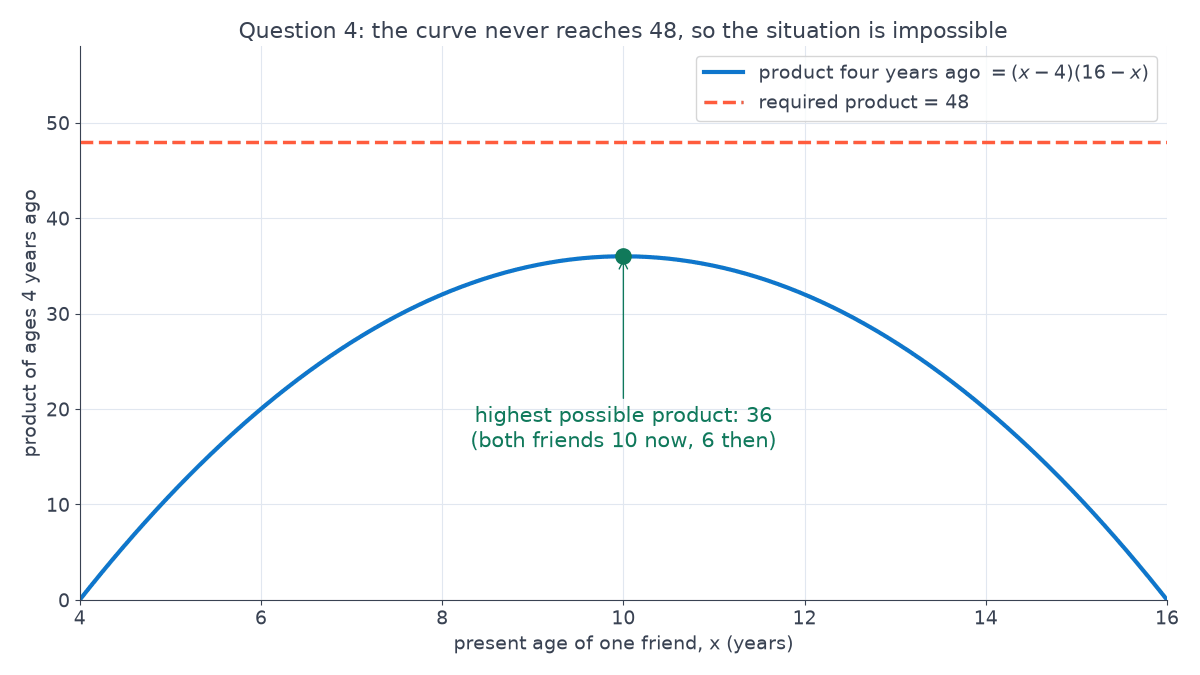
Is the following situation possible? If so, determine their present ages. The sum of the ages of two friends is 20 years. Four years ago, the product of their ages in years was 48.
Solution. Let the present age of one friend be x x x ( 20 − x ) (20 - x) ( 20 − x ) ( x − 4 ) (x - 4) ( x − 4 ) ( 16 − x ) (16 - x) ( 16 − x )
( x − 4 ) ( 16 − x ) = 48 16 x − x 2 − 64 + 4 x = 48 − x 2 + 20 x − 112 = 0 x 2 − 20 x + 112 = 0 \begin{aligned} (x - 4)(16 - x) &= 48 \\ 16x - x^2 - 64 + 4x &= 48 \\ -x^2 + 20x - 112 &= 0 \\ x^2 - 20x + 112 &= 0 \end{aligned} ( x − 4 ) ( 16 − x ) 16 x − x 2 − 64 + 4 x − x 2 + 20 x − 112 x 2 − 20 x + 112 = 48 = 48 = 0 = 0
Here a = 1 a = 1 a = 1 b = − 20 b = -20 b = − 20 c = 112 c = 112 c = 112
D = ( − 20 ) 2 − 4 ( 1 ) ( 112 ) = 400 − 448 = − 48 D = (-20)^2 - 4(1)(112) = 400 - 448 = -48 D = ( − 20 ) 2 − 4 ( 1 ) ( 112 ) = 400 − 448 = − 48
Since D < 0 D \lt 0 D < 0
Why this works: four years ago the two ages added up to ( x − 4 ) + ( 16 − x ) = 12 (x - 4) + (16 - x) = 12 ( x − 4 ) + ( 16 − x ) = 12 6 × 6 = 36 6 \times 6 = 36 6 × 6 = 36
Answer: no, the situation is not possible.
Question 4: the product of the ages four years ago is at most 36, so it can never equal 48. Question 5#
Is it possible to design a rectangular park of perimeter 80 m and area 400 m²? If so, find its length and breadth.
Solution. Let the length be x x x 2 ( length + breadth ) = 80 2(\text{length} + \text{breadth}) = 80 2 ( length + breadth ) = 80 ( 40 − x ) (40 - x) ( 40 − x )
x ( 40 − x ) = 400 40 x − x 2 = 400 x 2 − 40 x + 400 = 0 \begin{aligned} x(40 - x) &= 400 \\ 40x - x^2 &= 400 \\ x^2 - 40x + 400 &= 0 \end{aligned} x ( 40 − x ) 40 x − x 2 x 2 − 40 x + 400 = 400 = 400 = 0
Here a = 1 a = 1 a = 1 b = − 40 b = -40 b = − 40 c = 400 c = 400 c = 400
D = ( − 40 ) 2 − 4 ( 1 ) ( 400 ) = 1600 − 1600 = 0 D = (-40)^2 - 4(1)(400) = 1600 - 1600 = 0 D = ( − 40 ) 2 − 4 ( 1 ) ( 400 ) = 1600 − 1600 = 0
Since D = 0 D = 0 D = 0
x = − b 2 a = 40 2 = 20 \displaystyle x = -\frac{b}{2a} = \frac{40}{2} = 20 x = − 2 a b = 2 40 = 20
So the length is 20 m and the breadth is 40 − 20 = 20 40 - 20 = 20 40 − 20 = 20
Check: perimeter = 2 ( 20 + 20 ) = 80 = 2(20 + 20) = 80 = 2 ( 20 + 20 ) = 80 = 20 × 20 = 400 = 20 \times 20 = 400 = 20 × 20 = 400
Answer: yes, it is possible. Length = 20 m and breadth = 20 m. Because D = 0 D = 0 D = 0
Key terms#
Discriminant
D = b 2 − 4 a c D = b^2 - 4ac D = b 2 − 4 a c a x 2 + b x + c = 0 ax^2 + bx + c = 0 a x 2 + b x + c = 0 Nature of roots
Whether the roots are real and distinct (D > 0 D \gt 0 D > 0 D = 0 D = 0 D = 0 D < 0 D \lt 0 D < 0
Equal roots
Two identical real roots, each equal to − b 2 a \displaystyle -\frac{b}{2a} − 2 a b
Irrational roots
Real roots that involve a surd, as when D D D
Quadratic formula
x = − b ± b 2 − 4 a c 2 a \displaystyle x = \frac{-b \pm \sqrt{b^2 - 4ac}}{2a} x = 2 a − b ± b 2 − 4 a c b 2 − 4 a c ≥ 0 b^2 - 4ac \geq 0 b 2 − 4 a c ≥ 0 Sum and product of roots
For a x 2 + b x + c = 0 ax^2 + bx + c = 0 a x 2 + b x + c = 0 − b a \displaystyle -\frac{b}{a} − a b c a \displaystyle \frac{c}{a} a c
Perimeter
The total boundary length of a rectangle, 2 ( length + breadth ) 2(\text{length} + \text{breadth}) 2 ( length + breadth )
Common questions#
Why is k = 0 k = 0 k = 0 #
With k = 0 k = 0 k = 0 x 2 x^2 x 2 6 = 0 6 = 0 6 = 0
Is 2 3 \displaystyle \frac{2}{\sqrt{3}} 3 2 2 3 3 \displaystyle \frac{2\sqrt{3}}{3} 3 2 3 #
Yes. Multiplying the numerator and denominator of 2 3 \displaystyle \frac{2}{\sqrt{3}} 3 2 3 \sqrt{3} 3 2 3 3 \displaystyle \frac{2\sqrt{3}}{3} 3 2 3
In Question 3, why use the discriminant when x 2 = 400 x^2 = 400 x 2 = 400 #
The question asks whether the design is possible, and the discriminant answers that directly. Solving x 2 = 400 x^2 = 400 x 2 = 400
What does D < 0 D \lt 0 D < 0 #
It means no real value of the unknown satisfies all the conditions, so the situation described cannot happen, as in Question 4.
Why is the answer to Question 5 a square?#
With D = 0 D = 0 D = 0
References#
National Council of Educational Research and Training. Mathematics: Textbook for Class X . NCERT, New Delhi.
Sharma, R. D. Mathematics for Class 10 . Dhanpat Rai Publications.
Aggarwal, R. S. Secondary School Mathematics for Class 10 . Bharati Bhawan.