Once a situation has been written as a quadratic equation, the next job is to find the value of : the actual breadth, the actual number of toys, the actual number of marbles. The most direct way to do this, when it works, is factorisation: write the quadratic expression as a product of two linear factors and set each factor equal to zero. This lesson follows Section 4.3 of the NCERT Class 10 textbook and finishes the prayer hall and marbles problems from the previous lesson.
Roots of a quadratic equation
What "solving" means
Take the equation and substitute in the left-hand side:
The left-hand side equals the right-hand side, so makes the equation true. Such a value is called a root.
Definition
A real number is called a root of the quadratic equation if . We also say that is a solution of the equation, or that satisfies the equation.
The zeroes of the quadratic polynomial and the roots of the equation are the same numbers. A quadratic polynomial has at most two zeroes, so a quadratic equation has at most two roots.
The key result: the zero-product rule
Statement
If the product of two real numbers is zero, then at least one of them is zero:
Why it is true
Suppose and . Then has a reciprocal , and multiplying both sides by it gives . So if is not zero, must be. This is exactly why factorisation solves a quadratic equation: once is written as , the equation holds precisely when or .
Splitting the middle term
You learnt in Class IX to factorise by splitting the middle term: find two numbers whose sum is and whose product is , write as the sum of two terms using them, and then group.
Method: solving by factorisation
- Write the equation in standard form .
- Find two numbers and with and .
- Rewrite as .
- Group the first two terms and the last two terms, and take out the common factor from each group. The same bracket should appear twice.
- Write the expression as a product of two linear factors.
- Set each factor equal to zero and solve.
- Check each root in the original equation and, in a word problem, reject any root that does not fit the situation.
Worked examples
Example 1: two rational roots
Find the roots of by factorisation.
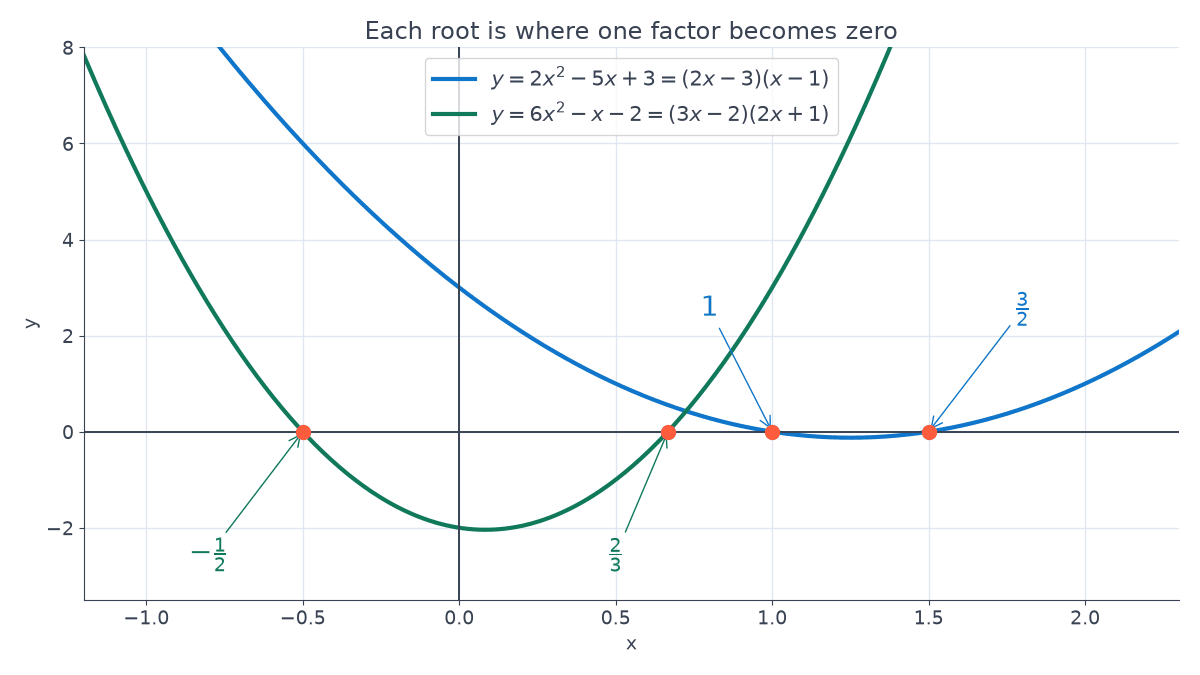
Here , , , so . We need two numbers with sum and product : they are and .
So , which gives or .
Answer: the roots are and .
Check with : .
Example 2: a negative coefficient
Find the roots of .
Here and . Two numbers with sum and product are and .
So or .
Answer: the roots are and .

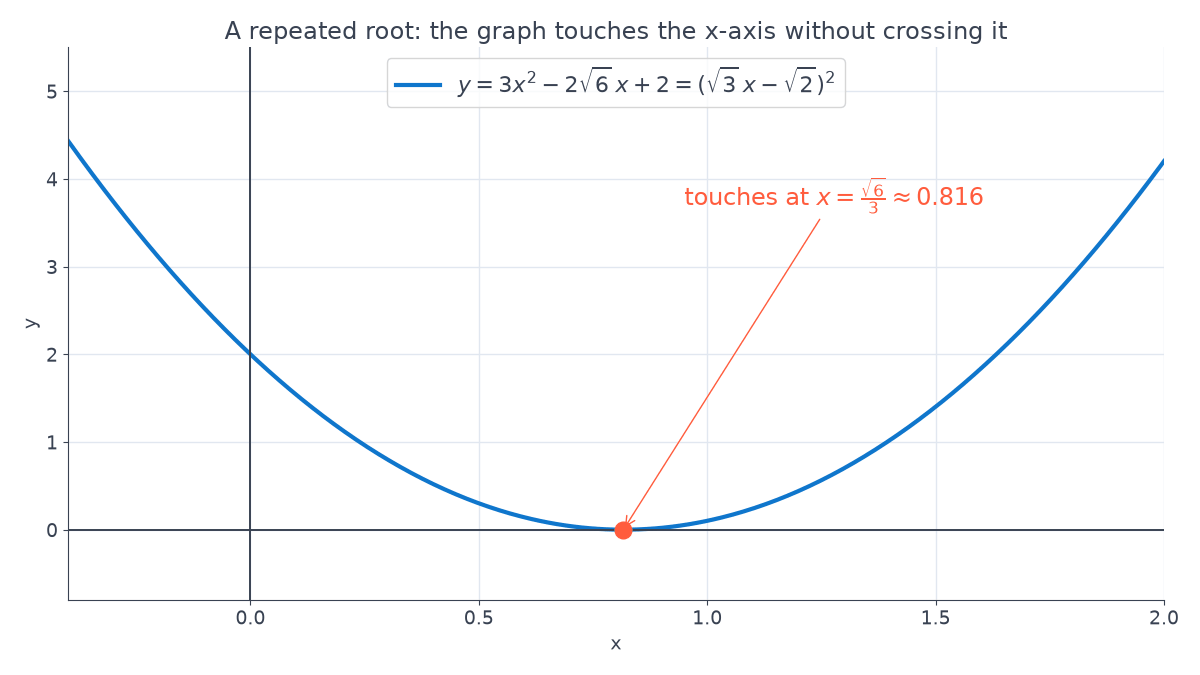
Example 3: a repeated root with surds
Find the roots of .
Here and . Two numbers with sum and product are and , since . Also note that and .
Both factors are the same, so the equation is , and
Answer: the roots are and .
Because the same factor appears twice, the root is counted twice. We say the equation has two equal roots (a repeated root). On a graph, the curve touches the -axis at one point without crossing it.

Example 4: the prayer hall
In the previous lesson, the breadth m of a prayer hall of area 300 m², whose length is m, satisfied . Find its dimensions.
Here and . Two numbers with sum and product are and .
So or . The breadth is a length, so it cannot be negative; we reject .
Answer: the breadth is 12 m and the length is m. Check: m².
Example 5: the marbles
John and Jivanti together had 45 marbles; after each lost 5, the product of their marbles was 124. With John's marbles as , this gave . How many did each have?
We need two numbers with sum and product : they are and .
So or . Both are sensible here. If John had 9, Jivanti had ; if John had 36, Jivanti had 9.
Answer: one of them had 36 marbles and the other had 9. Check: after losing 5 each they have 4 and 31, and .
Common mistakes
- Choosing two numbers whose product is instead of when .
- Dropping a sign while taking out a common factor: from the factor is , giving , not .
- Stopping at the factorised form and not writing the roots.
- Applying the zero-product rule when the right-hand side is not zero, for example writing from .
- Dividing both sides by in an equation such as , which loses the root .
- Keeping a negative length, age or number of objects as the answer to a word problem.
Try these
- Solve . Answer: or .
- Solve . Answer: or (that is, ).
- Solve . Answer: two equal roots, and .
- In the toy problem, the number of toys satisfies . Find . Answer: or .
Key terms
- Root (solution)
- A real number with .
- Zero of a polynomial
- A value of at which the polynomial equals zero; the zeroes of are the roots of .
- Factorisation
- Writing an expression as a product of simpler expressions, here two linear factors.
- Splitting the middle term
- Writing as with and , so the expression can be grouped.
- Zero-product rule
- If then or .
- Equal (repeated) roots
- Two roots that are the same number, arising when the two factors are identical.
- Surd
- An irrational root such as or left in exact form.
Common questions
How many roots can a quadratic equation have?
At most two. It may have two different real roots, two equal real roots, or no real roots at all.
What if I cannot find the two numbers for the split?
The equation may not factorise neatly over rational numbers, or it may have no real roots. In that case use the quadratic formula, and check the discriminant first.
Why must the equation equal zero before factorising?
The zero-product rule only works for a product equal to zero. A product equal to 124 tells you nothing about each factor separately.
Do both roots always give an answer to a word problem?
No. Both satisfy the equation, but a negative breadth, age or count must be rejected. In the marbles problem, however, both roots give valid answers.
Is an acceptable final answer?
It is correct, but it is usual to rationalise the denominator and write .
References
- National Council of Educational Research and Training. Mathematics: Textbook for Class X. NCERT, New Delhi.
- Gelfand, I. M. and Shen, A. Algebra. Birkhäuser.
- Aggarwal, R. S. Secondary School Mathematics for Class 10. Bharati Bhawan.