NCERT Class 10 Exercise 4.2 Solutions: Factorisation
Step-by-step solutions to all six questions of NCERT Class 10 Exercise 4.2: five quadratic equations solved by splitting the middle term, the marbles and toys problems, and four word problems, each answer checked.
Exercise 4.2 of the NCERT Class 10 chapter Quadratic Equations is about one skill: solving a quadratic equation by factorisation. It has six questions. Question 1 gives five equations to solve directly. Question 2 goes back to the two situations of Example 1 (the marbles and the toys) and solves them. Questions 3 to 6 are word problems: you turn the words into a quadratic equation, solve it, and then decide which root makes sense. Every answer below has been checked by putting it back into the original equation or condition.
To solve ax2+bx+c=0 by splitting the middle term:
Write the equation in standard form, with 0 on the right. Clear fractions or common factors first if that makes the numbers smaller.
Find two numbers whose product is ac and whose sum is b.
Split bx into two terms using those numbers.
Group the four terms in two pairs and take a common factor out of each pair. The two brackets left over must be the same.
Take that common bracket out, so the left side becomes a product of two factors.
Set each factor equal to zero and solve.
For a word problem, reject any root that does not fit the situation (a negative length, a negative count, and so on).
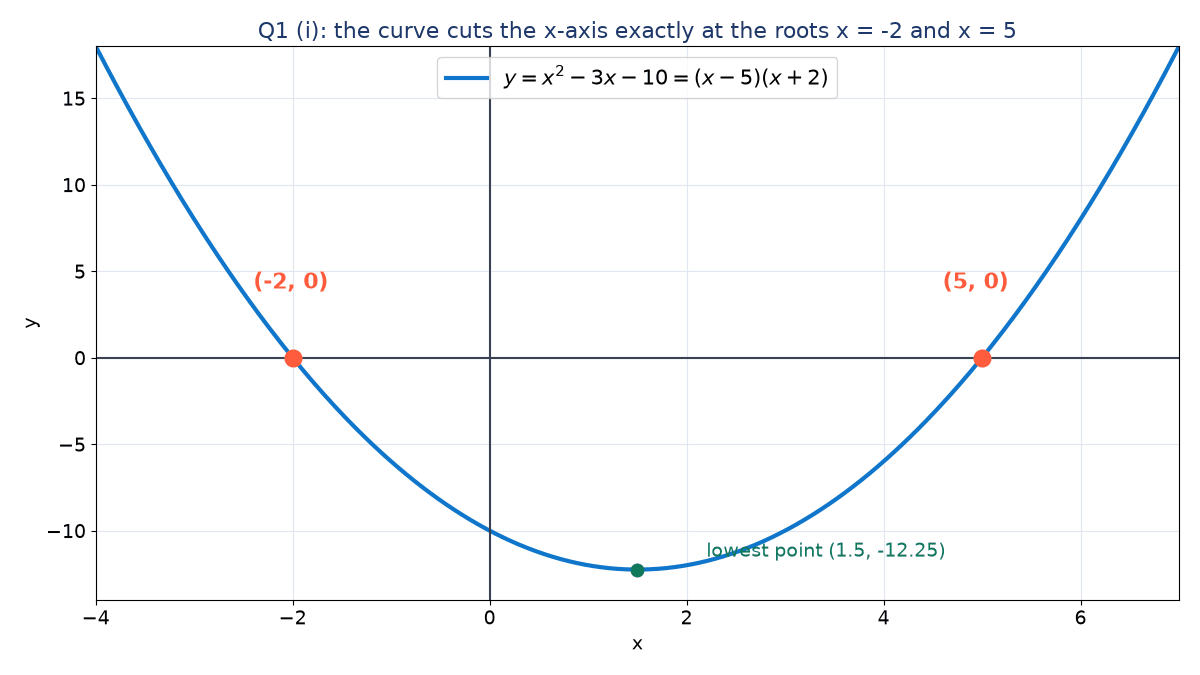
Why this works: if the product of two real numbers is zero, at least one of them must be zero. So (x−p)(x−q)=0 holds exactly when x=p or x=q. Those values are the roots of the equation, and they are also the points where the graph of y=ax2+bx+c meets the x-axis.
Question 1: Find the roots of the equations by factorisation#
The coefficients contain surds, but the rule is the same. Here a=2 and c=52, so
ac=2×52=5×2=10.
We need two numbers with product 10 and sum 7: these are 5 and 2.
2x2+5x+2x+52=0
Now group the terms. In the first pair take out x: 2x2+5x=x(2x+5). In the second pair take out 2, using 2=2×2: 2x+52=2(2x+5). The brackets match, so
x(2x+5)+2(2x+5)(2x+5)(x+2)=0=0
So 2x+5=0 or x+2=0. The first gives x=−25. Rationalising the denominator, −25×22=−252. The second gives x=−2.
Check: for x=−2: 2(2)+7(−2)+52=22−72+52=0. For x=−25: x2=225, so 2×225+7(−25)+52=2252−2352+2102=0. (We used 235=2352 and 52=2102.)
Answer: The roots are −2 and −25, that is, −252.
John and Jivanti together have 45 marbles. Each of them loses 5 marbles, and the product of the numbers they now have is 124. Find how many marbles each had to start with.
Let John have x marbles. Then Jivanti has 45−x. After losing 5 each, John has x−5 and Jivanti has 45−x−5=40−x. So
A cottage industry makes a certain number of toys in a day. The cost of making each toy (in rupees) is 55 minus the number of toys made that day. On a particular day the total cost of production was ₹750. Find the number of toys made that day.
Let the number of toys be x. The cost of each toy is ₹(55−x), and total cost is number of toys times cost of each:
x(55−x)55x−x2−750x2−55x+750=750=0=0
We need two numbers with product 750 and sum −55: these are −25 and −30.
So x=−14 or x=13. The question asks for positive integers, so we reject x=−14 and take x=13. The next integer is 14.
Check:132+142=169+196=365.
Why this works: the rejected root is not wrong algebra. The pair −14,−13 also has squares adding to 365, but those integers are not positive, so the condition in the question rules them out.
A cottage industry makes a certain number of pottery articles in a day. On one day, the cost of making each article (in rupees) was 3 more than twice the number of articles made that day, and the total cost of production was ₹90. Find the number of articles made and the cost of each article.
Let the number of articles be x. The cost of each article is ₹(2x+3), so the total cost is
x(2x+3)2x2+3x−90=90=0
Here ac=2×(−90)=−180 and b=3. We need two numbers with product −180 and sum 3: these are 15 and −12.
So x=−215 or x=6. The number of articles must be a positive whole number, so we reject −215 and take x=6. The cost of each article is 2(6)+3=15 rupees.
Looking for two numbers whose product is c when a=1. The product must be ac; in Question 1 (ii) it is −12, not −6.
Getting a sign wrong when taking out a negative common factor: −3x−6=−3(x+2), not −3(x−2).
Dividing both sides by x to "simplify". That can throw away a root; always bring everything to one side and factorise.
Writing only one root when the two factors are equal. Say the equation has two equal roots, as in Questions 1 (iv) and 1 (v).
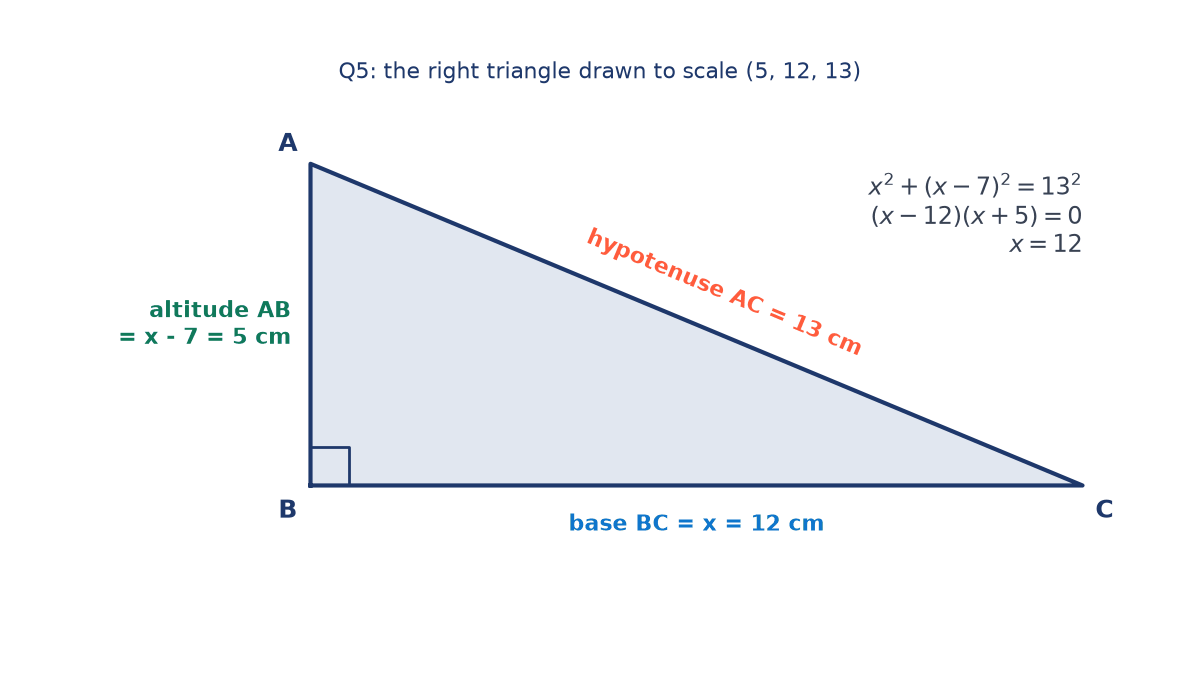
Forgetting to reject a root that does not fit the problem, such as a negative length in Question 5 or a fractional number of articles in Question 6.
Stopping at x in a word problem. Question 6 also asks for the cost of each article, and Question 5 asks for both sides.
Why must the two numbers multiply to ac and not to c?#
When you group ax2+px+qx+c, the first pair has common factor involving a and the second involves c. The brackets only match when pq=ac. When a=1, ac is simply c, which is why the shortcut seems to work for equations like x2−3x−10=0.
List the factor pairs of ∣ac∣. If ac is positive, both numbers have the same sign as b; if ac is negative, the numbers have opposite signs and the larger one takes the sign of b.
It can have two equal roots, as in 16x2−8x+1=0, where both roots are 41. In NCERT language we still say it has two roots, and they are equal.
Is it wrong to multiply or divide the whole equation by a number?#
No. Multiplying or dividing both sides by the same non-zero number leaves the roots unchanged. That is how we cleared the fraction in Question 1 (iv) and halved the equations in Questions 4 and 5.
Then the quadratic may not factorise neatly over the integers, or it may have no real roots at all. The quadratic formula and the discriminant, covered in the next exercise, handle every case.