These are com­plete solu­tions to NCERT Class 10 Math­e­mat­ics, Exer­cise 4.1 (Chap­ter 4, Qua­dratic Equa­tions). The exer­cise prac­tises two skills: decid­ing whether a given equa­tion is qua­dratic, and writ­ing a real-life sit­u­a­tion as a qua­dratic equa­tion. Both depend on the same habit: expand every­thing, col­lect like terms, and look at what is actu­ally left.

Quick recap of the method

An equa­tion in xx is qua­dratic exactly when it can be rearranged into

ax2+bx+c=0,a≠0,ax^2 + bx + c = 0, \qquad a \neq 0,

where aa, bb, cc are real num­bers.

  1. To test an equa­tion: expand both sides, bring every term to one side, sim­plify, and look at the high­est power of xx that sur­vives. x2x^2 with a non-zero coef­fi­cient means qua­dratic; only xx left means lin­ear; a sur­viv­ing x3x^3 means cubic.
  2. To form an equa­tion from a sit­u­a­tion: let a let­ter stand for one unknown, write the other quan­ti­ties in terms of it, turn the remain­ing con­di­tion into an equa­tion, and sim­plify to stan­dard form.

The iden­ti­ties you will need are (a±b)2=a2±2ab+b2(a \pm b)^2 = a^2 \pm 2ab + b^2 and (a±b)3=a3±3a2b+3ab2±b3(a \pm b)^3 = a^3 \pm 3a^2b + 3ab^2 \pm b^3.

Ques­tion 1

Check whether the fol­low­ing are qua­dratic equa­tions.

Ques­tion 1 (i)

(x+1)2=2(x−3)(x + 1)^2 = 2(x - 3)

Solu­tion. Expand the left-hand side with (a+b)2=a2+2ab+b2(a+b)^2 = a^2 + 2ab + b^2 and the right-hand side by dis­trib­ut­ing:

x2+2x+1=2x−6x^2 + 2x + 1 = 2x - 6

Bring every term to the left:

x2+2x+1−2x+6=0  ⟹  x2+7=0x^2 + 2x + 1 - 2x + 6 = 0 \implies x^2 + 7 = 0

The 2x2x terms can­cel, but x2x^2 remains with coef­fi­cient 1. This is ax2+bx+c=0ax^2 + bx + c = 0 with a=1a = 1, b=0b = 0, c=7c = 7.

Answer: Yes, it is a qua­dratic equa­tion (x2+7=0x^2 + 7 = 0).

Ques­tion 1 (ii)

x2−2x=(−2)(3−x)x^2 - 2x = (-2)(3 - x)

Solu­tion. Expand the right-hand side: (−2)(3−x)=−6+2x(-2)(3 - x) = -6 + 2x. So

x2−2x=−6+2xx^2 - 2x = -6 + 2x

Bring every term to the left:

x2−2x−2x+6=0  ⟹  x2−4x+6=0x^2 - 2x - 2x + 6 = 0 \implies x^2 - 4x + 6 = 0

An x2x^2 term with coef­fi­cient 1≠01 \neq 0 sur­vives.

Answer: Yes, it is a qua­dratic equa­tion (x2−4x+6=0x^2 - 4x + 6 = 0).

Ques­tion 1 (iii)

(x−2)(x+1)=(x−1)(x+3)(x - 2)(x + 1) = (x - 1)(x + 3)

Solu­tion. Both sides con­tain x2x^2, so expand both before decid­ing.

LHS=x2+x−2x−2=x2−x−2RHS=x2+3x−x−3=x2+2x−3\begin{aligned} \text{LHS} &= x^2 + x - 2x - 2 = x^2 - x - 2 \\ \text{RHS} &= x^2 + 3x - x - 3 = x^2 + 2x - 3 \end{aligned}

Sub­tract the right-hand side from the left-hand side:

x2−x−2−x2−2x+3=0  ⟹  −3x+1=0x^2 - x - 2 - x^2 - 2x + 3 = 0 \implies -3x + 1 = 0

The x2x^2 terms can­cel exactly and no x2x^2 term is left. The equa­tion is lin­ear.

Answer: No, it is not a qua­dratic equa­tion (it reduces to the lin­ear equa­tion −3x+1=0-3x + 1 = 0).

Ques­tion 1 (iv)

(x−3)(2x+1)=x(x+5)(x - 3)(2x + 1) = x(x + 5)

Solu­tion.

LHS=2x2+x−6x−3=2x2−5x−3RHS=x2+5x\begin{aligned} \text{LHS} &= 2x^2 + x - 6x - 3 = 2x^2 - 5x - 3 \\ \text{RHS} &= x^2 + 5x \end{aligned}

Sub­tract­ing:

2x2−5x−3−x2−5x=0  ⟹  x2−10x−3=02x^2 - 5x - 3 - x^2 - 5x = 0 \implies x^2 - 10x - 3 = 0

The squared terms were 2x22x^2 and x2x^2, so they do not can­cel; x2x^2 sur­vives with coef­fi­cient 1.

Answer: Yes, it is a qua­dratic equa­tion (x2−10x−3=0x^2 - 10x - 3 = 0).

Ques­tion 1 (v)

(2x−1)(x−3)=(x+5)(x−1)(2x - 1)(x - 3) = (x + 5)(x - 1)

Solu­tion.

LHS=2x2−6x−x+3=2x2−7x+3RHS=x2−x+5x−5=x2+4x−5\begin{aligned} \text{LHS} &= 2x^2 - 6x - x + 3 = 2x^2 - 7x + 3 \\ \text{RHS} &= x^2 - x + 5x - 5 = x^2 + 4x - 5 \end{aligned}

Sub­tract­ing:

2x2−7x+3−x2−4x+5=0  ⟹  x2−11x+8=02x^2 - 7x + 3 - x^2 - 4x + 5 = 0 \implies x^2 - 11x + 8 = 0

Again 2x2−x2=x2≠02x^2 - x^2 = x^2 \neq 0.

Answer: Yes, it is a qua­dratic equa­tion (x2−11x+8=0x^2 - 11x + 8 = 0).

Ques­tion 1 (vi)

x2+3x+1=(x−2)2x^2 + 3x + 1 = (x - 2)^2

Solu­tion. Expand the right-hand side: (x−2)2=x2−4x+4(x - 2)^2 = x^2 - 4x + 4. So

x2+3x+1=x2−4x+4x^2 + 3x + 1 = x^2 - 4x + 4

Sub­tract­ing:

x2+3x+1−x2+4x−4=0  ⟹  7x−3=0x^2 + 3x + 1 - x^2 + 4x - 4 = 0 \implies 7x - 3 = 0

Both sides had exactly x2x^2, so the squared terms can­cel and only a lin­ear equa­tion remains.

Answer: No, it is not a qua­dratic equa­tion (it reduces to 7x−3=07x - 3 = 0).

Ques­tion 1 (vii)

(x+2)3=2x(x2−1)(x + 2)^3 = 2x(x^2 - 1)

Solu­tion. Use (a+b)3=a3+3a2b+3ab2+b3(a+b)^3 = a^3 + 3a^2b + 3ab^2 + b^3 with a=xa = x, b=2b = 2:

(x+2)3=x3+3x2(2)+3x(4)+8=x3+6x2+12x+8(x+2)^3 = x^3 + 3x^2(2) + 3x(4) + 8 = x^3 + 6x^2 + 12x + 8

The right-hand side is 2x(x2−1)=2x3−2x2x(x^2 - 1) = 2x^3 - 2x. Sub­tract­ing:

x3+6x2+12x+8−2x3+2x=0  ⟹  −x3+6x2+14x+8=0x^3 + 6x^2 + 12x + 8 - 2x^3 + 2x = 0 \implies -x^3 + 6x^2 + 14x + 8 = 0

Mul­ti­ply­ing by −1-1: x3−6x2−14x−8=0x^3 - 6x^2 - 14x - 8 = 0. The x3x^3 terms were x3x^3 and 2x32x^3, so they do not can­cel; the equa­tion has degree 3.

Answer: No, it is not a qua­dratic equa­tion (it is the cubic equa­tion x3−6x2−14x−8=0x^3 - 6x^2 - 14x - 8 = 0).

Ques­tion 1 (viii)

x3−4x2−x+1=(x−2)3x^3 - 4x^2 - x + 1 = (x - 2)^3

Solu­tion. Use (a−b)3=a3−3a2b+3ab2−b3(a-b)^3 = a^3 - 3a^2b + 3ab^2 - b^3 with a=xa = x, b=2b = 2:

(x−2)3=x3−6x2+12x−8(x-2)^3 = x^3 - 6x^2 + 12x - 8

So the equa­tion is x3−4x2−x+1=x3−6x2+12x−8x^3 - 4x^2 - x + 1 = x^3 - 6x^2 + 12x - 8. Sub­tract­ing:

x3−4x2−x+1−x3+6x2−12x+8=02x2−13x+9=0\begin{aligned} x^3 - 4x^2 - x + 1 - x^3 + 6x^2 - 12x + 8 &= 0 \\ 2x^2 - 13x + 9 &= 0 \end{aligned}

Both sides started with x3x^3 with the same coef­fi­cient 1, so the cubes can­cel, and x2x^2 sur­vives with coef­fi­cient 2≠02 \neq 0.

Answer: Yes, it is a qua­dratic equa­tion (2x2−13x+9=02x^2 - 13x + 9 = 0).

Why (vii) and (viii) go dif­fer­ent ways. They look alike, but in (vii) the cubic terms are x3x^3 and 2x32x^3, which leave −x3-x^3 behind, while in (viii) both sides have exactly x3x^3, which can­cel and drop the degree to 2.

Sum­mary for Ques­tion 1: qua­dratic: (i), (ii), (iv), (v), (viii). Not qua­dratic: (iii) and (vi) are lin­ear, and (vii) is cubic.

Ques­tion 2

Rep­re­sent the fol­low­ing sit­u­a­tions in the form of qua­dratic equa­tions.

The ques­tion asks only for the equa­tion. After each one, we also solve it and check the answer against the story, so that you can be sure the equa­tion is right.

Ques­tion 2 (i)

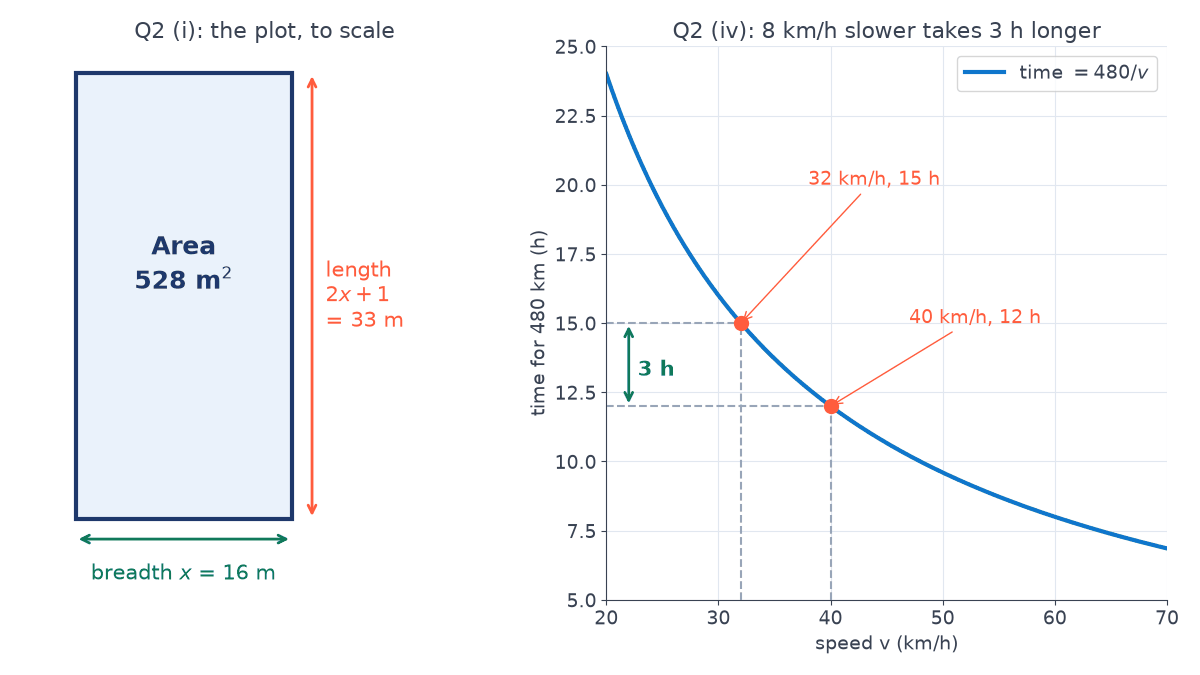
The area of a rec­tan­gu­lar plot is 528 m². The length of the plot (in metres) is one more than twice its breadth. We need to find the length and breadth of the plot.

Solu­tion. Let the breadth of the plot be xx m. Then the length is (2x+1)(2x + 1) m. Since area = length × breadth,

x(2x+1)=5282x2+x−528=0\begin{aligned} x(2x + 1) &= 528 \\ 2x^2 + x - 528 &= 0 \end{aligned}

Answer: 2x2+x−528=02x^2 + x - 528 = 0, where xx m is the breadth.

Going fur­ther. We need two num­bers with prod­uct 2×(−528)=−10562 \times (-528) = -1056 and sum 11. These are 3333 and −32-32. Split­ting the mid­dle term:

2x2+33x−32x−528=0x(2x+33)−16(2x+33)=0(2x+33)(x−16)=0\begin{aligned} 2x^2 + 33x - 32x - 528 &= 0 \\ x(2x + 33) - 16(2x + 33) &= 0 \\ (2x + 33)(x - 16) &= 0 \end{aligned}

So x=16x = 16 or x=−332\displaystyle x = -\frac{33}{2}. A breadth can­not be neg­a­tive, so the breadth is 16 m and the length is 2(16)+1=332(16) + 1 = 33 m. Check: 16×33=52816 \times 33 = 528 m², and 33 is one more than twice 16.

Left: rectangle drawn to scale, breadth x = 16 m, length 2x + 1 = 33 m, area 528 square metres. Right: graph of time = 480/v marking 40 km/h at 12 h and 32 km/h at 15 h, a 3 h gap.
Ques­tion 2 (i) and (iv): the 16 m by 33 m plot, and the time–speed curve for 480 km show­ing that 8 km/h less (40 to 32 km/h) takes 3 hours more (12 h to 15 h).

Ques­tion 2 (ii)

The prod­uct of two con­sec­u­tive pos­i­tive inte­gers is 306. We need to find the inte­gers.

Solu­tion. Let the smaller inte­ger be xx. The next con­sec­u­tive inte­ger is x+1x + 1. Their prod­uct is 306:

x(x+1)=306x2+x−306=0\begin{aligned} x(x + 1) &= 306 \\ x^2 + x - 306 &= 0 \end{aligned}

Answer: x2+x−306=0x^2 + x - 306 = 0, where xx is the smaller inte­ger.

Going fur­ther. Two num­bers with prod­uct −306-306 and sum 11 are 1818 and −17-17.

x2+18x−17x−306=0x(x+18)−17(x+18)=0(x+18)(x−17)=0\begin{aligned} x^2 + 18x - 17x - 306 &= 0 \\ x(x + 18) - 17(x + 18) &= 0 \\ (x + 18)(x - 17) &= 0 \end{aligned}

So x=17x = 17 or x=−18x = -18. The inte­gers are pos­i­tive, so x=17x = 17 and the inte­gers are 17 and 18. Check: 17×18=30617 \times 18 = 306.

Ques­tion 2 (iii)

Rohan's mother is 26 years older than him. The prod­uct of their ages (in years) 3 years from now will be 360. We would like to find Rohan's present age.

Solu­tion. Let Rohan's present age be xx years. His moth­er's present age is (x+26)(x + 26) years. After 3 years, Rohan will be (x+3)(x + 3) years old and his mother (x+29)(x + 29) years old. Their prod­uct then is 360:

(x+3)(x+29)=360x2+29x+3x+87=360x2+32x−273=0\begin{aligned} (x + 3)(x + 29) &= 360 \\ x^2 + 29x + 3x + 87 &= 360 \\ x^2 + 32x - 273 &= 0 \end{aligned}

Answer: x2+32x−273=0x^2 + 32x - 273 = 0, where xx years is Rohan's present age.

Going fur­ther. Two num­bers with prod­uct −273-273 and sum 3232 are 3939 and −7-7.

x2+39x−7x−273=0x(x+39)−7(x+39)=0(x+39)(x−7)=0\begin{aligned} x^2 + 39x - 7x - 273 &= 0 \\ x(x + 39) - 7(x + 39) &= 0 \\ (x + 39)(x - 7) &= 0 \end{aligned}

So x=7x = 7 or x=−39x = -39. An age can­not be neg­a­tive, so Rohan is 7 years old and his mother is 33. Check: in 3 years they will be 10 and 36, and 10×36=36010 \times 36 = 360.

Ques­tion 2 (iv)

A train trav­els a dis­tance of 480 km at a uni­form speed. If the speed had been 8 km/h less, then it would have taken 3 hours more to cover the same dis­tance. We need to find the speed of the train.

Solu­tion. Let the speed of the train be xx km/h. Since time = dis­tance ÷ speed, the time taken is 480x\displaystyle \frac{480}{x} hours. At (x−8)(x - 8) km/h the time would be 480x−8\displaystyle \frac{480}{x - 8} hours, which is 3 hours more:

480x−8−480x=3\displaystyle \frac{480}{x - 8} - \frac{480}{x} = 3

Com­bine the frac­tions over the com­mon denom­i­na­tor x(x−8)x(x - 8):

480x−480(x−8)x(x−8)=33840x2−8x=33840=3x2−24x3x2−24x−3840=0\displaystyle \begin{aligned} \frac{480x - 480(x - 8)}{x(x - 8)} &= 3 \\ \frac{3840}{x^2 - 8x} &= 3 \\ 3840 &= 3x^2 - 24x \\ 3x^2 - 24x - 3840 &= 0 \end{aligned}

Divid­ing every term by 3:

x2−8x−1280=0x^2 - 8x - 1280 = 0

Answer: x2−8x−1280=0x^2 - 8x - 1280 = 0, where xx km/h is the speed of the train.

Going fur­ther. Two num­bers with prod­uct −1280-1280 and sum −8-8 are −40-40 and 3232.

x2−40x+32x−1280=0x(x−40)+32(x−40)=0(x−40)(x+32)=0\begin{aligned} x^2 - 40x + 32x - 1280 &= 0 \\ x(x - 40) + 32(x - 40) &= 0 \\ (x - 40)(x + 32) &= 0 \end{aligned}

So x=40x = 40 or x=−32x = -32. A speed can­not be neg­a­tive, so the speed is 40 km/h. Check: 48040=12\displaystyle \frac{480}{40} = 12 h and 48032=15\displaystyle \frac{480}{32} = 15 h, a dif­fer­ence of 3 h.

Why this works: mul­ti­ply­ing both sides by x(x−8)x(x - 8) is allowed because nei­ther xx nor x−8x - 8 can be zero for a real train speed, and it turns the frac­tional equa­tion into a qua­dratic one.

Key terms

Qua­dratic equa­tion
An equa­tion reducible to ax2+bx+c=0ax^2 + bx + c = 0 with real aa, bb, cc and a≠0a \neq 0.
Stan­dard form
The qua­dratic writ­ten with terms in descend­ing pow­ers of xx and 0 on the right-hand side.
Lin­ear equa­tion
An equa­tion whose high­est sur­viv­ing power of xx is 1, such as 7x−3=07x - 3 = 0.
Cubic equa­tion
An equa­tion whose high­est sur­viv­ing power of xx is 3.
Like terms
Terms with the same power of xx, which can be added or sub­tracted.
Con­sec­u­tive inte­gers
Inte­gers that fol­low one another, such as xx and x+1x + 1.
Uni­form speed
A con­stant speed, so that time equals dis­tance divided by speed.

Com­mon ques­tions

Do I have to solve the equa­tions in Ques­tion 2?

No. The ques­tion asks only to rep­re­sent each sit­u­a­tion as a qua­dratic equa­tion. Solv­ing them, as done above, is a use­ful check that your equa­tion is cor­rect.

Why can the x2x^2 terms can­cel?

When both sides con­tain x2x^2 with the same coef­fi­cient, sub­tract­ing one side from the other removes it. That is why (iii) and (vi) turn out to be lin­ear.

Can an equa­tion with x3x^3 be qua­dratic?

Yes, if the x3x^3 terms can­cel, as in (viii). If they do not can­cel, as in (vii), the equa­tion is cubic.

Why do we reject the neg­a­tive root in Ques­tion 2?

Breadths, ages and speeds can­not be neg­a­tive, so a neg­a­tive root does not fit the sit­u­a­tion, even though it sat­is­fies the equa­tion.

Is it wrong to keep 3x2−24x−3840=03x^2 - 24x - 3840 = 0 with­out divid­ing by 3?

No. It is an equiv­a­lent equa­tion with the same roots. Divid­ing by 3 sim­ply gives the sim­pler form x2−8x−1280=0x^2 - 8x - 1280 = 0.

Ref­er­ences

  1. National Coun­cil of Edu­ca­tional Research and Train­ing. Math­e­mat­ics: Text­book for Class X. NCERT, New Delhi.
  2. Aggar­wal, R. S. Sec­ondary School Math­e­mat­ics for Class 10. Bharati Bhawan.
  3. Sharma, R. D. Math­e­mat­ics for Class 10. Dhan­pat Rai Pub­li­ca­tions.