Factorisation is quick when you can spot the split, but spotting it is not always easy, and some quadratic equations have no real roots at all, so no split exists. The quadratic formula works for every quadratic equation without guesswork, and one part of it, the discriminant b 2 − 4 a c b^2 - 4ac b 2 − 4 a c
Statement#
For the quadratic equation a x 2 + b x + c = 0 ax^2 + bx + c = 0 a x 2 + b x + c = 0 a ≠ 0 a \neq 0 a = 0 b 2 − 4 a c ≥ 0 b^2 - 4ac \geq 0 b 2 − 4 a c ≥ 0
x = − b ± b 2 − 4 a c 2 a \displaystyle x = \frac{-b \pm \sqrt{b^2 - 4ac}}{2a} x = 2 a − b ± b 2 − 4 a c
The sign ± \pm ± + + + − - −
x = − b + b 2 − 4 a c 2 a and x = − b − b 2 − 4 a c 2 a \displaystyle x = \frac{-b + \sqrt{b^2 - 4ac}}{2a} \qquad \text{and} \qquad x = \frac{-b - \sqrt{b^2 - 4ac}}{2a} x = 2 a − b + b 2 − 4 a c and x = 2 a − b − b 2 − 4 a c
The formula comes from completing the square. Since a ≠ 0 a \neq 0 a = 0 a a a ( b 2 a ) 2 \displaystyle \left(\frac{b}{2a}\right)^2 ( 2 a b ) 2
a x 2 + b x + c = a [ x 2 + b a x + c a ] = a [ ( x + b 2 a ) 2 − b 2 4 a 2 + c a ] = a [ ( x + b 2 a ) 2 − b 2 − 4 a c 4 a 2 ] \displaystyle \begin{aligned} ax^2 + bx + c &= a\left[x^2 + \frac{b}{a}x + \frac{c}{a}\right] \\ &= a\left[\left(x + \frac{b}{2a}\right)^2 - \frac{b^2}{4a^2} + \frac{c}{a}\right] \\ &= a\left[\left(x + \frac{b}{2a}\right)^2 - \frac{b^2 - 4ac}{4a^2}\right] \end{aligned} a x 2 + b x + c = a [ x 2 + a b x + a c ] = a [ ( x + 2 a b ) 2 − 4 a 2 b 2 + a c ] = a [ ( x + 2 a b ) 2 − 4 a 2 b 2 − 4 a c ]
So a x 2 + b x + c = 0 ax^2 + bx + c = 0 a x 2 + b x + c = 0
( x + b 2 a ) 2 = b 2 − 4 a c 4 a 2 \displaystyle \left(x + \frac{b}{2a}\right)^2 = \frac{b^2 - 4ac}{4a^2} ( x + 2 a b ) 2 = 4 a 2 b 2 − 4 a c
The left-hand side is a square, so it is never negative, and 4 a 2 > 0 4a^2 \gt 0 4 a 2 > 0 b 2 − 4 a c ≥ 0 b^2 - 4ac \geq 0 b 2 − 4 a c ≥ 0
x + b 2 a = ± b 2 − 4 a c 2 a ⟹ x = − b ± b 2 − 4 a c 2 a \displaystyle x + \frac{b}{2a} = \pm\frac{\sqrt{b^2 - 4ac}}{2a} \implies x = \frac{-b \pm \sqrt{b^2 - 4ac}}{2a} x + 2 a b = ± 2 a b 2 − 4 a c ⟹ x = 2 a − b ± b 2 − 4 a c
If b 2 − 4 a c < 0 b^2 - 4ac \lt 0 b 2 − 4 a c < 0 x x x
The discriminant and the nature of roots#
Definition#
The number D = b 2 − 4 a c D = b^2 - 4ac D = b 2 − 4 a c discriminant of the quadratic equation a x 2 + b x + c = 0 ax^2 + bx + c = 0 a x 2 + b x + c = 0
The three cases#
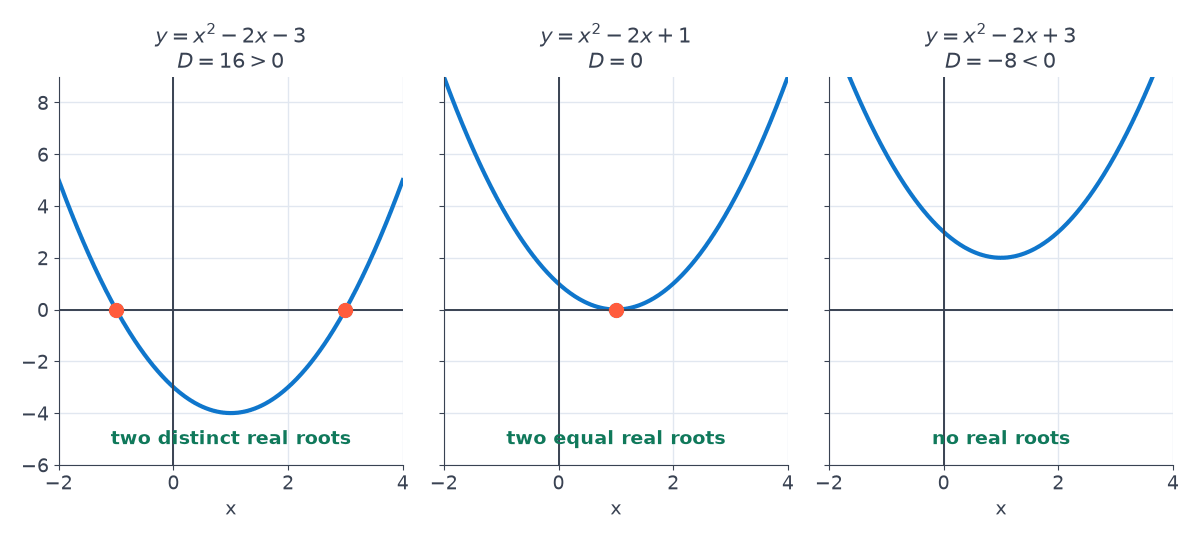
Case 1: D > 0 D \gt 0 D > 0 Then D \sqrt{D} D − b -b − b − b -b − b two distinct real roots , − b + D 2 a \displaystyle \frac{-b + \sqrt{D}}{2a} 2 a − b + D − b − D 2 a \displaystyle \frac{-b - \sqrt{D}}{2a} 2 a − b − D
Case 2: D = 0 D = 0 D = 0 Then D = 0 \sqrt{D} = 0 D = 0
x = − b 2 a \displaystyle x = -\frac{b}{2a} x = − 2 a b
The equation has two equal real roots . This is the repeated-root situation you met in the surd example of the factorisation lesson.
Case 3: D < 0 D \lt 0 D < 0 No real number has a negative square, so D \sqrt{D} D no real roots .
Summary#
A quadratic equation a x 2 + b x + c = 0 ax^2 + bx + c = 0 a x 2 + b x + c = 0
two distinct real roots, if b 2 − 4 a c > 0 b^2 - 4ac \gt 0 b 2 − 4 a c > 0
two equal real roots, if b 2 − 4 a c = 0 b^2 - 4ac = 0 b 2 − 4 a c = 0
no real roots, if b 2 − 4 a c < 0 b^2 - 4ac \lt 0 b 2 − 4 a c < 0
The sign of the discriminant decides how many times the graph of y = a x 2 + b x + c y = ax^2 + bx + c y = a x 2 + b x + c x x x
Write the equation in standard form and read off a a a b b b c c c
Compute D = b 2 − 4 a c D = b^2 - 4ac D = b 2 − 4 a c
Decide the nature of the roots from the sign of D D D
If D > 0 D \gt 0 D > 0 x = − b ± D 2 a \displaystyle x = \frac{-b \pm \sqrt{D}}{2a} x = 2 a − b ± D
If D = 0 D = 0 D = 0 x = − b 2 a \displaystyle x = -\frac{b}{2a} x = − 2 a b
If D < 0 D \lt 0 D < 0
Worked examples#
Example 1: checking for real roots#
Find the discriminant of 2 x 2 − 4 x + 3 = 0 2x^2 - 4x + 3 = 0 2 x 2 − 4 x + 3 = 0
Here a = 2 a = 2 a = 2 b = − 4 b = -4 b = − 4 c = 3 c = 3 c = 3
D = ( − 4 ) 2 − 4 ( 2 ) ( 3 ) = 16 − 24 = − 8 D = (-4)^2 - 4(2)(3) = 16 - 24 = -8 D = ( − 4 ) 2 − 4 ( 2 ) ( 3 ) = 16 − 24 = − 8
Answer: since D = − 8 < 0 D = -8 \lt 0 D = − 8 < 0
Solve 3 x 2 − 5 x + 2 = 0 3x^2 - 5x + 2 = 0 3 x 2 − 5 x + 2 = 0
Here a = 3 a = 3 a = 3 b = − 5 b = -5 b = − 5 c = 2 c = 2 c = 2 D = ( − 5 ) 2 − 4 ( 3 ) ( 2 ) = 25 − 24 = 1 > 0 D = (-5)^2 - 4(3)(2) = 25 - 24 = 1 \gt 0 D = ( − 5 ) 2 − 4 ( 3 ) ( 2 ) = 25 − 24 = 1 > 0
x = − ( − 5 ) ± 1 2 × 3 = 5 ± 1 6 \displaystyle x = \frac{-(-5) \pm \sqrt{1}}{2 \times 3} = \frac{5 \pm 1}{6} x = 2 × 3 − ( − 5 ) ± 1 = 6 5 ± 1
Answer: x = 6 6 = 1 \displaystyle x = \frac{6}{6} = 1 x = 6 6 = 1 x = 4 6 = 2 3 \displaystyle x = \frac{4}{6} = \frac{2}{3} x = 6 4 = 3 2
Example 3: two equal roots, found quickly#
Find the discriminant of 3 x 2 − 2 x + 1 3 = 0 \displaystyle 3x^2 - 2x + \frac{1}{3} = 0 3 x 2 − 2 x + 3 1 = 0
Here a = 3 a = 3 a = 3 b = − 2 b = -2 b = − 2 c = 1 3 \displaystyle c = \frac{1}{3} c = 3 1
D = ( − 2 ) 2 − 4 ( 3 ) ( 1 3 ) = 4 − 4 = 0 \displaystyle D = (-2)^2 - 4(3)\left(\frac{1}{3}\right) = 4 - 4 = 0 D = ( − 2 ) 2 − 4 ( 3 ) ( 3 1 ) = 4 − 4 = 0
So the roots are real and equal, each being
x = − b 2 a = 2 2 × 3 = 1 3 \displaystyle x = -\frac{b}{2a} = \frac{2}{2 \times 3} = \frac{1}{3} x = − 2 a b = 2 × 3 2 = 3 1
Answer: two equal real roots, 1 3 \displaystyle \frac{1}{3} 3 1 1 3 \displaystyle \frac{1}{3} 3 1
Example 4: finding an unknown coefficient#
Find the values of k k k x 2 − k x + 16 = 0 x^2 - kx + 16 = 0 x 2 − k x + 16 = 0
Here a = 1 a = 1 a = 1 b = − k b = -k b = − k c = 16 c = 16 c = 16 D = 0 D = 0 D = 0
( − k ) 2 − 4 ( 1 ) ( 16 ) = 0 ⟹ k 2 = 64 ⟹ k = ± 8 (-k)^2 - 4(1)(16) = 0 \implies k^2 = 64 \implies k = \pm 8 ( − k ) 2 − 4 ( 1 ) ( 16 ) = 0 ⟹ k 2 = 64 ⟹ k = ± 8
With k = 8 k = 8 k = 8 x 2 − 8 x + 16 = ( x − 4 ) 2 = 0 x^2 - 8x + 16 = (x - 4)^2 = 0 x 2 − 8 x + 16 = ( x − 4 ) 2 = 0 k = − 8 k = -8 k = − 8 ( x + 4 ) 2 = 0 (x + 4)^2 = 0 ( x + 4 ) 2 = 0 − 4 -4 − 4 − 4 -4 − 4
Answer: k = 8 k = 8 k = 8 k = − 8 k = -8 k = − 8 − 4 -4 − 4 − 4 -4 − 4
Example 5: a pole on the boundary of a circular park#
Is it possible to design a circular park of diameter 13 m with a pole on its boundary such that the difference of its distances from two diametrically opposite fixed gates A A A B B B
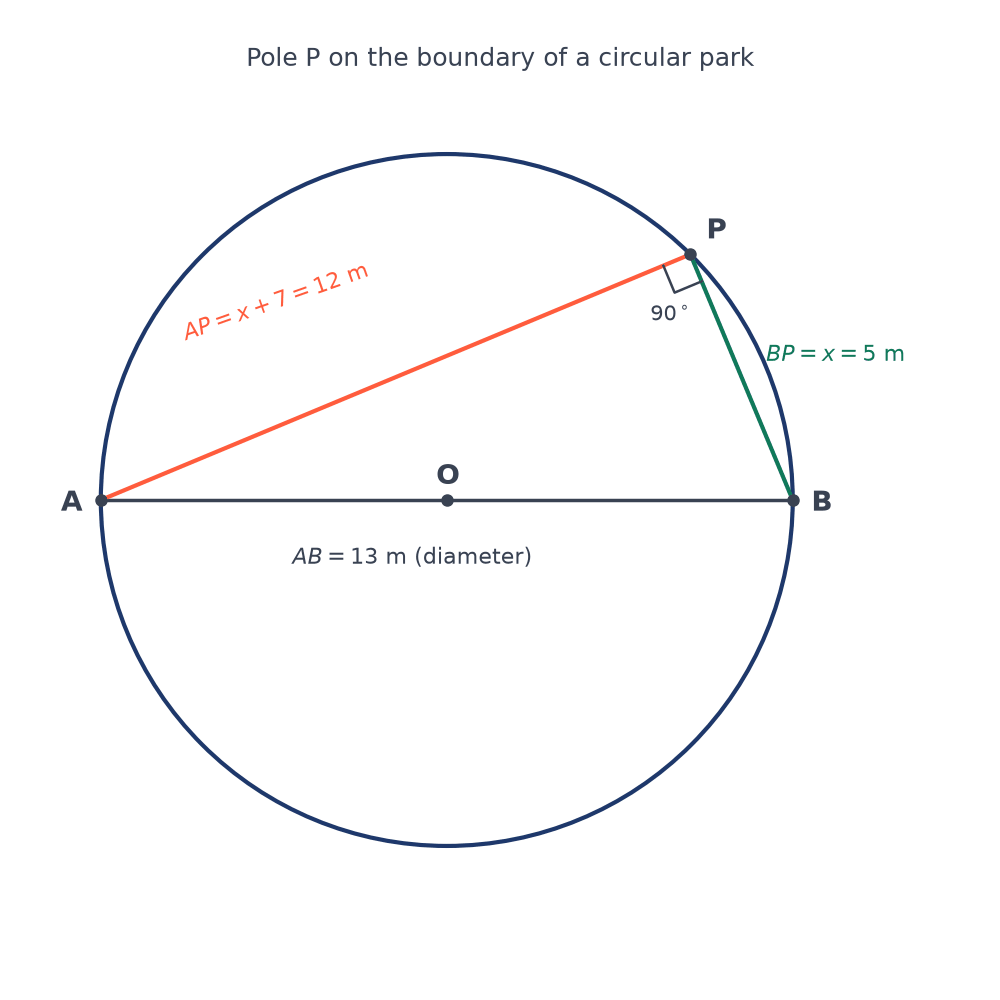
Let P P P B P = x BP = x B P = x A P = ( x + 7 ) AP = (x + 7) A P = ( x + 7 ) A B AB A B ∠ A P B = 90 ∘ \angle APB = 90^\circ ∠ A P B = 9 0 ∘ △ A P B \triangle APB △ A P B
A P 2 + B P 2 = A B 2 ( x + 7 ) 2 + x 2 = 13 2 x 2 + 14 x + 49 + x 2 = 169 2 x 2 + 14 x − 120 = 0 x 2 + 7 x − 60 = 0 \begin{aligned} AP^2 + BP^2 &= AB^2 \\ (x + 7)^2 + x^2 &= 13^2 \\ x^2 + 14x + 49 + x^2 &= 169 \\ 2x^2 + 14x - 120 &= 0 \\ x^2 + 7x - 60 &= 0 \end{aligned} A P 2 + B P 2 ( x + 7 ) 2 + x 2 x 2 + 14 x + 49 + x 2 2 x 2 + 14 x − 120 x 2 + 7 x − 60 = A B 2 = 1 3 2 = 169 = 0 = 0
Before solving, check whether real roots exist. Here a = 1 a = 1 a = 1 b = 7 b = 7 b = 7 c = − 60 c = -60 c = − 60
D = 7 2 − 4 ( 1 ) ( − 60 ) = 49 + 240 = 289 > 0 D = 7^2 - 4(1)(-60) = 49 + 240 = 289 \gt 0 D = 7 2 − 4 ( 1 ) ( − 60 ) = 49 + 240 = 289 > 0
So the equation has two real roots and the design is possible. By the formula, with 289 = 17 \sqrt{289} = 17 289 = 17
x = − 7 ± 17 2 ⟹ x = 5 or x = − 12 \displaystyle x = \frac{-7 \pm 17}{2} \implies x = 5 \ \text{or} \ x = -12 x = 2 − 7 ± 17 ⟹ x = 5 or x = − 12
A distance cannot be negative, so x = 5 x = 5 x = 5
Answer: yes, it is possible. The pole should be 5 m from gate B B B 5 + 7 = 12 5 + 7 = 12 5 + 7 = 12 A A A 5 2 + 12 2 = 25 + 144 = 169 = 13 2 5^2 + 12^2 = 25 + 144 = 169 = 13^2 5 2 + 1 2 2 = 25 + 144 = 169 = 1 3 2
Example 5 drawn to scale: the angle at P P P A B AB A B A P 2 + B P 2 = 13 2 AP^2 + BP^2 = 13^2 A P 2 + B P 2 = 1 3 2 Common mistakes#
Writing b 2 b^2 b 2 − b 2 -b^2 − b 2 b b b b = − 4 b = -4 b = − 4 b 2 = ( − 4 ) 2 = 16 b^2 = (-4)^2 = 16 b 2 = ( − 4 ) 2 = 16 − 16 -16 − 16
Reading a a a b b b c c c
Dividing only D \sqrt{D} D 2 a 2a 2 a − b ± D -b \pm \sqrt{D} − b ± D
Forgetting the minus sign in − b -b − b b = − 5 b = -5 b = − 5 − b = 5 -b = 5 − b = 5
Saying "no roots" when D < 0 D \lt 0 D < 0 real roots".
Accepting k = 0 k = 0 k = 0 x 2 x^2 x 2
Try these#
Find the nature of the roots of 2 x 2 − 7 x + 3 = 0 2x^2 - 7x + 3 = 0 2 x 2 − 7 x + 3 = 0 Answer: D = 25 > 0 D = 25 \gt 0 D = 25 > 0 x = 3 x = 3 x = 3 x = 1 2 \displaystyle x = \frac{1}{2} x = 2 1
Find the nature of the roots of x 2 + 4 x + 5 = 0 x^2 + 4x + 5 = 0 x 2 + 4 x + 5 = 0 Answer: D = − 4 < 0 D = -4 \lt 0 D = − 4 < 0
Find the nature of the roots of 4 x 2 − 12 x + 9 = 0 4x^2 - 12x + 9 = 0 4 x 2 − 12 x + 9 = 0 Answer: D = 0 D = 0 D = 0 3 2 \displaystyle \frac{3}{2} 2 3 3 2 \displaystyle \frac{3}{2} 2 3
Solve x 2 − 2 x − 1 = 0 x^2 - 2x - 1 = 0 x 2 − 2 x − 1 = 0 Answer: x = 1 + 2 x = 1 + \sqrt{2} x = 1 + 2 x = 1 − 2 x = 1 - \sqrt{2} x = 1 − 2
Find k k k x 2 − k x + 9 = 0 x^2 - kx + 9 = 0 x 2 − k x + 9 = 0 Answer: k = 6 k = 6 k = 6 k = − 6 k = -6 k = − 6
Key terms#
Quadratic formula
x = − b ± b 2 − 4 a c 2 a \displaystyle x = \frac{-b \pm \sqrt{b^2 - 4ac}}{2a} x = 2 a − b ± b 2 − 4 a c a x 2 + b x + c = 0 ax^2 + bx + c = 0 a x 2 + b x + c = 0 b 2 − 4 a c ≥ 0 b^2 - 4ac \geq 0 b 2 − 4 a c ≥ 0 Discriminant
The number D = b 2 − 4 a c D = b^2 - 4ac D = b 2 − 4 a c
Nature of roots
Whether the roots are real and distinct, real and equal, or not real.
Distinct real roots
Two different real roots, occurring when D > 0 D \gt 0 D > 0
Equal roots
Two identical real roots, each − b 2 a \displaystyle -\frac{b}{2a} − 2 a b D = 0 D = 0 D = 0
Completing the square
Rewriting x 2 + p x x^2 + px x 2 + p x ( x + p 2 ) 2 − p 2 4 \displaystyle \left(x + \frac{p}{2}\right)^2 - \frac{p^2}{4} ( x + 2 p ) 2 − 4 p 2
Angle in a semicircle
The angle subtended by a diameter at any point of the circle, which is always 90 ∘ 90^\circ 9 0 ∘
Common questions#
Use factorisation when the split is easy to see; it is faster. Use the formula when it is not, or when the roots involve surds. Both give the same roots.
Does D < 0 D \lt 0 D < 0 #
Not necessarily. Some equations genuinely have no real roots. Recheck a a a b b b c c c D D D
If D D D #
When a a a b b b c c c D D D
Why is the discriminant useful in word problems?#
It answers "is this possible?" directly. A negative discriminant means no real length, age or distance can satisfy the conditions.
Why are the equal roots − b 2 a \displaystyle -\frac{b}{2a} − 2 a b #
When D = 0 D = 0 D = 0 ± D \pm\sqrt{D} ± D x = − b 2 a \displaystyle x = \frac{-b}{2a} x = 2 a − b
References#
National Council of Educational Research and Training. Mathematics: Textbook for Class X . NCERT, New Delhi.
Hall, H. S. and Knight, S. R. Higher Algebra . Macmillan.
Stewart, J., Redlin, L. and Watson, S. Precalculus: Mathematics for Calculus . Cengage Learning.