Heights and Distances: Problems with Two Angles of Elevation
By Ravindra Reddy K
·10 min read
Solve heights and distances problems with two angles of elevation: a flagstaff on a building, a shadow that lengthens as the sun sinks, an observer walking towards a tower and a statue on a pedestal.
In the previous lesson every problem gave one right triangle and one known angle, and that was enough to find the one unknown. Real situations are often richer. Standing at one spot, you might measure the angle of elevation of the top of a building and the angle of elevation of the top of a flag flying above it. Or you might measure the same tower's shadow at two different times of day. Either way you get two right triangles that share a side, and two unknowns instead of one. This lesson shows how to link the two triangles, using the NCERT Class 10 examples from Chapter 9 and a few more of the same type that appear often in board examinations.
A two-angle problem has two right triangles drawn on the same figure. Each triangle on its own has too little information, but the two triangles always have something in common: a side they both use, such as the horizontal distance from a fixed observer, or a length that does not change, such as the height of a tower.
If a vertical object of height h is seen from a point at horizontal distance d with angle of elevation θ, then
h=dtanθandd=hcotθ
Writing one such equation for each triangle gives two equations. Because they share a quantity, the equations can be combined (by substitution or by equating) to find both unknowns.
Each triangle is right-angled at the foot of the vertical object, so tan of the known angle is fixed by the shape of that triangle. The shared side is literally the same segment in both triangles, so its length must satisfy both equations at once. Two independent equations in two unknowns can be solved, just as in a pair of linear equations.
Draw one figure containing both lines of sight. Name every point.
Identify the two right triangles and the side or length they share.
Let the unknown lengths be letters such as x and h.
Write one trigonometric equation for each triangle, using tan (height and horizontal distance).
If one triangle has a known side, solve it first and carry the result into the second. Otherwise equate the two expressions for the shared quantity.
Rationalise any denominator, give the exact answer, then a decimal if asked.
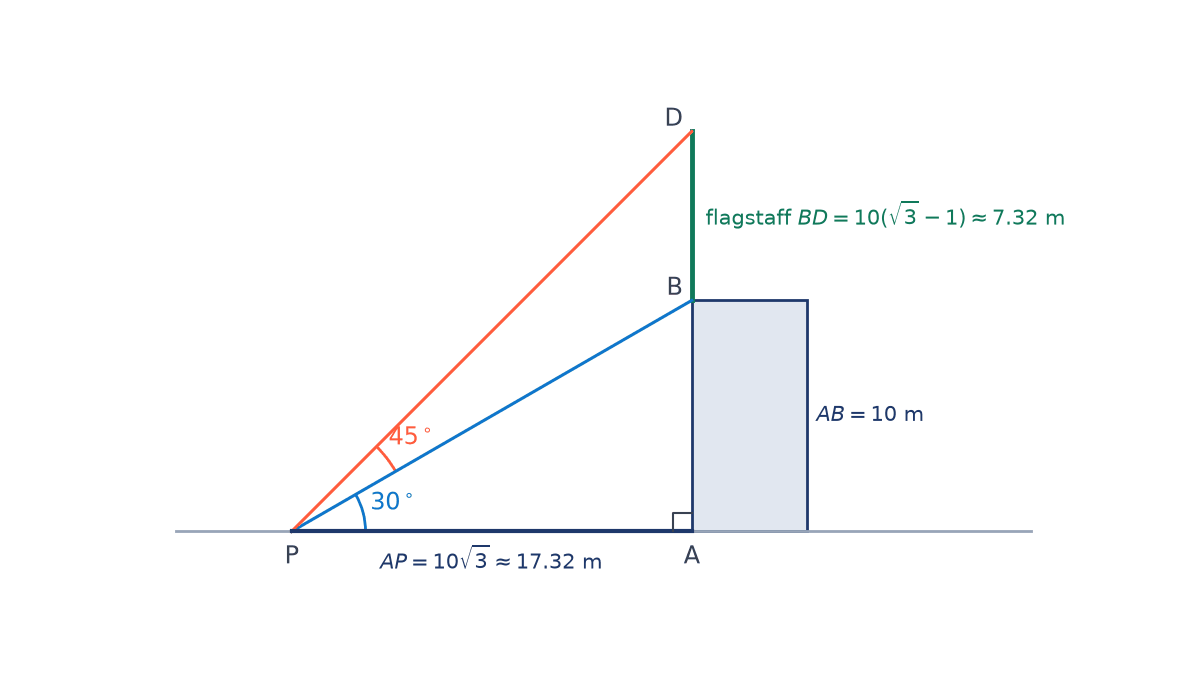
From a point P on the ground, the angle of elevation of the top of a 10 m tall building is 30∘. A flag is hoisted at the top of the building, and the angle of elevation of the top of the flagstaff from P is 45∘. Find the length of the flagstaff and the distance of the building from P. (Take 3=1.732.)
Let A be the foot of the building, B its top and D the top of the flagstaff, so AB=10 m and BD is the flagstaff. The two right triangles PAB (angle 30∘) and PAD (angle 45∘) share the side AP.
Step 1: solve the triangle with a known side. In triangle PAB, AB=10 m is opposite 30∘ and AP is adjacent:
tan30∘=APAB⇒31=AP10⇒AP=103 m≈17.32 m
Step 2: use the second triangle. Let BD=x m, so AD=10+x. In triangle PAD:
tan45∘=APAD⇒1=10310+x⇒10+x=103
x=103−10=10(3−1)=10×0.732=7.32 m
Example 1 to scale: both triangles share the base AP=103 m.
Answer: the flagstaff is 10(3−1)≈7.32 m long, and the building is 103≈17.32 m from P.
Why this works:P never moves, so the horizontal distance AP is the same in both triangles; only the angle changes as we look higher.
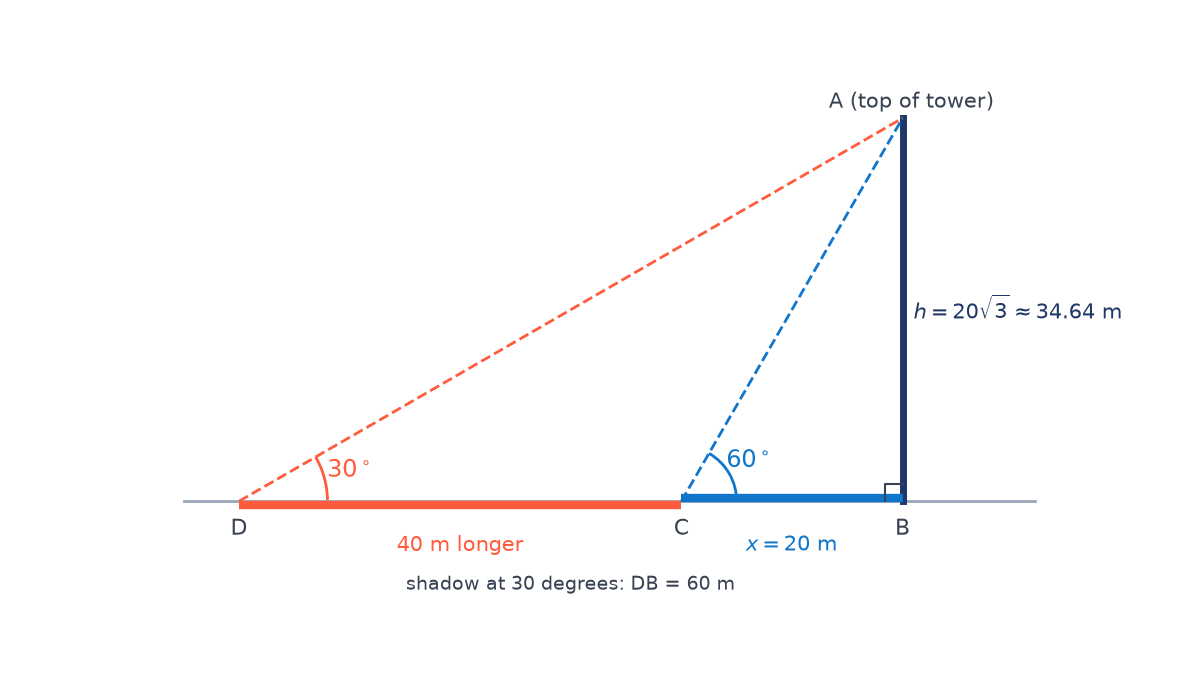
The shadow of a tower standing on level ground is found to be 40 m longer when the sun's altitude is 30∘ than when it is 60∘. Find the height of the tower.
This time the observer is not fixed. The two triangles come from the same tower at two different times of day. The sun's altitude is the angle of elevation of the sun, which is the angle at the tip of the shadow. When the sun is higher (60∘) the shadow is shorter; when it sinks to 30∘ the shadow is longer. What stays the same is the height of the tower.
Let AB=h m be the tower, BC=x m the shadow at 60∘, and BD=(x+40) m the shadow at 30∘.
Triangle ABC (sun at 60∘):
tan60∘=xh⇒h=3x(1)
Triangle ABD (sun at 30∘):
tan30∘=x+40h⇒h=3x+40(2)
Both equations describe the same h, so equate them and multiply by 3:
3x3x2xx=3x+40=x+40=40=20
Substitute in (1):
h=203 m≈34.64 m
Check with (2): 320+40=360=203, which agrees.
Example 2 to scale: the shadow grows from 20 m to 60 m as the sun's altitude falls from 60∘ to 30∘.
From a point on level ground, the angle of elevation of the top of a tower is 30∘. After walking 20 m towards the tower, the angle of elevation becomes 60∘. Find the height of the tower and the distance of the second point from the tower.
This is the shadow problem in a different costume. Let the height be h and the distance of the nearer point be x, so the farther point is (x+20) m away.
tan60∘=xh⇒h=3x,tan30∘=x+20h⇒h=3x+20
Equating: 3x=x+20, so x=10 and h=103.
Answer: the tower is 103≈17.32 m tall, and the second point is 10 m from its foot.
Why this works: for 30∘ and 60∘ the far distance is always three times the near one (since cot30∘=3cot60∘), so the 20 m walked is twice the near distance.
A statue 1.6 m tall stands on top of a pedestal. From a point on the ground, the angle of elevation of the top of the statue is 60∘ and from the same point the angle of elevation of the top of the pedestal is 45∘. Find the height of the pedestal.
Let the pedestal have height h and let the point be d m from its foot. The two triangles share d.
Each of these problems seemed to have too little information: two unknowns and only one triangle's worth of numbers at a time. The way through was always the same. Find a quantity that stays fixed across both triangles (the distance AP for the flagstaff, the height h for the shadow and the walking observer, the distance d for the pedestal), write an equation for it from each triangle, and combine the two. In the next lesson the same idea appears with angles of depression, where the observer is high up and looks down at two points or two structures.
From a point on the ground, the angles of elevation of the bottom and top of a transmission tower fixed on top of a 20 m high building are 45∘ and 60∘. Find the height of the tower. Answer:20(3−1)≈14.64 m.
The shadow of a pole is 20 m longer when the sun's altitude is 30∘ than when it is 60∘. Find the height of the pole. Answer:103≈17.32 m.
The angle of elevation of the top of a tower changes from 30∘ to 60∘ as an observer walks 50 m towards it. Find the height of the tower. Answer:253≈43.30 m.
The angle of elevation of the top of a tower changes from 45∘ to 60∘ as an observer walks 10 m towards it. Find the height of the tower. Answer:5(3+3)≈23.66 m.
A tower's shadow is 3 times its height. Find the sun's altitude. Answer:30∘.
Start with the triangle that has a known side as well as a known angle. In the flagstaff problem that is triangle PAB, where AB=10 m. If neither triangle has a known side, write both equations and equate the shared quantity.
Why does the shadow get longer when the sun is lower?#
For a fixed height h, the shadow is hcotθ. As the altitude θ decreases from 60∘ to 30∘, cotθ increases from 31 to 3, so the shadow becomes three times as long.