An externality is a cost or benefit that falls on someone outside a transaction. Here are positive and negative production and consumption externalities, and how they are corrected.
Whenever an economic agent or party is involved in some activity, such as consuming a good or a service, there may be potential costs and benefits incurred by other parties which were not present in a transaction. These are called externalities. If there are benefits that the third party incurs, then it is called a positive externality. However, if there are costs that the third party incurs, then it is called a negative externality.
Externalities are indirect costs or benefits that a third party incurs. These costs or benefits arise from another party’s activity such as consumption.
Externalities do not belong in the market where they can be bought or sold, which results in the missing market. Externalities are hard to measure in money terms, and different people judge the outcomes of their social costs and benefits differently.
Firms can cause externalities when producing goods that will be sold in the market. This is known as production externalities.
Individuals can also produce externalities when consuming goods. We refer to these externalities as consumption externalities. These can be both negative and positive externalities.
A positive externality is an indirect benefit that a third party incurs from another party’s production or consumption of a good. With a positive externality, the social benefit of producing or consuming a good is greater than the private benefit.
Positive externalities have numerous causes. For example, consumption of education causes positive externalities. An individual not only will receive private benefits such as being more knowledgeable and getting a better and higher-paying job. They will also be able to educate other people, commit fewer crimes, and pay more tax to the government.
A negative externality is an indirect cost that a third party incurs from another party's production or consumption of a good. With a negative externality, the social cost is higher than the private cost.
Negative externalities also have numerous causes. For example, the pollution created during the production of goods causes negative externalities. It negatively affects the communities that live nearby, causing certain health problems to individuals due to the bad quality of the air and water.
There are four main types of externalities: positive production, positive consumption, negative production, and negative consumption.
Negative production externalities are indirect costs that a third party incurs from another party’s good production.
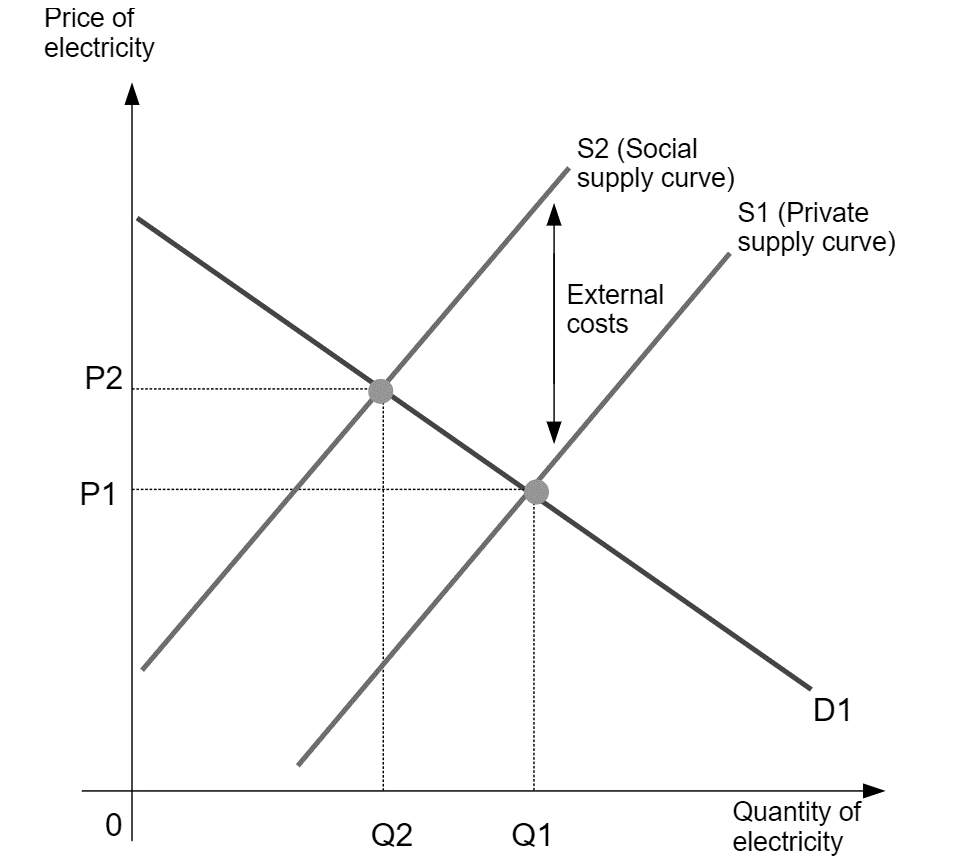
Negative production externalities can occur in the form of pollution released into the atmosphere due to the business’s course of production. For example, a firm releases pollution into the environment by producing electricity. The pollution produced by the firm is an external cost to individuals. This is because the price they pay doesn’t reflect the true costs, which involve a polluted environment and even health problems. The price only reflects the production costs. Under-pricing of electricity encourages its over-consumption, which in turn causes over-production of electricity and pollution.
This situation is illustrated in the figure. The supply curve S1 represents the negative production externalities caused by over-production and over-consumption of electricity as price P1 is set only in consideration to private costs and benefits. This results in quantity consumed of Q1, and reaching only private equilibrium.
On the other hand, the S2 supply curve represents the price P2 set considering the social costs and benefits. This reflects on the lower quantity consumed of Q2, and it encourages reaching social equilibrium.
The price may have increased due to the government regulations, such as an environmental tax, which causes the price of electricity to increase and the electricity usage to decrease.
Positive production externalities are indirect benefits that a third party incurs from another party’s good production.
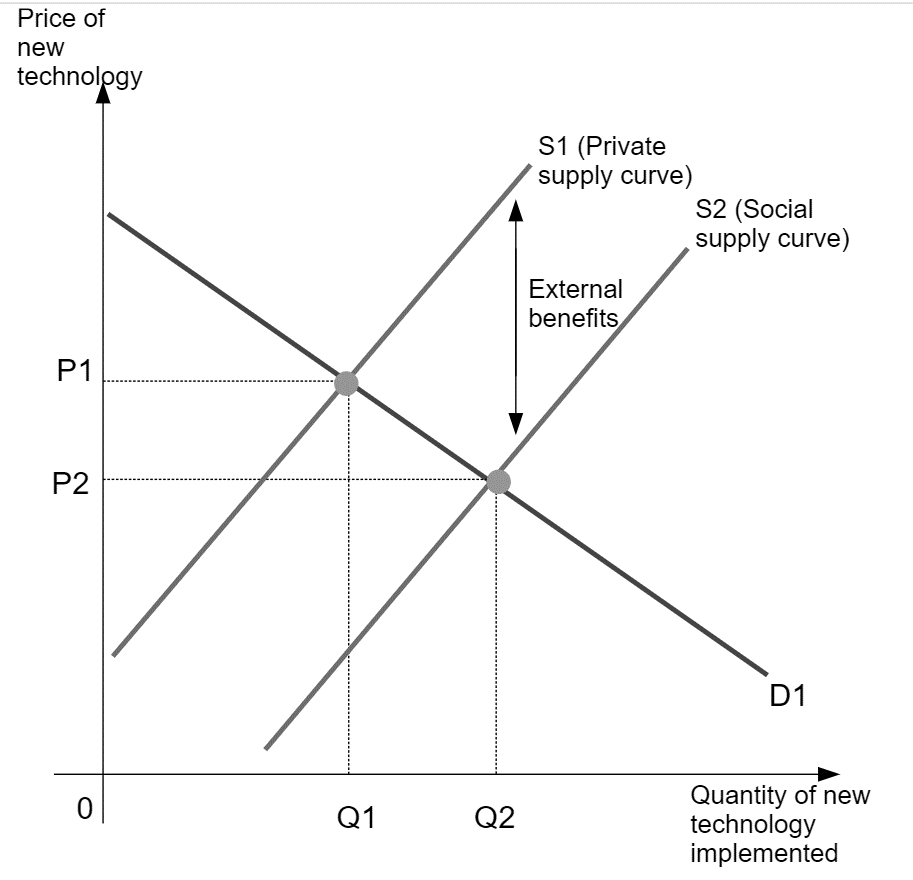
Positive production externalities can occur if a business develops a new technology that other companies can implement, improve their efficiency, and make the production process more environmentally friendly. If other companies implement this technology, they can sell their goods for a lower price to consumers, produce less pollution, and generate more profit.
The figure below illustrates positive production externalities for the implementation of a new technology.
Supply curve S1 represents the situation when we only consider the private benefits of implementing new technology such as firms generating more profit. In this case, the price of the new technology stays at P1 and the quantity at Q1, which results in under-consumption and under-production of the new technology, and only reaching private equilibrium.
On the other hand, supply curve S2 represents a situation where we consider the social benefits. For instance, companies can decrease pollution in the environment and make products more affordable for consumers by using a new technology. That will encourage the price to fall to P2, and the number of firms using new technology will increase to Q2, thus resulting in social equilibrium.
The government can encourage new technology's price to fall by giving financial incentives to businesses that produce it. That way, it will be more affordable for other businesses to implement the technology.
Consumption externalities are impacts on third parties generated by the consumption of a good or service. These can be negative or positive.
A negative consumption externality is an indirect cost that a third party incurs from another party’s good consumption.
When an individual’s consumption of goods or services negatively affects others, negative consumption externalities can arise. An example of this externality is the unpleasant experience we’ve all probably had at the cinema when someone’s phone rings or people talk loudly to each other.
A positive consumption externality is an indirect benefit that a third party incurs from another party’s good consumption.
Positive consumption externalities can arise when consuming a good or service generates benefits to other individuals. For example, wearing a mask during the Covid-19 pandemic to prevent the spread of an infectious disease. This benefit is not only limited to protecting an individual but also helps to protect others from catching the disease. However, not all people are aware of those benefits. Therefore, masks are not consumed enough unless they are made mandatory. This leads to an under-production of masks in a free market.
How do externalities affect a good’s or service’s production and consumption quantities?#
As we have seen before, externalities are indirect costs or benefits that a third party incurs that arise due to another party’s production or consumption(C) of goods and services. Those external effects are usually not considered in the pricing of the products or services. This encourages goods to be produced or consumed in the wrong quantity.
Negative externalities, for instance, can lead to over-production and consumption of certain goods. An example would be how firms don’t consider the pollution produced by their manufacturing process in the price of their products. This causes them to sell the product at too low a price, encouraging its over-consumption and over-production.
On the other hand, the goods that generate positive externalities are under-produced and under-consumed. This is because their benefits to others are not reflected in the price, and buyers are often unaware of them, so demand is lower than it should be and too little is produced.
Let’s look at an example of how the absence of property rights(PR) leads to both production and consumption externalities as well as market failure.
First, we should remember that market failure may occur if property rights are not clearly established. An individual’s lack of property ownership means that they can’t control the consumption or production of externalities.
For example, negative externalities such as the pollution caused by businesses in a neighborhood may lower the properties’ prices and cause health problems for residents. The third parties don’t own the air in the neighborhood, therefore they can’t control the air pollution and production of negative externalities.
Internalizing externalities means making changes in the market so that individuals are aware of all the costs and benefits they receive from externalities.
The objective of internalizing externalities is to change the behavior of individuals and businesses so that negative externalities decrease and positive ones increase. The goal is to make private costs or benefits equal to the social costs or benefits. We can achieve this by raising the prices of certain products and services to reflect the costs that individuals and unrelated third parties experience. Alternatively, the prices of products and services that bring benefits to individuals can be lowered to increase positive externalities.
Now let's look at the methods that governments and firms use to internalize externalities:
The consumption of demerit goods such as cigarettes and alcohol produces negative externalities. For example, in addition to harming their own health by smoking, individuals can also negatively affect third parties because smoke harms those around them. The government can internalise these externalities by taxing those demerit goods to decrease their consumption. They would also reflect the external costs that third parties experience in their price.
Raising prices of goods that produce negative externalities#
To internalise the negative production externality such as pollution, businesses can raise the price of their products to reduce their consumption. This would reflect the costs that third parties experience in the products’ prices.
Property rights are commonly identified as a right to own or possess something, such as land or an automobile, and to be able to dispose of it as one chooses.
Activities that bring benefits to third parties cause positive externalities. For example, the consumption of education. It not only benefits the individual but also other people. An educated individual will be able to educate other people, commit fewer crimes, get a higher-paying job, and pay more taxes to the government.
One of the methods that we can use to control externalities is the internalization of externalities. For example, the methods will include government tax and raising prices of demerit goods so that fewer negative externalities are produced.
Activities that bring costs to third parties cause negative externalities. For example, the pollution produced by firms causes negative externalities as it negatively affects communities by causing them certain health problems.