An exponent is a short way of writing repeated multiplication. Instead of we write , which equals 1024. Exponents appear wherever quantities grow or shrink by the same factor again and again: compound interest, population growth, scientific notation for very large and very small numbers, and the prime factorisations you will use in Class 10. Behind the large numbers sits a small set of rules. Once you know them, and why they work, you can simplify long expressions in a few lines.
What exactly is an exponent?
Base and exponent
An exponent tells you how many times to multiply a number, the base, by itself. In the expression :
- is the base;
- is the exponent (also called the power or index).
For a positive integer ,
So is not . It is , which equals .
Reading powers aloud
is read " squared", is " cubed", and is " to the power ". Note that , while : the exponent applies only to what sits directly below it.
The core exponent laws
The laws below hold for any non-zero bases and . We first see why each is true for positive whole-number exponents, where we can simply count factors. The definitions of zero, negative and fractional exponents later in the lesson are chosen so that the same laws keep working.
1. The product rule
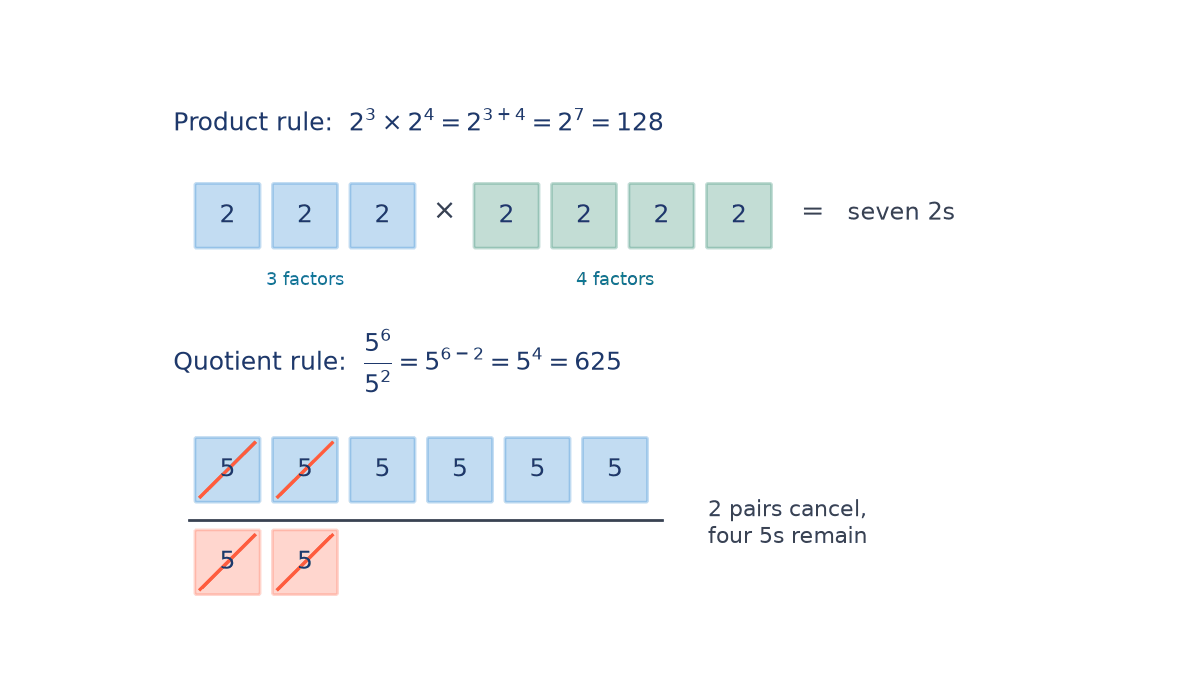
When you multiply two powers with the same base, add the exponents.
Why it works: contributes factors of and contributes more, so the product has factors of .
Example: .
2. The quotient rule
When you divide two powers with the same base, subtract the exponent of the denominator from the exponent of the numerator.
Why it works: each factor in the denominator cancels one factor in the numerator, so of the factors disappear.
Example: .
3. The power of a power rule
When a power is raised to another power, multiply the exponents.
Why it works: is copies of multiplied together, and each copy has factors, giving factors in all.
Example: .
Handling different bases and brackets
Sometimes the base is a product or a quotient. The power then applies to each part.
4. The power of a product rule
Why it works: with brackets. Rearranging gives factors of and factors of .
Example: .
5. The power of a quotient rule
Example: .
The special cases: zero and negative exponents
These are the rules that most often cause mistakes in exams, yet they follow directly from the quotient rule.
6. The zero exponent rule
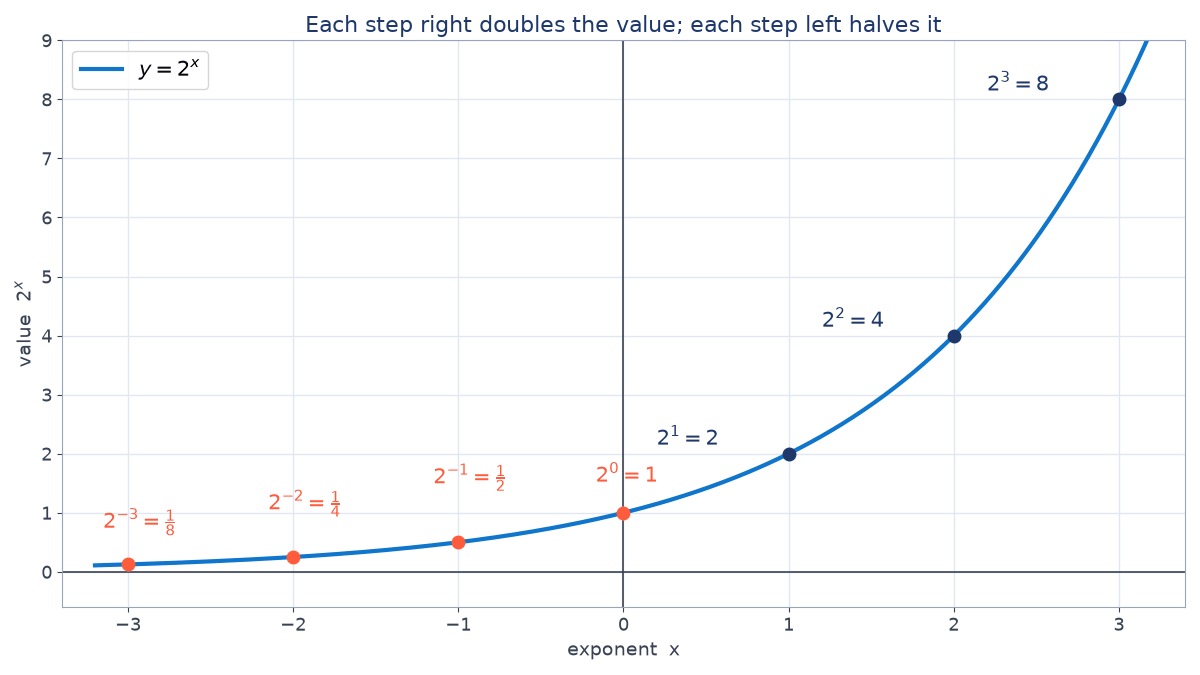
Any non-zero base raised to the power zero equals 1.
Why: by the quotient rule, . But any non-zero number divided by itself is 1, so must be 1. The expression is left undefined in school mathematics.
7. The negative exponent rule
A negative exponent means "take the reciprocal".
Why: , and .
Example: . A useful consequence is .
Fractional (rational) exponents
8. The rational exponent rule
When the exponent is a fraction, it describes a root. The denominator of the fraction is the index of the root. For a positive base ,
Why: by the power of a power rule, . So is the number whose th power is , which is exactly .
Example: .
Example: .
Taking the root first, as here, keeps the numbers small.
A method for simplifying any expression
- Write every number as a power of a prime (for example , , ).
- Remove brackets using the power of a product, power of a quotient and power of a power rules.
- Collect powers of the same base using the product and quotient rules.
- Turn any negative exponents into reciprocals at the end, and evaluate.
Worked examples
Example 1: combining rules with one base
Simplify .
Example 2: algebraic bases
Simplify .
Example 3: a negative fractional exponent
Evaluate .
Example 4: negative exponents inside a sum
Evaluate . The laws do not apply to a sum, so work out the bracket first.
Example 5: mixed bases
Evaluate .
Example 6: solving for an unknown exponent
Solve .
Write 32 as a power of 2: . If two powers of the same base (other than 0, 1 or ) are equal, their exponents are equal.
Summary table for quick reference
| Rule | Formula | Example |
|---|---|---|
| Product | ||
| Quotient | ||
| Power of a power | ||
| Power of a product | ||
| Power of a quotient | ||
| Zero power | ||
| Negative power | ||
| Fractional power |
Common mistakes
- Using the laws when the bases are different. is not ; work each power out separately: .
- Multiplying the base by the exponent: is , not .
- Adding exponents in a sum: , which is not . The product rule is for products only.
- Thinking a negative exponent makes a number negative: , which is positive.
- Writing . For any non-zero , .
- Forgetting brackets: but , and means , not .
Try these
- Simplify . Answer:
- Simplify . Answer:
- Evaluate . Answer:
- Evaluate . Answer:
- Solve . Answer:
- Evaluate . Answer:
Key terms
- Base
- The number or expression being multiplied repeatedly; in it is .
- Exponent (power, index)
- The number that says how many times the base is used as a factor; in it is .
- Power
- The whole expression , or its value.
- Reciprocal
- The number that multiplies with a given non-zero number to give 1; the reciprocal of is .
- Rational exponent
- An exponent that is a fraction, such as ; it combines a power and a root.
- th root
- For a positive number , the positive number whose th power is , written or .
- Exponential growth
- Growth by the same factor in each step, as in , described by powers such as .
Common questions
Why is any number to the power zero equal to 1?
Because the quotient rule must keep working. is 1 for any non-zero , and the quotient rule says it is also . So has to be 1.
Can I add exponents when the bases are different?
No. The product and quotient rules need the same base. If the exponents are equal you can combine the bases instead, as in .
What is the difference between and ?
is the reciprocal , while is the negative of . For example, but .
Should I take the root or the power first in ?
Both give the same answer for a positive base, but taking the root first keeps the numbers small: is easier than .
Where are exponents used in Class 10?
In the Real Numbers chapter, every number is written as a product of prime powers, and the HCF and LCM are found by comparing exponents. Exponents also appear in scientific notation and in compound interest.
References
- National Council of Educational Research and Training. Mathematics: Textbook for Class X. NCERT, New Delhi.
- Gelfand, I. M. and Shen, A. Algebra. Birkhäuser.
- Stewart, J., Redlin, L. and Watson, S. Precalculus: Mathematics for Calculus. Cengage Learning.