A complete guide to factorisation: the HCF of monomials, fifteen identities from common factors to the three-cube identity, worked examples of each, splitting the middle term, and dividing algebraic expressions.
Factorisation means writing an algebraic expression as a product of simpler expressions, called its factors. It is the reverse of expanding brackets: expanding turns 3 a b ( 4 a + 5 b ) 3ab(4a + 5b) 3 ab ( 4 a + 5 b ) 12 a 2 b + 15 a b 2 12a^2b + 15ab^2 12 a 2 b + 15 a b 2
Highest common factor (HCF) of monomials#
Definition#
The HCF of two or more monomials is the common factor with the greatest numerical coefficient and the highest power of each variable that divides all of them. In practice this means: the HCF of the coefficients, multiplied by every variable common to all the monomials, each raised to its smallest power.
Method#
Write each monomial as a product of prime numbers and variables.
Pick out the prime factors and variables that appear in every monomial.
For each one, take the lowest power that appears.
Multiply these together.
Worked examples#
Example 1. Find the HCF of 6 x 3 y 6x^3y 6 x 3 y 18 x 2 y 3 18x^2y^3 18 x 2 y 3
6 x 3 y = 2 × 3 × x 3 × y 18 x 2 y 3 = 2 × 3 2 × x 2 × y 3 HCF = 2 × 3 × x 2 × y = 6 x 2 y \begin{aligned} 6x^3y &= 2 \times 3 \times x^3 \times y \\ 18x^2y^3 &= 2 \times 3^2 \times x^2 \times y^3 \\ \text{HCF} &= 2 \times 3 \times x^2 \times y = 6x^2y \end{aligned} 6 x 3 y 18 x 2 y 3 HCF = 2 × 3 × x 3 × y = 2 × 3 2 × x 2 × y 3 = 2 × 3 × x 2 × y = 6 x 2 y
Example 2. Find the HCF of 5 x y 5xy 5 x y 10 x 10x 10 x
5 x y = 5 × x × y 10 x = 2 × 5 × x HCF = 5 × x = 5 x \begin{aligned} 5xy &= 5 \times x \times y \\ 10x &= 2 \times 5 \times x \\ \text{HCF} &= 5 \times x = 5x \end{aligned} 5 x y 10 x HCF = 5 × x × y = 2 × 5 × x = 5 × x = 5 x
The variable y y y 10 x 10x 10 x
Example 3. The HCF of 12 a 2 b 12a^2b 12 a 2 b 15 a b 2 15ab^2 15 a b 2 3 a b 3ab 3 ab 12 a 2 b = 2 2 × 3 × a 2 × b 12a^2b = 2^2 \times 3 \times a^2 \times b 12 a 2 b = 2 2 × 3 × a 2 × b 15 a b 2 = 3 × 5 × a × b 2 15ab^2 = 3 \times 5 \times a \times b^2 15 a b 2 = 3 × 5 × a × b 2 a a a b b b a 1 a^1 a 1 b 1 b^1 b 1
Example 4. The HCF of 2 x 2x 2 x 4 4 4 2 2 2 x x x
Example 5. The HCF of 12 x 12x 12 x 36 36 36 12 12 12 12 = 2 2 × 3 12 = 2^2 \times 3 12 = 2 2 × 3 36 = 2 2 × 3 2 36 = 2^2 \times 3^2 36 = 2 2 × 3 2
Example 6. The HCF of 14 p q 14pq 14 pq 35 p q r 35pqr 35 pq r 7 p q 7pq 7 pq HCF ( 14 , 35 ) = 7 \text{HCF}(14, 35) = 7 HCF ( 14 , 35 ) = 7 p p p q q q r r r
What factorisation is, and the fifteen identities#
Factorisation is the process of expressing an algebraic expression as a product of two or more factors. The methods and identities below are the tools for doing it. Each one is simply an expansion read from right to left.
Basic methods (common factor and grouping)#
a b + a c = a ( b + c ) ab + ac = a(b + c) ab + a c = a ( b + c ) a b − a c = a ( b − c ) ab - ac = a(b - c) ab − a c = a ( b − c ) a c + a d + b c + b d = ( a + b ) ( c + d ) ac + ad + bc + bd = (a + b)(c + d) a c + a d + b c + b d = ( a + b ) ( c + d )
Square-based identities#
a 2 − b 2 = ( a + b ) ( a − b ) a^2 - b^2 = (a + b)(a - b) a 2 − b 2 = ( a + b ) ( a − b ) a 2 + 2 a b + b 2 = ( a + b ) 2 a^2 + 2ab + b^2 = (a + b)^2 a 2 + 2 ab + b 2 = ( a + b ) 2 a 2 − 2 a b + b 2 = ( a − b ) 2 a^2 - 2ab + b^2 = (a - b)^2 a 2 − 2 ab + b 2 = ( a − b ) 2 x 2 + ( a + b ) x + a b = ( x + a ) ( x + b ) x^2 + (a + b)x + ab = (x + a)(x + b) x 2 + ( a + b ) x + ab = ( x + a ) ( x + b ) a 2 + b 2 + c 2 + 2 a b + 2 b c + 2 c a = ( a + b + c ) 2 a^2 + b^2 + c^2 + 2ab + 2bc + 2ca = (a + b + c)^2 a 2 + b 2 + c 2 + 2 ab + 2 b c + 2 c a = ( a + b + c ) 2 a 2 + b 2 + c 2 + 2 a b − 2 b c − 2 c a = ( a + b − c ) 2 a^2 + b^2 + c^2 + 2ab - 2bc - 2ca = (a + b - c)^2 a 2 + b 2 + c 2 + 2 ab − 2 b c − 2 c a = ( a + b − c ) 2
Cubic and advanced identities#
a 3 + 3 a 2 b + 3 a b 2 + b 3 = ( a + b ) 3 a^3 + 3a^2b + 3ab^2 + b^3 = (a + b)^3 a 3 + 3 a 2 b + 3 a b 2 + b 3 = ( a + b ) 3 a 3 − 3 a 2 b + 3 a b 2 − b 3 = ( a − b ) 3 a^3 - 3a^2b + 3ab^2 - b^3 = (a - b)^3 a 3 − 3 a 2 b + 3 a b 2 − b 3 = ( a − b ) 3 a 3 + b 3 = ( a + b ) ( a 2 − a b + b 2 ) a^3 + b^3 = (a + b)(a^2 - ab + b^2) a 3 + b 3 = ( a + b ) ( a 2 − ab + b 2 ) a 3 − b 3 = ( a − b ) ( a 2 + a b + b 2 ) a^3 - b^3 = (a - b)(a^2 + ab + b^2) a 3 − b 3 = ( a − b ) ( a 2 + ab + b 2 ) a 3 + b 3 + c 3 − 3 a b c = ( a + b + c ) ( a 2 + b 2 + c 2 − a b − b c − c a ) a^3 + b^3 + c^3 - 3abc = (a + b + c)(a^2 + b^2 + c^2 - ab - bc - ca) a 3 + b 3 + c 3 − 3 ab c = ( a + b + c ) ( a 2 + b 2 + c 2 − ab − b c − c a ) If a + b + c = 0 a + b + c = 0 a + b + c = 0 a 3 + b 3 + c 3 = 3 a b c a^3 + b^3 + c^3 = 3abc a 3 + b 3 + c 3 = 3 ab c
A general order of attack#
Take out the HCF of all the terms first.
Count the terms. Two terms: look for a difference of squares or a sum or difference of cubes. Three terms: look for a perfect square or split the middle term. Four terms: try grouping, or a perfect cube.
Check each factor you get: can it be factorised again?
Expand your answer mentally to confirm it gives the original expression.
Basic methods in factorisation#
1. Common factor (sum): a b + a c = a ( b + c ) ab + ac = a(b + c) ab + a c = a ( b + c ) #
Example 1. Factorise 2 x + 4 2x + 4 2 x + 4
2 x + 4 = 2 × x + 2 × 2 = 2 ( x + 2 ) 2x + 4 = 2 \times x + 2 \times 2 = 2(x + 2) 2 x + 4 = 2 × x + 2 × 2 = 2 ( x + 2 )
Example 2. Factorise 5 x y + 10 x 5xy + 10x 5 x y + 10 x
5 x y + 10 x = 5 x × y + 5 x × 2 = 5 x ( y + 2 ) 5xy + 10x = 5x \times y + 5x \times 2 = 5x(y + 2) 5 x y + 10 x = 5 x × y + 5 x × 2 = 5 x ( y + 2 )
Example 3. Factorise 12 a 2 b + 15 a b 2 12a^2b + 15ab^2 12 a 2 b + 15 a b 2
12 a 2 b + 15 a b 2 = 3 × 4 × a 2 × b + 3 × 5 × a × b 2 = 3 a b ( 4 a + 5 b ) \begin{aligned} 12a^2b + 15ab^2 &= 3 \times 4 \times a^2 \times b + 3 \times 5 \times a \times b^2 \\ &= 3ab(4a + 5b) \end{aligned} 12 a 2 b + 15 a b 2 = 3 × 4 × a 2 × b + 3 × 5 × a × b 2 = 3 ab ( 4 a + 5 b )
2. Common factor (difference): a b − a c = a ( b − c ) ab - ac = a(b - c) ab − a c = a ( b − c ) #
Example 1. Factorise 22 y − 33 z 22y - 33z 22 y − 33 z
22 y − 33 z = 11 × 2 × y − 11 × 3 × z = 11 ( 2 y − 3 z ) \begin{aligned} 22y - 33z &= 11 \times 2 \times y - 11 \times 3 \times z \\ &= 11(2y - 3z) \end{aligned} 22 y − 33 z = 11 × 2 × y − 11 × 3 × z = 11 ( 2 y − 3 z )
Example 2. Factorise 10 x 2 − 18 x 3 + 14 x 4 10x^2 - 18x^3 + 14x^4 10 x 2 − 18 x 3 + 14 x 4
The HCF of 10, 18 and 14 is 2, and the lowest power of x x x x 2 x^2 x 2 2 x 2 2x^2 2 x 2
10 x 2 − 18 x 3 + 14 x 4 = 2 x 2 ( 5 − 9 x + 7 x 2 ) 10x^2 - 18x^3 + 14x^4 = 2x^2(5 - 9x + 7x^2) 10 x 2 − 18 x 3 + 14 x 4 = 2 x 2 ( 5 − 9 x + 7 x 2 )
3. Grouping: a c + a d + b c + b d = ( a + b ) ( c + d ) ac + ad + bc + bd = (a + b)(c + d) a c + a d + b c + b d = ( a + b ) ( c + d ) #
Example 1. Factorise 2 x y + 2 y + 3 x + 3 2xy + 2y + 3x + 3 2 x y + 2 y + 3 x + 3
2 x y + 2 y + 3 x + 3 = 2 y ( x + 1 ) + 3 ( x + 1 ) = ( 2 y + 3 ) ( x + 1 ) \begin{aligned} 2xy + 2y + 3x + 3 &= 2y(x + 1) + 3(x + 1) \\ &= (2y + 3)(x + 1) \end{aligned} 2 x y + 2 y + 3 x + 3 = 2 y ( x + 1 ) + 3 ( x + 1 ) = ( 2 y + 3 ) ( x + 1 )
Example 2. Factorise 6 x y − 4 y + 6 − 9 x 6xy - 4y + 6 - 9x 6 x y − 4 y + 6 − 9 x
Rearrange so that each pair shares a factor, then take out 2 y 2y 2 y − 3 -3 − 3
6 x y − 4 y + 6 − 9 x = 6 x y − 4 y − 9 x + 6 = 2 y ( 3 x − 2 ) − 3 ( 3 x − 2 ) = ( 2 y − 3 ) ( 3 x − 2 ) \begin{aligned} 6xy - 4y + 6 - 9x &= 6xy - 4y - 9x + 6 \\ &= 2y(3x - 2) - 3(3x - 2) \\ &= (2y - 3)(3x - 2) \end{aligned} 6 x y − 4 y + 6 − 9 x = 6 x y − 4 y − 9 x + 6 = 2 y ( 3 x − 2 ) − 3 ( 3 x − 2 ) = ( 2 y − 3 ) ( 3 x − 2 )
Square-based identities in factorisation#
4. Difference of two squares: a 2 − b 2 = ( a + b ) ( a − b ) a^2 - b^2 = (a + b)(a - b) a 2 − b 2 = ( a + b ) ( a − b ) #
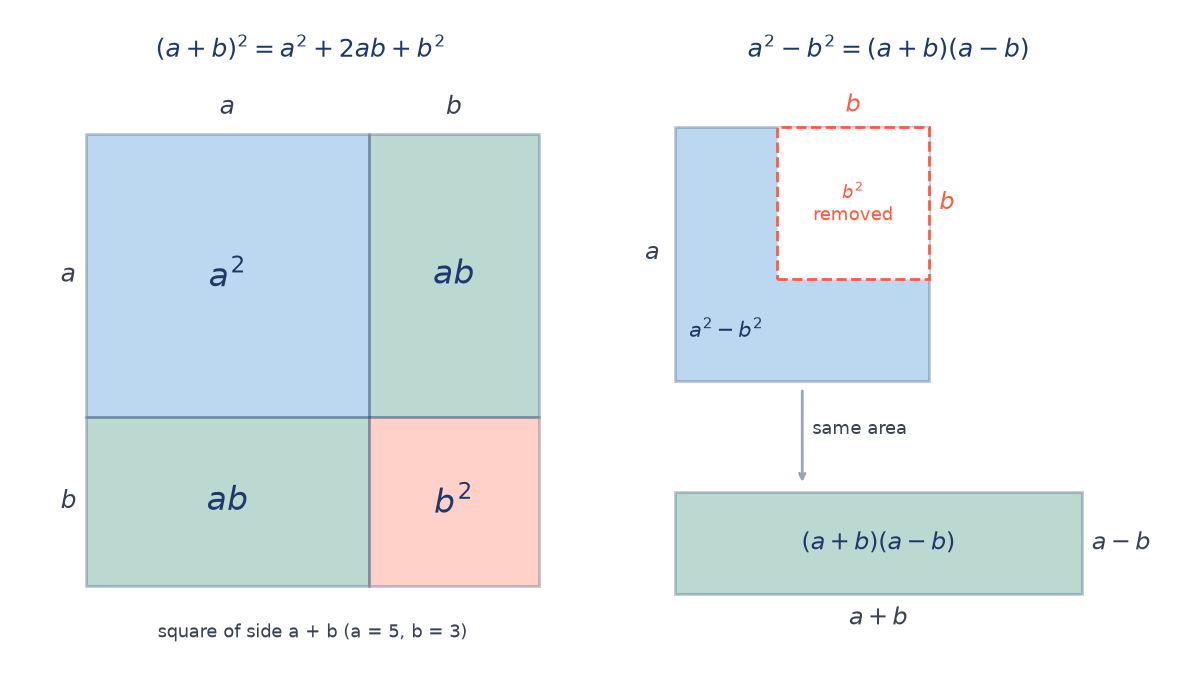
Area models: ( a + b ) 2 (a+b)^2 ( a + b ) 2 a 2 + 2 a b + b 2 a^2 + 2ab + b^2 a 2 + 2 ab + b 2 a 2 − b 2 a^2 - b^2 a 2 − b 2 ( a + b ) (a+b) ( a + b ) ( a − b ) (a-b) ( a − b ) Example 1.
49 y 2 − 36 = ( 7 y ) 2 − 6 2 = ( 7 y + 6 ) ( 7 y − 6 ) 49y^2 - 36 = (7y)^2 - 6^2 = (7y + 6)(7y - 6) 49 y 2 − 36 = ( 7 y ) 2 − 6 2 = ( 7 y + 6 ) ( 7 y − 6 )
Example 2. Here the identity is used twice, because p 2 − 9 p^2 - 9 p 2 − 9
p 4 − 81 = ( p 2 ) 2 − 9 2 = ( p 2 + 9 ) ( p 2 − 9 ) = ( p 2 + 9 ) ( p + 3 ) ( p − 3 ) p^4 - 81 = (p^2)^2 - 9^2 = (p^2 + 9)(p^2 - 9) = (p^2 + 9)(p + 3)(p - 3) p 4 − 81 = ( p 2 ) 2 − 9 2 = ( p 2 + 9 ) ( p 2 − 9 ) = ( p 2 + 9 ) ( p + 3 ) ( p − 3 )
Example 3 (mixed). Factorise a 2 − 2 a b + b 2 − c 2 a^2 - 2ab + b^2 - c^2 a 2 − 2 ab + b 2 − c 2
a 2 − 2 a b + b 2 − c 2 = ( a − b ) 2 − c 2 = [ ( a − b ) + c ] [ ( a − b ) − c ] = ( a − b + c ) ( a − b − c ) \begin{aligned} a^2 - 2ab + b^2 - c^2 &= (a - b)^2 - c^2 \\ &= [(a - b) + c][(a - b) - c] \\ &= (a - b + c)(a - b - c) \end{aligned} a 2 − 2 ab + b 2 − c 2 = ( a − b ) 2 − c 2 = [( a − b ) + c ] [( a − b ) − c ] = ( a − b + c ) ( a − b − c )
5. and 6. Perfect square trinomials#
These come from squaring a binomial sum or difference: a 2 + 2 a b + b 2 = ( a + b ) 2 a^2 + 2ab + b^2 = (a + b)^2 a 2 + 2 ab + b 2 = ( a + b ) 2 a 2 − 2 a b + b 2 = ( a − b ) 2 a^2 - 2ab + b^2 = (a - b)^2 a 2 − 2 ab + b 2 = ( a − b ) 2
Example 1. x 2 + 8 x + 16 = x 2 + 2 ( x ) ( 4 ) + 4 2 = ( x + 4 ) 2 x^2 + 8x + 16 = x^2 + 2(x)(4) + 4^2 = (x + 4)^2 x 2 + 8 x + 16 = x 2 + 2 ( x ) ( 4 ) + 4 2 = ( x + 4 ) 2
Example 2. 25 m 2 + 30 m + 9 = ( 5 m ) 2 + 2 ( 5 m ) ( 3 ) + 3 2 = ( 5 m + 3 ) 2 25m^2 + 30m + 9 = (5m)^2 + 2(5m)(3) + 3^2 = (5m + 3)^2 25 m 2 + 30 m + 9 = ( 5 m ) 2 + 2 ( 5 m ) ( 3 ) + 3 2 = ( 5 m + 3 ) 2
Example 3. 4 y 2 − 12 y + 9 = ( 2 y ) 2 − 2 ( 2 y ) ( 3 ) + 3 2 = ( 2 y − 3 ) 2 4y^2 - 12y + 9 = (2y)^2 - 2(2y)(3) + 3^2 = (2y - 3)^2 4 y 2 − 12 y + 9 = ( 2 y ) 2 − 2 ( 2 y ) ( 3 ) + 3 2 = ( 2 y − 3 ) 2
7. Splitting the middle term: x 2 + ( a + b ) x + a b = ( x + a ) ( x + b ) x^2 + (a + b)x + ab = (x + a)(x + b) x 2 + ( a + b ) x + ab = ( x + a ) ( x + b ) #
Method.
For x 2 + p x + q x^2 + px + q x 2 + p x + q p p p q q q
For a x 2 + b x + c ax^2 + bx + c a x 2 + b x + c a ≠ 1 a \neq 1 a = 1 b b b a c ac a c
Split the middle term using those numbers and factorise by grouping.
Example 1. x 2 + 5 x + 6 x^2 + 5x + 6 x 2 + 5 x + 6 x 2 + 5 x + 6 = ( x + 3 ) ( x + 2 ) x^2 + 5x + 6 = (x + 3)(x + 2) x 2 + 5 x + 6 = ( x + 3 ) ( x + 2 )
Example 2. y 2 − 7 y + 12 y^2 - 7y + 12 y 2 − 7 y + 12 − 4 -4 − 4 − 3 -3 − 3 − 7 -7 − 7 y 2 − 7 y + 12 = ( y − 4 ) ( y − 3 ) y^2 - 7y + 12 = (y - 4)(y - 3) y 2 − 7 y + 12 = ( y − 4 ) ( y − 3 )
Example 3. 3 x 2 + 10 x + 3 3x^2 + 10x + 3 3 x 2 + 10 x + 3 a c = 9 ac = 9 a c = 9 9 + 1 = 10 9 + 1 = 10 9 + 1 = 10
3 x 2 + 10 x + 3 = 3 x 2 + 9 x + x + 3 = 3 x ( x + 3 ) + 1 ( x + 3 ) = ( x + 3 ) ( 3 x + 1 ) \begin{aligned} 3x^2 + 10x + 3 &= 3x^2 + 9x + x + 3 \\ &= 3x(x + 3) + 1(x + 3) \\ &= (x + 3)(3x + 1) \end{aligned} 3 x 2 + 10 x + 3 = 3 x 2 + 9 x + x + 3 = 3 x ( x + 3 ) + 1 ( x + 3 ) = ( x + 3 ) ( 3 x + 1 )
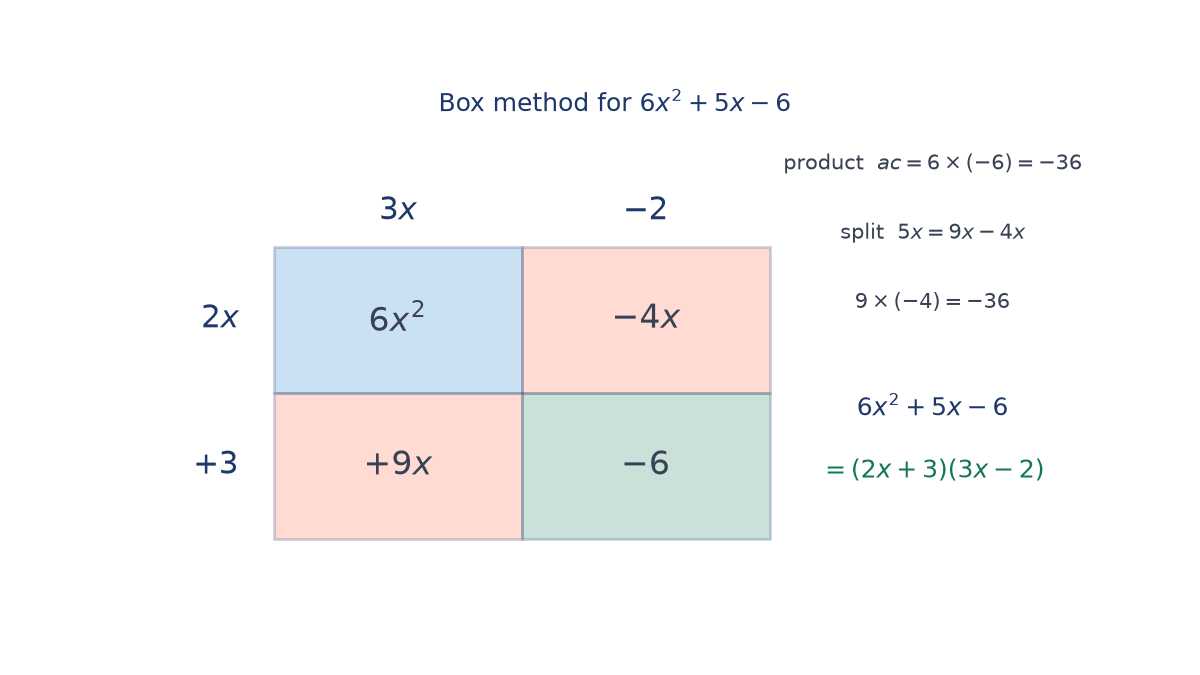
Example 4. 6 x 2 + 5 x − 6 6x^2 + 5x - 6 6 x 2 + 5 x − 6 a c = − 36 ac = -36 a c = − 36 9 + ( − 4 ) = 5 9 + (-4) = 5 9 + ( − 4 ) = 5 9 × ( − 4 ) = − 36 9 \times (-4) = -36 9 × ( − 4 ) = − 36
6 x 2 + 5 x − 6 = 6 x 2 + 9 x − 4 x − 6 = 3 x ( 2 x + 3 ) − 2 ( 2 x + 3 ) = ( 2 x + 3 ) ( 3 x − 2 ) \begin{aligned} 6x^2 + 5x - 6 &= 6x^2 + 9x - 4x - 6 \\ &= 3x(2x + 3) - 2(2x + 3) \\ &= (2x + 3)(3x - 2) \end{aligned} 6 x 2 + 5 x − 6 = 6 x 2 + 9 x − 4 x − 6 = 3 x ( 2 x + 3 ) − 2 ( 2 x + 3 ) = ( 2 x + 3 ) ( 3 x − 2 )
The box method for 6 x 2 + 5 x − 6 6x^2 + 5x - 6 6 x 2 + 5 x − 6 9 x 9x 9 x − 4 x -4x − 4 x 5 x 5x 5 x Example 5 (substitution). Factorise ( 2 a − b ) 2 + 2 ( 2 a − b ) − 8 (2a - b)^2 + 2(2a - b) - 8 ( 2 a − b ) 2 + 2 ( 2 a − b ) − 8 t = 2 a − b t = 2a - b t = 2 a − b t 2 + 2 t − 8 = ( t + 4 ) ( t − 2 ) t^2 + 2t - 8 = (t + 4)(t - 2) t 2 + 2 t − 8 = ( t + 4 ) ( t − 2 ) 4 × ( − 2 ) = − 8 4 \times (-2) = -8 4 × ( − 2 ) = − 8 4 + ( − 2 ) = 2 4 + (-2) = 2 4 + ( − 2 ) = 2
( 2 a − b ) 2 + 2 ( 2 a − b ) − 8 = ( 2 a − b + 4 ) ( 2 a − b − 2 ) (2a - b)^2 + 2(2a - b) - 8 = (2a - b + 4)(2a - b - 2) ( 2 a − b ) 2 + 2 ( 2 a − b ) − 8 = ( 2 a − b + 4 ) ( 2 a − b − 2 )
8. Square of a trinomial: a 2 + b 2 + c 2 + 2 a b + 2 b c + 2 c a = ( a + b + c ) 2 a^2 + b^2 + c^2 + 2ab + 2bc + 2ca = (a + b + c)^2 a 2 + b 2 + c 2 + 2 ab + 2 b c + 2 c a = ( a + b + c ) 2 #
Example 1. 4 a 2 + b 2 + c 2 + 4 a b + 2 b c + 4 a c 4a^2 + b^2 + c^2 + 4ab + 2bc + 4ac 4 a 2 + b 2 + c 2 + 4 ab + 2 b c + 4 a c ( 2 a ) 2 (2a)^2 ( 2 a ) 2 b 2 b^2 b 2 c 2 c^2 c 2 2 ( 2 a ) ( b ) = 4 a b 2(2a)(b) = 4ab 2 ( 2 a ) ( b ) = 4 ab 2 ( b ) ( c ) = 2 b c 2(b)(c) = 2bc 2 ( b ) ( c ) = 2 b c 2 ( c ) ( 2 a ) = 4 a c 2(c)(2a) = 4ac 2 ( c ) ( 2 a ) = 4 a c
4 a 2 + b 2 + c 2 + 4 a b + 2 b c + 4 a c = ( 2 a + b + c ) 2 4a^2 + b^2 + c^2 + 4ab + 2bc + 4ac = (2a + b + c)^2 4 a 2 + b 2 + c 2 + 4 ab + 2 b c + 4 a c = ( 2 a + b + c ) 2
Example 2. 9 a 2 + 4 b 2 + 16 + 12 a b + 16 b + 24 a 9a^2 + 4b^2 + 16 + 12ab + 16b + 24a 9 a 2 + 4 b 2 + 16 + 12 ab + 16 b + 24 a ( 3 a ) 2 (3a)^2 ( 3 a ) 2 ( 2 b ) 2 (2b)^2 ( 2 b ) 2 4 2 4^2 4 2 2 ( 3 a ) ( 2 b ) = 12 a b 2(3a)(2b) = 12ab 2 ( 3 a ) ( 2 b ) = 12 ab 2 ( 2 b ) ( 4 ) = 16 b 2(2b)(4) = 16b 2 ( 2 b ) ( 4 ) = 16 b 2 ( 4 ) ( 3 a ) = 24 a 2(4)(3a) = 24a 2 ( 4 ) ( 3 a ) = 24 a
9 a 2 + 4 b 2 + 16 + 12 a b + 16 b + 24 a = ( 3 a + 2 b + 4 ) 2 9a^2 + 4b^2 + 16 + 12ab + 16b + 24a = (3a + 2b + 4)^2 9 a 2 + 4 b 2 + 16 + 12 ab + 16 b + 24 a = ( 3 a + 2 b + 4 ) 2
9. Square of a trinomial with two negative cross terms: a 2 + b 2 + c 2 + 2 a b − 2 b c − 2 c a = ( a + b − c ) 2 a^2 + b^2 + c^2 + 2ab - 2bc - 2ca = (a + b - c)^2 a 2 + b 2 + c 2 + 2 ab − 2 b c − 2 c a = ( a + b − c ) 2 #
Use this when the two cross terms that contain one particular variable are both negative. That variable takes the minus sign.
Example. Factorise 25 x 2 + y 2 + 4 z 2 − 10 x y − 4 y z + 20 z x 25x^2 + y^2 + 4z^2 - 10xy - 4yz + 20zx 25 x 2 + y 2 + 4 z 2 − 10 x y − 4 y z + 20 z x
The negative cross terms − 10 x y -10xy − 10 x y − 4 y z -4yz − 4 y z y y y y y y c c c a = 5 x a = 5x a = 5 x b = 2 z b = 2z b = 2 z c = y c = y c = y 2 a b = 20 z x 2ab = 20zx 2 ab = 20 z x 2 b c = 4 y z 2bc = 4yz 2 b c = 4 y z 2 c a = 10 x y 2ca = 10xy 2 c a = 10 x y
25 x 2 + y 2 + 4 z 2 − 10 x y − 4 y z + 20 z x = ( 5 x ) 2 + ( 2 z ) 2 + y 2 + 2 ( 5 x ) ( 2 z ) − 2 ( 2 z ) ( y ) − 2 ( y ) ( 5 x ) = ( 5 x + 2 z − y ) 2 = ( 5 x − y + 2 z ) 2 \begin{aligned} 25x^2 + y^2 + 4z^2 - 10xy - 4yz + 20zx &= (5x)^2 + (2z)^2 + y^2 + 2(5x)(2z) - 2(2z)(y) - 2(y)(5x) \\ &= (5x + 2z - y)^2 = (5x - y + 2z)^2 \end{aligned} 25 x 2 + y 2 + 4 z 2 − 10 x y − 4 y z + 20 z x = ( 5 x ) 2 + ( 2 z ) 2 + y 2 + 2 ( 5 x ) ( 2 z ) − 2 ( 2 z ) ( y ) − 2 ( y ) ( 5 x ) = ( 5 x + 2 z − y ) 2 = ( 5 x − y + 2 z ) 2
You get the same answer from identity 8 with the terms 5 x 5x 5 x − y -y − y 2 z 2z 2 z
Cubic and advanced identities in factorisation#
10. Cube of a sum: a 3 + 3 a 2 b + 3 a b 2 + b 3 = ( a + b ) 3 a^3 + 3a^2b + 3ab^2 + b^3 = (a + b)^3 a 3 + 3 a 2 b + 3 a b 2 + b 3 = ( a + b ) 3 #
Example. Factorise 8 a 3 + b 3 + 12 a 2 b + 6 a b 2 8a^3 + b^3 + 12a^2b + 6ab^2 8 a 3 + b 3 + 12 a 2 b + 6 a b 2
8 a 3 + b 3 + 12 a 2 b + 6 a b 2 = ( 2 a ) 3 + b 3 + 3 ( 2 a ) 2 ( b ) + 3 ( 2 a ) ( b ) 2 = ( 2 a + b ) 3 \begin{aligned} 8a^3 + b^3 + 12a^2b + 6ab^2 &= (2a)^3 + b^3 + 3(2a)^2(b) + 3(2a)(b)^2 \\ &= (2a + b)^3 \end{aligned} 8 a 3 + b 3 + 12 a 2 b + 6 a b 2 = ( 2 a ) 3 + b 3 + 3 ( 2 a ) 2 ( b ) + 3 ( 2 a ) ( b ) 2 = ( 2 a + b ) 3
11. Cube of a difference: a 3 − 3 a 2 b + 3 a b 2 − b 3 = ( a − b ) 3 a^3 - 3a^2b + 3ab^2 - b^3 = (a - b)^3 a 3 − 3 a 2 b + 3 a b 2 − b 3 = ( a − b ) 3 #
Example. Factorise 27 − 125 a 3 − 135 a + 225 a 2 27 - 125a^3 - 135a + 225a^2 27 − 125 a 3 − 135 a + 225 a 2
27 − 125 a 3 − 135 a + 225 a 2 = 3 3 − ( 5 a ) 3 − 3 ( 3 ) 2 ( 5 a ) + 3 ( 3 ) ( 5 a ) 2 = ( 3 − 5 a ) 3 \begin{aligned} 27 - 125a^3 - 135a + 225a^2 &= 3^3 - (5a)^3 - 3(3)^2(5a) + 3(3)(5a)^2 \\ &= (3 - 5a)^3 \end{aligned} 27 − 125 a 3 − 135 a + 225 a 2 = 3 3 − ( 5 a ) 3 − 3 ( 3 ) 2 ( 5 a ) + 3 ( 3 ) ( 5 a ) 2 = ( 3 − 5 a ) 3
12. Sum of two cubes: a 3 + b 3 = ( a + b ) ( a 2 − a b + b 2 ) a^3 + b^3 = (a + b)(a^2 - ab + b^2) a 3 + b 3 = ( a + b ) ( a 2 − ab + b 2 ) #
Example. Factorise y 3 + 125 y^3 + 125 y 3 + 125
y 3 + 125 = y 3 + 5 3 = ( y + 5 ) ( y 2 − y × 5 + 5 2 ) = ( y + 5 ) ( y 2 − 5 y + 25 ) \begin{aligned} y^3 + 125 &= y^3 + 5^3 \\ &= (y + 5)(y^2 - y \times 5 + 5^2) \\ &= (y + 5)(y^2 - 5y + 25) \end{aligned} y 3 + 125 = y 3 + 5 3 = ( y + 5 ) ( y 2 − y × 5 + 5 2 ) = ( y + 5 ) ( y 2 − 5 y + 25 )
13. Difference of two cubes: a 3 − b 3 = ( a − b ) ( a 2 + a b + b 2 ) a^3 - b^3 = (a - b)(a^2 + ab + b^2) a 3 − b 3 = ( a − b ) ( a 2 + ab + b 2 ) #
Example. Factorise x 3 216 − 8 y 3 \displaystyle \frac{x^3}{216} - 8y^3 216 x 3 − 8 y 3
x 3 216 − 8 y 3 = ( x 6 ) 3 − ( 2 y ) 3 = ( x 6 − 2 y ) [ ( x 6 ) 2 + x 6 ( 2 y ) + ( 2 y ) 2 ] = ( x 6 − 2 y ) ( x 2 36 + x y 3 + 4 y 2 ) \displaystyle \begin{aligned} \frac{x^3}{216} - 8y^3 &= \left(\frac{x}{6}\right)^3 - (2y)^3 \\ &= \left(\frac{x}{6} - 2y\right)\left[\left(\frac{x}{6}\right)^2 + \frac{x}{6}(2y) + (2y)^2\right] \\ &= \left(\frac{x}{6} - 2y\right)\left(\frac{x^2}{36} + \frac{xy}{3} + 4y^2\right) \end{aligned} 216 x 3 − 8 y 3 = ( 6 x ) 3 − ( 2 y ) 3 = ( 6 x − 2 y ) [ ( 6 x ) 2 + 6 x ( 2 y ) + ( 2 y ) 2 ] = ( 6 x − 2 y ) ( 36 x 2 + 3 x y + 4 y 2 )
14. The three-cube identity#
a 3 + b 3 + c 3 − 3 a b c = ( a + b + c ) ( a 2 + b 2 + c 2 − a b − b c − c a ) a^3 + b^3 + c^3 - 3abc = (a + b + c)(a^2 + b^2 + c^2 - ab - bc - ca) a 3 + b 3 + c 3 − 3 ab c = ( a + b + c ) ( a 2 + b 2 + c 2 − ab − b c − c a )
Example. Factorise a 3 − b 3 + 1 + 3 a b a^3 - b^3 + 1 + 3ab a 3 − b 3 + 1 + 3 ab
Write the terms as cubes of a a a − b -b − b 1 1 1 − 3 ( a ) ( − b ) ( 1 ) = 3 a b -3(a)(-b)(1) = 3ab − 3 ( a ) ( − b ) ( 1 ) = 3 ab
a 3 − b 3 + 1 + 3 a b = a 3 + ( − b ) 3 + 1 3 − 3 ( a ) ( − b ) ( 1 ) = ( a − b + 1 ) [ a 2 + ( − b ) 2 + 1 2 − a ( − b ) − ( − b ) ( 1 ) − ( 1 ) ( a ) ] = ( a − b + 1 ) ( a 2 + b 2 + 1 + a b + b − a ) \begin{aligned} a^3 - b^3 + 1 + 3ab &= a^3 + (-b)^3 + 1^3 - 3(a)(-b)(1) \\ &= (a - b + 1)\left[a^2 + (-b)^2 + 1^2 - a(-b) - (-b)(1) - (1)(a)\right] \\ &= (a - b + 1)(a^2 + b^2 + 1 + ab + b - a) \end{aligned} a 3 − b 3 + 1 + 3 ab = a 3 + ( − b ) 3 + 1 3 − 3 ( a ) ( − b ) ( 1 ) = ( a − b + 1 ) [ a 2 + ( − b ) 2 + 1 2 − a ( − b ) − ( − b ) ( 1 ) − ( 1 ) ( a ) ] = ( a − b + 1 ) ( a 2 + b 2 + 1 + ab + b − a )
15. The conditional cube property#
If a + b + c = 0 a + b + c = 0 a + b + c = 0 a 3 + b 3 + c 3 − 3 a b c = 0 a^3 + b^3 + c^3 - 3abc = 0 a 3 + b 3 + c 3 − 3 ab c = 0 a 3 + b 3 + c 3 = 3 a b c a^3 + b^3 + c^3 = 3abc a 3 + b 3 + c 3 = 3 ab c
Example. Factorise ( x − y ) 3 + ( y − z ) 3 + ( z − x ) 3 (x - y)^3 + (y - z)^3 + (z - x)^3 ( x − y ) 3 + ( y − z ) 3 + ( z − x ) 3
Let a = x − y a = x - y a = x − y b = y − z b = y - z b = y − z c = z − x c = z - x c = z − x a + b + c = x − y + y − z + z − x = 0 a + b + c = x - y + y - z + z - x = 0 a + b + c = x − y + y − z + z − x = 0
( x − y ) 3 + ( y − z ) 3 + ( z − x ) 3 = 3 a b c = 3 ( x − y ) ( y − z ) ( z − x ) (x - y)^3 + (y - z)^3 + (z - x)^3 = 3abc = 3(x - y)(y - z)(z - x) ( x − y ) 3 + ( y − z ) 3 + ( z − x ) 3 = 3 ab c = 3 ( x − y ) ( y − z ) ( z − x )
Division of algebraic expressions#
Dividing a monomial by a monomial#
Factorise both, then cancel the common factors.
Example 1.
6 x 3 ÷ 2 x = 2 × 3 × x × x × x 2 × x = 3 x 2 \displaystyle 6x^3 \div 2x = \frac{2 \times 3 \times x \times x \times x}{2 \times x} = 3x^2 6 x 3 ÷ 2 x = 2 × x 2 × 3 × x × x × x = 3 x 2
Example 2.
− 20 x 4 ÷ 10 x 2 = − 2 × 10 × x 2 × x 2 10 × x 2 = − 2 x 2 \displaystyle -20x^4 \div 10x^2 = \frac{-2 \times 10 \times x^2 \times x^2}{10 \times x^2} = -2x^2 − 20 x 4 ÷ 10 x 2 = 10 × x 2 − 2 × 10 × x 2 × x 2 = − 2 x 2
Example 3.
7 x 2 y 2 z 2 ÷ 14 x y z = 7 × x y z × x y z 2 × 7 × x y z = x y z 2 \displaystyle 7x^2y^2z^2 \div 14xyz = \frac{7 \times xyz \times xyz}{2 \times 7 \times xyz} = \frac{xyz}{2} 7 x 2 y 2 z 2 ÷ 14 x y z = 2 × 7 × x y z 7 × x y z × x y z = 2 x y z
Dividing a polynomial by a monomial#
Take the HCF out of the polynomial first, so that the divisor cancels in one step.
Example 1. Divide 24 ( x 2 y z + x y 2 z + x y z 2 ) 24(x^2yz + xy^2z + xyz^2) 24 ( x 2 y z + x y 2 z + x y z 2 ) 8 x y z 8xyz 8 x y z
24 ( x 2 y z + x y 2 z + x y z 2 ) 8 x y z = 24 x y z ( x + y + z ) 8 x y z = 3 ( x + y + z ) \displaystyle \begin{aligned} \frac{24(x^2yz + xy^2z + xyz^2)}{8xyz} &= \frac{24xyz(x + y + z)}{8xyz} \\ &= 3(x + y + z) \end{aligned} 8 x y z 24 ( x 2 y z + x y 2 z + x y z 2 ) = 8 x y z 24 x y z ( x + y + z ) = 3 ( x + y + z )
Example 2. Divide 3 y 8 − 4 y 6 + 5 y 4 3y^8 - 4y^6 + 5y^4 3 y 8 − 4 y 6 + 5 y 4 y 4 y^4 y 4
3 y 8 − 4 y 6 + 5 y 4 y 4 = y 4 ( 3 y 4 − 4 y 2 + 5 ) y 4 = 3 y 4 − 4 y 2 + 5 \displaystyle \begin{aligned} \frac{3y^8 - 4y^6 + 5y^4}{y^4} &= \frac{y^4(3y^4 - 4y^2 + 5)}{y^4} \\ &= 3y^4 - 4y^2 + 5 \end{aligned} y 4 3 y 8 − 4 y 6 + 5 y 4 = y 4 y 4 ( 3 y 4 − 4 y 2 + 5 ) = 3 y 4 − 4 y 2 + 5
Common mistakes#
Taking out a common factor from only one term: 22 y − 33 z 22y - 33z 22 y − 33 z 11 ( 2 y − 3 z ) 11(2y - 3z) 11 ( 2 y − 3 z ) 11 ( 2 y − 33 z ) 11(2y - 33z) 11 ( 2 y − 33 z )
Stopping too early: ( p 2 + 9 ) ( p 2 − 9 ) (p^2 + 9)(p^2 - 9) ( p 2 + 9 ) ( p 2 − 9 ) p 2 − 9 = ( p + 3 ) ( p − 3 ) p^2 - 9 = (p + 3)(p - 3) p 2 − 9 = ( p + 3 ) ( p − 3 )
Trying to factorise a 2 + b 2 a^2 + b^2 a 2 + b 2 ( a + b ) ( a + b ) (a + b)(a + b) ( a + b ) ( a + b ) ( a + b ) 2 = a 2 + 2 a b + b 2 (a + b)^2 = a^2 + 2ab + b^2 ( a + b ) 2 = a 2 + 2 ab + b 2
Mixing up the signs in the cube identities: a 3 + b 3 a^3 + b^3 a 3 + b 3 − a b -ab − ab a 3 − b 3 a^3 - b^3 a 3 − b 3 + a b +ab + ab
Choosing numbers whose product is c c c a c ac a c a x 2 + b x + c ax^2 + bx + c a x 2 + b x + c a ≠ 1 a \neq 1 a = 1
Including a variable in the HCF that is missing from one of the monomials, as in writing the HCF of 5 x y 5xy 5 x y 10 x 10x 10 x 5 x y 5xy 5 x y
Try these#
Find the HCF of 8 a 3 b 2 8a^3b^2 8 a 3 b 2 20 a 2 b 4 20a^2b^4 20 a 2 b 4 Answer: 4 a 2 b 2 4a^2b^2 4 a 2 b 2
Factorise x 2 + 7 x + 12 x^2 + 7x + 12 x 2 + 7 x + 12 Answer: ( x + 3 ) ( x + 4 ) (x + 3)(x + 4) ( x + 3 ) ( x + 4 )
Factorise 2 x 2 − 7 x + 3 2x^2 - 7x + 3 2 x 2 − 7 x + 3 Answer: ( 2 x − 1 ) ( x − 3 ) (2x - 1)(x - 3) ( 2 x − 1 ) ( x − 3 )
Factorise 16 a 2 − 81 b 2 16a^2 - 81b^2 16 a 2 − 81 b 2 Answer: ( 4 a + 9 b ) ( 4 a − 9 b ) (4a + 9b)(4a - 9b) ( 4 a + 9 b ) ( 4 a − 9 b )
Factorise 27 x 3 − 8 27x^3 - 8 27 x 3 − 8 Answer: ( 3 x − 2 ) ( 9 x 2 + 6 x + 4 ) (3x - 2)(9x^2 + 6x + 4) ( 3 x − 2 ) ( 9 x 2 + 6 x + 4 )
Divide 15 x 3 y 2 − 10 x 2 y 3 15x^3y^2 - 10x^2y^3 15 x 3 y 2 − 10 x 2 y 3 5 x 2 y 2 5x^2y^2 5 x 2 y 2 Answer: 3 x − 2 y 3x - 2y 3 x − 2 y
Key terms#
Factor
An expression that divides another expression exactly; in 3 a b ( 4 a + 5 b ) 3ab(4a + 5b) 3 ab ( 4 a + 5 b ) 3 a b 3ab 3 ab 4 a + 5 b 4a + 5b 4 a + 5 b
Factorisation
Writing an expression as a product of its factors.
Monomial
An expression with a single term, such as 6 x 3 y 6x^3y 6 x 3 y
Highest common factor (HCF)
The largest expression that divides each of the given expressions exactly.
Identity
An equality that holds for every value of its variables, such as a 2 − b 2 = ( a + b ) ( a − b ) a^2 - b^2 = (a + b)(a - b) a 2 − b 2 = ( a + b ) ( a − b )
Perfect square trinomial
A three-term expression that equals the square of a binomial, such as x 2 + 8 x + 16 = ( x + 4 ) 2 x^2 + 8x + 16 = (x + 4)^2 x 2 + 8 x + 16 = ( x + 4 ) 2
Splitting the middle term
Rewriting the middle term of a quadratic as two terms so that the expression can be factorised by grouping.
Grouping
Arranging terms in pairs that share a common factor, then taking out the common bracket.
Common questions#
How do I know which identity to use?#
Take out the HCF first, then count the terms. Two terms suggest a difference of squares or a sum or difference of cubes; three terms suggest a perfect square or splitting the middle term; four terms suggest grouping or a perfect cube; six terms with three squares suggest the square of a trinomial.
How can I check that a factorisation is right?#
Multiply the factors back out. If the expansion gives the original expression exactly, the factorisation is correct. Also check that no factor can be broken down further.
Is the HCF of monomials found the same way as the HCF of numbers?#
Yes. Find the HCF of the numerical coefficients as usual, and for the variables take only those common to every monomial, each with its lowest power.
Can every quadratic be factorised by splitting the middle term?#
No. If no two integers have the required sum and product, the quadratic has no factors with integer coefficients. For example, x 2 + x + 1 x^2 + x + 1 x 2 + x + 1
Why does a 3 + b 3 + c 3 = 3 a b c a^3 + b^3 + c^3 = 3abc a 3 + b 3 + c 3 = 3 ab c a + b + c = 0 a + b + c = 0 a + b + c = 0 #
Identity 14 says a 3 + b 3 + c 3 − 3 a b c a^3 + b^3 + c^3 - 3abc a 3 + b 3 + c 3 − 3 ab c ( a + b + c ) (a + b + c) ( a + b + c ) a + b + c = 0 a + b + c = 0 a + b + c = 0 a 3 + b 3 + c 3 = 3 a b c a^3 + b^3 + c^3 = 3abc a 3 + b 3 + c 3 = 3 ab c
References#
National Council of Educational Research and Training. Mathematics: Textbook for Class X . NCERT, New Delhi.
Hall, H. S. and Knight, S. R. Higher Algebra . Macmillan.
Gelfand, I. M. and Shen, A. Algebra . Birkhäuser.