Before you start

Here are twelve ques­tions from across the whole chap­ter. Before you write any­thing, pause and ask your­self what kind of ques­tion it is. Is it a con­di­tional prob­a­bil­ity? A prod­uct of inde­pen­dent events? Or do you need Bayes' the­o­rem to turn a con­di­tion around? Get that choice right and the work­ing usu­ally falls into place.

Try these

  1. P(A)=0.7P(A) = 0.7, P(B)=0.5P(B) = 0.5, P(A∪B)=0.85P(A \cup B) = 0.85. Find P(A∩B)P(A \cap B), P(A∣B)P(A \mid B) and then decide whether AA and BB are inde­pen­dent.
  2. Two cards are drawn with­out replace­ment. Find the prob­a­bil­ity that both are aces, and the prob­a­bil­ity that the sec­ond is an ace given that the first was not.
  3. You keep throw­ing a die until a six turns up. Find the prob­a­bil­ity that it takes exactly three throws.
  4. Three friends try a puz­zle on their own, with suc­cess prob­a­bil­i­ties 12\displaystyle \tfrac{1}{2}, 13\displaystyle \tfrac{1}{3} and 15\displaystyle \tfrac{1}{5}. Find the prob­a­bil­ity that exactly one solves it.
  5. A fam­ily has three chil­dren. Given that at least one is a boy, find the prob­a­bil­ity that all three are boys.
  6. In a class, 45%45\% of the stu­dents are girls; 20%20\% of girls and 30%30\% of boys wear glasses. A stu­dent with glasses is cho­sen at ran­dom. Find P(girl)P(\text{girl}).
  7. Bag A has 44 red and 66 black balls; bag B has 77 red and 33 black. A die is thrown: on 11 or 22 a ball is drawn from A, oth­er­wise from B. The ball is red. Find P(from A)P(\text{from A}).
  8. AA and BB are inde­pen­dent, P(A)=0.4P(A) = 0.4 and P(A∩B)=0.16P(A \cap B) = 0.16. Find P(B)P(B) and P(A′∩B′)P(A' \cap B').
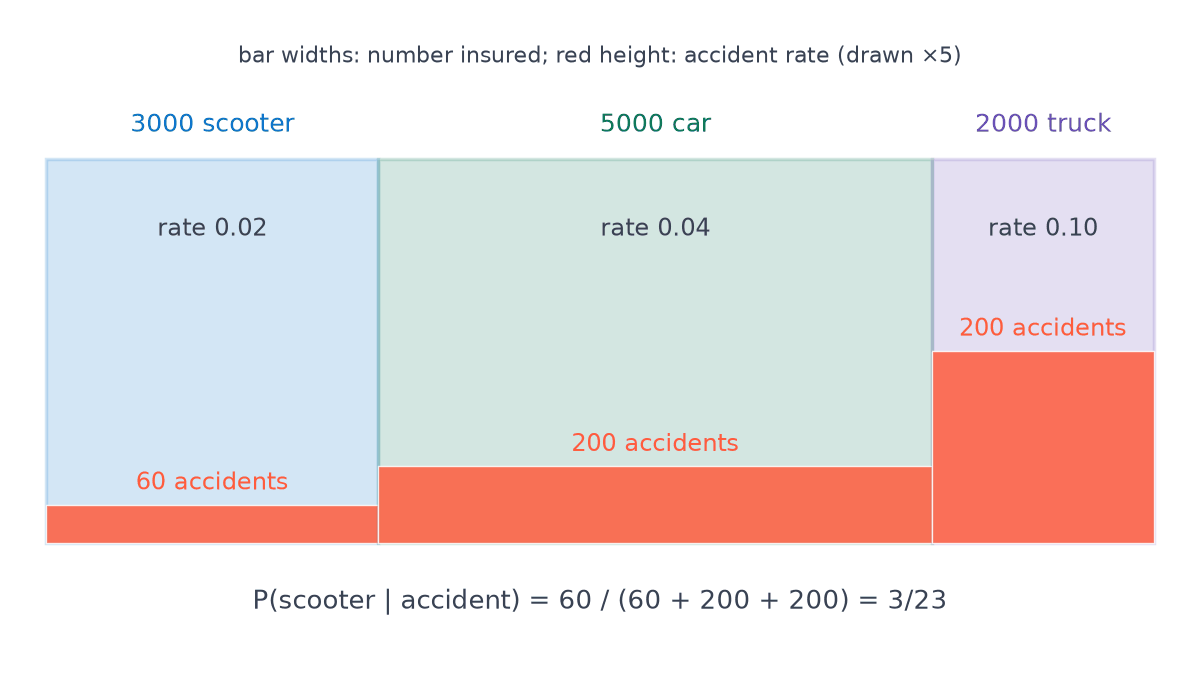
  9. An insur­ance com­pany insures 30003000 scooter rid­ers, 50005000 car dri­vers and 20002000 truck dri­vers, with acci­dent prob­a­bil­i­ties 0.020.02, 0.040.04 and 0.100.10. One of these insured peo­ple has an acci­dent. Find the prob­a­bil­ity that it was a scooter rider.
  10. A coin is tossed. If it shows heads, a die is thrown and the num­ber noted. If it shows tails, a card is drawn from a pack. Find the prob­a­bil­ity of a head fol­lowed by a six.
  11. Prove that mutu­ally exclu­sive events AA, BB with P(A),P(B)>0P(A), P(B) > 0 can­not be inde­pen­dent.
  12. A shelf has 33 faulty and 77 good bat­ter­ies. Two are tested one after the other, with­out replace­ment. If the sec­ond one is good, find the prob­a­bil­ity that the first was faulty.

Answers to check your work

Show answers
  1. 0.350.35; 0.70.7; 0.35=0.7×0.50.35 = 0.7 \times 0.5, so they are inde­pen­dent.
  2. 452⋅351=1221\displaystyle \tfrac{4}{52}\cdot\tfrac{3}{51} = \tfrac{1}{221}; 451\displaystyle \tfrac{4}{51}.
  3. (56)216=25216\displaystyle \left(\tfrac{5}{6}\right)^2\tfrac{1}{6} = \tfrac{25}{216}.
  4. 12⋅23⋅45+12⋅13⋅45+12⋅23⋅15=8+4+230=715\displaystyle \tfrac{1}{2}\cdot\tfrac{2}{3}\cdot\tfrac{4}{5} + \tfrac{1}{2}\cdot\tfrac{1}{3}\cdot\tfrac{4}{5} + \tfrac{1}{2}\cdot\tfrac{2}{3}\cdot\tfrac{1}{5} = \tfrac{8 + 4 + 2}{30} = \tfrac{7}{15}.
  5. 1/87/8=17\displaystyle \tfrac{1/8}{7/8} = \tfrac{1}{7}.
  6. 0.45×0.20.45×0.2+0.55×0.3=0.090.255=617\displaystyle \tfrac{0.45 \times 0.2}{0.45 \times 0.2 + 0.55 \times 0.3} = \tfrac{0.09}{0.255} = \tfrac{6}{17}.
  7. 13⋅2513⋅25+23⋅710=2/152/15+7/15=29\displaystyle \frac{\frac{1}{3}\cdot\frac{2}{5}}{\frac{1}{3}\cdot\frac{2}{5} + \frac{2}{3}\cdot\frac{7}{10}} = \frac{2/15}{2/15 + 7/15} = \tfrac{2}{9}.
  8. P(B)=0.160.4=0.4\displaystyle P(B) = \tfrac{0.16}{0.4} = 0.4 (inde­pen­dent); P(A′∩B′)=0.6×0.6=0.36P(A' \cap B') = 0.6 \times 0.6 = 0.36. Remem­ber, com­ple­ments of inde­pen­dent events are inde­pen­dent too.
  9. 3000×0.0260+200+200=60460=323\displaystyle \frac{3000 \times 0.02}{60 + 200 + 200} = \tfrac{60}{460} = \tfrac{3}{23}.
  10. 12⋅16=112\displaystyle \tfrac{1}{2}\cdot\tfrac{1}{6} = \tfrac{1}{12}.
  11. P(A∩B)=0≠P(A)P(B)>0P(A \cap B) = 0 \ne P(A)P(B) > 0.
  12. P(F1∩G2)=310⋅79=730\displaystyle P(F_1 \cap G_2) = \tfrac{3}{10}\cdot\tfrac{7}{9} = \tfrac{7}{30}; P(G2)=710\displaystyle P(G_2) = \tfrac{7}{10} by sym­me­try; so the answer is 13\displaystyle \tfrac{1}{3}.
Three blocks with widths 3000 scooter riders, 5000 car drivers and 2000 truck drivers; red bars show accident rates 0.02, 0.04, 0.10, giving 60, 200 and 200 expected accidents.
Ques­tion 9: of 460 expected acci­dents, 60 involve scooter rid­ers, so the answer is 3/23.