Suppose you already know one thing has happened. Does that change the chances of something else? Very often it does, and that simple idea is the heart of this chapter. We will build conditional probability, get the multiplication rule out of it, and then see what it means for two events to be independent.
If F has already happened (P(F)=0), the probability of E is
P(E∣F)=P(F)P(E∩F).
When all outcomes are equally likely, this is just n(F)n(E∩F). Think of it this way: once you know the given event has occurred, F becomes your whole sample space.
A few properties follow directly: P(F∣F)=1; P(E′∣F)=1−P(E∣F); and P((A∪B)∣F)=P(A∣F)+P(B∣F)−P((A∩B)∣F).
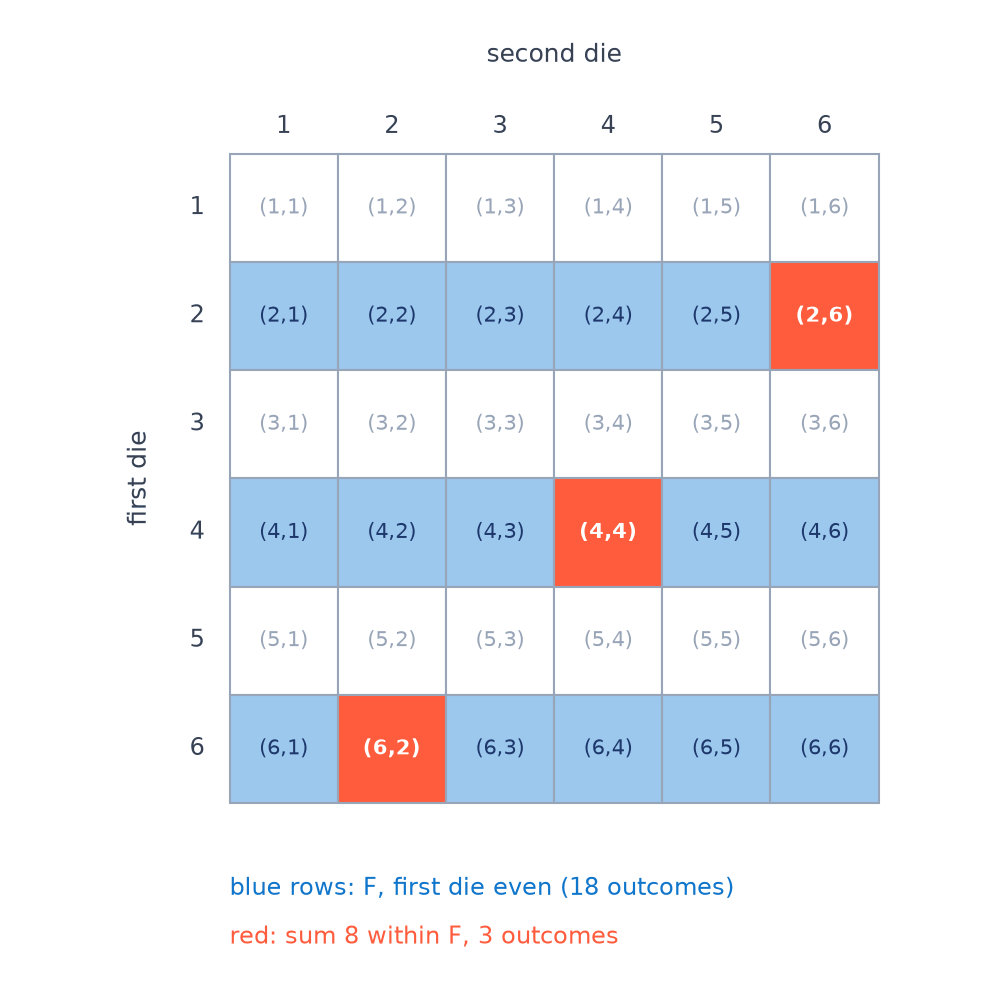
Example 1. Throw two dice. Let E be "the sum is 8" and F be "the first die shows an even number". Here n(F)=18, and E∩F={(2,6),(4,4),(6,2)}. So P(E∣F)=183=61.
Given F, only the 18 blue outcomes count; 3 of them have sum 8.
Example 2. A family has two children, and you are told at least one is a girl. What is the chance both are girls? Now F={GG,GB,BG}, so the answer is 31, not a half as many people guess.
Example 3. Take P(A)=0.5, P(B)=0.4, P(A∩B)=0.2. Then P(A∣B)=0.5, P(B∣A)=0.4, and P(A∣A∪B)=0.70.5=75.
and with three events, P(E∩F∩G)=P(E)P(F∣E)P(G∣E∩F). Each new factor takes into account what has already happened.
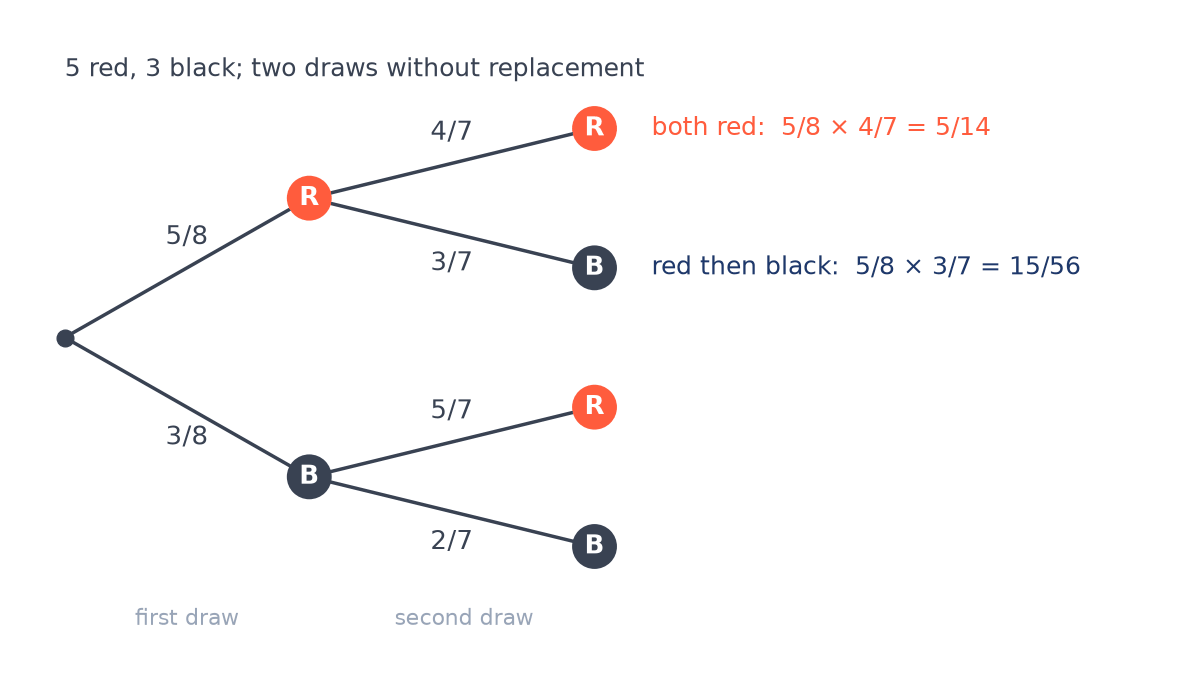
Example 4. A bag holds 5 red and 3 black balls, and you draw two without putting the first back. P(both red)=85⋅74=145, and P(red then black)=85⋅73=5615.
Multiply along the branches: both red is 5/14, red then black is 15/56.
Example 5. Draw three cards, one after another, without replacement. P(king, king, queen in that order)=524⋅513⋅504=55252.
We call E and Findependent when knowing one tells you nothing new about the other, that is P(E∣F)=P(E). The same thing, written more usefully:
P(E∩F)=P(E)P(F).
Students often mix up independent and mutually exclusive, so be careful. If two events with non-zero probabilities are mutually exclusive, they can never be independent, because one happening rules the other out. Also, if E and F are independent, then so are E and F′, and so are E′ and F′.
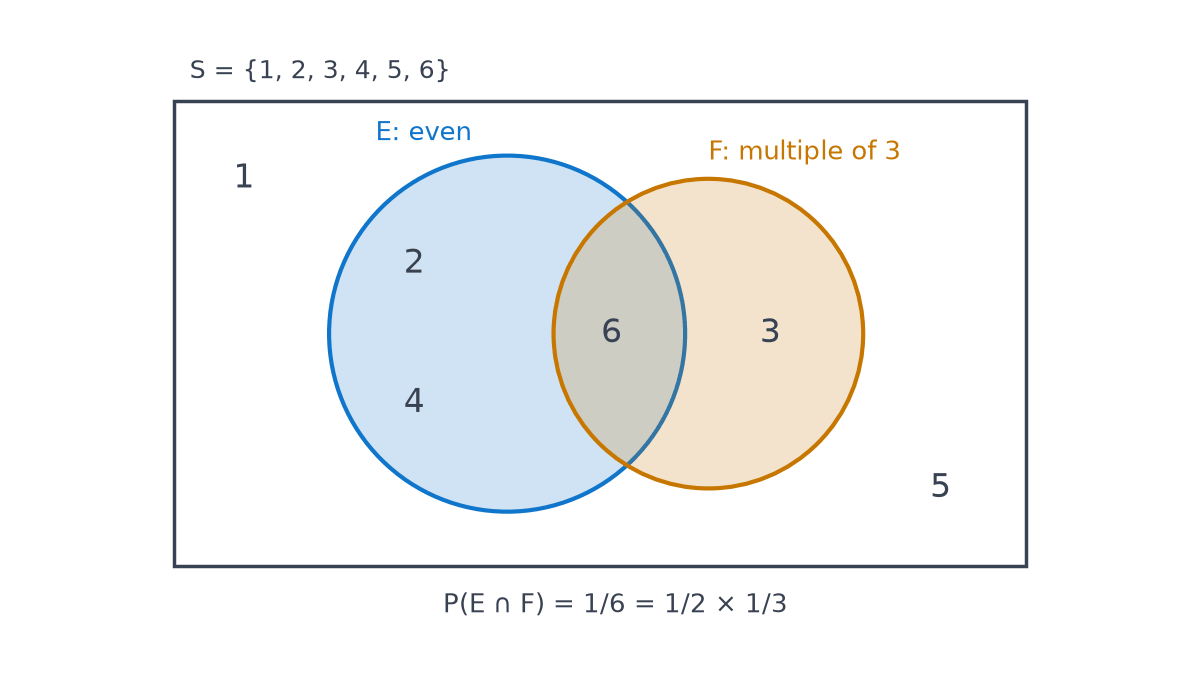
Example 6. Throw a die. Let E be "even" and F be "a multiple of 3". Then P(E∩F)=P({6})=61=21⋅31, so the two are independent.
E and F share only the outcome 6, and 1/6 = 1/2 x 1/3.
Example 7. Two students try a problem on their own, and they solve it with probabilities 32 and 53. The problem stays unsolved only if both fail, so P(solved)=1−31⋅52=1513. For exactly one of them, P(exactly one)=32⋅52+31⋅53=157.
P(E)=0.6, P(F)=0.3, P(E∩F)=0.2. Find P(E∣F) and P(F∣E).
A coin is tossed three times. Find P(at least two heads∣first toss is a head).
Two dice are thrown. Find P(sum>9∣one die shows 5).
A box has 4 good and 2 faulty bulbs. Two are drawn without replacement. Find P(both good) and P(one good, one faulty).
Are E = "a card is a heart" and F = "a card is a king" independent?
P(A)=0.3, P(B)=0.4, and A and B are independent. Find P(A∪B), P(A′∩B′) and P(A∣B′).
Three shooters hit a target with probabilities 21, 31 and 41. Find the probability that the target is hit at least once.
Show that if E and F are independent, then so are E′ and F′.
A die is thrown twice. A = first throw even, B = second throw odd, C = sum odd. Are A and B independent? What about A and C?
An urn has 3 white and 5 black balls. One ball is drawn, its colour is noted, and it goes back in along with 2 more of the same colour. Then a second ball is drawn. Find P(second is white).