Before you begin

Four­teen ques­tions from across the whole chap­ter. Two habits will carry you through. When eval­u­at­ing, bring every angle back to the first quad­rant and set­tle the sign from the quad­rant it came from. When prov­ing, start from the more com­pli­cated side and sim­plify it; that is almost always eas­ier than build­ing up the sim­ple side.

Ques­tions

  1. Con­vert −37∘30′-37^\circ 30' to radi­ans and 11π18\displaystyle \tfrac{11\pi}{18} to degrees.
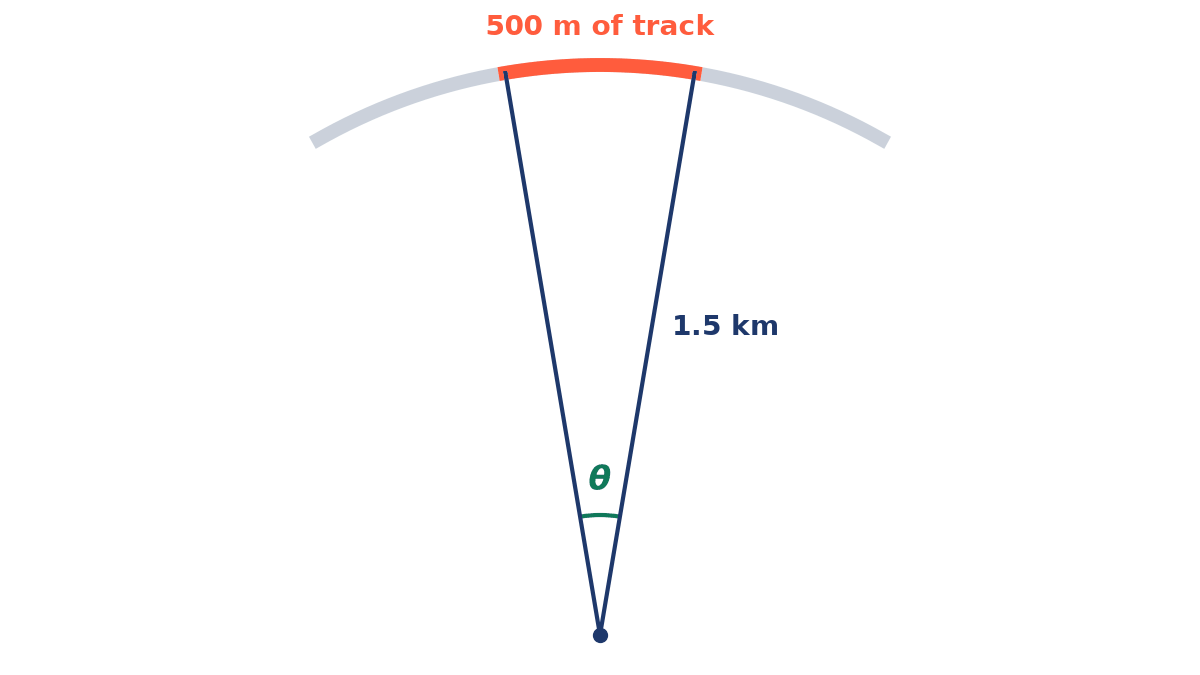
  2. A rail­way track curves along an arc of radius 1.51.5 km. Through what angle (in degrees) does a train turn while it trav­els 500500 m? Take π=227\displaystyle \pi = \tfrac{22}{7}.
  3. Given sec⁡x=−53\displaystyle \sec x = -\tfrac{5}{3} with xx in III, find the other five func­tions.
  4. Eval­u­ate: sin⁡765∘\sin 765^\circ; cot⁡(−15π4)\displaystyle \cot(-\tfrac{15\pi}{4}); cos⁡−19π3\displaystyle \cos \tfrac{-19\pi}{3}.
  5. Find: sin⁡2π6+cos⁡2π3−tan⁡2π4\displaystyle \sin^2 \tfrac{\pi}{6} + \cos^2 \tfrac{\pi}{3} - \tan^2 \tfrac{\pi}{4}.
  6. Prove: 2sin⁡23π4+2cos⁡2π4+2sec⁡2π3=10\displaystyle 2\sin^2 \tfrac{3\pi}{4} + 2\cos^2 \tfrac{\pi}{4} + 2\sec^2 \tfrac{\pi}{3} = 10.
  7. Find cos⁡(x−y)\cos(x - y) given cos⁡x=45\displaystyle \cos x = \tfrac{4}{5}, sin⁡y=513\displaystyle \sin y = \tfrac{5}{13}, x,yx, y acute.
  8. Prove: sin⁡(n+1)xsin⁡(n+2)x+cos⁡(n+1)xcos⁡(n+2)x=cos⁡x\sin(n + 1)x \sin(n + 2)x + \cos(n + 1)x \cos(n + 2)x = \cos x.
  9. Prove: cos⁡22x−cos⁡26x=sin⁡4xsin⁡8x\cos^2 2x - \cos^2 6x = \sin 4x \sin 8x.
  10. Prove: sin⁡x+sin⁡3xcos⁡x+cos⁡3x=tan⁡2x\displaystyle \frac{\sin x + \sin 3x}{\cos x + \cos 3x} = \tan 2x.
  11. Prove: cot⁡4x(sin⁡5x+sin⁡3x)=cot⁡x(sin⁡5x−sin⁡3x)\cot 4x(\sin 5x + \sin 3x) = \cot x(\sin 5x - \sin 3x).
  12. Given sin⁡x=14\displaystyle \sin x = \tfrac{1}{4} with xx in II, find sin⁡2x\sin 2x and cos⁡x2\displaystyle \cos \tfrac{x}{2}.
  13. Prove: tan⁡3xtan⁡2xtan⁡x=tan⁡3x−tan⁡2x−tan⁡x\tan 3x \tan 2x \tan x = \tan 3x - \tan 2x - \tan x.
  14. Prove: cos⁡6x=32cos⁡6x−48cos⁡4x+18cos⁡2x−1\cos 6x = 32\cos^6 x - 48\cos^4 x + 18\cos^2 x - 1.
Curved railway track drawn as an arc of a circle of radius 1.5 km; a 500 m stretch of track is highlighted and the angle theta it subtends at the centre is marked.
Ques­tion 2: 500 m of track on a curve of radius 1.5 km

Answers

Show answers
  1. −5π24\displaystyle -\tfrac{5\pi}{24}; 110∘110^\circ.
  2. θ=0.51.5=13\displaystyle \theta = \tfrac{0.5}{1.5} = \tfrac{1}{3} rad ≈19∘5′\approx 19^\circ 5' (180×73×22=19111∘\displaystyle \tfrac{180 \times 7}{3 \times 22} = 19\tfrac{1}{11}^\circ).
  3. cos⁡=−35\displaystyle \cos = -\tfrac{3}{5}, sin⁡=−45\displaystyle \sin = -\tfrac{4}{5}, tan⁡=43\displaystyle \tan = \tfrac{4}{3}, cot⁡=34\displaystyle \cot = \tfrac{3}{4}, csc⁡=−54\displaystyle \csc = -\tfrac{5}{4}.
  4. 12\displaystyle \tfrac{1}{\sqrt{2}}; 11; 12\displaystyle \tfrac{1}{2}.
  5. 14+14−1=−12\displaystyle \tfrac{1}{4} + \tfrac{1}{4} - 1 = -\tfrac{1}{2}.
  6. 1+1+8=101 + 1 + 8 = 10.
  7. cos⁡x=45\displaystyle \cos x = \tfrac{4}{5}, sin⁡x=35\displaystyle \sin x = \tfrac{3}{5}, cos⁡y=1213\displaystyle \cos y = \tfrac{12}{13}: 4865+1565=6365\displaystyle \tfrac{48}{65} + \tfrac{15}{65} = \tfrac{63}{65}.
  8. The left side is cos⁡((n+2)x−(n+1)x)\cos((n + 2)x - (n + 1)x).
  9. (cos⁡2x−cos⁡6x)(cos⁡2x+cos⁡6x)=(2sin⁡4xsin⁡2x)(2cos⁡4xcos⁡2x)=sin⁡8xsin⁡4x(\cos 2x - \cos 6x)(\cos 2x + \cos 6x) = (2\sin 4x \sin 2x)(2\cos 4x \cos 2x) = \sin 8x \sin 4x.
  10. 2sin⁡2xcos⁡x2cos⁡2xcos⁡x\displaystyle \frac{2\sin 2x \cos x}{2\cos 2x \cos x}.
  11. Left: cos⁡4xsin⁡4x⋅2sin⁡4xcos⁡x=2cos⁡4xcos⁡x\displaystyle \tfrac{\cos 4x}{\sin 4x} \cdot 2\sin 4x \cos x = 2\cos 4x\cos x. Right: cos⁡xsin⁡x⋅2cos⁡4xsin⁡x\displaystyle \tfrac{\cos x}{\sin x} \cdot 2\cos 4x \sin x, which is the same.
  12. cos⁡x=−154\displaystyle \cos x = -\tfrac{\sqrt{15}}{4}: sin⁡2x=−158\displaystyle \sin 2x = -\tfrac{\sqrt{15}}{8}; x2\displaystyle \tfrac{x}{2} in I: cos⁡x2=1−15/42=4−158\displaystyle \cos\tfrac{x}{2} = \sqrt{\tfrac{1 - \sqrt{15}/4}{2}} = \sqrt{\tfrac{4 - \sqrt{15}}{8}}.
  13. Start from tan⁡3x=tan⁡(2x+x)=tan⁡2x+tan⁡x1−tan⁡2xtan⁡x\displaystyle \tan 3x = \tan(2x + x) = \tfrac{\tan 2x + \tan x}{1 - \tan 2x \tan x}, then cross-mul­ti­ply and rearrange.
  14. cos⁡6x=2cos⁡23x−1\cos 6x = 2\cos^2 3x - 1 with cos⁡3x=4c3−3c\cos 3x = 4c^3 - 3c: 2(16c6−24c4+9c2)−12(16c^6 - 24c^4 + 9c^2) - 1.