Let us clear up the most common mistake first: cos ( x + y ) \cos(x + y) cos ( x + y ) cos x + cos y \cos x + \cos y cos x + cos y
cos ( x + y ) = cos x cos y − sin x sin y , cos ( x − y ) = cos x cos y + sin x sin y \cos(x + y) = \cos x \cos y - \sin x \sin y, \qquad \cos(x - y) = \cos x \cos y + \sin x \sin y cos ( x + y ) = cos x cos y − sin x sin y , cos ( x − y ) = cos x cos y + sin x sin y sin ( x + y ) = sin x cos y + cos x sin y , sin ( x − y ) = sin x cos y − cos x sin y \sin(x + y) = \sin x \cos y + \cos x \sin y, \qquad \sin(x - y) = \sin x \cos y - \cos x \sin y sin ( x + y ) = sin x cos y + cos x sin y , sin ( x − y ) = sin x cos y − cos x sin y tan ( x ± y ) = tan x ± tan y 1 ∓ tan x tan y , cot ( x ± y ) = cot x cot y ∓ 1 cot y ± cot x \displaystyle \tan(x \pm y) = \frac{\tan x \pm \tan y}{1 \mp \tan x \tan y}, \qquad \cot(x \pm y) = \frac{\cot x \cot y \mp 1}{\cot y \pm \cot x} tan ( x ± y ) = 1 ∓ tan x tan y tan x ± tan y , cot ( x ± y ) = cot y ± cot x cot x cot y ∓ 1
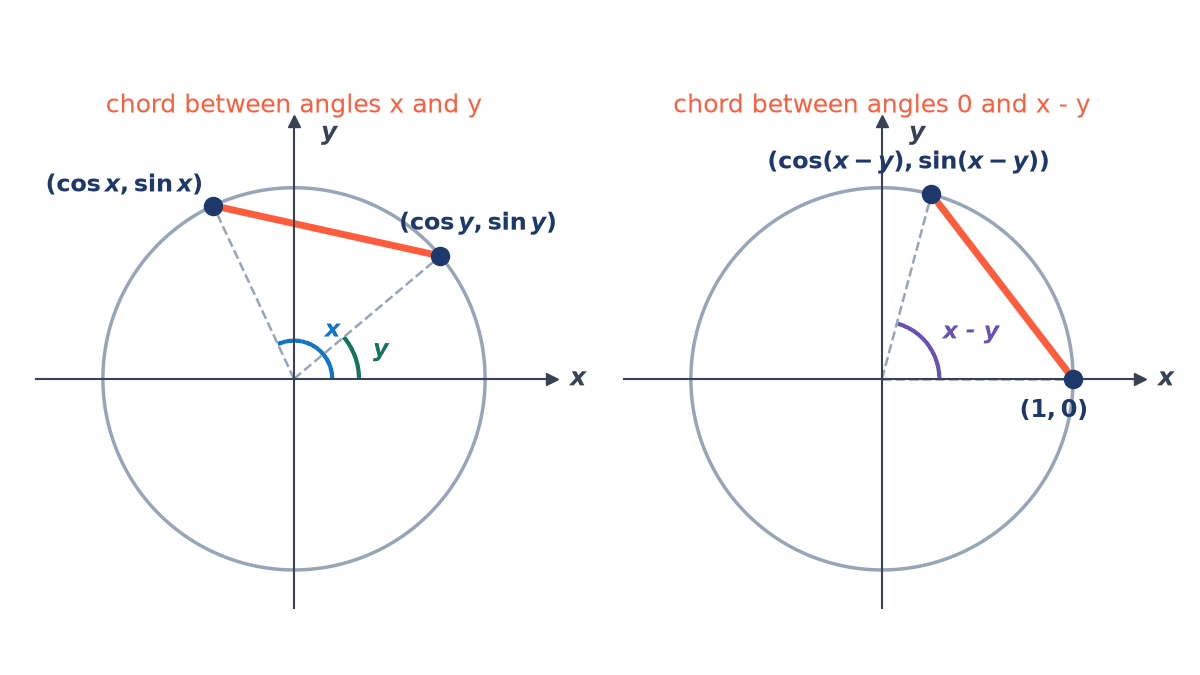
You don't need to memorise six separate proofs. Only the cosine difference formula needs real work: compare the chord joining the unit-circle points at angles x x x y y y ( 1 , 0 ) (1, 0) ( 1 , 0 ) x − y x - y x − y y → − y y \to -y y → − y x → π 2 − x \displaystyle x \to \tfrac{\pi}{2} - x x → 2 π − x
The two equal chords behind the cosine difference formula Consequences. The familiar allied-angle results drop straight out: cos ( π 2 − x ) = sin x \displaystyle \cos\left(\tfrac{\pi}{2} - x\right) = \sin x cos ( 2 π − x ) = sin x sin ( π − x ) = sin x \sin(\pi - x) = \sin x sin ( π − x ) = sin x cos ( π + x ) = − cos x \cos(\pi + x) = -\cos x cos ( π + x ) = − cos x sin ( 3 π 2 + x ) = − cos x \displaystyle \sin\left(\tfrac{3\pi}{2} + x\right) = -\cos x sin ( 2 3 π + x ) = − cos x
Example 1. cos 75 ∘ = cos ( 45 ∘ + 30 ∘ ) = 1 2 ⋅ 3 2 − 1 2 ⋅ 1 2 = 3 − 1 2 2 \displaystyle \cos 75^\circ = \cos(45^\circ + 30^\circ) = \tfrac{1}{\sqrt{2}} \cdot \tfrac{\sqrt{3}}{2} - \tfrac{1}{\sqrt{2}} \cdot \tfrac{1}{2} = \tfrac{\sqrt{3} - 1}{2\sqrt{2}} cos 7 5 ∘ = cos ( 4 5 ∘ + 3 0 ∘ ) = 2 1 ⋅ 2 3 − 2 1 ⋅ 2 1 = 2 2 3 − 1
Example 2. tan 105 ∘ = tan ( 60 ∘ + 45 ∘ ) = 3 + 1 1 − 3 = − ( 2 + 3 ) \displaystyle \tan 105^\circ = \tan(60^\circ + 45^\circ) = \frac{\sqrt{3} + 1}{1 - \sqrt{3}} = -(2 + \sqrt{3}) tan 10 5 ∘ = tan ( 6 0 ∘ + 4 5 ∘ ) = 1 − 3 3 + 1 = − ( 2 + 3 )
Example 3. Let sin x = 3 5 \displaystyle \sin x = \tfrac{3}{5} sin x = 5 3 cos y = − 5 13 \displaystyle \cos y = -\tfrac{5}{13} cos y = − 13 5 cos x = − 4 5 \displaystyle \cos x = -\tfrac{4}{5} cos x = − 5 4 sin y = 12 13 \displaystyle \sin y = \tfrac{12}{13} sin y = 13 12 sin ( x + y ) = 3 5 ( − 5 13 ) + ( − 4 5 ) 12 13 = − 63 65 \displaystyle \sin(x + y) = \tfrac{3}{5}\left(-\tfrac{5}{13}\right) + \left(-\tfrac{4}{5}\right)\tfrac{12}{13} = -\tfrac{63}{65} sin ( x + y ) = 5 3 ( − 13 5 ) + ( − 5 4 ) 13 12 = − 65 63
Double and triple angles#
sin 2 x = 2 sin x cos x = 2 tan x 1 + tan 2 x \displaystyle \sin 2x = 2\sin x \cos x = \frac{2\tan x}{1 + \tan^2 x} sin 2 x = 2 sin x cos x = 1 + tan 2 x 2 tan x cos 2 x = cos 2 x − sin 2 x = 2 cos 2 x − 1 = 1 − 2 sin 2 x = 1 − tan 2 x 1 + tan 2 x \displaystyle \cos 2x = \cos^2 x - \sin^2 x = 2\cos^2 x - 1 = 1 - 2\sin^2 x = \frac{1 - \tan^2 x}{1 + \tan^2 x} cos 2 x = cos 2 x − sin 2 x = 2 cos 2 x − 1 = 1 − 2 sin 2 x = 1 + tan 2 x 1 − tan 2 x tan 2 x = 2 tan x 1 − tan 2 x \displaystyle \tan 2x = \frac{2\tan x}{1 - \tan^2 x} tan 2 x = 1 − tan 2 x 2 tan x sin 3 x = 3 sin x − 4 sin 3 x , cos 3 x = 4 cos 3 x − 3 cos x , tan 3 x = 3 tan x − tan 3 x 1 − 3 tan 2 x \displaystyle \sin 3x = 3\sin x - 4\sin^3 x, \quad \cos 3x = 4\cos^3 x - 3\cos x, \quad \tan 3x = \frac{3\tan x - \tan^3 x}{1 - 3\tan^2 x} sin 3 x = 3 sin x − 4 sin 3 x , cos 3 x = 4 cos 3 x − 3 cos x , tan 3 x = 1 − 3 tan 2 x 3 tan x − tan 3 x
Half angles come from reading the cos 2 x \cos 2x cos 2 x sin 2 x 2 = 1 − cos x 2 \displaystyle \sin^2 \tfrac{x}{2} = \tfrac{1 - \cos x}{2} sin 2 2 x = 2 1 − c o s x cos 2 x 2 = 1 + cos x 2 \displaystyle \cos^2 \tfrac{x}{2} = \tfrac{1 + \cos x}{2} cos 2 2 x = 2 1 + c o s x
Example 4. To find tan π 8 \displaystyle \tan \tfrac{\pi}{8} tan 8 π x = π 8 \displaystyle x = \tfrac{\pi}{8} x = 8 π tan 2 x = 1 = 2 t 1 − t 2 \displaystyle \tan 2x = 1 = \tfrac{2t}{1 - t^2} tan 2 x = 1 = 1 − t 2 2 t t 2 + 2 t − 1 = 0 t^2 + 2t - 1 = 0 t 2 + 2 t − 1 = 0 t = 2 − 1 t = \sqrt{2} - 1 t = 2 − 1
Example 5. Let cos x = − 7 25 \displaystyle \cos x = -\tfrac{7}{25} cos x = − 25 7 π < x < 3 π 2 \displaystyle \pi < x < \tfrac{3\pi}{2} π < x < 2 3 π x 2 \displaystyle \tfrac{x}{2} 2 x sin x 2 = 1 + 7 / 25 2 = 4 5 \displaystyle \sin \tfrac{x}{2} = \sqrt{\tfrac{1 + 7/25}{2}} = \tfrac{4}{5} sin 2 x = 2 1 + 7/25 = 5 4 cos x 2 = − 1 − 7 / 25 2 = − 3 5 \displaystyle \cos \tfrac{x}{2} = -\sqrt{\tfrac{1 - 7/25}{2}} = -\tfrac{3}{5} cos 2 x = − 2 1 − 7/25 = − 5 3 tan x 2 = − 4 3 \displaystyle \tan \tfrac{x}{2} = -\tfrac{4}{3} tan 2 x = − 3 4
Sum-to-product and product-to-sum#
sin x + sin y = 2 sin x + y 2 cos x − y 2 , sin x − sin y = 2 cos x + y 2 sin x − y 2 \displaystyle \sin x + \sin y = 2\sin\tfrac{x + y}{2}\cos\tfrac{x - y}{2}, \qquad \sin x - \sin y = 2\cos\tfrac{x + y}{2}\sin\tfrac{x - y}{2} sin x + sin y = 2 sin 2 x + y cos 2 x − y , sin x − sin y = 2 cos 2 x + y sin 2 x − y cos x + cos y = 2 cos x + y 2 cos x − y 2 , cos x − cos y = − 2 sin x + y 2 sin x − y 2 \displaystyle \cos x + \cos y = 2\cos\tfrac{x + y}{2}\cos\tfrac{x - y}{2}, \qquad \cos x - \cos y = -2\sin\tfrac{x + y}{2}\sin\tfrac{x - y}{2} cos x + cos y = 2 cos 2 x + y cos 2 x − y , cos x − cos y = − 2 sin 2 x + y sin 2 x − y
Going the other way, products turn back into sums: 2 sin x cos y = sin ( x + y ) + sin ( x − y ) 2\sin x \cos y = \sin(x + y) + \sin(x - y) 2 sin x cos y = sin ( x + y ) + sin ( x − y ) 2 cos x cos y = cos ( x + y ) + cos ( x − y ) 2\cos x \cos y = \cos(x + y) + \cos(x - y) 2 cos x cos y = cos ( x + y ) + cos ( x − y ) 2 sin x sin y = cos ( x − y ) − cos ( x + y ) 2\sin x \sin y = \cos(x - y) - \cos(x + y) 2 sin x sin y = cos ( x − y ) − cos ( x + y )
Example 6. sin 7 x + sin 3 x cos 7 x + cos 3 x = 2 sin 5 x cos 2 x 2 cos 5 x cos 2 x = tan 5 x \displaystyle \frac{\sin 7x + \sin 3x}{\cos 7x + \cos 3x} = \frac{2\sin 5x \cos 2x}{2\cos 5x \cos 2x} = \tan 5x cos 7 x + cos 3 x sin 7 x + sin 3 x = 2 cos 5 x cos 2 x 2 sin 5 x cos 2 x = tan 5 x
Example 7. Here is a lovely trick for cos 20 ∘ cos 40 ∘ cos 80 ∘ \cos 20^\circ \cos 40^\circ \cos 80^\circ cos 2 0 ∘ cos 4 0 ∘ cos 8 0 ∘ 8 sin 20 ∘ 8\sin 20^\circ 8 sin 2 0 ∘ 2 sin θ cos θ = sin 2 θ 2\sin\theta\cos\theta = \sin 2\theta 2 sin θ cos θ = sin 2 θ sin 160 ∘ 8 sin 20 ∘ = 1 8 \displaystyle \frac{\sin 160^\circ}{8\sin 20^\circ} = \tfrac{1}{8} 8 sin 2 0 ∘ sin 16 0 ∘ = 8 1
Practice questions#
Find exactly: sin 15 ∘ \sin 15^\circ sin 1 5 ∘ cos 105 ∘ \cos 105^\circ cos 10 5 ∘ tan 75 ∘ \tan 75^\circ tan 7 5 ∘
Prove: cos ( π 4 + x ) + cos ( π 4 − x ) = 2 cos x \displaystyle \cos\left(\tfrac{\pi}{4} + x\right) + \cos\left(\tfrac{\pi}{4} - x\right) = \sqrt{2}\cos x cos ( 4 π + x ) + cos ( 4 π − x ) = 2 cos x
Prove: tan ( π 4 + x ) tan ( π 4 − x ) = ( 1 + tan x 1 − tan x ) 2 \displaystyle \frac{\tan(\tfrac{\pi}{4} + x)}{\tan(\tfrac{\pi}{4} - x)} = \left(\frac{1 + \tan x}{1 - \tan x}\right)^2 tan ( 4 π − x ) tan ( 4 π + x ) = ( 1 − tan x 1 + tan x ) 2
tan A = 1 2 \displaystyle \tan A = \tfrac{1}{2} tan A = 2 1 tan B = 1 3 \displaystyle \tan B = \tfrac{1}{3} tan B = 3 1 A + B = π 4 \displaystyle A + B = \tfrac{\pi}{4} A + B = 4 π sin x = 12 13 \displaystyle \sin x = \tfrac{12}{13} sin x = 13 12 x x x sin 2 x \sin 2x sin 2 x cos 2 x \cos 2x cos 2 x tan 2 x \tan 2x tan 2 x tan x = 3 4 \displaystyle \tan x = \tfrac{3}{4} tan x = 4 3 π < x < 3 π 2 \displaystyle \pi < x < \tfrac{3\pi}{2} π < x < 2 3 π sin x 2 \displaystyle \sin \tfrac{x}{2} sin 2 x cos x 2 \displaystyle \cos \tfrac{x}{2} cos 2 x Prove: sin 5 x − sin 3 x cos 5 x + cos 3 x = tan x \displaystyle \frac{\sin 5x - \sin 3x}{\cos 5x + \cos 3x} = \tan x cos 5 x + cos 3 x sin 5 x − sin 3 x = tan x
Prove: cos 4 x = 1 − 8 sin 2 x cos 2 x \cos 4x = 1 - 8\sin^2 x \cos^2 x cos 4 x = 1 − 8 sin 2 x cos 2 x
Prove: sin 3 x + sin 2 x − sin x = 4 sin x cos x 2 cos 3 x 2 \displaystyle \sin 3x + \sin 2x - \sin x = 4\sin x \cos\tfrac{x}{2}\cos\tfrac{3x}{2} sin 3 x + sin 2 x − sin x = 4 sin x cos 2 x cos 2 3 x
Find sin 18 ∘ \sin 18^\circ sin 1 8 ∘ sin 2 θ = cos 3 θ \sin 2\theta = \cos 3\theta sin 2 θ = cos 3 θ θ = 18 ∘ \theta = 18^\circ θ = 1 8 ∘
Answers#
Show answers
3 − 1 2 2 \displaystyle \tfrac{\sqrt{3} - 1}{2\sqrt{2}} 2 2 3 − 1 1 − 3 2 2 \displaystyle \tfrac{1 - \sqrt{3}}{2\sqrt{2}} 2 2 1 − 3 2 + 3 2 + \sqrt{3} 2 + 3 The sin \sin sin 2 cos π 4 cos x \displaystyle 2\cos\tfrac{\pi}{4}\cos x 2 cos 4 π cos x
tan ( π 4 ± x ) = 1 ± tan x 1 ∓ tan x \displaystyle \tan(\tfrac{\pi}{4} \pm x) = \tfrac{1 \pm \tan x}{1 \mp \tan x} tan ( 4 π ± x ) = 1 ∓ t a n x 1 ± t a n x tan ( A + B ) = 1 / 2 + 1 / 3 1 − 1 / 6 = 1 \displaystyle \tan(A + B) = \tfrac{1/2 + 1/3}{1 - 1/6} = 1 tan ( A + B ) = 1 − 1/6 1/2 + 1/3 = 1 cos x = − 5 13 \displaystyle \cos x = -\tfrac{5}{13} cos x = − 13 5 sin 2 x = − 120 169 \displaystyle \sin 2x = -\tfrac{120}{169} sin 2 x = − 169 120 cos 2 x = − 119 169 \displaystyle \cos 2x = -\tfrac{119}{169} cos 2 x = − 169 119 tan 2 x = 120 119 \displaystyle \tan 2x = \tfrac{120}{119} tan 2 x = 119 120 cos x = − 4 5 \displaystyle \cos x = -\tfrac{4}{5} cos x = − 5 4 x 2 \displaystyle \tfrac{x}{2} 2 x sin x 2 = 3 10 \displaystyle \sin \tfrac{x}{2} = \tfrac{3}{\sqrt{10}} sin 2 x = 10 3 cos x 2 = − 1 10 \displaystyle \cos \tfrac{x}{2} = -\tfrac{1}{\sqrt{10}} cos 2 x = − 10 1 2 cos 4 x sin x 2 cos 4 x cos x \displaystyle \frac{2\cos 4x \sin x}{2\cos 4x \cos x} 2 cos 4 x cos x 2 cos 4 x sin x cos 4 x = 1 − 2 sin 2 2 x = 1 − 8 sin 2 x cos 2 x \cos 4x = 1 - 2\sin^2 2x = 1 - 8\sin^2 x\cos^2 x cos 4 x = 1 − 2 sin 2 2 x = 1 − 8 sin 2 x cos 2 x sin 3 x − sin x = 2 cos 2 x sin x \sin 3x - \sin x = 2\cos 2x \sin x sin 3 x − sin x = 2 cos 2 x sin x sin 2 x = 2 sin x cos x \sin 2x = 2\sin x \cos x sin 2 x = 2 sin x cos x 2 sin x ( cos 2 x + cos x ) = 4 sin x cos 3 x 2 cos x 2 \displaystyle 2\sin x(\cos 2x + \cos x) = 4\sin x \cos\tfrac{3x}{2}\cos\tfrac{x}{2} 2 sin x ( cos 2 x + cos x ) = 4 sin x cos 2 3 x cos 2 x 2 sin θ cos θ = 4 cos 3 θ − 3 cos θ 2\sin\theta\cos\theta = 4\cos^3\theta - 3\cos\theta 2 sin θ cos θ = 4 cos 3 θ − 3 cos θ cos θ \cos\theta cos θ 2 s = 1 − 4 s 2 2s = 1 - 4s^2 2 s = 1 − 4 s 2 s = 5 − 1 4 \displaystyle s = \tfrac{\sqrt{5} - 1}{4} s = 4 5 − 1