In earlier classes, trigonometry lived inside right triangles, so every angle was acute. That is too small a world. A wheel keeps turning past ninety degrees, and a clock hand goes round and round. So here an angle becomes a rotation of any size, positive or negative, measured in degrees or in radians, and sine and cosine become functions of every real number. You will convert between degrees and radians, use l=rθ, define the six trigonometric functions on the unit circle, and work out their signs, periods and values for large or negative angles.
Think of an angle as the amount a ray rotates about its starting point. Anticlockwise turns count as positive and clockwise turns as negative. One full turn is 360∘, and each degree is split further: 1∘=60′, 1′=60′′.
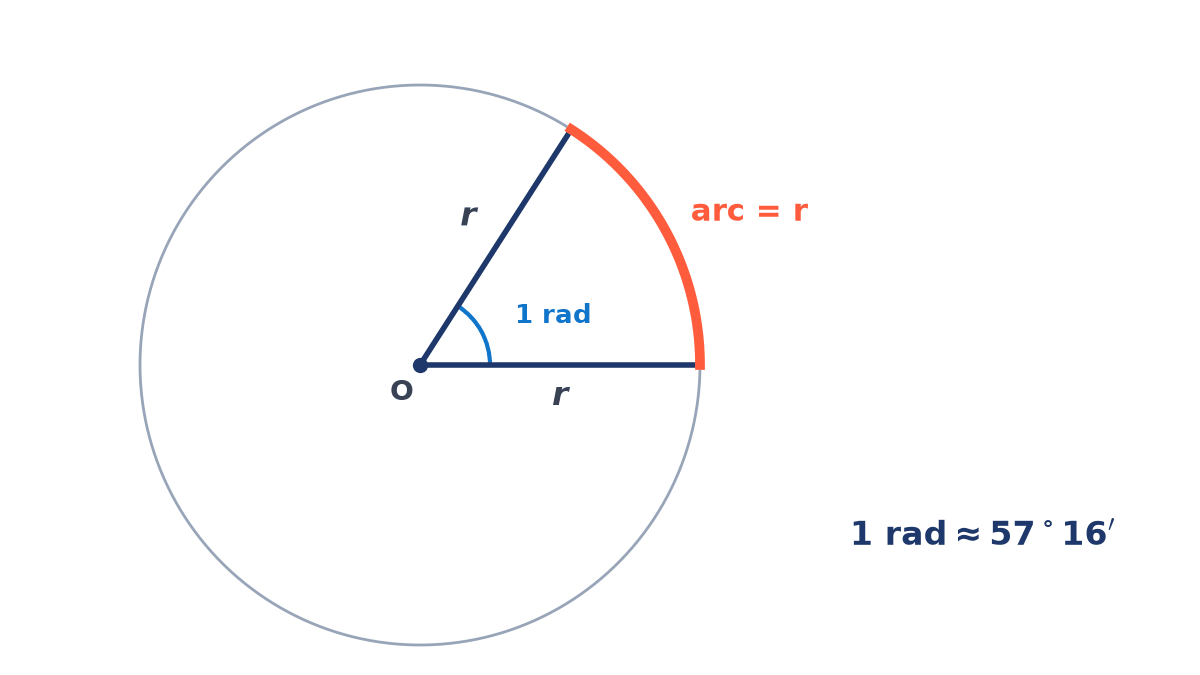
Degrees are a human choice. The radian comes from the circle itself: it is the angle subtended at the centre by an arc whose length equals the radius. A full turn is 2π radians, so
One radian: the arc is as long as the radius
π rad=180∘,1 rad≈57∘16′,1∘=180π rad.
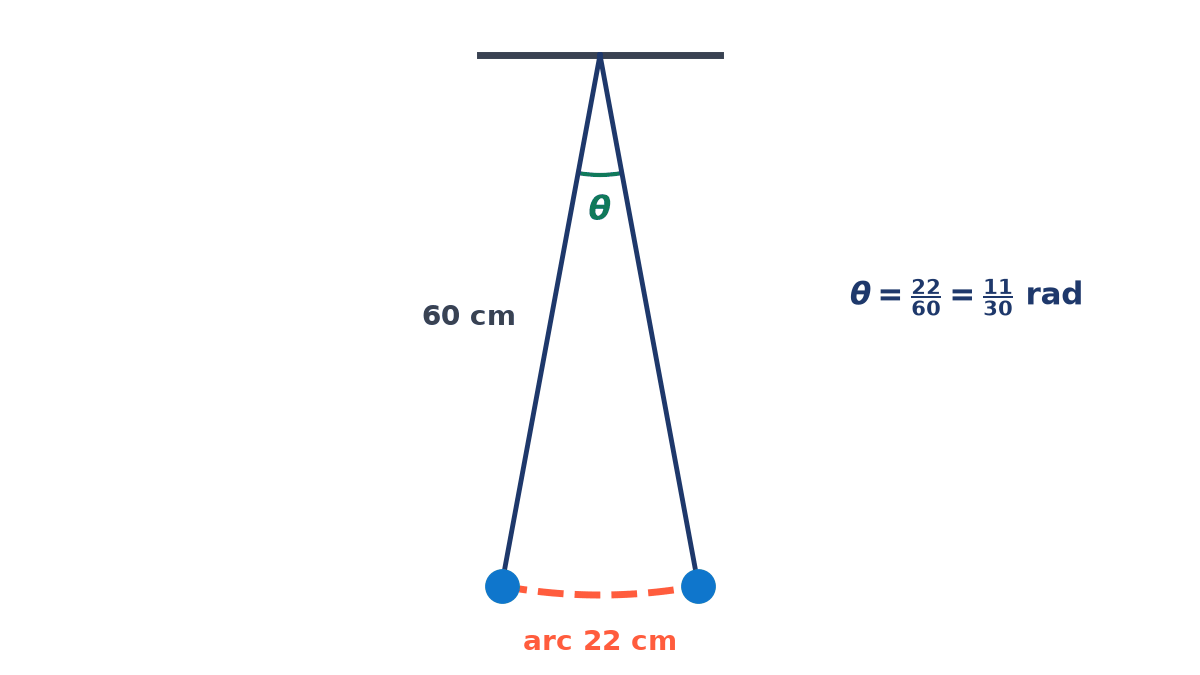
This is why radians are so convenient. An arc of length l on a circle of radius r subtends θ=rl radians, which gives the tidy formula l=rθ. There is no stray conversion factor to remember.
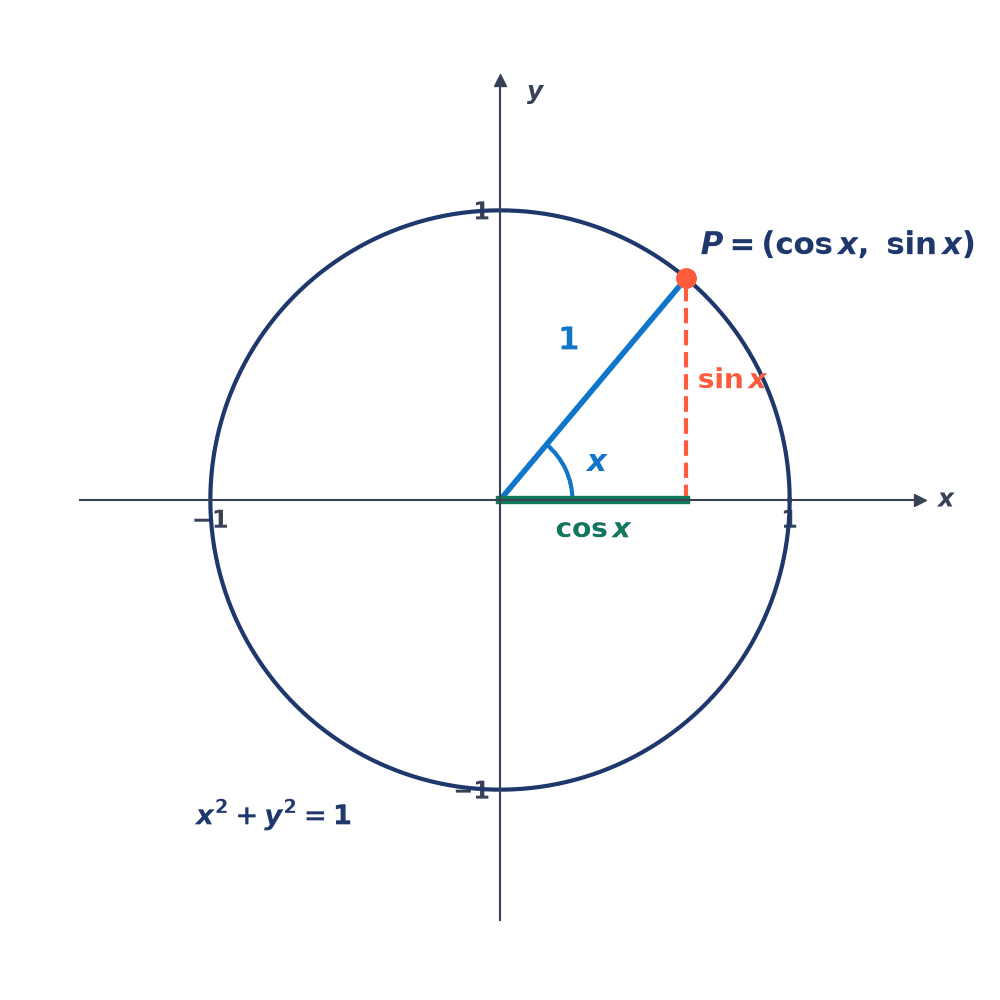
Here is the key idea. Draw the unit circle x2+y2=1. Turn a ray through angle x (in radians) from the positive x-axis; it meets the circle at a point, and we simply define that point to be P=(cosx,sinx). For an acute angle this agrees with the triangle definitions you already know, but now it works for any angle at all. The other four functions follow:
On the unit circle the point at angle x is (cos x, sin x)
Because P lies on the unit circle, sin2x+cos2x=1 comes for free. Divide it through by the square of cosine, and then of sine, and you get 1+tan2x=sec2x and 1+cot2x=csc2x.
Zeros.sinx=0 at x=nπ, and cosx=0 at x=(2n+1)2π.
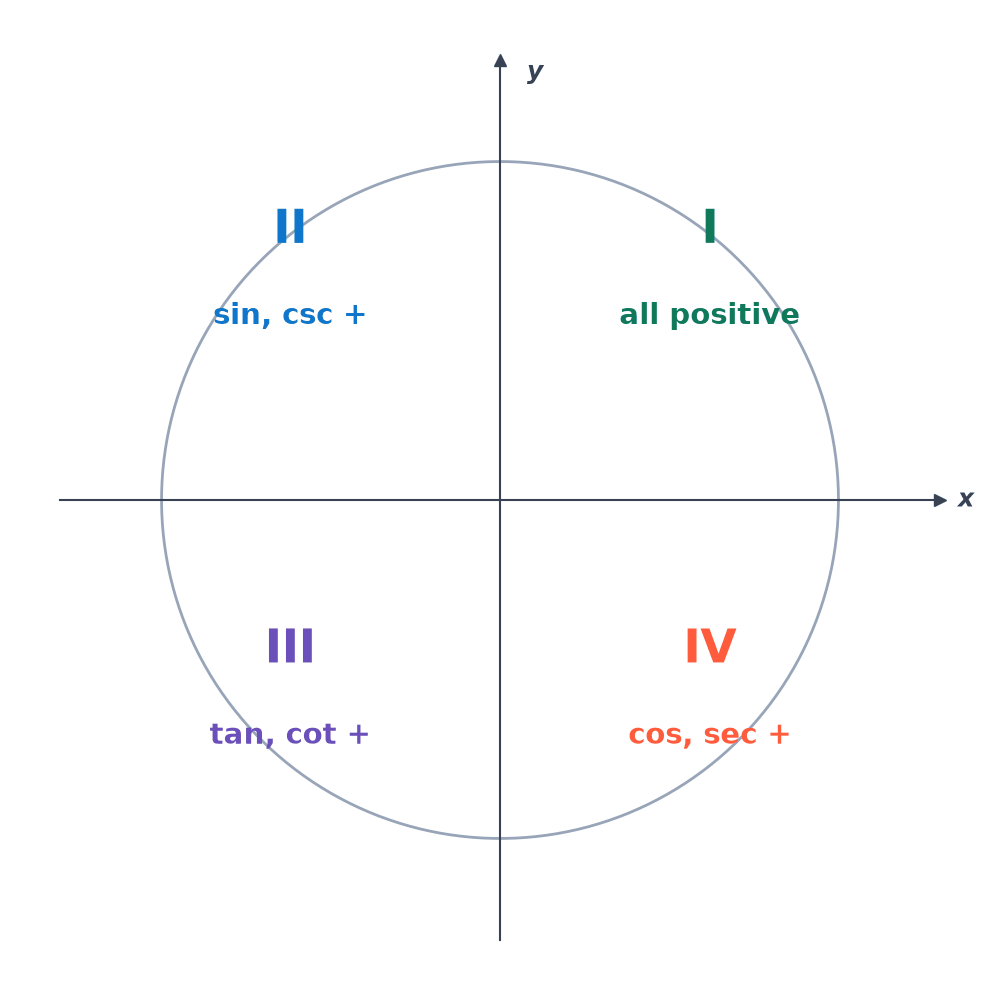
Signs depend on the quadrant. Many students remember the order as "all, sine, tangent, cosine" for the positive ones in I, II, III and IV:
I
II
III
IV
sin, csc
+
+
−
−
cos, sec
+
−
−
+
tan, cot
+
−
+
−
Which functions are positive in each quadrant
Ranges. Since the point never leaves the unit circle, −1≤sinx,cosx≤1. On the other hand tanx and cotx take every real value, and ∣secx∣,∣cscx∣≥1.
Periods. One full turn brings the point back to where it started, so sin, cos, sec, csc repeat every 2π. The functions tan and cot repeat sooner, every π. Reflecting in the horizontal axis also gives sin(−x)=−sinx and cos(−x)=cosx.
In practice, to find a value you settle the sign from the quadrant, and find the size from a right triangle or a known angle.
Example 5. Suppose sinx=−178 with x in quadrant III. Only tangent and cotangent are positive there, so cosx=−1715, tanx=158, cotx=815, secx=−1517 and cscx=−817.
Example 6. Suppose tanx=−247 with x in quadrant IV. Then sec2x=1+57649=576625. Secant is positive in IV, so secx=2425, giving cosx=2524 and sinx=−257.
Example 7. For big angles, strip off whole periods first. cos625π=cos(4π+6π)=23. Next, tan(−413π)=−tan(3π+4π)=−1. And sin(−1470∘)=−sin(1470∘−4×360∘)=−sin30∘=−21.