Before you start

Twelve ques­tions on straight lines. A small habit that saves a lot of trou­ble: sketch the points roughly before you cal­cu­late any­thing. Then look at what the ques­tion gives you and let that decide which form of the equa­tion to use.

The ques­tions

  1. Find the equa­tion of the line through (−2,3)(-2, 3) with incli­na­tion 135∘135^\circ.
  2. Find pp if (p,1)(p, 1), (3,5)(3, 5) and (7,13)(7, 13) are collinear.
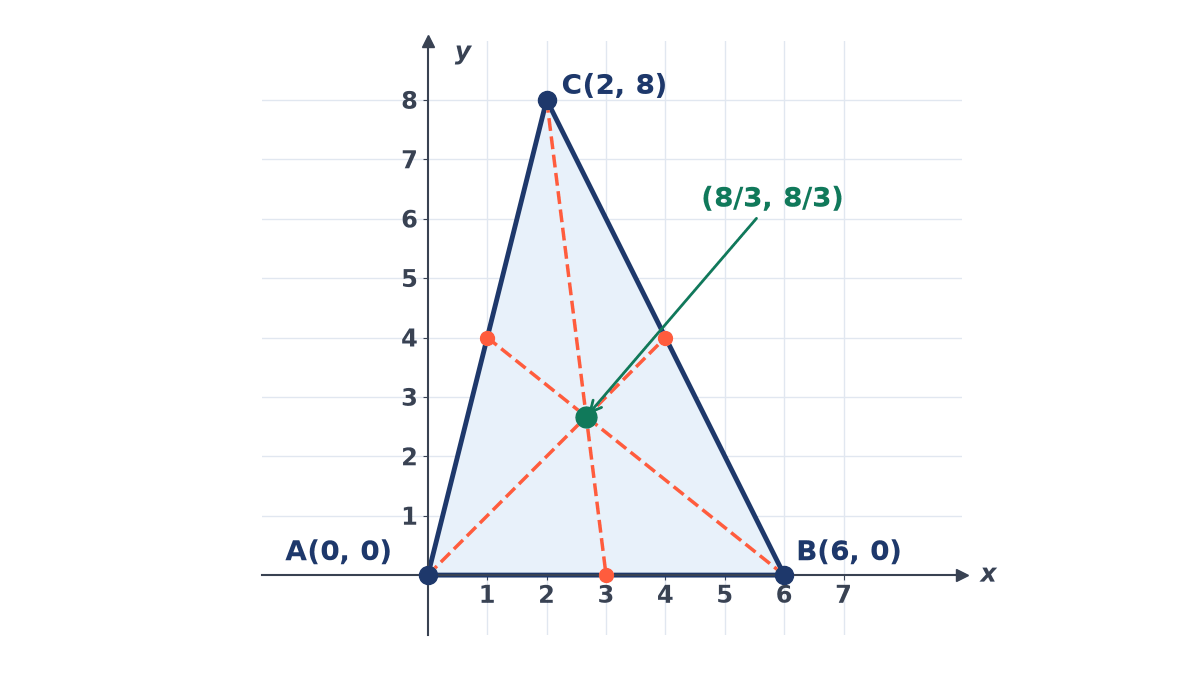
  3. Find the equa­tions of the medi­ans of the tri­an­gle A(0,0)A(0, 0), B(6,0)B(6, 0), C(2,8)C(2, 8) and ver­ify that they meet at (83,83)\displaystyle (\tfrac{8}{3}, \tfrac{8}{3}).
  4. Find the point on the xx-axis equidis­tant from (1,4)(1, 4) and (5,2)(5, 2).
  5. Find the equa­tion of the line through the inter­sec­tion of 2x+y=52x + y = 5 and x−3y=−1x - 3y = -1 and per­pen­dic­u­lar to x+y=0x + y = 0.
  6. Find the angle between 3x−y=2\sqrt{3}x - y = 2 and x−3y=5x - \sqrt{3}y = 5.
  7. Find the image of (1,2)(1, 2) in the line x−3y+4=0x - 3y + 4 = 0.
  8. Find the equa­tions of the lines through (1,2)(1, 2) mak­ing an angle of 45∘45^\circ with 3x−y=73x - y = 7.
  9. Find the dis­tance of the point (2,3)(2, 3) from the line 2x−3y+9=02x - 3y + 9 = 0 mea­sured along the line x−y+1=0x - y + 1 = 0.
  10. Show that the area of the tri­an­gle formed by y=m1x+c1y = m_1x + c_1, y=m2x+c2y = m_2x + c_2 and x=0x = 0 is (c1−c2)22∣m1−m2∣\displaystyle \frac{(c_1 - c_2)^2}{2\lvert m_1 - m_2 \rvert}.
  11. A stu­den­t's monthly phone bill comes to ₹250250 when she uses 300300 min­utes and ₹370370 when she uses 500500 min­utes. If the bill grows lin­early with the min­utes used, what is the fixed charge?
  12. Find the equa­tion of the line whose per­pen­dic­u­lar dis­tance from the ori­gin is 44 and whose nor­mal makes 30∘30^\circ with the pos­i­tive xx-axis.
Triangle with vertices A(0, 0), B(6, 0) and C(2, 8); dashed medians run from each vertex to the midpoint of the opposite side, (4, 4), (1, 4) and (3, 0), and meet at (8/3, 8/3).
Ques­tion 3: the three medi­ans meet at one point

Answers to check against

Show answers
  1. The slope is −1-1, so x+y−1=0x + y - 1 = 0.
  2. The slope must be 22 through­out: 5−13−p=2\displaystyle \tfrac{5 - 1}{3 - p} = 2, p=1p = 1.
  3. Mid­points (4,4)(4, 4), (1,4)(1, 4), (3,0)(3, 0). The medi­ans are y=xy = x; 4x+5y=244x + 5y = 24; 8x+y=248x + y = 24, and all three pass through (83,83)\displaystyle (\tfrac{8}{3}, \tfrac{8}{3}).
  4. (x−1)2+16=(x−5)2+4(x - 1)^2 + 16 = (x - 5)^2 + 4: x=32\displaystyle x = \tfrac{3}{2}.
  5. The lines meet at (2,1)(2, 1) and the required slope is 11, so x−y−1=0x - y - 1 = 0.
  6. Slopes 3\sqrt{3} and 13\displaystyle \tfrac{1}{\sqrt{3}}: 30∘30^\circ.
  7. Foot (1110,1710)\displaystyle \left(\tfrac{11}{10}, \tfrac{17}{10}\right); image (65,75)\displaystyle \left(\tfrac{6}{5}, \tfrac{7}{5}\right).
  8. ∣m−31+3m∣=1\displaystyle \left\lvert\tfrac{m - 3}{1 + 3m}\right\rvert = 1: m=−2m = -2 or 12\displaystyle \tfrac{1}{2}: 2x+y−4=02x + y - 4 = 0 and x−2y+3=0x - 2y + 3 = 0.
  9. The two lines meet at (6,7)(6, 7), so the dis­tance is 16+16=42\sqrt{16 + 16} = 4\sqrt{2}.
  10. Ver­tices (0,c1)(0, c_1), (0,c2)(0, c_2) and (c2−c1m1−m2,…)\displaystyle \left(\tfrac{c_2 - c_1}{m_1 - m_2}, \ldots\right); base ∣c1−c2∣\lvert c_1 - c_2 \rvert, height ∣c1−c2∣∣m1−m2∣\displaystyle \tfrac{\lvert c_1 - c_2 \rvert}{\lvert m_1 - m_2 \rvert}.
  11. The rate is 120200=0.6\displaystyle \tfrac{120}{200} = 0.6 per minute, so the fixed charge is 250−180=70250 - 180 = 70 rupees.
  12. xcos⁡30∘+ysin⁡30∘=4x\cos 30^\circ + y\sin 30^\circ = 4: 3x+y=8\sqrt{3}x + y = 8.