Think of a road climbing up a ghat. How steep it is can be captured by one number, its slope. Compare the slopes of two lines and you can tell at once whether they are parallel or perpendicular. We will quickly revise the distance and section formulas, define slope and inclination, use slopes to check whether points lie on one line, and find the angle between two lines.
You already know these from earlier classes. Distance: PQ=(x2−x1)2+(y2−y1)2. The point dividing PQ internally in the ratio m:n: (m+nmx2+nx1,m+nmy2+ny1). And the area of a triangle: 21∣x1(y2−y3)+x2(y3−y1)+x3(y1−y2)∣.
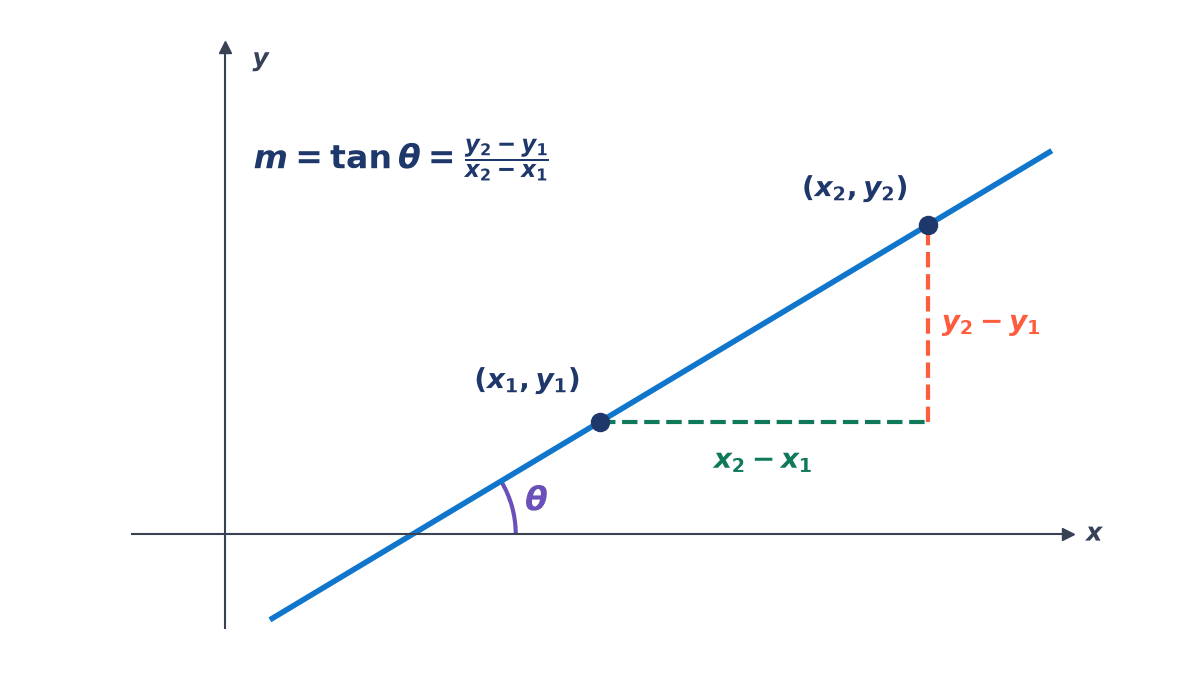
The inclinationθ of a line is the angle it makes with the positive x-axis, 0≤θ<π. Its slope is simply m=tanθ (θ=2π). If you know two points (x1,y1) and (x2,y2) on it, with x1=x2, the slope is rise over run:
Slope is rise over run, and equals the tangent of the inclination
m=x2−x1y2−y1.
A horizontal line has slope 0, while a vertical line has no slope at all. As you read from left to right, a line with positive slope climbs and one with negative slope goes downhill.
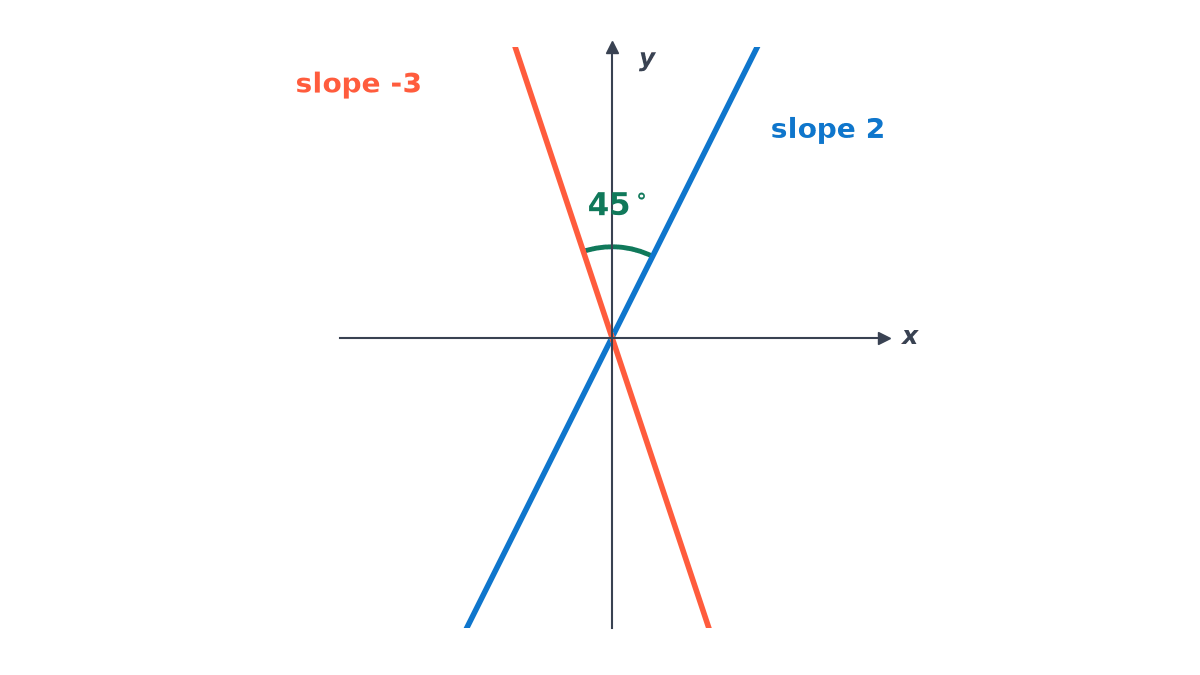
Parallel and perpendicular. Two non-vertical lines are parallel exactly when m1=m2, and they are perpendicular exactly when m1m2=−1.
Collinearity.A, B, C lie on one line exactly when slope AB = slope BC.
Example 1. The slope of the line through (2,−3) and (−4,9) is −612=−2.
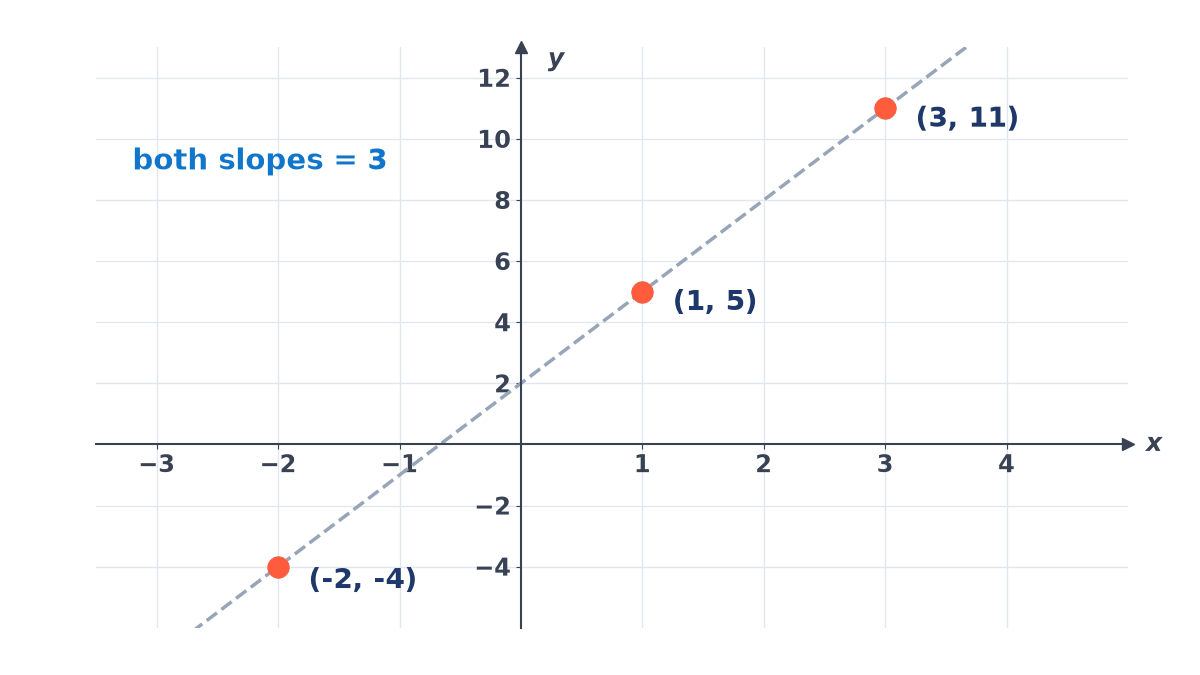
Example 2. Are (1,5), (3,11), (−2,−4) collinear? The two slopes are 26=3 and 515=3, the same, so yes.
Example 2: the three points lie on one line of slope 3
Example 3. A line through (3,k) and (5,7) is perpendicular to one of slope 21, so its own slope must be the negative reciprocal: 27−k=−2, k=11.