What pins a line down?

You need sur­pris­ingly lit­tle to fix a line: a point and a slope will do, or two points, or the places where it cuts the axes. Each of these gives its own form of the equa­tion, and we will write them all down. Then you will learn to turn the gen­eral equa­tion Ax+By+C=0Ax + By + C = 0 into whichever form is handy, and to mea­sure how far a point is from a line, and how far apart two par­al­lel lines are.

The stan­dard forms

  • Hor­i­zon­tal / ver­ti­cal: y=by = b; x=ax = a.
  • Point–slope: if the line passes through (x0,y0)(x_0, y_0) with slope mm, then y−y0=m(x−x0)y - y_0 = m(x - x_0).
  • Two-point: y−y1=y2−y1x2−x1(x−x1)\displaystyle y - y_1 = \frac{y_2 - y_1}{x_2 - x_1}(x - x_1).
  • Slope–inter­cept: y=mx+cy = mx + c (cc the yy-inter­cept); or y=m(x−d)y = m(x - d) with xx-inter­cept dd.
  • Inter­cept form: xa+yb=1\displaystyle \frac{x}{a} + \frac{y}{b} = 1, for a line cut­ting the axes at (a,0)(a, 0) and (0,b)(0, b).
  • Gen­eral form: Ax+By+C=0Ax + By + C = 0 (A,BA, B not both 00): slope −AB\displaystyle -\tfrac{A}{B}, xx-inter­cept −CA\displaystyle -\tfrac{C}{A}, yy-inter­cept −CB\displaystyle -\tfrac{C}{B}.

Exam­ple 1. The line through (−1,4)(-1, 4) with slope −3-3 is y−4=−3(x+1)y - 4 = -3(x + 1), i.e. 3x+y−1=03x + y - 1 = 0.

Exam­ple 2. For the line through (2,5)(2, 5) and (−4,−7)(-4, -7), the slope works out to 22, so y−5=2(x−2)y - 5 = 2(x - 2), i.e. 2x−y+1=02x - y + 1 = 0.

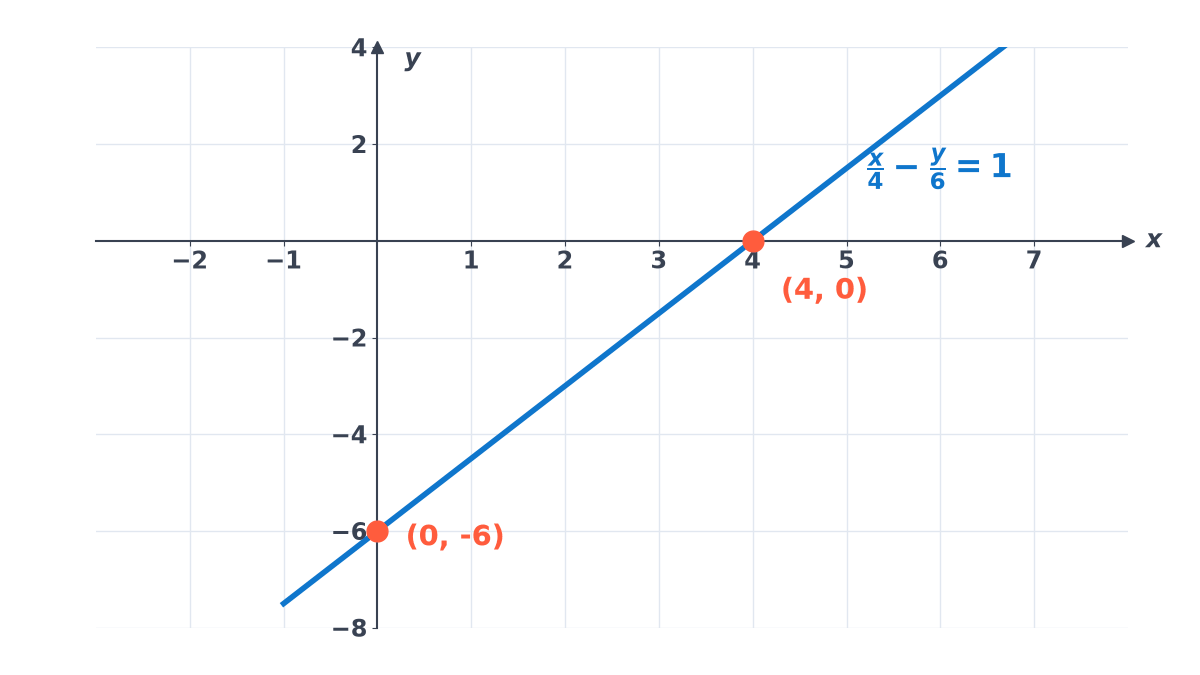
Exam­ple 3. With inter­cepts 44 and −6-6 we get x4−y6=1\displaystyle \tfrac{x}{4} - \tfrac{y}{6} = 1, i.e. 3x−2y=123x - 2y = 12.

Graph of the line x/4 - y/6 = 1, that is 3x - 2y = 12, cutting the x-axis at (4, 0) and the y-axis at (0, -6).
Exam­ple 3: the line with inter­cepts 4 and -6

Exam­ple 4. A line through (3,2)(3, 2) mak­ing equal inter­cepts on the axes must sat­isfy xa+ya=1\displaystyle \tfrac{x}{a} + \tfrac{y}{a} = 1, which gives a=5a = 5, so the line is x+y=5x + y = 5.

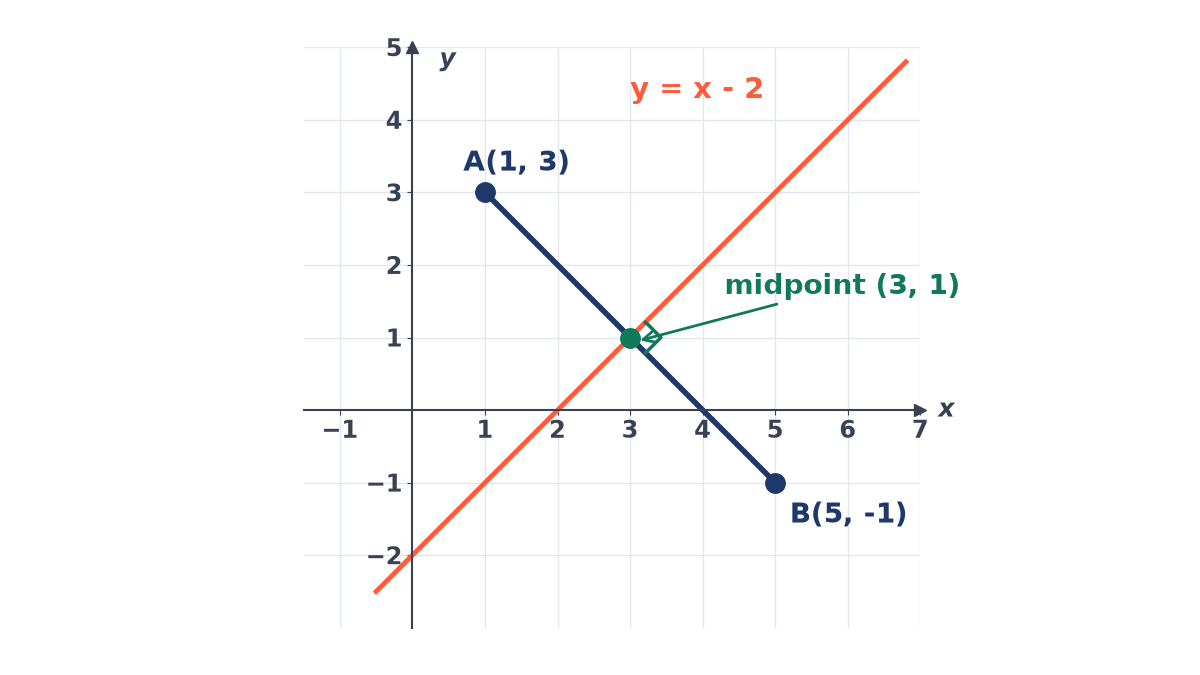
Exam­ple 5. The per­pen­dic­u­lar bisec­tor of A(1,3)A(1, 3), B(5,−1)B(5, -1) must pass through the mid­point (3,1)(3, 1). Since slope of ABAB =−1= -1, our line has slope 11 and its equa­tion is y=x−2y = x - 2.

Segment from A(1, 3) to B(5, -1) with its midpoint (3, 1) marked; the line y = x - 2 passes through the midpoint at right angles to AB.
Exam­ple 5: the per­pen­dic­u­lar bisec­tor of AB is y = x - 2

Dis­tance from a point to a line

The per­pen­dic­u­lar dis­tance of (x1,y1)(x_1, y_1) from Ax+By+C=0Ax + By + C = 0 is

d=∣Ax1+By1+C∣A2+B2.\displaystyle d = \frac{\lvert Ax_1 + By_1 + C \rvert}{\sqrt{A^2 + B^2}}.

For two par­al­lel lines Ax+By+C1=0Ax + By + C_1 = 0 and Ax+By+C2=0Ax + By + C_2 = 0:

d=∣C1−C2∣A2+B2.\displaystyle d = \frac{\lvert C_1 - C_2 \rvert}{\sqrt{A^2 + B^2}}.

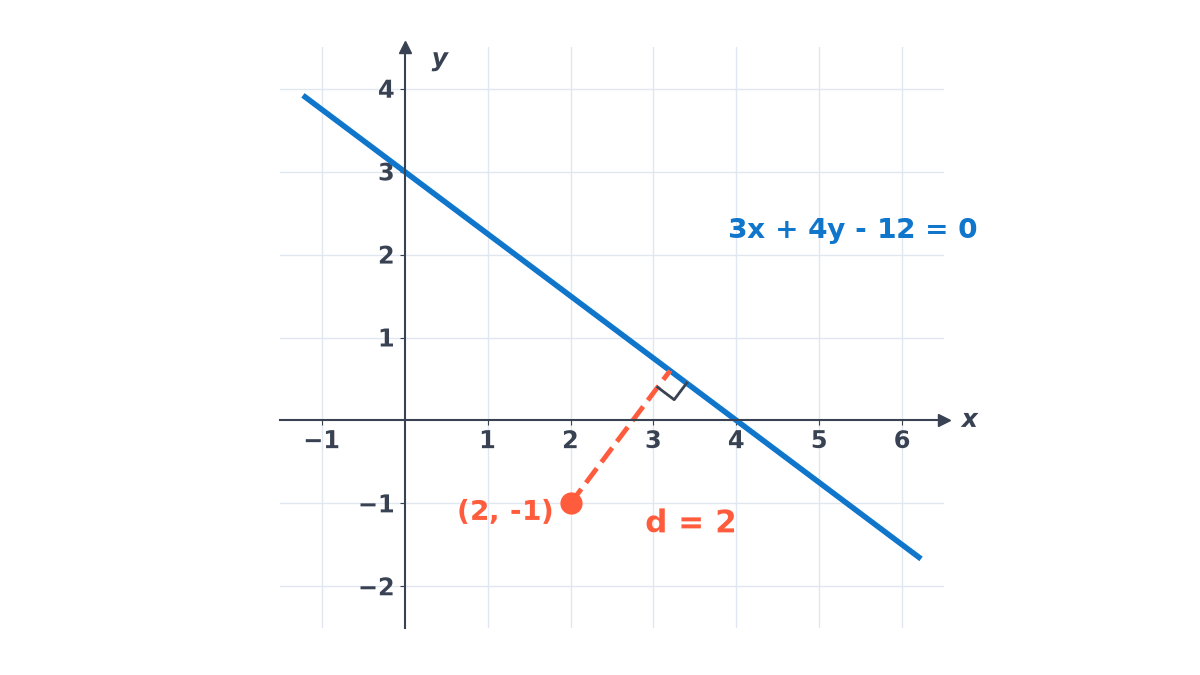
Exam­ple 6. The dis­tance of (2,−1)(2, -1) from 3x+4y−12=03x + 4y - 12 = 0 is ∣6−4−12∣5=2\displaystyle \tfrac{\lvert 6 - 4 - 12 \rvert}{5} = 2.

The line 3x + 4y - 12 = 0 and the point (2, -1); a dashed perpendicular from the point meets the line at a right angle, and its length is d = 2.
Exam­ple 6: the per­pen­dic­u­lar dis­tance from (2, -1) to the line is 2

Exam­ple 7. Dis­tance between 6x−8y+5=06x - 8y + 5 = 0 and 3x−4y−5=03x - 4y - 5 = 0. Care­ful here: the coef­fi­cients must match first, so rewrite the sec­ond as 6x−8y−10=06x - 8y - 10 = 0. Then the dis­tance is 1510=32\displaystyle \tfrac{15}{10} = \tfrac{3}{2}.

Exam­ple 8. To find the foot of the per­pen­dic­u­lar from (−1,3)(-1, 3) to 3x−4y−16=03x - 4y - 16 = 0, first write the per­pen­dic­u­lar through the point, 4x+3y−5=04x + 3y - 5 = 0. Solv­ing the two equa­tions together gives (6825,−4925)\displaystyle \left(\tfrac{68}{25}, -\tfrac{49}{25}\right).

Try these your­self

  1. Find the equa­tion of each line: (a) through (0,−2)(0, -2) with slope 34\displaystyle \tfrac{3}{4}; (b) through (−3,5)(-3, 5) and (1,−3)(1, -3); (c) inter­cepts −2-2 and 55; (d) through (4,−3)(4, -3) par­al­lel to the yy-axis.
  2. Write 5x−2y+10=05x - 2y + 10 = 0 in slope–inter­cept and inter­cept forms.
  3. Find the line through (1,−2)(1, -2) per­pen­dic­u­lar to 2x−3y+7=02x - 3y + 7 = 0.
  4. Find the line through (2,3)(2, 3) par­al­lel to x+4y=9x + 4y = 9.
  5. Find the dis­tance of (3,−5)(3, -5) from 4x−3y+8=04x - 3y + 8 = 0.
  6. Find the dis­tance between x+2y=3x + 2y = 3 and 2x+4y=112x + 4y = 11.
  7. Find the equa­tion of the line whose seg­ment between the axes is bisected at (2,3)(2, 3).
  8. Find kk if the lines kx+2y=5kx + 2y = 5 and 3x−6y=13x - 6y = 1 are per­pen­dic­u­lar.
  9. Find the equa­tion of the alti­tude from AA in tri­an­gle A(2,4)A(2, 4), B(−1,1)B(-1, 1), C(5,−2)C(5, -2).
  10. The Fahren­heit tem­per­a­ture is a lin­ear func­tion of the Cel­sius tem­per­a­ture, with F=32F = 32 at C=0C = 0 and F=212F = 212 at C=100C = 100. Write the equa­tion and find CC when F=104F = 104.

Answers to check against

Show answers
  1. (a) 3x−4y−8=03x - 4y - 8 = 0; (b) 2x+y+1=02x + y + 1 = 0; (c) 5x−2y+10=05x - 2y + 10 = 0; (d) x=4x = 4.
  2. y=52x+5\displaystyle y = \tfrac{5}{2}x + 5; x−2+y5=1\displaystyle \tfrac{x}{-2} + \tfrac{y}{5} = 1.
  3. 3x+2y+1=03x + 2y + 1 = 0.
  4. x+4y−14=0x + 4y - 14 = 0.
  5. ∣12+15+8∣5=7\displaystyle \tfrac{\lvert 12 + 15 + 8 \rvert}{5} = 7.
  6. 2x+4y−6=02x + 4y - 6 = 0 and 2x+4y−11=02x + 4y - 11 = 0, so the dis­tance is 520=52\displaystyle \tfrac{5}{\sqrt{20}} = \tfrac{\sqrt{5}}{2}.
  7. Inter­cepts 44 and 66: 3x+2y=123x + 2y = 12.
  8. Slopes −k2\displaystyle -\tfrac{k}{2} and 12\displaystyle \tfrac{1}{2}: −k4=−1\displaystyle -\tfrac{k}{4} = -1, k=4k = 4.
  9. Slope BC=−12\displaystyle BC = -\tfrac{1}{2}; alti­tude slope 22 through AA: 2x−y=02x - y = 0.
  10. F=95C+32\displaystyle F = \tfrac{9}{5}C + 32; C=40C = 40.