Almost everything you will meet in higher mathematics, from functions to probability, is written in the language of sets, so it pays to get comfortable with it now. A set is a well-defined collection of objects. "Well-defined" simply means that, given any object, you can say without doubt whether it belongs or not. We will write sets in roster and set-builder form, and then meet the empty set, finite and infinite sets, equal sets, subsets, intervals and the universal set.
"The prime numbers below 20" is a set. "The good cricketers of India" is not, because two people will never agree on who counts as good. The objects in a set are called its elements. We write 5∈P to say that 5 belongs to P, and 9∈/P to say that it does not.
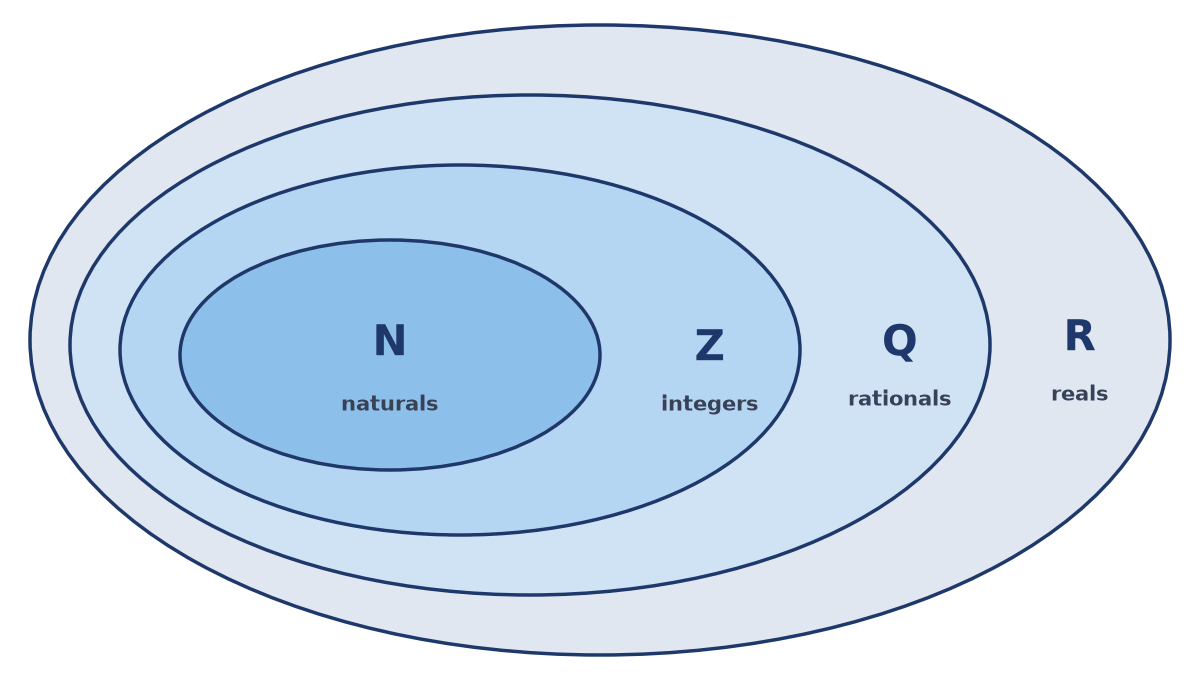
A few sets appear so often that they have their own letters: N (natural numbers), Z (integers), Q (rationals) and R (reals).
Roster form simply lists the elements: A={2,3,5,7,11,13,17,19}. The order doesn't matter, and repeated elements are written only once, so the letters of "LEVEL" give {L,E,V}.
Set-builder form describes the property the elements share instead: A={x:x is a prime,x<20}.
Example 1. The solution set of x2−5x+6=0 is {2,3}.
Example 2.{x:x∈N,x2<30}={1,2,3,4,5}.
Example 3.{3,6,9,12,…}={x:x=3n,n∈N}. And {21,32,43,54}={x:x=n+1n,n∈N,n≤4}.
A set with no elements at all is the empty set, written ∅ or {}. For example, {x∈R:x2=−4}=∅, since no real number squares to a negative. A set is finite if you can count its elements and come to an end (that count is written n(A)); otherwise it is infinite. The months of the year form a finite set (n=12), while the points on a line, or the multiples of 7, go on for ever.
Two sets are equal, A=B, when they have exactly the same elements, however they are described: {x:x2=9}={−3,3}.
We write A⊂B, and say A is a subset of B, when every element of A is also in B. So {1,3}⊂{1,2,3}. Every set is a subset of itself, and ∅ is a subset of every set, since it has no element that could fail the test. The familiar number systems sit inside one another: N⊂Z⊂Q⊂R.
The natural numbers sit inside the integers, the rationals and the reals
How many subsets does a set with n elements have? Think of building a subset one element at a time: each element is either in or out, two choices each time, so there are 2n subsets. The collection of all subsets of A is called its power setP(A). For A={a,b}, P(A)={∅,{a},{b},{a,b}}.
Keep this one in your pocket, because it is the standard way to prove two sets equal: if A⊂B and B⊂A, then A=B.
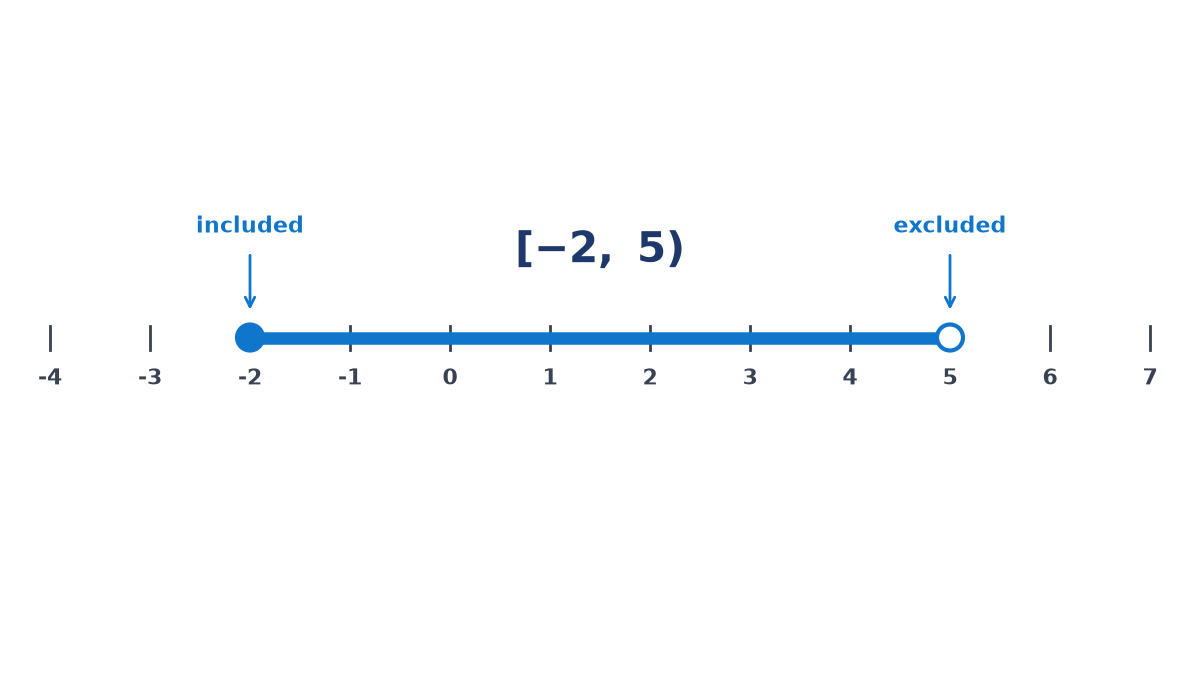
Intervals are a neat shorthand for certain subsets of R. There is the open interval (a,b)={x:a<x<b}, the closed interval [a,b]={x:a≤x≤b}, and the half-open ones [a,b) and (a,b]. A square bracket means the end point is included; a round one means it is left out. So {x:−2≤x<5}=[−2,5).
In any problem there is a background set that contains everything we are talking about. This is the universal setU. In a question about digits, for instance, U={0,1,…,9}.