Just as numbers can be added and multiplied, sets can be combined. Union gathers everything, intersection keeps only what is shared, difference takes something away, and the complement is whatever lies outside. We will define each of these, picture them in Venn diagrams, prove the main laws (De Morgan's among them), and then use the very practical counting formula n(A∪B)=n(A)+n(B)−n(A∩B).
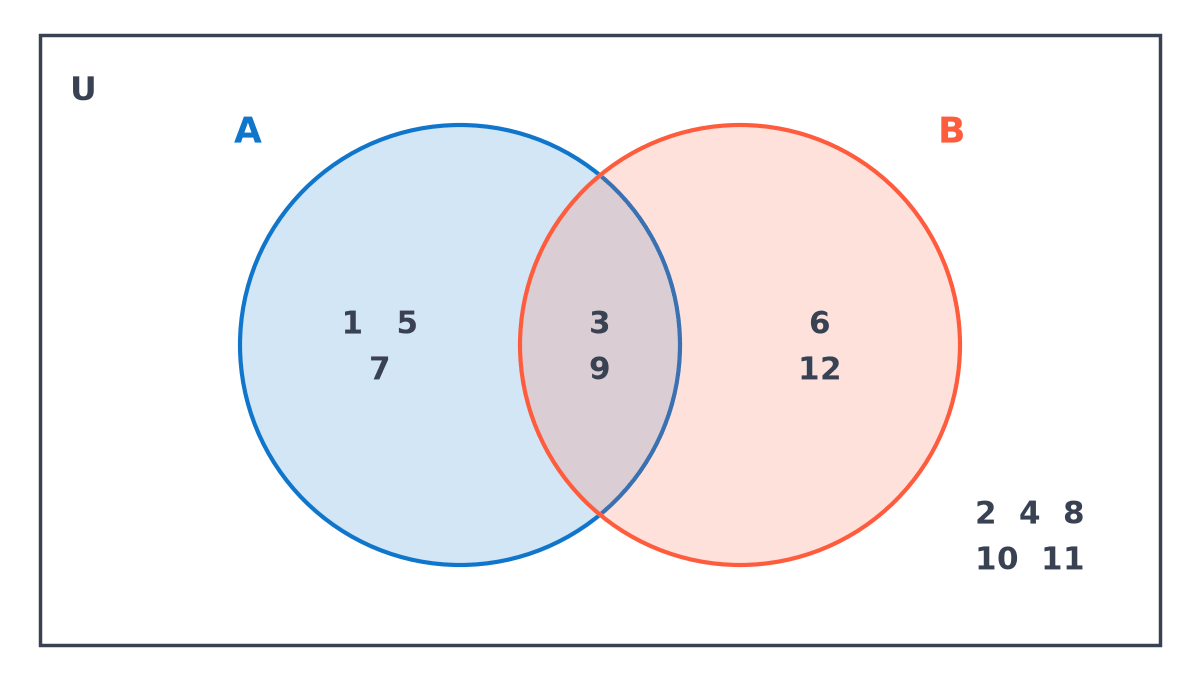
Example 2. With U={1,2,…,12} and A as above, A′={2,4,6,8,10,11,12}.
A Venn diagram makes all this visible. Draw U as a rectangle and each set as a circle inside it, then shade the region an operation produces. You will notice that A−B, A∩B and B−A are three separate pieces which, put together, make up A∪B.
A = {1, 3, 5, 7, 9} and B = {3, 6, 9, 12} inside U = {1, ..., 12}
For finite sets, if you simply add the two counts, the elements lying in both get counted twice. Subtract them once and the count comes out right:
n(A∪B)=n(A)+n(B)−n(A∩B)
With three sets the same idea runs one step further. Take away the pairwise overlaps, then add back the centre, which those subtractions removed once too often:
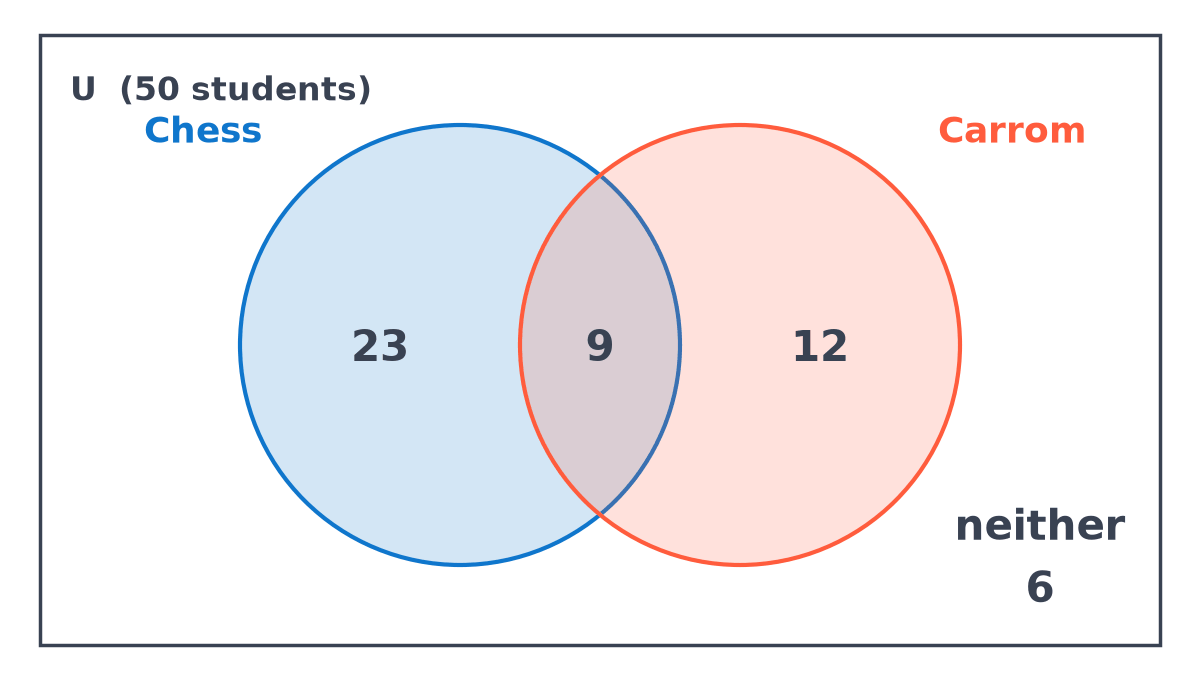
Example 4. In a class of 50, 32 take chess, 21 take carrom and 9 take both. The number taking at least one is 32+21−9=44, so 6 take neither, and 23 take chess only.
Chess and carrom in a class of 50
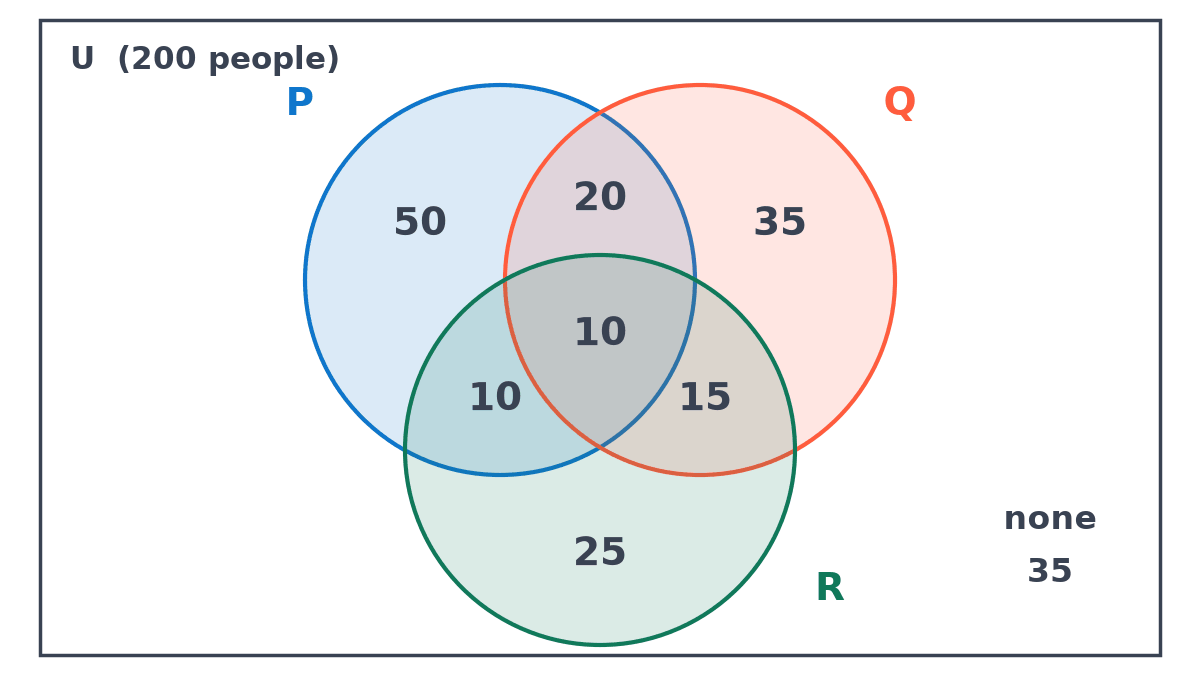
Example 5. Of 200 people, 90 read paper P, 80 read Q and 60 read R. Also, 30 read P and Q, 25 read Q and R, 20 read P and R, and 10 read all three. Those reading at least one number 90+80+60−30−25−20+10=165, which leaves 35 who read none. A tip for such problems: fill the Venn diagram from the centre outwards, as in the figure.
Readers of papers P, Q and R, filled from the centre outwards
U={x∈N:x≤10}, A={x:x is prime}, B={x:x is odd}. Find A′, B′, (A∪B)′, A′∩B′.
Are {x:x is a multiple of 4} and {x:x is odd} disjoint?
Shade in Venn diagrams: A′∩B; (A∩B)′; A−(B∪C).
Verify A∩(B∪C)=(A∩B)∪(A∩C) for A={1,2,3,4}, B={3,4,5}, C={1,5,6}.
Prove: A−B=A∩B′.
Show that A∪B=A∩B implies A=B.
n(A)=25, n(B)=18, n(A∪B)=36. Find n(A∩B), n(A−B).
Of 60 students, 38 like tea, 30 like coffee, 6 like neither. How many like both?
In a survey of 400 families: 210 own a scooter, 180 a car, 120 a cycle; 80 own scooter and car, 50 car and cycle, 60 scooter and cycle, 30 all three. How many own none?