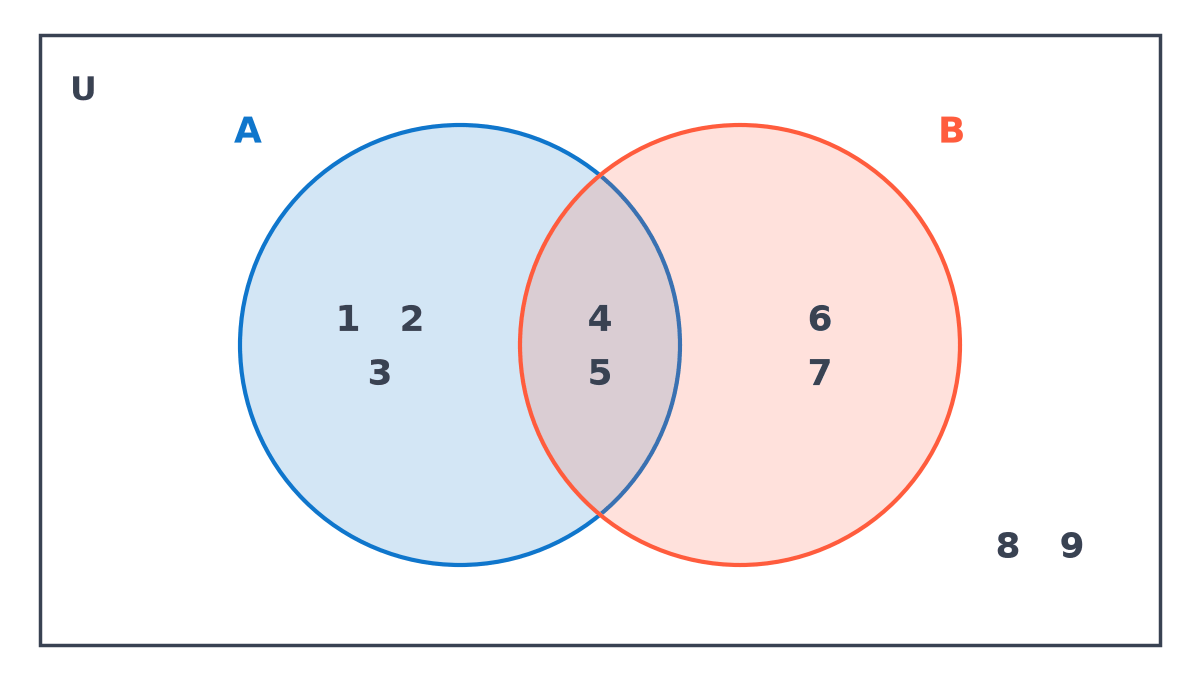
Twelve questions on sets, from notation to counting. For every counting question, draw a Venn diagram first and fill it from the innermost region outwards. It takes a minute and saves you from counting the overlaps twice.
In a group of 90 people, 55 speak Telugu and 48 speak Hindi, and everyone speaks at least one of the two. How many speak both? How many speak only Hindi?
A college has 300 students. Of these, 150 study mathematics, 120 physics and 100 chemistry; 50 take maths and physics, 40 physics and chemistry, 45 maths and chemistry, and 20 take all three. How many study none of the three? How many study exactly one?
Find sets A, B, C with A∩B=A∩C but B=C. (So you cannot "cancel" a set from an intersection.)
A∩(A∪B)⊂A; and every x∈A lies in A∪B, so A⊂A∩(A∪B).
B and A, because every element of A is already in B.
n(A∪B)=53; 70−53=17.
55+48−90=13; 35.
At least one: 150+120+100−50−40−45+20=255; none 45. Exactly one: maths only 150−50−45+20=75; physics only 120−50−40+20=50; chemistry only 100−40−45+20=35; total 160.
A={1}, B={1,2}, C={1,3}.
Test yourself
Sets: Mixed Practice — Quiz
Five mixed questions on sets. Pick one answer for each.