Before you start

Here are twelve ques­tions on sequences and series. For each one, first ask your­self what kind of pro­gres­sion you are look­ing at. If the series is a mix­ture, break its gen­eral term into pieces you already know how to add, and han­dle each piece on its own.

The ques­tions

  1. Find the nnth term and the 1010th term of a1=1a_1 = 1, an+1=an+2na_{n+1} = a_n + 2n.
  2. The 1212th term of an AP is −13-13 and the sum of its first four terms is 2424. What is the sum of its first 1010 terms?
  3. How many three-digit num­bers leave remain­der 22 when divided by 55? What is their sum?
  4. The sums of nn terms of two APs are in the ratio (5n+4):(9n+6)(5n + 4) : (9n + 6). Find the ratio of their 1818th terms.
  5. The 55th, 88th and 1111th terms of a GP are pp, qq, ss. Show q2=psq^2 = ps.
  6. Find the sum of nn terms of 7+77+777+⋯7 + 77 + 777 + \cdots
  7. The sum of an infi­nite GP is 1515 and the sum of the squares of its terms is 4545. Find the GP.
  8. Find the sum of the series 1⋅2+2⋅3+3⋅4+⋯1 \cdot 2 + 2 \cdot 3 + 3 \cdot 4 + \cdots to nn terms.
  9. Find the sum of nn terms of 12+32+52+⋯1^2 + 3^2 + 5^2 + \cdots
  10. If a,b,ca, b, c are in AP and b,c,db, c, d in GP, and 1c,1d,1e\displaystyle \tfrac{1}{c}, \tfrac{1}{d}, \tfrac{1}{e} in AP, prove a,c,ea, c, e are in GP.
  11. A farmer in a vil­lage buys a trac­tor for ₹6,00,0006{,}00{,}000 and pays ₹1,20,0001{,}20{,}000 down. He clears the rest in yearly instal­ments of ₹60,00060{,}000 plus 10%10\% inter­est on the unpaid amount. What does the trac­tor cost him in all?
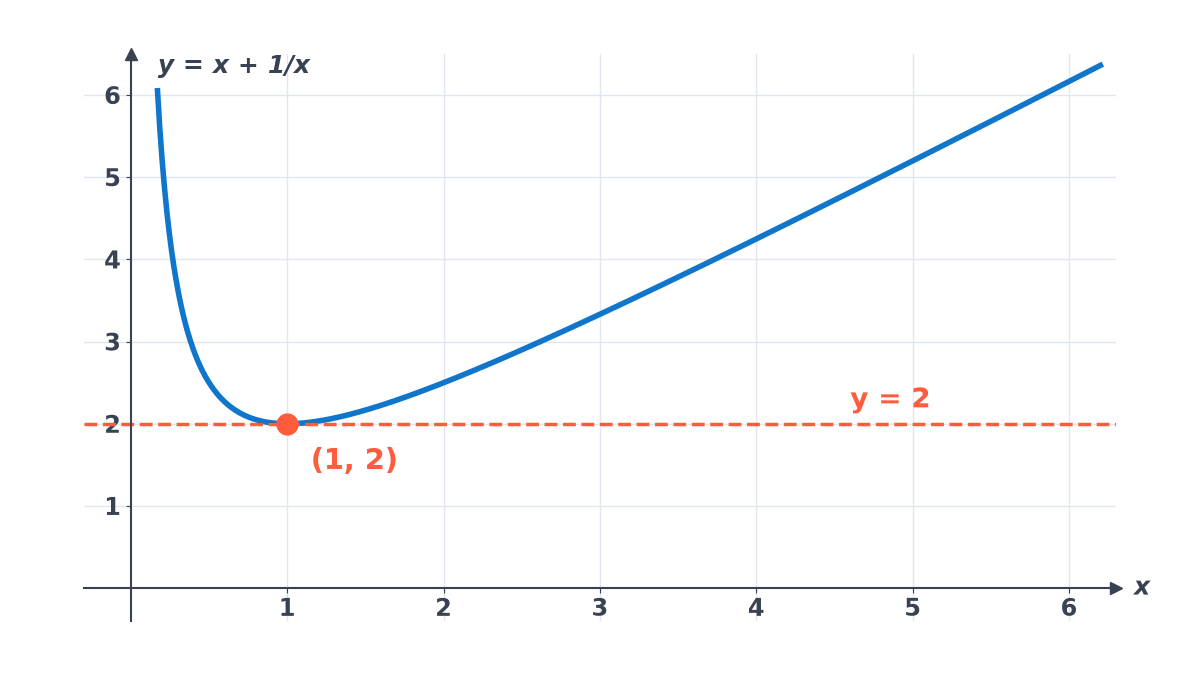
  12. Show that for pos­i­tive xx, x+1x≥2\displaystyle x + \tfrac{1}{x} \ge 2.
Graph of y = x + 1/x for positive x: the curve falls to its lowest point (1, 2), touching the dashed line y = 2, and rises again, so it never goes below 2.
Ques­tion 12: x + 1/x never falls below 2 for pos­i­tive x

Answers to check against

Show answers
  1. an=1+2(1+2+⋯+(n−1))=n2−n+1a_n = 1 + 2(1 + 2 + \cdots + (n - 1)) = n^2 - n + 1; a10=91a_{10} = 91.
  2. a+11d=−13a + 11d = -13, 4a+6d=244a + 6d = 24: d=−2d = -2, a=9a = 9; S10=5(18−18)=0S_{10} = 5(18 - 18) = 0.
  3. 102,107,…,997102, 107, \ldots, 997: 180180 num­bers, sum 90(102+997)=98,91090(102 + 997) = 98{,}910.
  4. a18a18′=S35S35′=179321\displaystyle \tfrac{a_{18}}{a'_{18}} = \tfrac{S_{35}}{S'_{35}} = \tfrac{179}{321}.
  5. q2=a2r14=(ar4)(ar10)q^2 = a^2 r^{14} = (ar^4)(ar^{10}).
  6. 79[(10−1)+(100−1)+⋯ ]=781(10n+1−10−9n)\displaystyle \tfrac{7}{9}[(10 - 1) + (100 - 1) + \cdots] = \tfrac{7}{81}(10^{n+1} - 10 - 9n).
  7. a1−r=15\displaystyle \tfrac{a}{1 - r} = 15, a21−r2=45\displaystyle \tfrac{a^2}{1 - r^2} = 45: divid­ing, a1+r=3\displaystyle \tfrac{a}{1 + r} = 3; r=23\displaystyle r = \tfrac{2}{3}, a=5a = 5: 5,103,209,…\displaystyle 5, \tfrac{10}{3}, \tfrac{20}{9}, \ldots
  8. ∑(k2+k)=n(n+1)(n+2)3\displaystyle \sum (k^2 + k) = \tfrac{n(n + 1)(n + 2)}{3}.
  9. ∑(2k−1)2=n(2n−1)(2n+1)3\displaystyle \sum (2k - 1)^2 = \tfrac{n(2n - 1)(2n + 1)}{3}.
  10. 2b=a+c2b = a + c, c2=bdc^2 = bd, 2d=1c+1e\displaystyle \tfrac{2}{d} = \tfrac{1}{c} + \tfrac{1}{e}. Elim­i­nate bb and dd and you are left with c2=aec^2 = ae.
  11. 88 instal­ments; inter­est 10%10\% of 4,80,000,4,20,000,…,60,0004{,}80{,}000, 4{,}20{,}000, \ldots, 60{,}000 =0.1×21,60,000=2,16,000= 0.1 \times 21{,}60{,}000 = 2{,}16{,}000. Total 8,16,0008{,}16{,}000 rupees.
  12. Apply AM ≥\ge GM to xx and 1x\displaystyle \tfrac{1}{x}: x+1/x2≥1\displaystyle \tfrac{x + 1/x}{2} \ge 1.