Why bother?#
Sometimes you do not add the same amount each time; you multiply by the same amount. Money in a bank at compound interest behaves like this, and so does a ball that keeps bouncing a little lower. Such sequences are geometric progressions. We will find the general term and the sum of n n n ∣ r ∣ < 1 \lvert r \rvert < 1 ∣ r ∣ < 1
Geometric progressions#
In a GP each term is the previous one times a constant common ratio r r r a , a r , a r 2 , … a, ar, ar^2, \ldots a , a r , a r 2 , …
a n = a r n − 1 , S n = a ( r n − 1 ) r − 1 = a ( 1 − r n ) 1 − r ( r ≠ 1 ) , \displaystyle a_n = ar^{n-1}, \qquad S_n = \frac{a(r^n - 1)}{r - 1} = \frac{a(1 - r^n)}{1 - r} \quad (r \ne 1), a n = a r n − 1 , S n = r − 1 a ( r n − 1 ) = 1 − r a ( 1 − r n ) ( r = 1 ) ,
and S n = n a S_n = na S n = na r = 1 r = 1 r = 1 S n − r S n = a − a r n S_n - rS_n = a - ar^n S n − r S n = a − a r n
Example 1. In 5 , 15 , 45 , … 5, 15, 45, \ldots 5 , 15 , 45 , … a 8 = 5 ⋅ 3 7 = 10,935 a_8 = 5 \cdot 3^7 = 10{,}935 a 8 = 5 ⋅ 3 7 = 10 , 935 S 8 = 5 ( 3 8 − 1 ) 2 = 16,400 \displaystyle S_8 = \tfrac{5(3^8 - 1)}{2} = 16{,}400 S 8 = 2 5 ( 3 8 − 1 ) = 16 , 400
Example 2. Which term of 1 4 , 1 2 , 1 , … \displaystyle \tfrac{1}{4}, \tfrac{1}{2}, 1, \ldots 4 1 , 2 1 , 1 , … 128 128 128 1 4 ⋅ 2 n − 1 = 128 \displaystyle \tfrac{1}{4} \cdot 2^{n-1} = 128 4 1 ⋅ 2 n − 1 = 128 2 n − 1 = 512 2^{n-1} = 512 2 n − 1 = 512 n = 10 n = 10 n = 10
Example 3. The 3 3 3 12 12 12 6 6 6 96 96 96 r 3 = 8 r^3 = 8 r 3 = 8 r = 2 r = 2 r = 2 a = 3 a = 3 a = 3
Example 4. 0.4 + 0.44 + 0.444 + ⋯ 0.4 + 0.44 + 0.444 + \cdots 0.4 + 0.44 + 0.444 + ⋯ n n n = 4 9 [ ( 1 − 0.1 ) + ( 1 − 0.01 ) + ⋯ ] = 4 9 [ n − 1 9 ( 1 − 10 − n ) ] \displaystyle = \tfrac{4}{9}[(1 - 0.1) + (1 - 0.01) + \cdots] = \tfrac{4}{9}\left[n - \tfrac{1}{9}(1 - 10^{-n})\right] = 9 4 [( 1 − 0.1 ) + ( 1 − 0.01 ) + ⋯ ] = 9 4 [ n − 9 1 ( 1 − 1 0 − n ) ]
Example 5. ₹20,000 20{,}000 20 , 000 8 % 8\% 8% 20,000 ( 1.08 ) n 20{,}000(1.08)^n 20 , 000 ( 1.08 ) n n n n 1.08 1.08 1.08
Adding forever: the infinite GP#
Can you add infinitely many numbers and get a finite answer? Yes, when ∣ r ∣ < 1 \lvert r \rvert < 1 ∣ r ∣ < 1 r n → 0 r^n \to 0 r n → 0
S ∞ = a 1 − r . \displaystyle S_\infty = \frac{a}{1 - r}. S ∞ = 1 − r a .
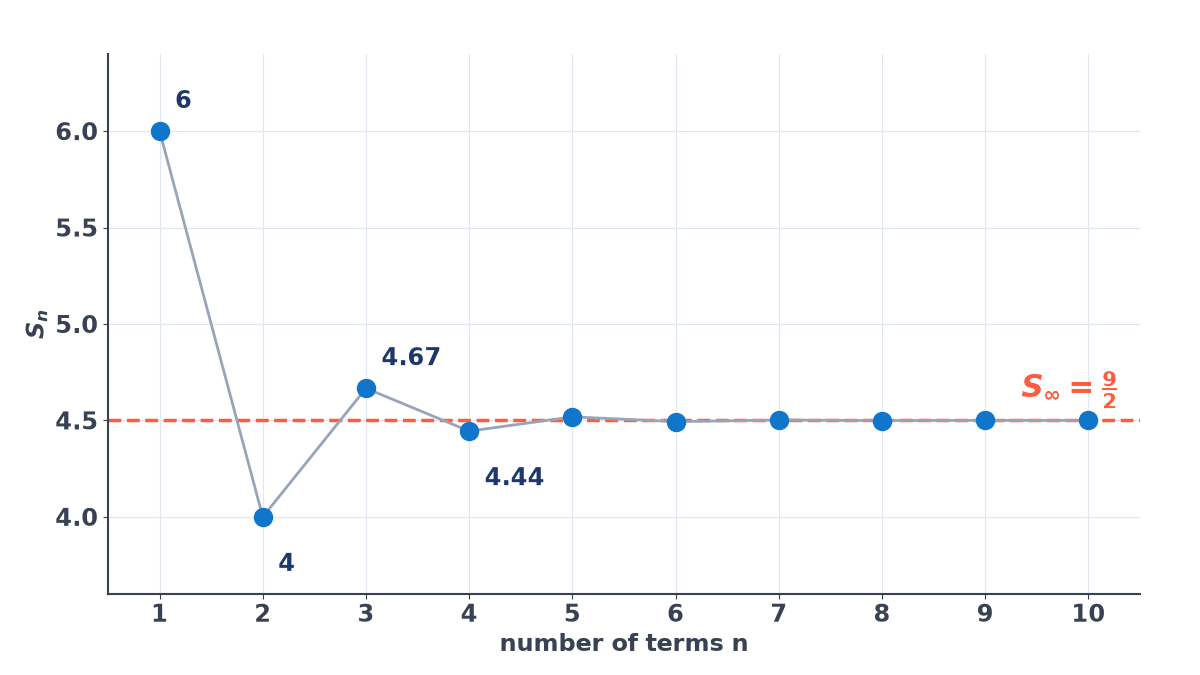
Example 6. 6 − 2 + 2 3 − ⋯ = 6 1 + 1 / 3 = 9 2 \displaystyle 6 - 2 + \tfrac{2}{3} - \cdots = \tfrac{6}{1 + 1/3} = \tfrac{9}{2} 6 − 2 + 3 2 − ⋯ = 1 + 1/3 6 = 2 9 0. 27 ‾ = 27 100 ⋅ 1 1 − 1 / 100 = 27 99 = 3 11 \displaystyle 0.\overline{27} = \tfrac{27}{100} \cdot \tfrac{1}{1 - 1/100} = \tfrac{27}{99} = \tfrac{3}{11} 0. 27 = 100 27 ⋅ 1 − 1/100 1 = 99 27 = 11 3
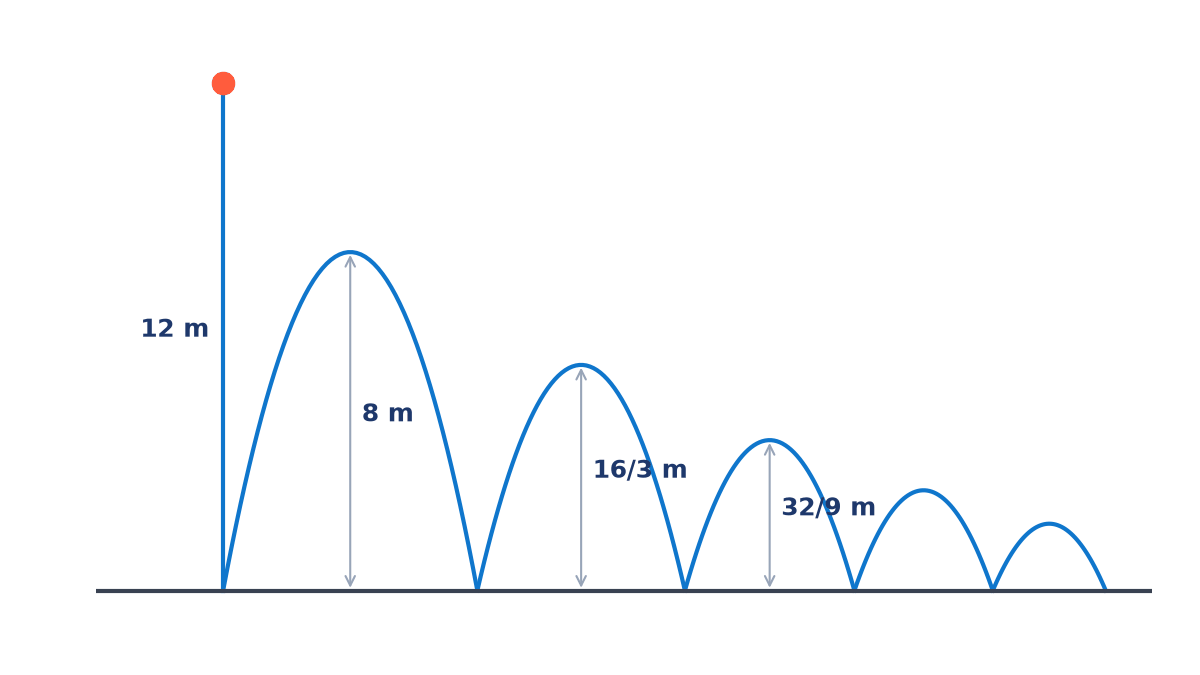
Example 6: the partial sums settle on 9/2 Example 7. A ball dropped from 12 12 12 2 3 \displaystyle \tfrac{2}{3} 3 2 12 + 2 × 8 1 − 2 / 3 = 12 + 48 = 60 \displaystyle 12 + 2 \times \tfrac{8}{1 - 2/3} = 12 + 48 = 60 12 + 2 × 1 − 2/3 8 = 12 + 48 = 60
Example 7: each rebound is two-thirds of the previous height Geometric mean#
The GM of positive a a a b b b G = a b G = \sqrt{ab} G = ab a , G , b a, G, b a , G , b n n n a a a b b b r = ( b a ) 1 / ( n + 1 ) \displaystyle r = \left(\tfrac{b}{a}\right)^{1/(n+1)} r = ( a b ) 1/ ( n + 1 )
AM ≥ \ge ≥ A − G = a + b 2 − a b = ( a − b ) 2 2 ≥ 0 \displaystyle A - G = \tfrac{a + b}{2} - \sqrt{ab} = \tfrac{(\sqrt{a} - \sqrt{b})^2}{2} \ge 0 A − G = 2 a + b − ab = 2 ( a − b ) 2 ≥ 0 a = b a = b a = b
Example 8. Two numbers have AM 10 10 10 8 8 8 a + b = 20 a + b = 20 a + b = 20 a b = 64 ab = 64 ab = 64 16 16 16 4 4 4
Sums of powers worth remembering#
∑ k = 1 n k = n ( n + 1 ) 2 , ∑ k = 1 n k 2 = n ( n + 1 ) ( 2 n + 1 ) 6 , ∑ k = 1 n k 3 = [ n ( n + 1 ) 2 ] 2 . \displaystyle \sum_{k=1}^n k = \frac{n(n + 1)}{2}, \quad \sum_{k=1}^n k^2 = \frac{n(n + 1)(2n + 1)}{6}, \quad \sum_{k=1}^n k^3 = \left[\frac{n(n + 1)}{2}\right]^2. k = 1 ∑ n k = 2 n ( n + 1 ) , k = 1 ∑ n k 2 = 6 n ( n + 1 ) ( 2 n + 1 ) , k = 1 ∑ n k 3 = [ 2 n ( n + 1 ) ] 2 .
Example 9. ∑ k = 1 n k ( k + 2 ) = ∑ k 2 + 2 ∑ k = n ( n + 1 ) ( 2 n + 7 ) 6 \displaystyle \sum_{k=1}^{n} k(k + 2) = \sum k^2 + 2\sum k = \tfrac{n(n + 1)(2n + 7)}{6} k = 1 ∑ n k ( k + 2 ) = ∑ k 2 + 2 ∑ k = 6 n ( n + 1 ) ( 2 n + 7 )
Try these yourself#
Find the 9 9 9 9 9 9 2 , − 6 , 18 , … 2, -6, 18, \ldots 2 , − 6 , 18 , …
Which term of 2 , 2 , 2 2 , … \sqrt{2}, 2, 2\sqrt{2}, \ldots 2 , 2 , 2 2 , … 64 64 64
The sum of the first three terms of a GP is 13 12 \displaystyle \tfrac{13}{12} 12 13 − 1 -1 − 1
Find the sum to infinity: 1 − 1 3 + 1 9 − ⋯ \displaystyle 1 - \tfrac{1}{3} + \tfrac{1}{9} - \cdots 1 − 3 1 + 9 1 − ⋯ 0. 6 ‾ 0.\overline{6} 0. 6
Find n n n 3 + 6 + 12 + ⋯ 3 + 6 + 12 + \cdots 3 + 6 + 12 + ⋯ n n n 765 765 765
Insert 3 3 3 2 2 2 162 162 162
The AM and GM of two positive numbers are 25 25 25 15 15 15
Evaluate ∑ k = 1 12 ( 3 k 2 − k ) \displaystyle \sum_{k=1}^{12} (3k^2 - k) k = 1 ∑ 12 ( 3 k 2 − k ) 1 3 + 2 3 + ⋯ + 10 3 1^3 + 2^3 + \cdots + 10^3 1 3 + 2 3 + ⋯ + 1 0 3
If a , b , c a, b, c a , b , c a 2 + b 2 , a b + b c , b 2 + c 2 a^2 + b^2, ab + bc, b^2 + c^2 a 2 + b 2 , ab + b c , b 2 + c 2
A culture of bacteria doubles every hour. Starting with 50 50 50 8 8 8
Answers to check against#
Show answers
2 ⋅ ( − 3 ) 8 = 13,122 2 \cdot (-3)^8 = 13{,}122 2 ⋅ ( − 3 ) 8 = 13 , 122 2 ( 1 − ( − 3 ) 9 ) 4 = 9,842 \displaystyle \tfrac{2(1 - (-3)^9)}{4} = 9{,}842 4 2 ( 1 − ( − 3 ) 9 ) = 9 , 842 2 n = 64 = 2 12 \sqrt{2}^n = 64 = \sqrt{2}^{12} 2 n = 64 = 2 12 12 12 12 Middle term b b b b 3 = − 1 b^3 = -1 b 3 = − 1 b = − 1 b = -1 b = − 1 − 1 r − 1 − r = 13 12 \displaystyle \tfrac{-1}{r} - 1 - r = \tfrac{13}{12} r − 1 − 1 − r = 12 13 12 r 2 + 25 r + 12 = 0 12r^2 + 25r + 12 = 0 12 r 2 + 25 r + 12 = 0 r = − 3 4 \displaystyle r = -\tfrac{3}{4} r = − 4 3 − 4 3 \displaystyle -\tfrac{4}{3} − 3 4 4 3 , − 1 , 3 4 \displaystyle \tfrac{4}{3}, -1, \tfrac{3}{4} 3 4 , − 1 , 4 3
3 4 \displaystyle \tfrac{3}{4} 4 3 2 3 \displaystyle \tfrac{2}{3} 3 2 3 ( 2 n − 1 ) = 765 3(2^n - 1) = 765 3 ( 2 n − 1 ) = 765 2 n = 256 2^n = 256 2 n = 256 n = 8 n = 8 n = 8 r 4 = 81 r^4 = 81 r 4 = 81 r = 3 r = 3 r = 3 6 , 18 , 54 6, 18, 54 6 , 18 , 54 a + b = 50 a + b = 50 a + b = 50 a b = 225 ab = 225 ab = 225 45 45 45 5 5 5 3 ⋅ 650 − 78 = 1872 3 \cdot 650 - 78 = 1872 3 ⋅ 650 − 78 = 1872 3025 3025 3025 With b 2 = a c b^2 = ac b 2 = a c ( a b + b c ) 2 = b 2 ( a + c ) 2 = a c ( a + c ) 2 (ab + bc)^2 = b^2(a + c)^2 = ac(a + c)^2 ( ab + b c ) 2 = b 2 ( a + c ) 2 = a c ( a + c ) 2 ( a 2 + b 2 ) ( b 2 + c 2 ) = ( a 2 + a c ) ( a c + c 2 ) = a c ( a + c ) 2 (a^2 + b^2)(b^2 + c^2) = (a^2 + ac)(ac + c^2) = ac(a + c)^2 ( a 2 + b 2 ) ( b 2 + c 2 ) = ( a 2 + a c ) ( a c + c 2 ) = a c ( a + c ) 2
50 × 2 8 = 12,800 50 \times 2^8 = 12{,}800 50 × 2 8 = 12 , 800