Get­ting started

Think of a sequence as num­bers stand­ing in a queue, in a fixed order. Add them up and you have a series. We will first see two ways of describ­ing a sequence, by a for­mula or by a rule that builds each term from the ones before it. Then we spend most of our time on the friend­liest kind, the arith­metic pro­gres­sion, where you keep adding the same amount: its gen­eral term, the sum of nn terms, and the arith­metic mean.

Sequences and series

A sequence is a func­tion on N\mathbf{N}: a1,a2,a3,…a_1, a_2, a_3, \ldots, with ana_n the gen­eral term. You can describe it by a for­mula, so an=n2−1a_n = n^2 - 1 gives 0,3,8,15,…0, 3, 8, 15, \ldots, or recur­sively, so a1=2a_1 = 2, an+1=3an−1a_{n+1} = 3a_n - 1 gives 2,5,14,41,…2, 5, 14, 41, \ldots The famous Fibonacci sequence is recur­sive too: a1=a2=1a_1 = a_2 = 1, an+2=an+1+ana_{n+2} = a_{n+1} + a_n.

A series is just the sum a1+a2+⋯+an=∑k=1nak\displaystyle a_1 + a_2 + \cdots + a_n = \sum_{k=1}^{n} a_k.

Arith­metic pro­gres­sions

In an AP you move by a con­stant com­mon dif­fer­ence dd: a,a+d,a+2d,…a, a + d, a + 2d, \ldots

an=a+(n−1)d,Sn=n2[2a+(n−1)d]=n2(a+l),\displaystyle a_n = a + (n - 1)d, \qquad S_n = \frac{n}{2}[2a + (n - 1)d] = \frac{n}{2}(a + l),

where ll is the last term. Where does the sum for­mula come from? Write SnS_n for­wards, then back­wards under­neath, and add the two lines. Every pair adds up to the same thing, a+la + l, and that is the whole trick.

A handy fact: if you add, sub­tract, mul­ti­ply or divide every term by the same con­stant, you still have an AP.

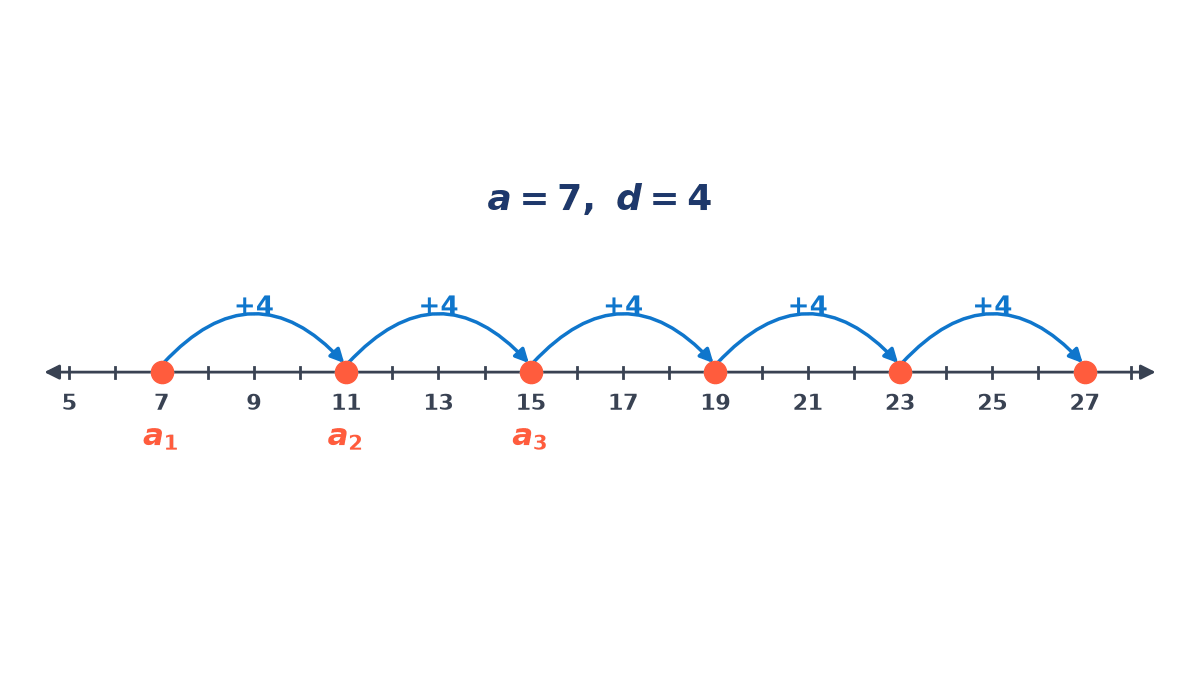
Exam­ple 1. In the AP 7,11,15,…7, 11, 15, \ldots: a20=7+19×4=83a_{20} = 7 + 19 \times 4 = 83; S20=10(7+83)=900S_{20} = 10(7 + 83) = 900.

Number line from 5 to 28 with the terms 7, 11, 15, 19, 23, 27 of the AP marked as dots, each joined to the next by an arrow labelled +4; first term a = 7 and d = 4.
Exam­ple 1: the AP 7, 11, 15, ... moves in equal steps of 4

Exam­ple 2. Which term of 5,12,19,…5, 12, 19, \ldots is 278278? Set the gen­eral term equal to it: 5+7(n−1)=2785 + 7(n - 1) = 278, so n=40n = 40.

Exam­ple 3. Sup­pose the 44th term is 1313 and the 1111th is 4141. Sub­tract­ing, 7d=287d = 28, d=4d = 4, a=1a = 1; an=4n−3a_n = 4n - 3.

Exam­ple 4. How many terms of −12,−9,−6,…-12, -9, -6, \ldots do you need for the sum to reach 5454? n2(−24+3(n−1))=54\displaystyle \tfrac{n}{2}(-24 + 3(n - 1)) = 54 gives n2−9n−36=0n^2 - 9n - 36 = 0, n=12n = 12 (the neg­a­tive root makes no sense for a count of terms, so we drop it).

Exam­ple 5. Find the sum of the inte­gers from 11 to 300300 divis­i­ble by 33 or 77. Take the mul­ti­ples of 33 first: 100100 terms, sum 15,15015{,}150. Mul­ti­ples of 77: 4242 terms, sum 6,3216{,}321. But mul­ti­ples of 2121 got counted twice: 1414 terms, sum 2,2052{,}205. So the answer is 15,150+6,321−2,205=19,26615{,}150 + 6{,}321 - 2{,}205 = 19{,}266.

Arith­metic mean

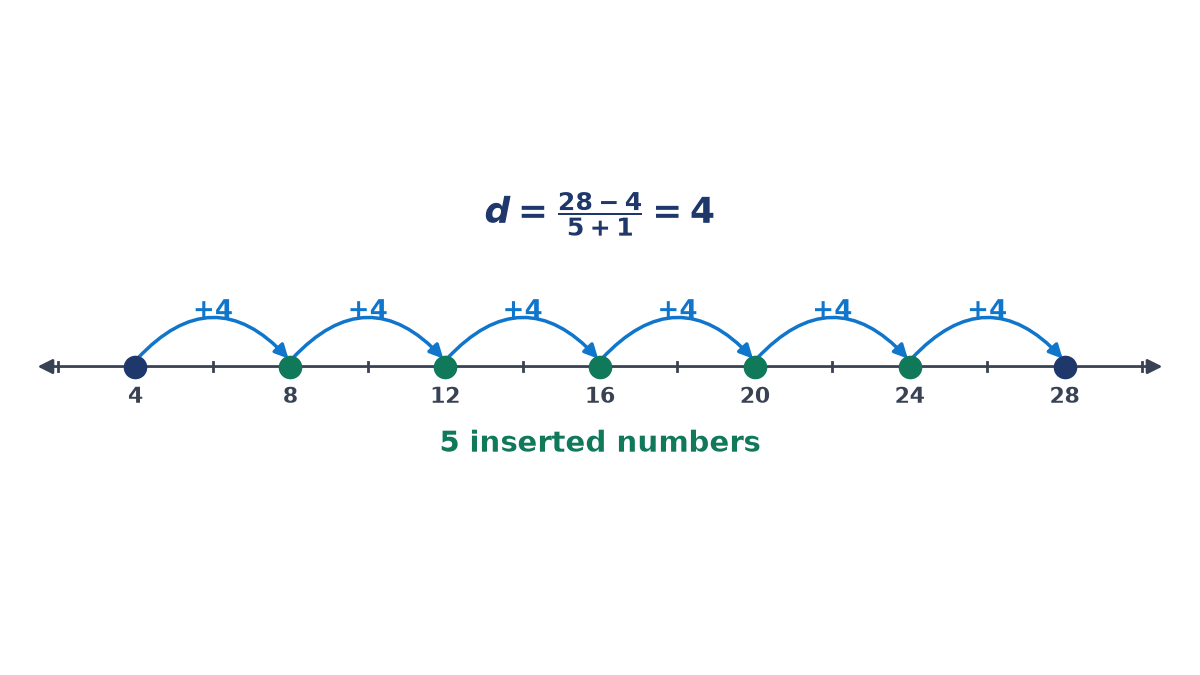
The AM of aa and bb is a+b2\displaystyle \tfrac{a + b}{2}, the num­ber sit­ting exactly halfway, so that a,A,ba, A, b is an AP. If you want to insert nn num­bers between aa and bb mak­ing an AP, take d=b−an+1\displaystyle d = \tfrac{b - a}{n + 1}.

Exam­ple 6. Insert 55 num­bers between 44 and 2828. Here d=4d = 4, so we get 8,12,16,20,248, 12, 16, 20, 24.

Number line from 2 to 30 with 4 and 28 marked as ends and the five inserted numbers 8, 12, 16, 20, 24 between them, each step labelled +4, where d = (28 - 4)/(5 + 1) = 4.
Exam­ple 6: five num­bers inserted between 4 and 28 make an AP
Try these your­self

  1. Write down the first four terms of each: an=2n−1n+1\displaystyle a_n = \tfrac{2n - 1}{n + 1}; an=(−1)n3na_n = (-1)^n 3^n; a1=4a_1 = 4, an+1=an2+1\displaystyle a_{n+1} = \tfrac{a_n}{2} + 1.
  2. Find the 2525th term and the sum of 2525 terms of 3,8,13,…3, 8, 13, \ldots
  3. Which term of 3,33,53,…\sqrt{3}, 3\sqrt{3}, 5\sqrt{3}, \ldots is 39339\sqrt{3}?
  4. The 55th term of an AP is 1919 and the sum of the first 1010 terms is 185185. Find aa and dd.
  5. Find the sum of all odd num­bers between 100100 and 300300.
  6. The sum of nn terms of an AP is 3n2+2n3n^2 + 2n. Find its nnth term.
  7. If the ppth term is qq and the qqth term is pp (p≠qp \ne q), show that the (p+q)(p + q)th term is 00.
  8. Insert 66 arith­metic means between −5-5 and 3030.
  9. A man saves ₹800800 in the first month and increases his sav­ing by ₹150150 each month. How much has he saved in 22 years?
  10. The angles of a hexa­gon are in AP with the small­est 95∘95^\circ. Find the com­mon dif­fer­ence.

Answers to check against

Show answers
  1. 12,1,54,75\displaystyle \tfrac{1}{2}, 1, \tfrac{5}{4}, \tfrac{7}{5}; −3,9,−27,81-3, 9, -27, 81; 4,3,52,94\displaystyle 4, 3, \tfrac{5}{2}, \tfrac{9}{4}.
  2. 123123; 252(3+123)=1575\displaystyle \tfrac{25}{2}(3 + 123) = 1575.
  3. 2n−1=392n - 1 = 39: 2020th.
  4. a+4d=19a + 4d = 19, 2a+9d=372a + 9d = 37: d=−1d = -1, a=23a = 23.
  5. 101+⋯+299101 + \cdots + 299: 100100 terms, sum 20,00020{,}000.
  6. an=Sn−Sn−1=6n−1a_n = S_n - S_{n-1} = 6n - 1.
  7. a+(p−1)d=qa + (p - 1)d = q, a+(q−1)d=pa + (q - 1)d = p give d=−1d = -1, a=p+q−1a = p + q - 1; ap+q=a+(p+q−1)d=0a_{p+q} = a + (p + q - 1)d = 0.
  8. d=5d = 5: 0,5,10,15,20,250, 5, 10, 15, 20, 25.
  9. 12(1600+23×150)=12×5050=60,60012(1600 + 23 \times 150) = 12 \times 5050 = 60{,}600 rupees.
  10. The angles add up to 720∘720^\circ, so 6×95+15d=7206 \times 95 + 15d = 720, d=10∘d = 10^\circ.