Before you begin

Twelve ques­tions on com­plex num­bers and qua­drat­ics. One rule saves a lot of grief: sim­plify to the form a+iba + ib before you try to find a mod­u­lus or an argu­ment. For the argu­ment, sketch the point so you know its quad­rant.

Ques­tions

  1. Express (1−2i)−3(1 - 2i)^{-3} in the form a+iba + ib.
  2. Find x,yx, y if (x+iy)(2−3i)=4+i(x + iy)(2 - 3i) = 4 + i.
  3. Eval­u­ate i17+i22+i35+i100i^{17} + i^{22} + i^{35} + i^{100}.
  4. Find the mul­ti­plica­tive inverse of 5+3i\sqrt{5} + 3i.
  5. If x+iy=a+iba−ib\displaystyle x + iy = \frac{a + ib}{a - ib}, prove x2+y2=1x^2 + y^2 = 1.
  6. Find the mod­u­lus of (3+4i)(5−12i)6+8i\displaystyle \frac{(3 + 4i)(5 - 12i)}{6 + 8i}.
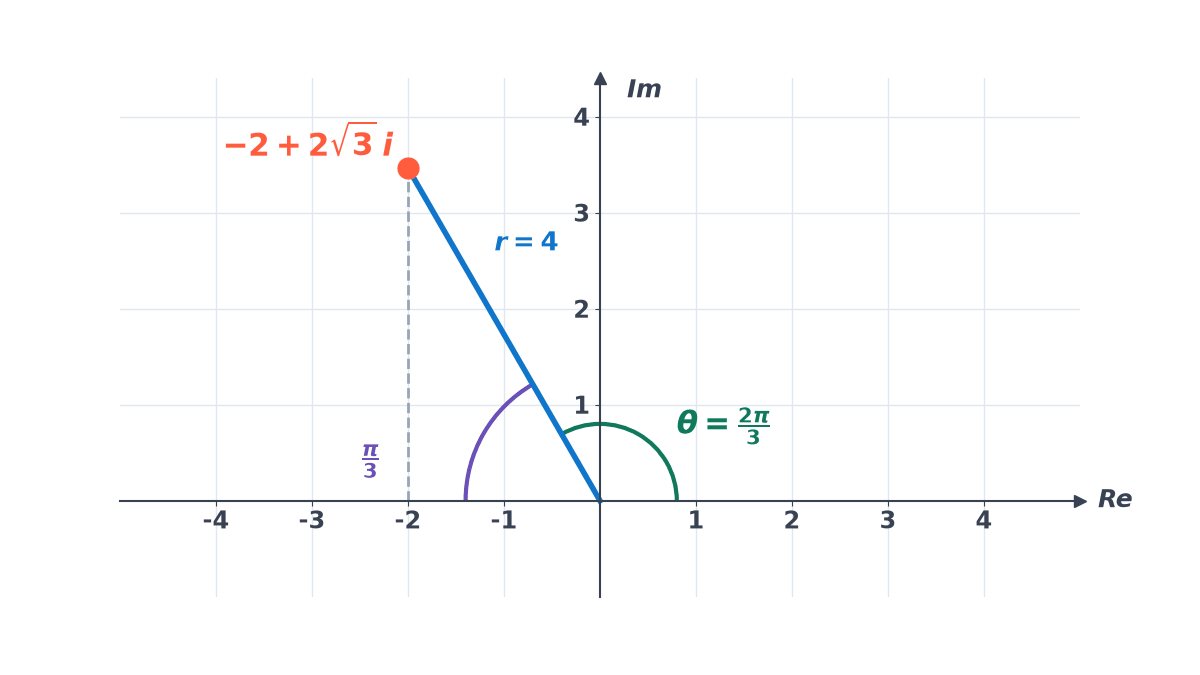
  7. Con­vert to polar form: −2+23i-2 + 2\sqrt{3}i; 1−icos⁡π3+isin⁡π3\displaystyle \frac{1 - i}{\cos\frac{\pi}{3} + i\sin\frac{\pi}{3}}.
  8. Solve: 5x2−6x+2=05x^2 - 6x + 2 = 0; 27x2−10x+1=027x^2 - 10x + 1 = 0; x2−x+2=0x^2 - x + 2 = 0.
  9. If α\alpha and β\beta are the roots of x2+x+1=0x^2 + x + 1 = 0, find α2+β2\alpha^2 + \beta^2 and show α3=1\alpha^3 = 1.
  10. For which real kk does x2+kx+9=0x^2 + kx + 9 = 0 have non-real roots?
  11. If (1+i1−i)3−(1−i1+i)3=x+iy\displaystyle \left(\tfrac{1 + i}{1 - i}\right)^3 - \left(\tfrac{1 - i}{1 + i}\right)^3 = x + iy, find (x,y)(x, y).
  12. Let z1,z2z_1, z_2 be com­plex num­bers with ∣z1∣=∣z2∣=1\lvert z_1 \rvert = \lvert z_2 \rvert = 1. Show that ∣z1−z21−zˉ1z2∣=1\displaystyle \left\lvert \tfrac{z_1 - z_2}{1 - \bar z_1 z_2} \right\rvert = 1 when­ever the denom­i­na­tor is non-zero. (Hint: ∣w∣2=wwˉ\lvert w \rvert^2 = w\bar w.)
Argand plane with the point -2 + 2 root 3 i joined to the origin by a segment of length r = 4; the argument from the positive real axis is 2 pi/3, with reference angle pi/3.
Ques­tion 7: the point -2 + 2 root 3 i has mod­u­lus 4 and argu­ment 2 pi/3

Answers

Show answers
  1. (1−2i)3=−11+2i(1 - 2i)^3 = -11 + 2i; inverse −11−2i125\displaystyle \tfrac{-11 - 2i}{125}.
  2. x+iy=(4+i)(2+3i)13=5+14i13\displaystyle x + iy = \tfrac{(4 + i)(2 + 3i)}{13} = \tfrac{5 + 14i}{13}.
  3. i−1−i+1=0i - 1 - i + 1 = 0.
  4. 5−3i14\displaystyle \tfrac{\sqrt{5} - 3i}{14}.
  5. ∣x+iy∣=∣a+ib∣∣a−ib∣=1\displaystyle \lvert x + iy \rvert = \tfrac{\lvert a + ib \rvert}{\lvert a - ib \rvert} = 1.
  6. 5×1310=132\displaystyle \tfrac{5 \times 13}{10} = \tfrac{13}{2}.
  7. 4(cos⁡2π3+isin⁡2π3)\displaystyle 4(\cos\tfrac{2\pi}{3} + i\sin\tfrac{2\pi}{3}); 2(cos⁡(−7π12)+isin⁡(−7π12))\displaystyle \sqrt{2}(\cos(-\tfrac{7\pi}{12}) + i\sin(-\tfrac{7\pi}{12})). For the sec­ond, divide the mod­uli and sub­tract the argu­ments: −π4−π3\displaystyle -\tfrac{\pi}{4} - \tfrac{\pi}{3}.
  8. 3±i5\displaystyle \tfrac{3 \pm i}{5}; 5±2i27\displaystyle \tfrac{5 \pm \sqrt{2}i}{27}; 1±7i2\displaystyle \tfrac{1 \pm \sqrt{7}i}{2}.
  9. α+β=−1\alpha + \beta = -1, αβ=1\alpha\beta = 1: α2+β2=1−2=−1\alpha^2 + \beta^2 = 1 - 2 = -1; α3−1=(α−1)(α2+α+1)=0\alpha^3 - 1 = (\alpha - 1)(\alpha^2 + \alpha + 1) = 0.
  10. k2<36k^2 < 36: −6<k<6-6 < k < 6.
  11. 1+i1−i=i\displaystyle \tfrac{1 + i}{1 - i} = i: i3−(−i)3=−i−i=−2ii^3 - (-i)^3 = -i - i = -2i; (0,−2)(0, -2).
  12. ∣z1−z2∣2=2−z1zˉ2−zˉ1z2=∣1−zˉ1z2∣2\lvert z_1 - z_2 \rvert^2 = 2 - z_1\bar z_2 - \bar z_1 z_2 = \lvert 1 - \bar z_1 z_2 \rvert^2.