So far complex numbers have been symbols on paper. Here is a picture that makes them far easier to understand: think of a+ib as the point (a,b) in the plane. Seen this way, every complex number has a distance from the origin (its modulus) and a direction (its argument), and multiplying turns out to be a mix of stretching and turning. We will draw the Argand plane, write numbers in polar form, and finally solve those quadratic equations whose discriminant is negative, the ones you were told had "no solution" in earlier classes.
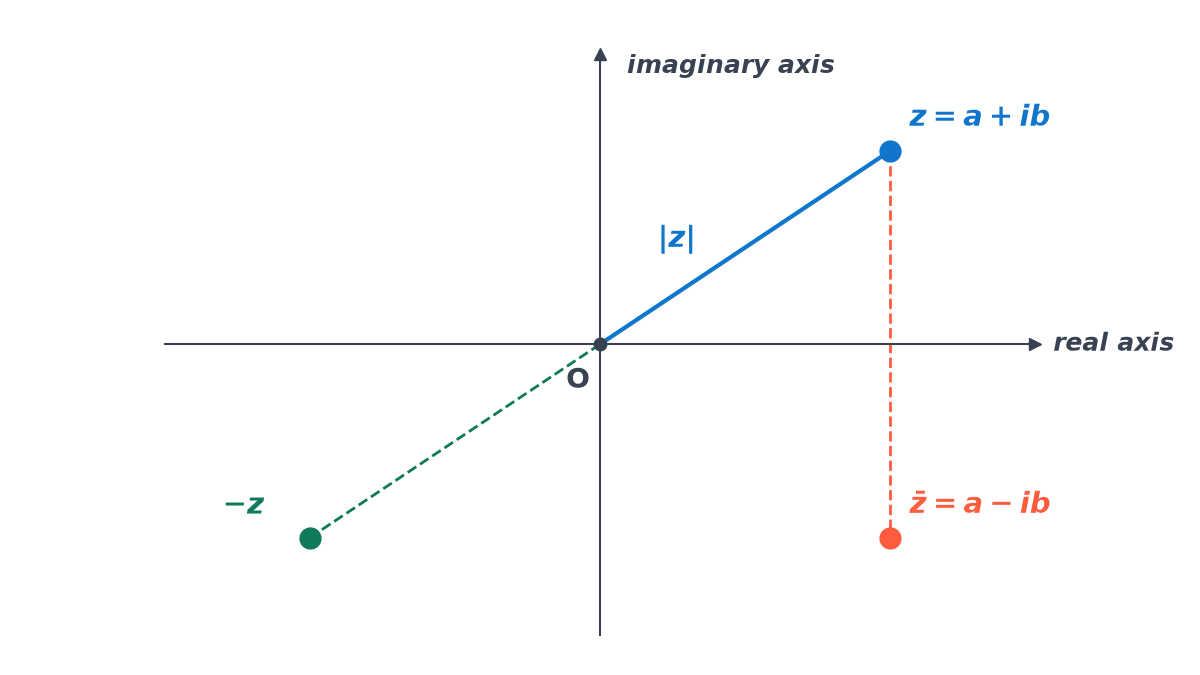
Plot z=a+ib at the point (a,b). The horizontal axis is now called the real axis and the vertical one the imaginary axis. Many algebraic ideas become simple geometry. The conjugate zˉ is the mirror image of z in the real axis, and −z is its reflection through the origin. The modulus ∣z∣ is just the distance from O, and ∣z1−z2∣ is the distance between two points.
A complex number, its conjugate and its negative
Instead of saying how far across and how far up a point is, we can say how far away it is and in which direction. If z=x+iy has modulus r=∣z∣ and makes an angle θ with the positive real axis, then x=rcosθ, y=rsinθ and
z=r(cosθ+isinθ).
The angle is not unique, since adding a full turn lands on the same point. So we pick the principal argumentθ=argz in (−π,π]. The safest method is in two steps. First find the reference angle α=tan−1xy, ignoring signs. Then place it according to the quadrant of the point: in I it is α; in II, π−α; in III, −(π−α); in IV, −α. A quick sketch of the point prevents most mistakes here.
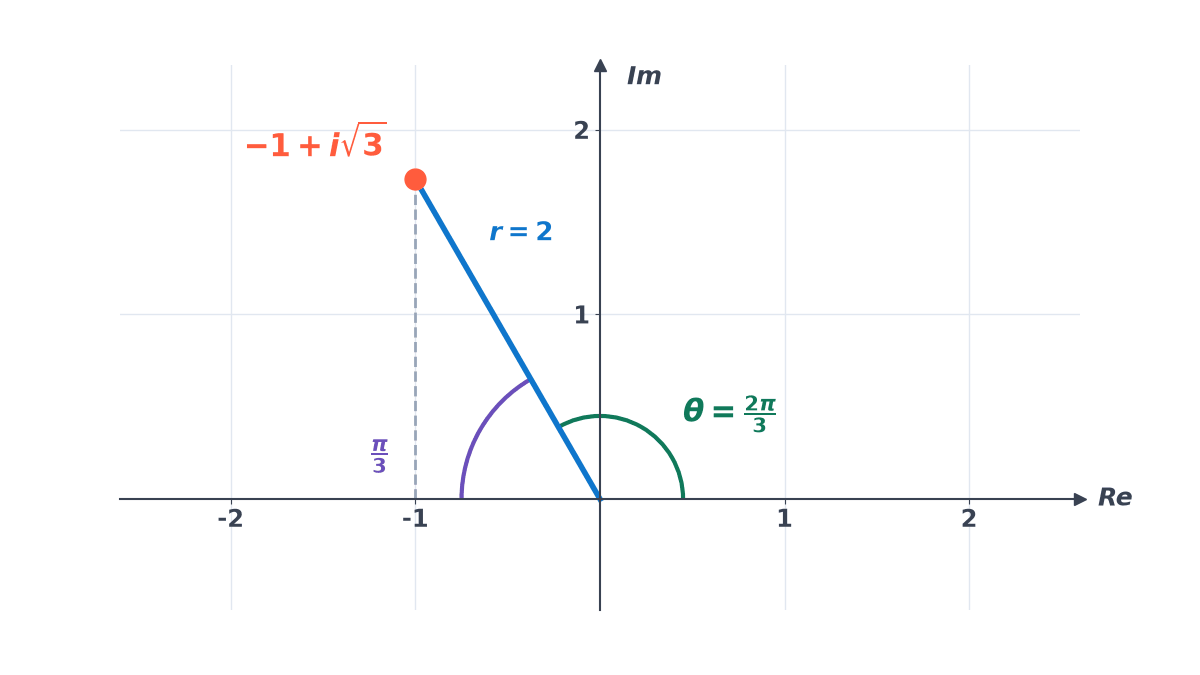
Example 1. For z=−1+i3 we get r=2 and reference angle 3π. The point is in quadrant II, so θ=32π, and z=2(cos32π+isin32π).
Example 1: modulus 2 and argument 2 pi/3
Example 2. For z=−3−3i, in quadrant III, r=32 and θ=−43π.
Example 3. Points on the axes need no formula. For z=−4, r=4 and θ=π. For z=5i, r=5 and θ=2π.
Example 4. For (2−i)21+7i, first simplify: (2−i)2=3−4i, and 25(1+7i)(3+4i)=25−25+25i=−1+i=2(cos43π+isin43π).
Quadratic equations with negative discriminant#
For ax2+bx+c=0 with real coefficients and D=b2−4ac<0:
x=2a−b±i4ac−b2.
Notice that the two roots always come as a pair of complex conjugates. There is a bigger story here too. The fundamental theorem of algebra says that a polynomial equation of degree n has n roots once we count in the complex numbers. So with complex numbers, no polynomial equation is ever left without a solution.
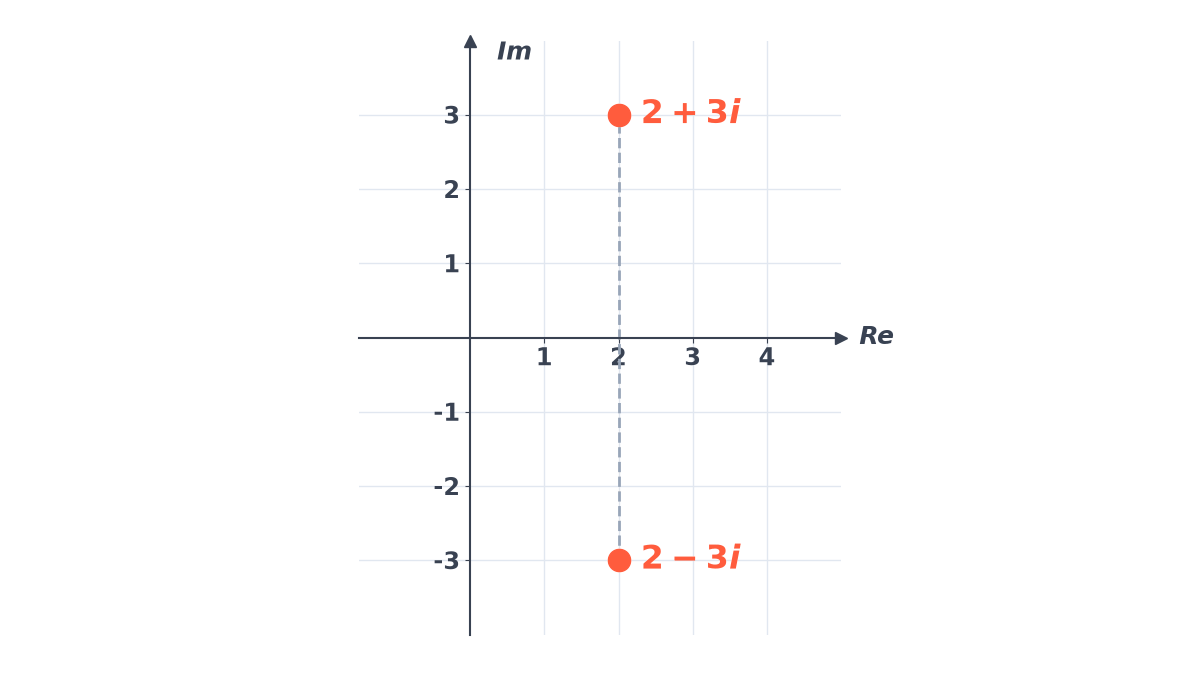
Example 5. For x2−4x+13=0, D=−36, so x=24±6i=2±3i.
The roots 2 + 3i and 2 - 3i are complex conjugates
Example 6. For 3x2+2x+1=0, D=−8, so x=6−2±22i=3−1±2i.
Example 7. Surds in the coefficients change nothing. For 2x2+x+2=0, D=1−8=−7, and x=22−1±7i.