The equation x2+1=0 has no real solution, since no real number has a negative square. Mathematicians faced this problem long ago, and their answer was bold: allow a new number i with i2=−1. That single step gives us the complex numbers a+ib. Don't let the word "imaginary" put you off; these numbers follow very sensible rules. We will define them, learn their arithmetic (adding, multiplying, dividing with the help of the conjugate, and taking powers of i), and meet the modulus.
A complex number has the form z=a+ib, where a,b are real and i=−1. We call a=Rez the real part and b=Imz the imaginary part. Two complex numbers are equal only when both parts match: a+ib=c+id exactly when a=c and b=d. This one fact turns a single complex equation into two real ones.
Example 1. Comparing parts in (2x−1)+i(y+3)=5−2i gives x=3 and y=−5.
All the old rules still hold. Addition and multiplication are commutative and associative, multiplication distributes over addition, 0 and 1 are the identities, and −z is the additive inverse.
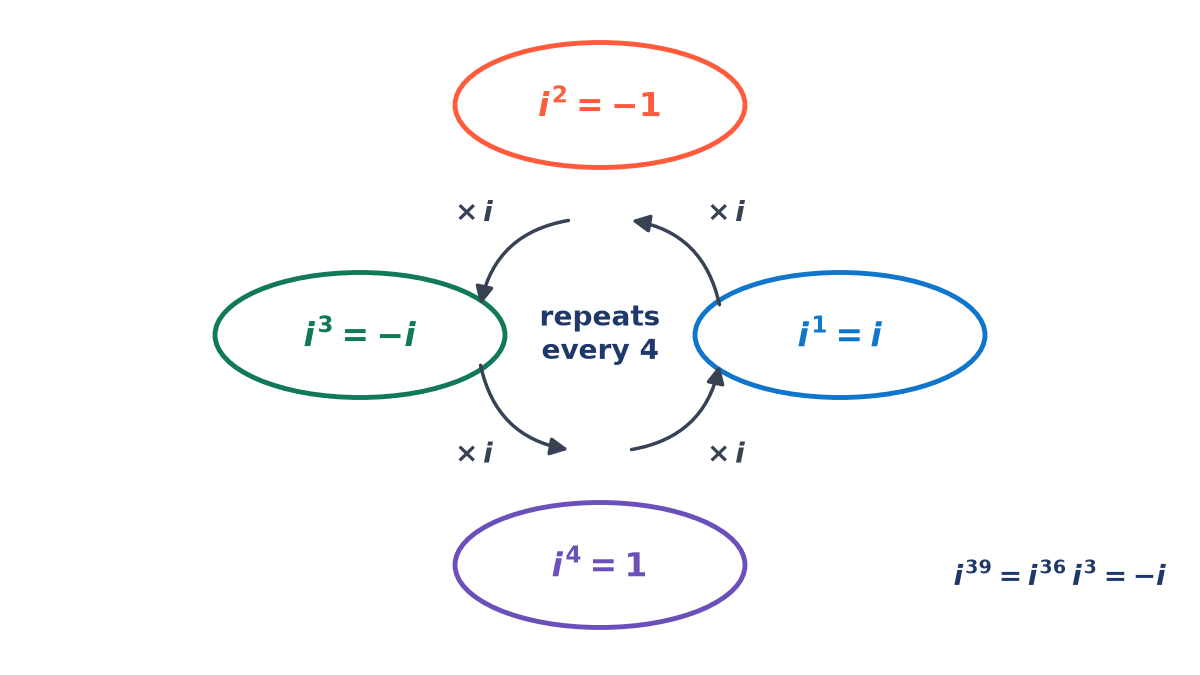
Powers of i go round in a cycle of four: i,−1,−i,1, and then back again. So i4k=1, i4k+1=i, i4k+2=−1 and i4k+3=−i. For any power, divide the index by four and look only at the remainder. For example, i39=i36i3=−i, and i−5=i51=i1=−i.
Each multiplication by i moves one step round a cycle of four
Square roots of negatives. We write −9=3i. Now a warning that catches many students: the rule ab=ab fails when both numbers are negative. Indeed −4−9=(2i)(3i)=−6, not 36. Always write each root in terms of i first, then multiply.
Example 2.(3−2i)(4+5i)=12+15i−8i−10i2=22+7i. (1+i)2=2i, so (1+i)6=(2i)3=−8i.
The conjugate of z=a+ib is zˉ=a−ib; you just flip the sign of the imaginary part. The beauty of it is that zzˉ=a2+b2, a non-negative real number. The modulus is ∣z∣=a2+b2.
That is exactly what we need for division. Multiply the top and bottom by the conjugate of the denominator, and the denominator becomes real, much like rationalising a surd:
z1=∣z∣2zˉ,1−2i2+3i=1+4(2+3i)(1+2i)=5−4+7i.
A few properties save a lot of work: ∣z1z2∣=∣z1∣∣z2∣, z2z1=∣z2∣∣z1∣, z1z2=zˉ1zˉ2 and z1+z2=zˉ1+zˉ2.
Example 3. The inverse of 4−3i is 254+3i. And for a modulus you never need to multiply out; take the modulus of each piece: 2−i(1+i)(3−4i)=52⋅5=10.
Example 4. In the same spirit, if 2−ia+i=x+iy, then ∣x+iy∣2=5a2+1.