Lists with a rule
A sequence is simply an ordered list of numbers, and the interesting ones follow a rule. There are two ways to state that rule. An explicit formula works out any term straight from its position. A recursive formula builds each term from the ones before it. In this lesson you will learn the notation, see both kinds of rule at work, and meet the Virahāṅka sequence, in which each term is the sum of the two before it.
Sequences and terms
Each of these is a sequence, and each number in it is a term. The dots at the end mean it goes on for ever, so it is an infinite sequence. A list that stops, such as , is finite.
We name terms by their position. is the first, the second, and the -th. For the odd numbers, and . We use different letters, such as or , for different sequences. The position is always a natural number, but the term itself can be anything: negative, a fraction, a decimal.
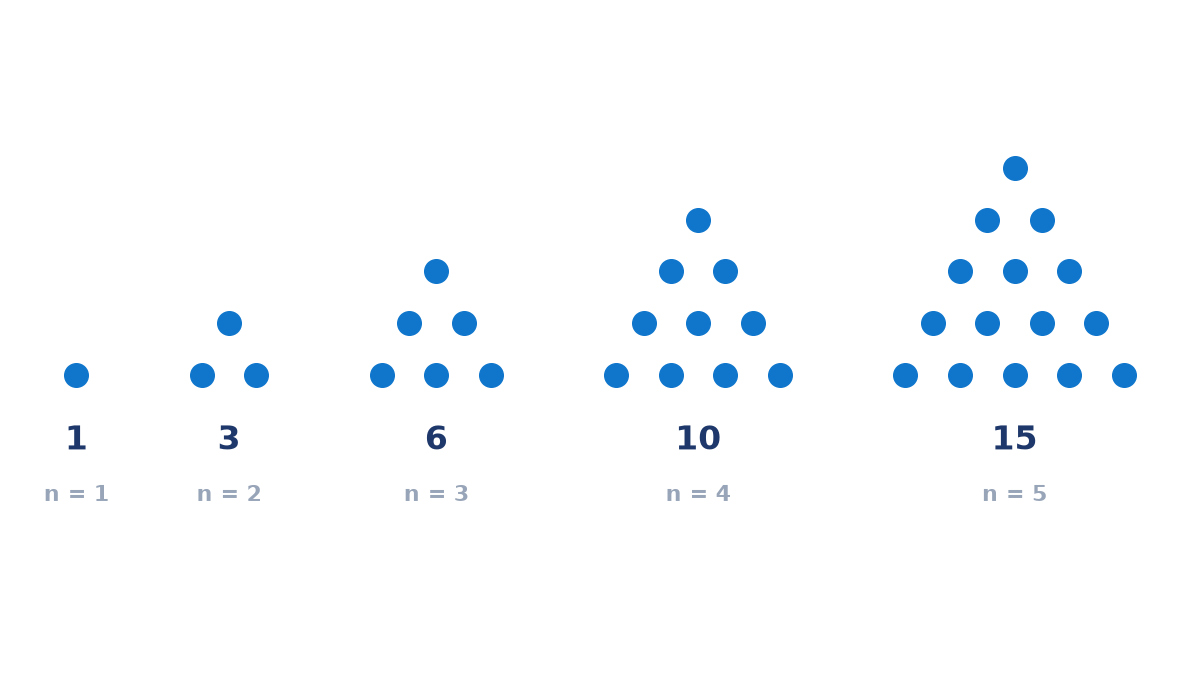
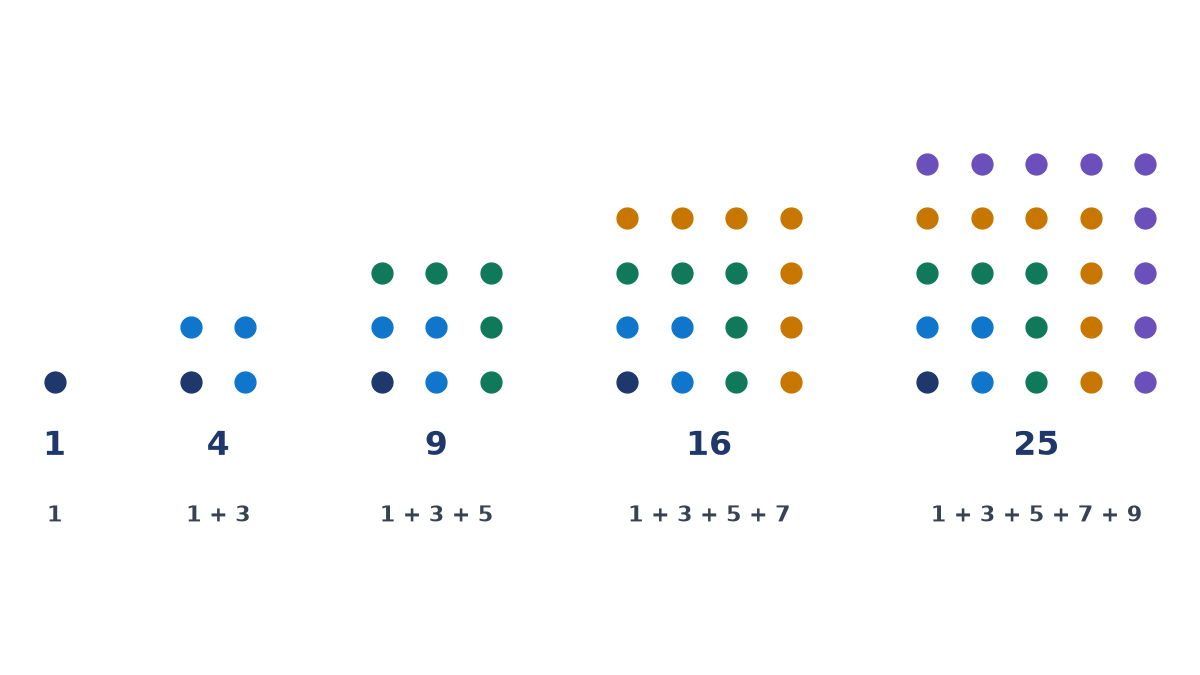
The triangular numbers are the running totals of . A triangle of dots with rows has dots. The square numbers are the running totals of the odd numbers, as in . You can see why in the picture: an -shaped border of dots turns an -square into an -square.
Explicit rules
An explicit rule gives as a formula in . Its great strength is that you can jump straight to any term.
Example 1. gives : the odd numbers. So the th odd number is , and the th is . You do not need to write out the first to get there.
Example 2. : The th term is .
Is a number in the sequence? Set that number, solve, and check whether comes out as a natural number.
Example 3. Is a term of ? Solving gives , so yes, it is the th term. What about ? Then and . So no, because there is no such thing as a th term.
Example 4. For , the first three terms are , and the th is . Which term is ? From we get . Is a term? That would need , which is not a multiple of , so no.
Example 5. For square numbers the rule is . For triangular numbers it is , which we prove in the next lesson. Check: ✓.
Not every sequence has a rule you can use. The primes are perfectly definite, and yet no simple, practical formula produces the -th prime from .
Recursive rules
A recursive rule tells you the first term, or the first few, and then how to get each term from the one or ones before it.
The sequence has the explicit rule and also the recursive rule
The catch is that a recursive rule needs the earlier terms. You cannot jump straight to without first computing .
Example 6. , . Then , , and . Is a term? Working one more step gives , so yes, it is the sixth.
Example 7. , . Then , and . Look how fast the terms explode!
Example 8. , : In explicit form this is . Is a term? From we get , so yes.
The Virahāṅka sequence
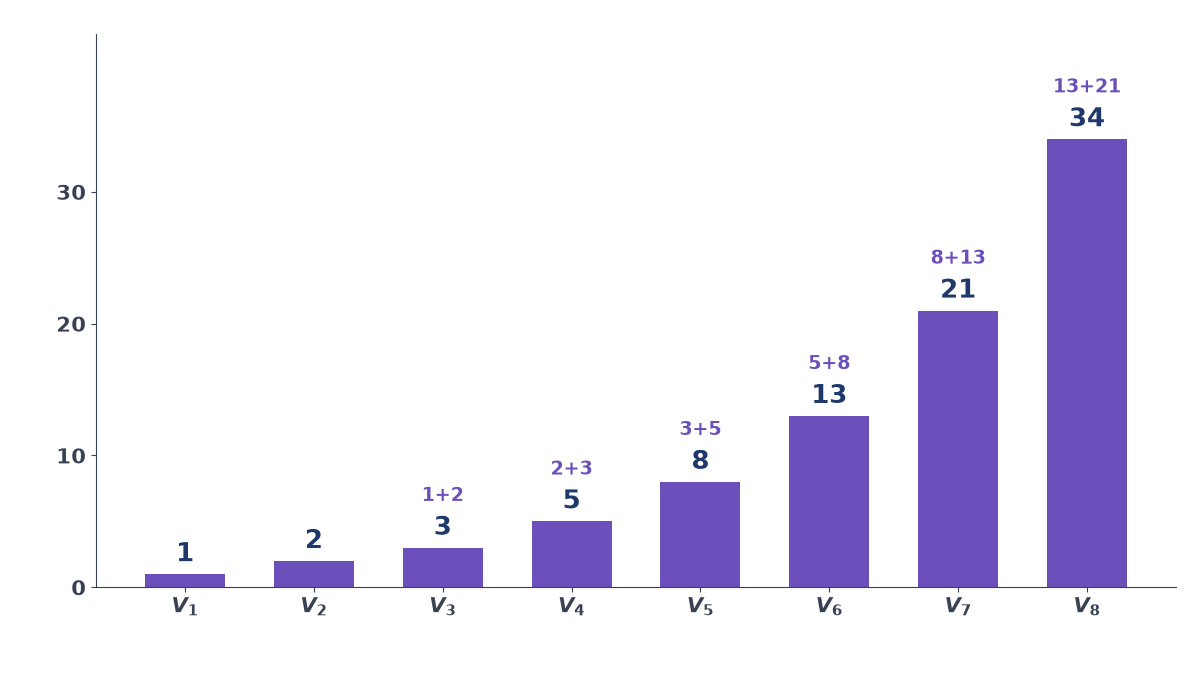
A rule can also use the previous two terms. For example,
gives , where each term is the sum of the two before it. Virahāṅka wrote it down in the seventh century CE while counting the rhythms of Prakrit poetry. Gopāla and Hemacandra studied it around 1150, and Fibonacci in Italy around 1200. It turns up all over mathematics and nature, and you will meet it again in later classes.
A rule can even reach back three terms or more. For instance, , gives
Practice
- Write the first five terms of (a) ; (b) ; (c) ; (d) .
- For find and , and decide whether and are terms.
- Which term of is ?
- A sequence has and . Write five terms, give an explicit rule, and find which term is .
- , . Find to . Is a term?
- Write the next four terms of the Virahāṅka sequence after .
- , , , . Find to .
- Give an explicit rule for (Hint: compare with .)
Answers
Show answers
- (a) . (b) . (c) . (d) .
- ; . gives : yes. : not a multiple of : no.
- , .
- . . , .
- . Yes: .
- .
- , , , .
- .