Predicting What Comes Next: Sequences and Progressions
Sequences and Progressions: Mixed Practice
Fourteen questions across the chapter, explicit and recursive rules, classifying AP, GP or neither, terms from two given terms, multiples in a range and their sums, consecutive-number sums of 45, GP terms and ratios, a tripling population, and the Sierpiński area.
Lesson 4 of 4
3 min read
How to use this set
Here are fourteen questions from across the chapter. For every sequence, first decide whether it is an AP, a GP or neither, by checking the differences and the ratios. Write down a and d or r before you use any formula. And whenever you answer a "which term" question, put your answer back in to check it.
Section A, Rules
Write the first four terms of (a) tn=5n−9; (b) tn=2n+1; (c) tn=n+2n.
u1=4, un=3un−1−5. Find u2 to u5.
Classify each as AP, GP or neither, giving d or r: (a) 7,12,17,22; (b) 2,6,18,54; (c) 1,1,2,3,5; (d) 100,50,25,12.5; (e) 9,5,1,−3.
Section B, Arithmetic progressions
Find the 25th term of an AP whose 7th term is 31 and 12th term is 56.
Find the AP whose third term is 14 and whose ninth term exceeds its sixth term by 15.
How many three-digit numbers are multiples of 9? Find their sum.
How many multiples of 6 lie strictly between 20 and 300?
Find S45 and 101+102+⋯+200.
In how many different ways can 45 be written as a sum of two or more consecutive natural numbers? List them all.
Section C, Geometric progressions
Find the 7th term of 41,21,1,2,… and say which term is 256.
A GP has second term 12 and fifth term 324. Find a, r and the seventh term.
Find a GP whose first two terms add to −6 and whose fourth term is 9 times its second term, with r>0.
A population of insects starts at 40 and triples every week. After how many weeks does it first exceed 100,000?
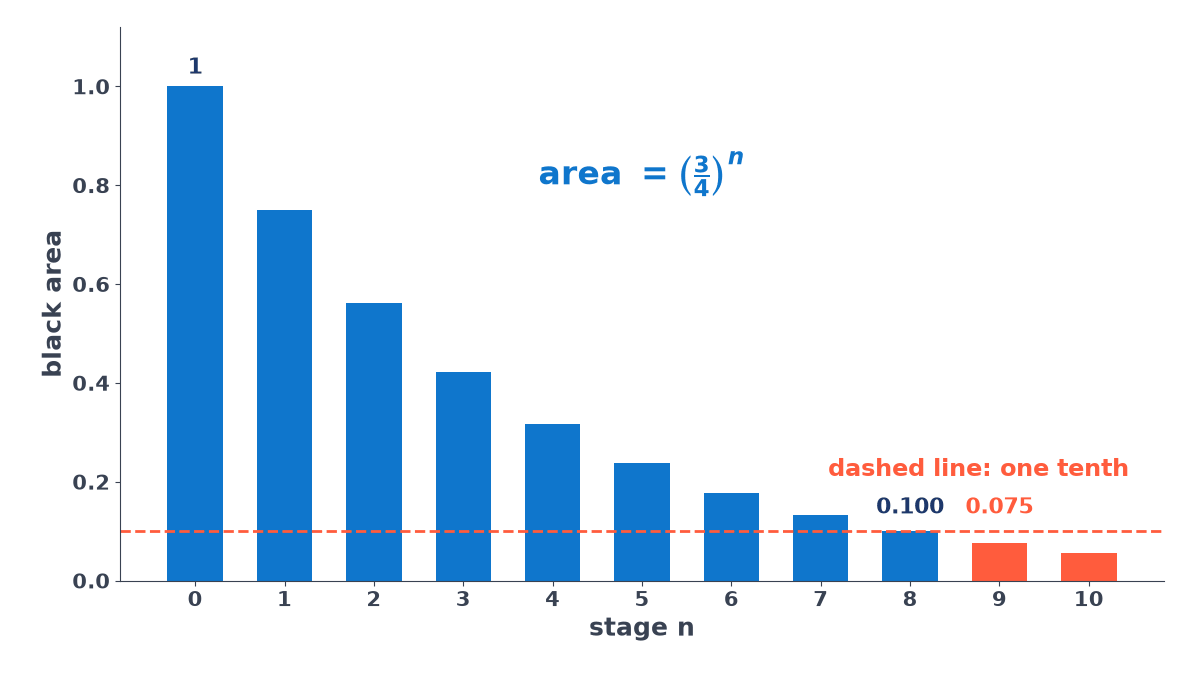
In a Sierpiński triangle, at which stage does the black area first fall below 101 of the original?
t9−t6=3d=15, d=5; a+2d=14, a=4. The AP is 4,9,14,19,…
108 to 999: tn=99+9n=999, n=100. Sum =100×2108+999=55350.
24 to 294: tn=18+6n=294, n=46.
S45=1035. S200−S100=20100−5050=15050.
Two terms: 22+23. Three: 14+15+16. Five: 7+8+9+10+11. Six: 5+6+7+8+9+10. Nine: 1+2+⋯+9. Five ways. (A run of k terms with middle value m sums to km for odd k; for even k the sum is k times a half-integer, so look at the odd divisors of 45: 3,5,9,15,45, the last two giving even-length runs of 6 and 2.)
r=2, t7=41×26=16. 41×2n−1=256=28, so 2n−1=210, n=11.
ar=12, ar4=324: r3=27, r=3, a=4; t7=4×36=2916.
ar3=9ar gives r2=9, r=3; a+3a=−6, a=−23. The GP is −23,−29,−227,…
40×3n>100000 means 3n>2500; 37=2187, 38=6561: after 8 weeks.