Predicting What Comes Next: Sequences and Progressions
Arithmetic Progressions and the Sum of Natural Numbers
The general term a + (n − 1)d, finding a and d from two terms, why an AP plots on a straight line, the pairing proof of 1 + 2 + ⋯ + n = n(n + 1)/2 as recorded by Āryabhaṭa, sums of blocks of consecutive numbers, and triangular numbers.
Lesson 2 of 4
5 min read
10 practice questions
Equal steps
When a sequence rises or falls by the same amount at every step, we call it an arithmetic progression. We will find its general term and see that its points lie on a straight line when plotted. Then comes the best part. Using a pairing trick that Āryabhaṭa recorded in 499 CE, we prove the formula for 1+2+⋯+n, and with it we get every triangular number for free.
Arithmetic progressions
A pattern of tiles starts with 1 tile and gains 4 at every stage: 1,5,9,13,17,… If we write it as 1,1+4,1+2×4,1+3×4,…, the pattern jumps out, and the n-th term is 1+(n−1)×4=4n−3.
A sequence whose consecutive terms always differ by the same number is called an arithmetic progression, or AP for short. With first term a and common differenced, it looks like this:
a,a+d,a+2d,a+3d,…tn=a+(n−1)d
In recursive form, the same AP is t1=a, tn=tn−1+d.
The difference can be negative too. For example, 11,7,3,−1,−5,… has a=11, d=−4, tn=15−4n.
Example 1. For 3,8,13,18,… we have a=3 and d=5, so tn=5n−2. Then t10=48 and t26=128.
Example 2. Which term of 21,18,15,… is −81? Setting tn=24−3n=−81 gives n=35. Is 0 a term? Solving 24−3n=0 gives n=8, so yes, it is the eighth.
Example 3. An AP has t3=12 and t50=106. Find t29.
Write both facts as equations: a+2d=12 and a+49d=106. Subtracting, 47d=94, so d=2 and a=8. Then t29=8+28×2=64.
Example 4. A taxi charges ₹200 for booking plus ₹40 per km. The fares for 1,2,3,… km form the AP 240,280,320,… with tn=200+40n. So a 10 km trip costs ₹600.
Example 5. How many two-digit numbers are multiples of 7? They run 14,21,…,98. Setting tn=7n+7=98 gives n=13, so there are thirteen of them.
Plotting an AP
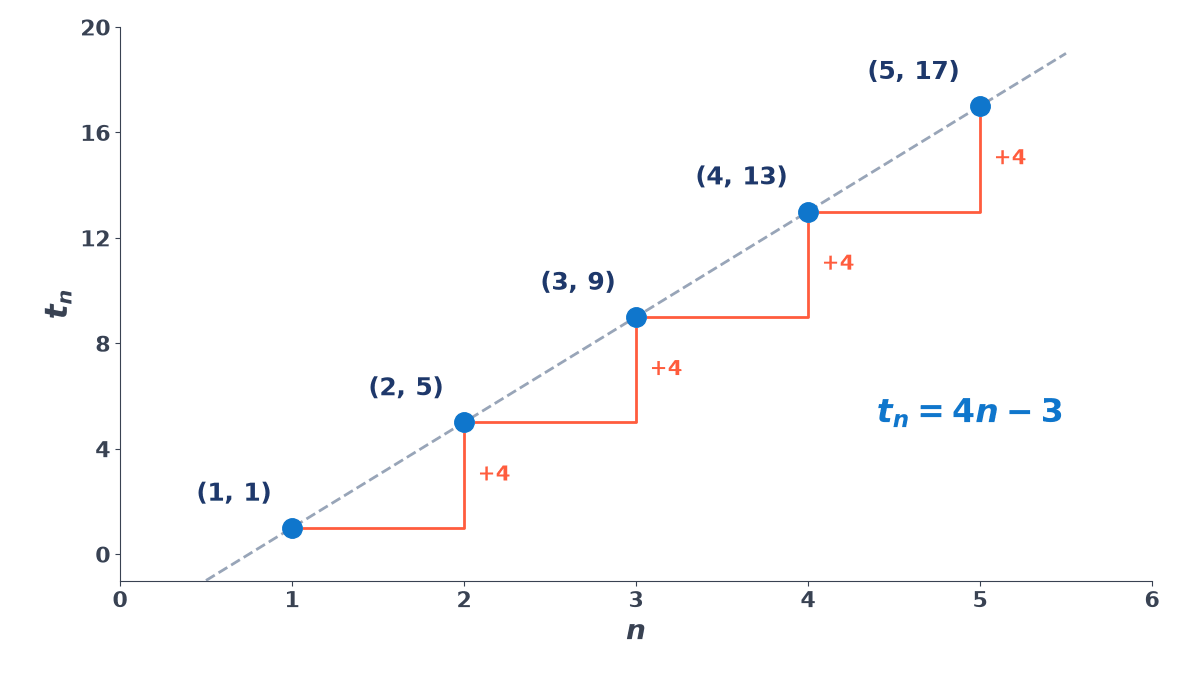
Plot (n,tn) for 1,5,9,13,17. The points (1,1),(2,5),(3,9),(4,13),(5,17) lie on a straight line, because tn=4n−3 is a linear expression in n. The common difference is simply the line's slope. So every AP plots as evenly spaced points on a line, and if a sequence's points do not line up, it is not an AP.
The terms of an AP lie on a straight line.
The sum 1+2+⋯+n
How would you add the numbers from 1 to 10 quickly? Here is the trick. Write the sum forwards, and then backwards underneath it.
S=1+2+3+⋯+10 S=10+9+8+⋯+1
Every column adds up to 11, and there are ten columns. So 2S=110, and S=55.
The same works for any n. Each column adds up to n+1, and there are n columns, so 2S=n(n+1) and
Sn=1+2+⋯+n=2n(n+1)
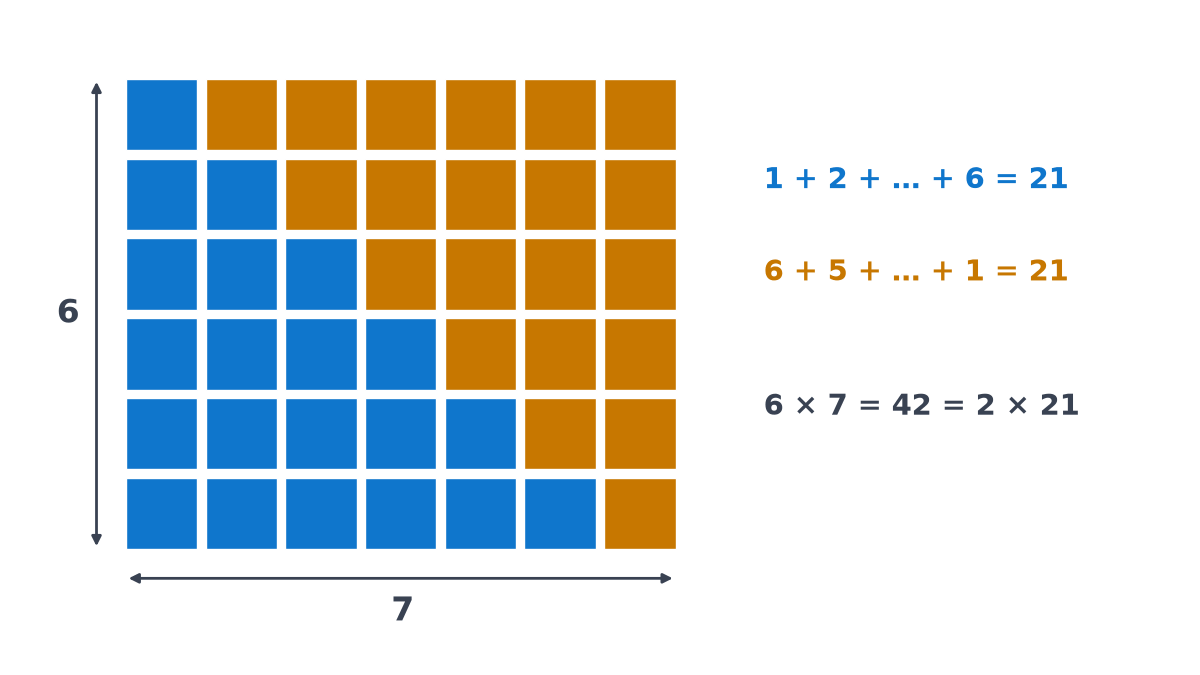
You can see the same idea in a picture: two staircases of 1+2+⋯+6 dots fit together to make a 6×7 rectangle.
Two staircases of 1 + 2 + ... + 6 make a 6 by 7 rectangle.
Āryabhaṭa's Āryabhaṭīya gives the rule in a form that works for any AP: take the average of the first and last terms, and multiply by the number of terms.
Example 6.S40=240×41=820. S1000=500500.
Example 7.31+32+⋯+70=S70−S30=2485−465=2020. Or use Āryabhaṭa's form: forty terms with average 231+70=50.5 give a total of 2020.
Example 8. The n-th triangular number is just Sn. So the 12th is 78, and the 30th is 465.
Example 9. Now add up the two-digit multiples of 7 from Example 5. There are thirteen terms, the first is 14 and the last is 98, so the average is 56 and the total is 728.
Example 10. A worker starts at ₹4,80,000 a year with a raise of ₹25,000 each year. The salary in year n is 455000+25000n. It reaches ₹7,30,000 when 25000n=275000, that is n=11. So it happens in the eleventh year, after ten raises.
Practice
Find t15 and t40 of the AP 6,11,16,…
Which term of 50,46,42,… is −30? Is 5 a term?
Write the n-th term and the recursive rule of 9,5,1,−3,…
An AP has t4=19 and t20=83. Find a, d and t35.
How many two-digit numbers are multiples of 6, and what is their sum?
Find S25, S60 and 41+42+⋯+90.
Find the 15th and 40th triangular numbers.
A hall has 20 rows of seats; the first row has 12 seats and each row has 2 more than the one before. How many seats in the last row, and in the hall?
Marbles are laid in rows of 1,2,3,… up to 30 rows. How many marbles?
Three numbers in AP have sum 27 and the largest is 5 more than the smallest. Find them.
Answers
Show answers
tn=5n+1: 76; 201.
tn=54−4n=−30: n=21. 54−4n=5 gives n=12.25: no.
tn=13−4n; t1=9, tn=tn−1−4.
16d=64, d=4, a=7; t35=7+34×4=143.
12,18,…,96: tn=6n+6=96, n=15. Sum =15×212+96=810.
325; 1830; S90−S40=4095−820=3275.
120; 820.
Last row 12+19×2=50. Total 20×212+50=620.
S30=465.
Middle term 9 (sum ÷3); 2d=5, d=2.5: 6.5,9,11.5.
Test yourself
Arithmetic Progressions and the Sum of Natural Numbers, Quiz
Five questions on arithmetic progressions and the sum 1+2+⋯+n. Pick one answer for each.