From adding to multiplying
Add the same amount at each step and you get an arithmetic progression. Now multiply by the same amount at each step instead. You get a geometric progression, and it grows, or shrinks, far faster. We will find its general term, learn to test a sequence for a common ratio, and see that a GP's points do not line up. Then we follow two GPs into the real world: the Sierpiński triangle, whose pieces multiply while its area melts away, and a bouncing ball.
Geometric progressions
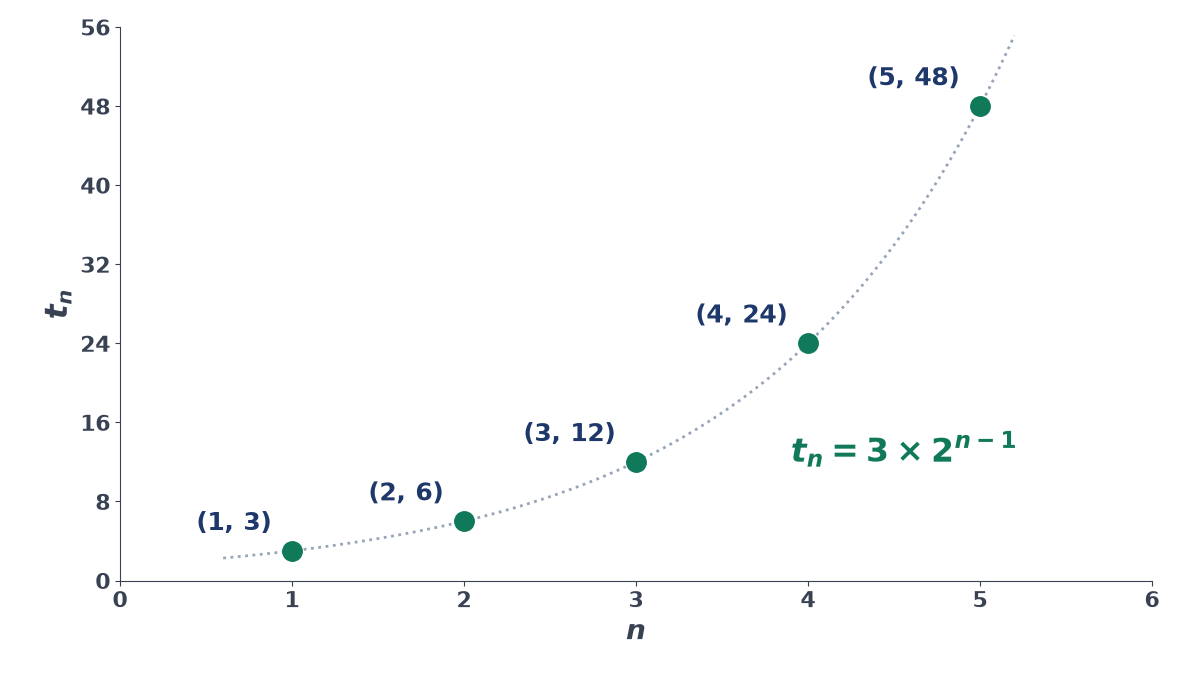
A pattern of squares starts with squares and doubles at every stage: If we write it as , we can see that the -th term is .
A sequence in which each term is the previous term times a fixed number is called a geometric progression, or GP. With first term and common ratio , it looks like this:
In recursive form it is , .
Testing for a GP. Divide each term by the one before it. If every answer is the same, you have a GP with that ratio.
Example 1. has ratio , and has ratio . What about ? Its ratio is , which shows that a GP can flip its sign back and forth.
Example 2. : , , . So it is a GP with and , and .
Example 3. Which term is ? We need , so , and .
Example 4. A GP has ratio and eighth term . To go forward four terms, multiply by two four times: the twelfth term is . To go back to the first term, divide: .
Example 5. has ratio , so and . Now compare it with the AP , which has difference . Its tenth term is only . That is the power of multiplying.
Plotting a GP
Plot : and the points do not lie on a line. They curve upwards, each step steeper than the one before. A GP with ratio between and curves the other way: it drops steeply at first and then flattens out towards .
Fractals: the Sierpiński triangle
Start with a black equilateral triangle. Call this Stage 0. Join the midpoints of its sides and remove the middle triangle, and three black triangles remain. That is Stage 1. Do the same to each of them and you have nine, which is Stage 2. Then come , , , and so on.
| Stage | ||||||
|---|---|---|---|---|---|---|
| Black triangles | ||||||
| Black area (Stage 0 ) |
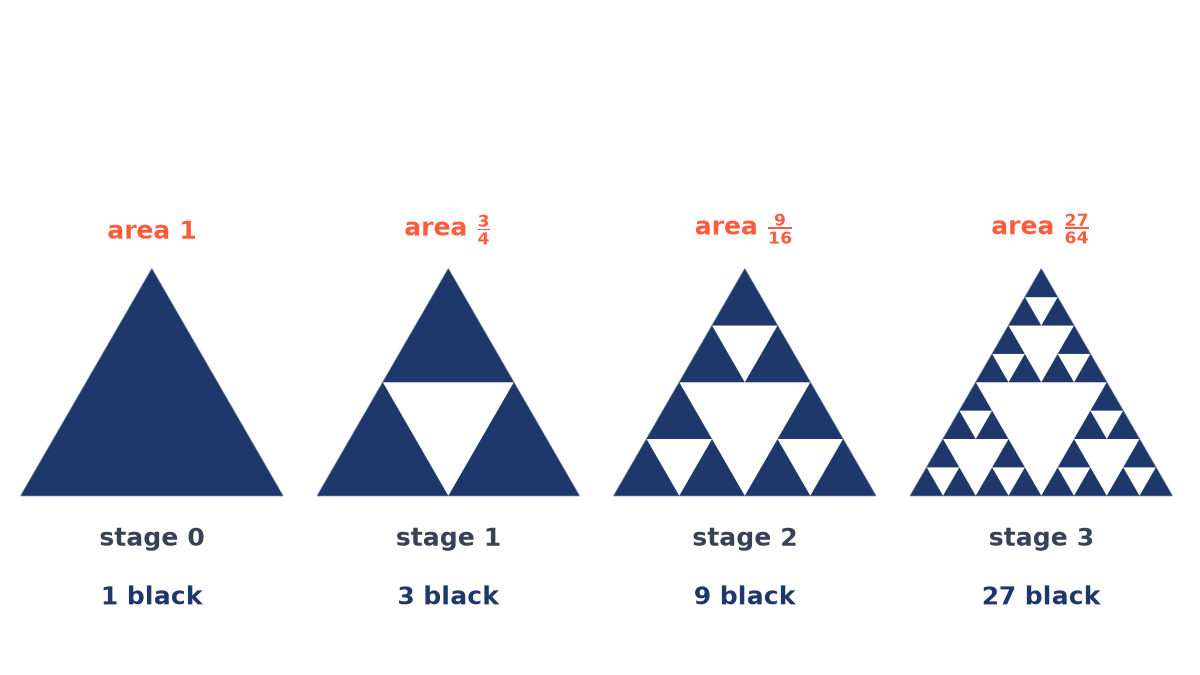
Each step multiplies the count by and the area by , since one quarter of each black triangle is removed. So both rows are GPs. But look at what happens. The count explodes while the area shrinks towards . After stages less than of the original area remains, and yet over three thousand million tiny triangles are still there. Strange, but true.
If the process goes on for ever, the finished object is a fractal. Zoom in on any corner and you see the whole pattern again. Wacław Sierpiński described it in 1915. Ferns, cauliflower heads, coastlines and lightning all show this same self-similarity.
The Sierpiński carpet does the same thing with a square, cut into nine with the centre removed. It has squares at stage , area .
A bouncing ball
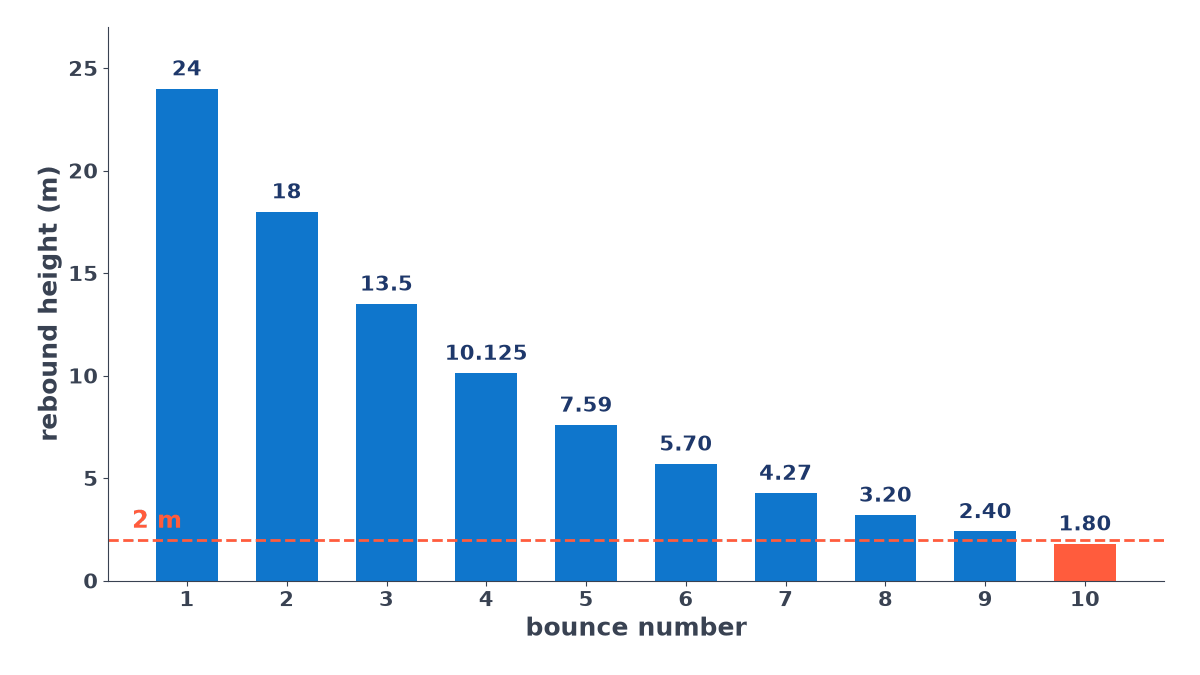
A ball dropped from m rebounds each time to of the height it fell from. The rebound heights are , which is a GP with , , .
When does it first bounce to less than m? Work it out: , , , . So it happens at the tenth bounce.
Example 6. A ball dropped from m rebounds to each time. After the fourth bounce it rises to m. What is the total distance travelled up to the fourth landing? There is the first drop of , and then each of the first three rebounds counted twice, once going up and once coming down: m.
Example 7. A colony of bacteria doubles every hour from . After hours there are bacteria. They pass a million when , which first happens after hours, since .
Practice
- Which of these are GPs? Give the ratio where there is one. (a) ; (b) ; (c) ; (d) ; (e) .
- Find and of
- Which term of is ?
- A GP has ratio and fifth term . Find its first and ninth terms.
- Check whether is a GP and give its -th term.
- Write the explicit and recursive rules for
- For the Sierpiński carpet, give the number of squares and the shaded area at stages to , and the rules for stage .
- A ball dropped from m rebounds to of its fall height each time. Find the height after the third bounce and the total distance travelled up to the third landing.
- A sum of ₹ grows by a year. Write the amount after years as a GP term and find it after years.
Answers
Show answers
- (a) Yes, . (b) No (an AP). (c) Yes, . (d) Yes, . (e) No.
- ; .
- , , .
- , ; .
- Ratios all : yes; .
- ; , .
- Squares ; area . Stage : squares, area ; recursively , .
- m. Distance m.
- ; after years ₹.