Matching corresponding sides after a similarity is established, heights from shadows, lengths inside figures, ratios of perimeters and altitudes, and proofs that end in a product of lengths.
Lesson 5 of 6
5 min read
5 practice questions
From "similar" to an actual number
Proving two triangles similar is only half the job. The payoff comes next: one proportion, and the unknown length drops out. This lesson is about that second half. You'll practise matching the corresponding sides correctly, setting up the ratio, and solving it, whether the question is a figure, a word problem about heights and shadows, or a proof that finishes with a product of lengths.
Matching the sides
Once you have △ABC∼△PQR, the sides pair up according to their position in the names:
PQAB=QRBC=RPCA
AB joins the first two letters of the first triangle, and PQ joins the first two letters of the second. If you named the similarity in the wrong order, every ratio after that will be wrong too. So settle the order first, using the equal angles: the vertex carrying angle θ in one triangle matches the vertex carrying angle θ in the other.
Heights and shadows
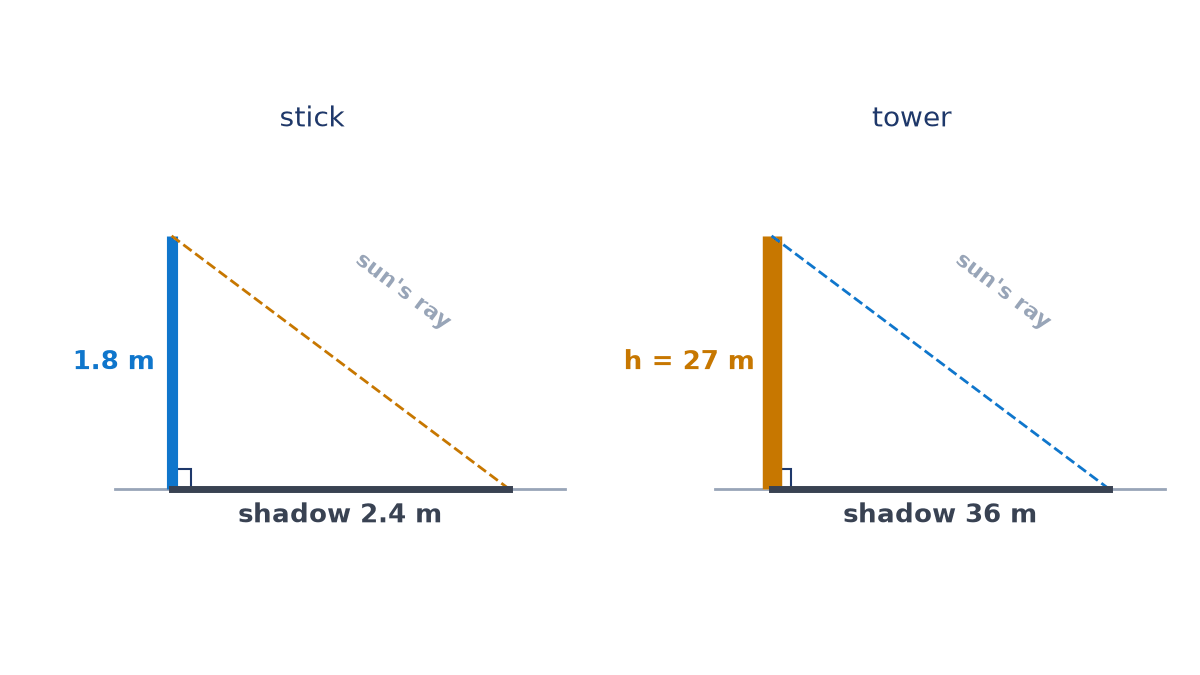
Example 1. A vertical stick 1.8 m tall casts a shadow 2.4 m long. At the same moment, a tower casts a shadow 36 m long. How tall is the tower?
Both triangles have a right angle at the ground and the same angle of elevation of the sun, so they are similar by AA.
1.8h=2.436⟹h=1.8×15=27 m
Stick and tower: the same shape, drawn to different scales
Example 2. A girl 1.2 m tall walks away from the foot of a lamp post 4.8 m tall at 1 m/s. How long is her shadow after 5 seconds?
After 5 s she is 5 m from the post. Call her shadow s m. The big triangle (lamp, foot of the post, tip of the shadow) is similar by AA to the small one (her head, her feet, tip of the shadow):
1.24.8=s5+s⟹4s=5+s⟹s=35 m
The lamp post, the girl 5 m away, and her shadow s
Lengths inside a figure
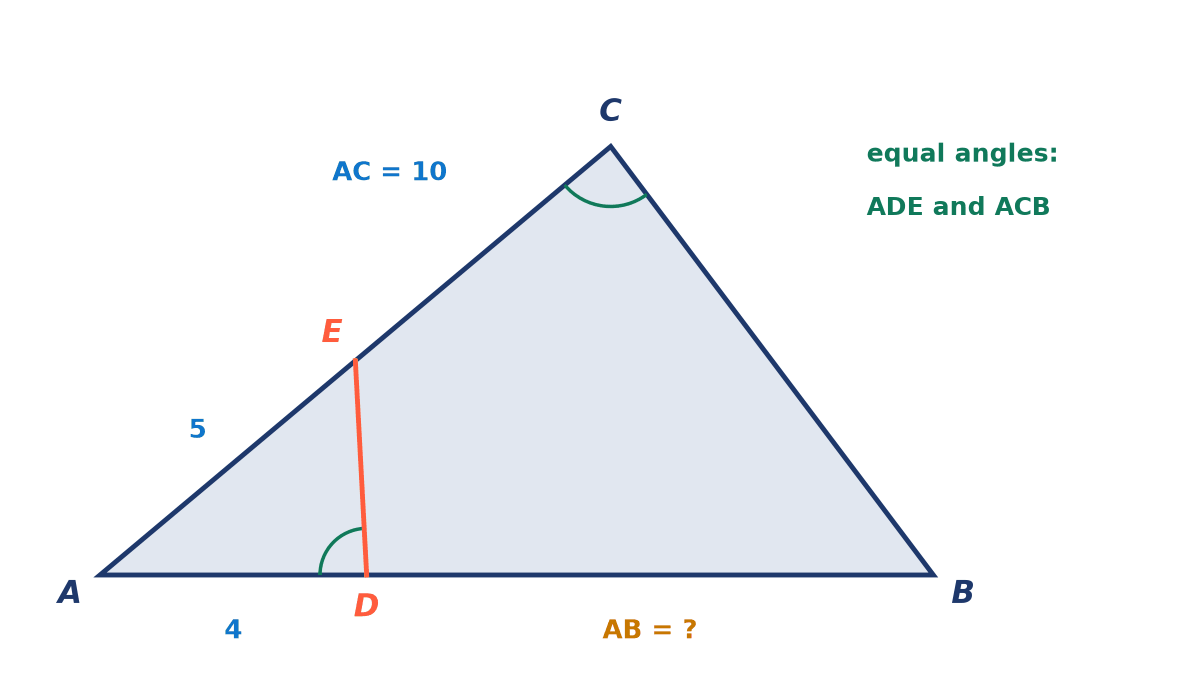
Example 3. In △ABC, D is on AB and E on AC, with ∠ADE=∠ACB. AD=4, AC=10, AE=5. Find AB.
In △ADE and △ACB, ∠A is shared and ∠ADE=∠ACB. So by AA, △ADE∼△ACB. Look closely at the order: D↔C and E↔B. This is exactly where students slip.
ACAD=ABAE⟹104=AB5⟹AB=12.5
Example 3: angle ADE equals angle ACB
Example 4. The diagonals of trapezium ABCD (AB∥DC) meet at O. AB=12, DC=8, AO=9. Find OC.
△AOB∼△COD by AA: the angles at O are vertically opposite, and the parallels give a pair of alternate angles. So COAO=CDAB=812=23, which gives OC=6.
Example 4: triangles AOB and COD in the trapezium
Ratios of other things
If △ABC∼△PQR with scale factor k=PQAB, then matching perimeters, medians, altitudes and angle bisectors are also in the ratio k. In short, any length at all scales by k.
Example 5.△ABC∼△DEF, AB=6, DE=8, and the altitude from A is 4.5. Find the altitude from D.
The ratio is 68=34, so the altitude is =4.5×34=6.
Proofs ending in a product
Example 6.E is a point on side AD produced of parallelogram ABCD, and BE meets CD at F. Prove that AB⋅BF=CF⋅BE.
In △ABE and △CFB, ∠A=∠C (opposite angles of the parallelogram) and ∠AEB=∠CBF (alternate angles, since AE∥BC). By AA, △ABE∼△CFB, with A↔C, B↔F, E↔B. So CFAB=FBBE=CBAE. Taking the first two, AB⋅FB=CF⋅BE. Here's a habit worth building: always write the full chain of three equal ratios, then pick out the two you need.
Practice
A pole 3 m tall casts a 4 m shadow while a building casts a 60 m shadow. How tall is the building?
A boy 1.6 m tall stands 6 m from a street light, and his shadow is 2 m long. How high is the light?
In △ABC, D is on AB and E on AC, with ∠AED=∠ABC, AD=3, AE=4, AB=8. Find AC.
△PQR∼△XYZ with PQ=10 and XY=4, and PQR has perimeter 45. Find the perimeter of XYZ.
The diagonals of trapezium ABCD, with AB∥DC, meet at O. If AB=3DC, find ODOB.
Answers
Show answers
3h=460, so h=45 m.
Let the light be at height H. Then 1.6H=26+2=4, so H=6.4 m.
△AED∼△ABC (they share ∠A, and ∠AED=∠ABC). So ABAE=ACAD, giving 84=AC3 and AC=6.
The ratio is 104=52, so the perimeter is 45×52=18.
△AOB∼△COD by AA, so ODOB=CDAB=3.
Test yourself
Using Similarity to Find Lengths, Quiz
Five questions on using similarity to find lengths. Pick one answer for each.