Ten questions on the BPT and its converse, lengths, unknowns that lead to a quadratic, deciding whether two lines are parallel, and three proofs including the midpoint theorem in one line.
Lesson 3 of 6
4 min read
How to use this set
Here are ten questions on the Basic Proportionality Theorem and its converse. Some want a length, some want an unknown x, and some want you to prove that two lines are parallel. Whatever the question, begin by naming the triangle and the parallel line you are using, and only then write the ratio. That one sentence is what turns a bare calculation into a proper solution.
Section A: Find the length
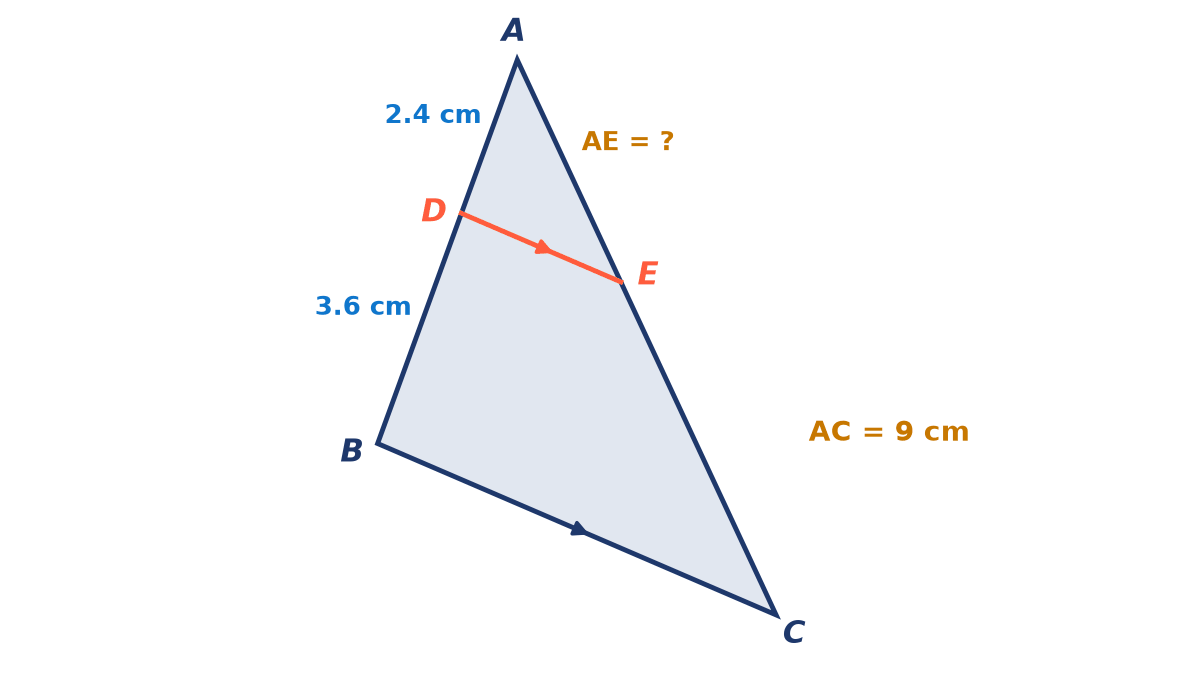
In △ABC, DE∥BC with D on AB and E on AC. AD=2.4 cm, DB=3.6 cm, AC=9 cm. Find AE.
In △PQR, ST∥QR with S on PQ and T on PR. PS=6, PQ=15, TR=12. Find PT.
In △ABC, DE∥BC. AD=3.5, DB=2.5, DE=7. You are also told that △ADE∼△ABC. Find BC.
Question 1: AD = 2.4, DB = 3.6, AC = 9; find AE
Section B: Find x
DE∥BC with AD=x−1, DB=x+1, AE=x, EC=x+3. Find x.
DE∥BC with AD=7x−4, AE=5x−2, DB=3x+4, EC=3x. Find x.
Section C: Parallel or not?
D is on AB and E on AC, with AB=12, AD=8, AE=12, AC=18. Is DE∥BC?
D is on AB and E on AC, with AD=5.7, DB=9.5, AE=3.3, EC=5.5. Is DE∥BC?
Section D: Prove
In △ABC, D and E are the midpoints of AB and AC. Prove that DE∥BC.
In trapezium ABCD with AB∥DC, a line is drawn through O, where the diagonals cross, parallel to AB. It meets AD at P and BC at Q. Prove that PDAP=QCBQ.
ABCD is a quadrilateral whose diagonals meet at O, with OCAO=ODBO. Prove that ABCD is a trapezium.
Question 9: the line PQ through O, parallel to AB
Answers
Show answers
Use ABAD=ACAE. Since AB=6, we get 62.4=9AE, so AE=3.6 cm.
First, SQ=9. Then SQPS=TRPT gives 96=12PT, so PT=8.
Here AB=6. Similarity gives BCDE=ABAD=63.5, so BC=7×3.56=12.
x+1x−1=x+3x. Cross-multiplying, (x−1)(x+3)=x(x+1), so x2+2x−3=x2+x and x=3. Check: 42=63 ✓.
3x+47x−4=3x5x−2. Cross-multiplying, 3x(7x−4)=(5x−2)(3x+4), so 21x2−12x=15x2+14x−8, then 6x2−26x+8=0, 3x2−13x+4=0, and (3x−1)(x−4)=0. That gives x=4 or x=31. But at x=31 we would have AD=−35<0, which is impossible, so reject it. Hence x=4. Check: 1624=1218=23 ✓.
DB=4 and EC=6. Then DBAD=2 and ECAE=2. They're equal, so the lines are parallel.
9.55.7=0.6 and 5.53.3=0.6. They're equal, so the lines are parallel.
DBAD=1=ECAE, so by the converse of the BPT, DE∥BC. (That's the midpoint theorem, proved in a single line.)
In △ADC, PO∥DC gives PDAP=OCAO. In △CAB, OQ∥AB gives QBCQ=OACO, which is the same as QCBQ=OCAO. Both ratios equal OCAO, so they equal each other.
Through O, draw OE∥AB with E on AD. In △DAB, EO∥AB gives EADE=OBDO. But OBDO=OACO (that's the given ratio turned upside down), so EADE=OACO. By the converse of the BPT in △ADC, EO∥DC. Since EO∥AB too, AB∥DC, and so ABCD is a trapezium.
Test yourself
Basic Proportionality: Practice, Quiz
Five questions on using the Basic Proportionality Theorem. Pick one answer for each.