Twelve questions across similar figures, the BPT, the three criteria and their applications, with full answers, including the angle bisector property and a midpoint proof by construction.
Lesson 6 of 6
4 min read
How to use this set
These twelve questions sweep across the whole chapter: similar figures, the Basic Proportionality Theorem, the three similarity criteria, and how they get used. In a proof, name the two triangles, list the equal angles or proportional sides with a reason for each, and then state the criterion. In a calculation, write the similarity with the vertices in matching order before you write a single ratio. Do this every time and most errors simply won't happen.
Section A: Similar figures and BPT
Are rectangles of sides 4×6 and 6×9 similar? What about 4×6 and 5×8?
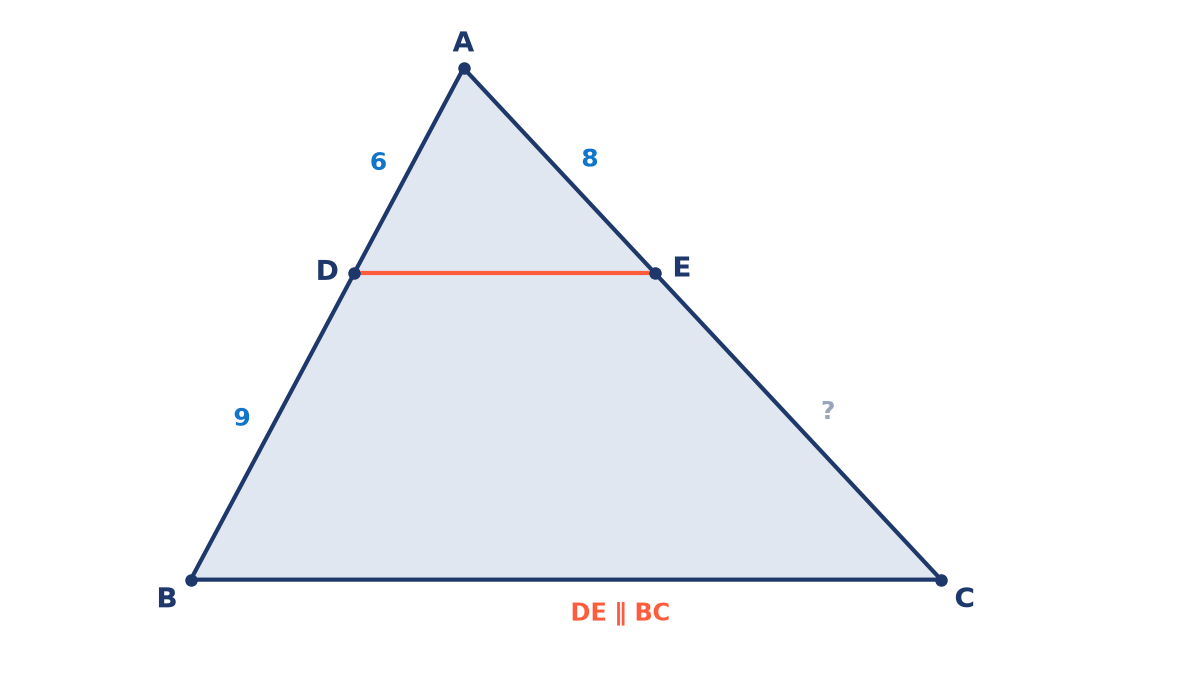
In △ABC, DE∥BC, AD=6, DB=9, AE=8. Find AC.
In △PQR, M is on PQ and N on PR, with PM=4.5, MQ=7.5, PN=3, NR=5. Is MN∥QR?
DE∥BC with AD=x, DB=4, AE=x+2, EC=6. Find x.
Question 2: DE parallel to BC in triangle ABC
Section B: Criteria
One triangle has sides 5,12,13 and another 7.5,18,19.5. Are they similar? If so, by which criterion?
△ABC has ∠A=65∘, ∠B=45∘. △PQR has ∠Q=70∘, ∠R=65∘. Are they similar? Write down the correspondence.
△ABC: AB=6, BC=8, ∠B=50∘. △DEF: DE=9, EF=12, ∠E=50∘. Are they similar, and by which criterion?
Section C: Proofs
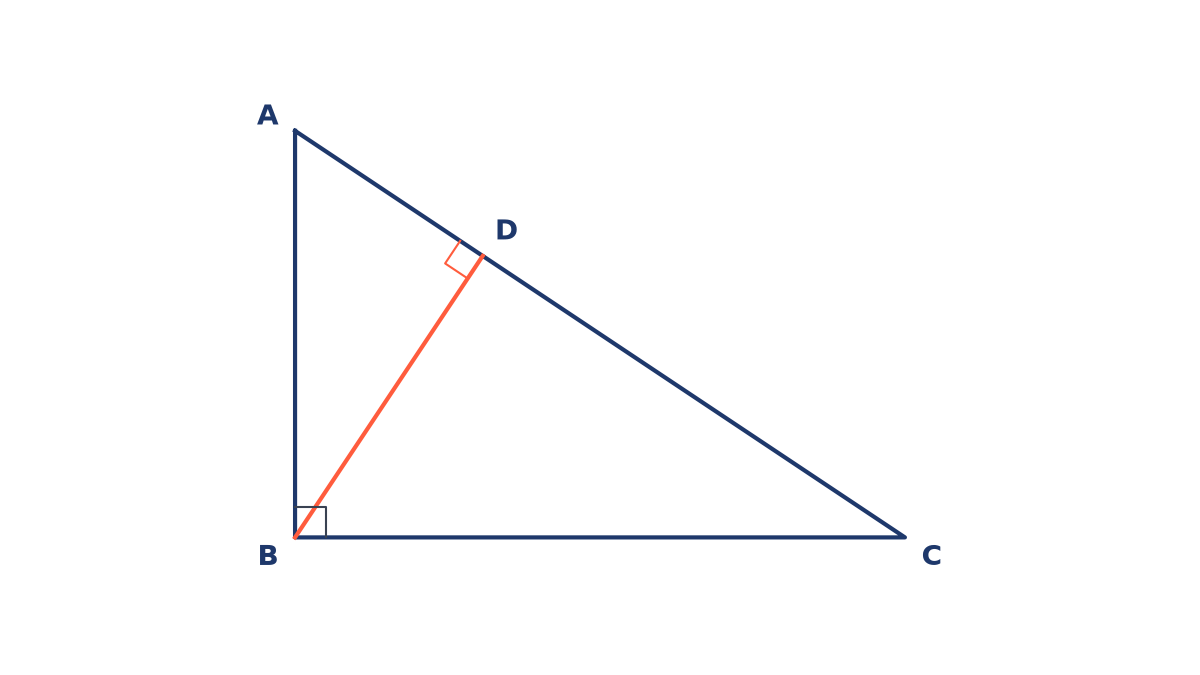
In triangle ABC, ∠B=90∘, and BD is the altitude to AC. Prove that AB2=AD⋅AC.
In △ABC, AD bisects ∠A and meets BC at D. A line through C parallel to DA meets BA produced at E. Prove that AE=AC, and hence that DCBD=ACAB.
P is the midpoint of side BC of △ABC, and Q is a point on AP with AQ:QP=2:1. The line BQ, extended, meets AC at R. Prove that R is the midpoint of AC.
Question 8: altitude BD from the right angle to AC
Section D: Applications
A tree casts a shadow 15 m long at the moment a 2 m stick casts a shadow 2.5 m long. How tall is the tree?
Two similar triangles have medians from matching vertices of 6 cm and 9 cm. A side of the smaller one is 8 cm. Find the matching side of the larger one.
Question 11: tree and stick with their shadows
Answers
Show answers
64=96=32, so the first pair is similar. 54=86, so the second pair is not.
96=EC8 gives EC=12, so AC=20.
7.54.5=53, and the other ratio is also 53. They're equal, so yes.
4x=6x+2, so 6x=4x+8 and x=4.
Every ratio is 32, so they are similar by SSS. (Both happen to be right-angled, since 25+144=169.)
∠C=70∘ and ∠P=45∘. The angles 65,45,70 match 65,45,70 with A↔R, B↔P, C↔Q. So by AA, △ABC∼△RPQ.
96=128=32, and the included angles are equal. So by SAS, △ABC∼△DEF.
In △ADB and △ABC, ∠A is shared and ∠ADB=∠ABC=90∘. By AA, △ADB∼△ABC, so ABAD=ACAB, that is, AB2=AD⋅AC.
Since DA∥CE, ∠DAC=∠ACE (alternate) and ∠BAD=∠AEC (corresponding). But ∠BAD=∠DAC, so ∠ACE=∠AEC, which means AE=AC. Now in △BCE, DA∥CE gives DCBD=AEBA=ACAB.
Draw PS∥BR with S on AC. In △BCR, P is the midpoint of BC and PS∥BR, so S is the midpoint of CR (converse of BPT, with ratio 1). In △APS, QR∥PS and QPAQ=2, so RSAR=2, which means AR=2RS. Then AC=AR+RS+SC=2RS+RS+RS=4RS, and AR=2RS=2AC. So R is the midpoint.
2h=2.515=6, so h=12 m.
Medians scale just like sides. The ratio is 69=23, so the side is 8×23=12 cm.
Test yourself
Triangles: Mixed Practice, Quiz
Five questions on the whole Triangles chapter. Pick one answer for each.