A line parallel to one side of a triangle divides the other two in the same ratio, with the area-based proof the examination asks for, the converse, the equivalent forms, and how it justifies dividing a segment in a given ratio.
Lesson 2 of 6
5 min read
6 practice questions
A line that keeps the balance
Take any triangle and draw a line across it, parallel to one side. It cuts the other two sides in exactly the same ratio, every single time. That is the Basic Proportionality Theorem. Its converse runs the other way: if a line cuts two sides in the same ratio, it has to be parallel to the third. You will lean on both of these again and again, so in this lesson we state them carefully, see why they hold, and work through the calculations they make possible.
The theorem
Basic Proportionality Theorem (Thales' theorem). If a line is drawn parallel to one side of a triangle, intersecting the other two sides at distinct points, then it divides those two sides in the same ratio.
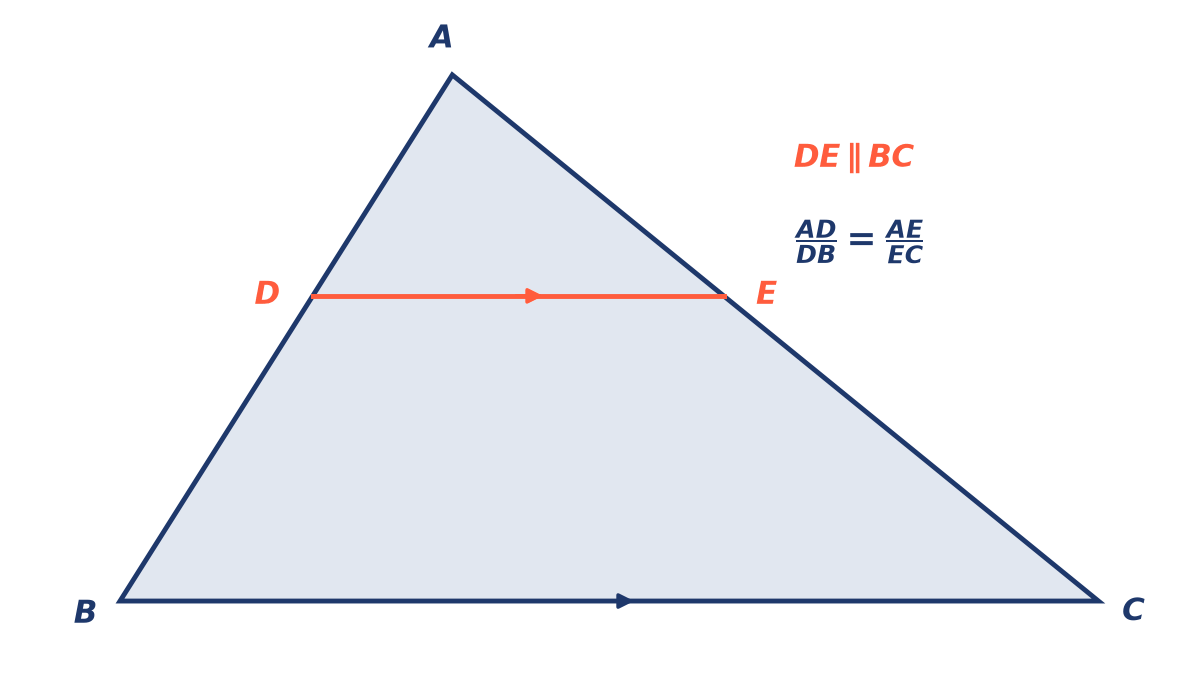
In △ABC, suppose a line parallel to BC meets AB at D and AC at E. Then
DBAD=ECAE
A line DE parallel to BC cuts AB and AC in the same ratio
Why it is true
Join B to E and C to D. Triangles ADE and DBE share the same height from E (the perpendicular to AB), so their areas compare just as their bases do:
ar(DBE)ar(ADE)=DBAD
In the same way, triangles ADE and DEC share a height from D (the perpendicular to AC):
ar(DEC)ar(ADE)=ECAE
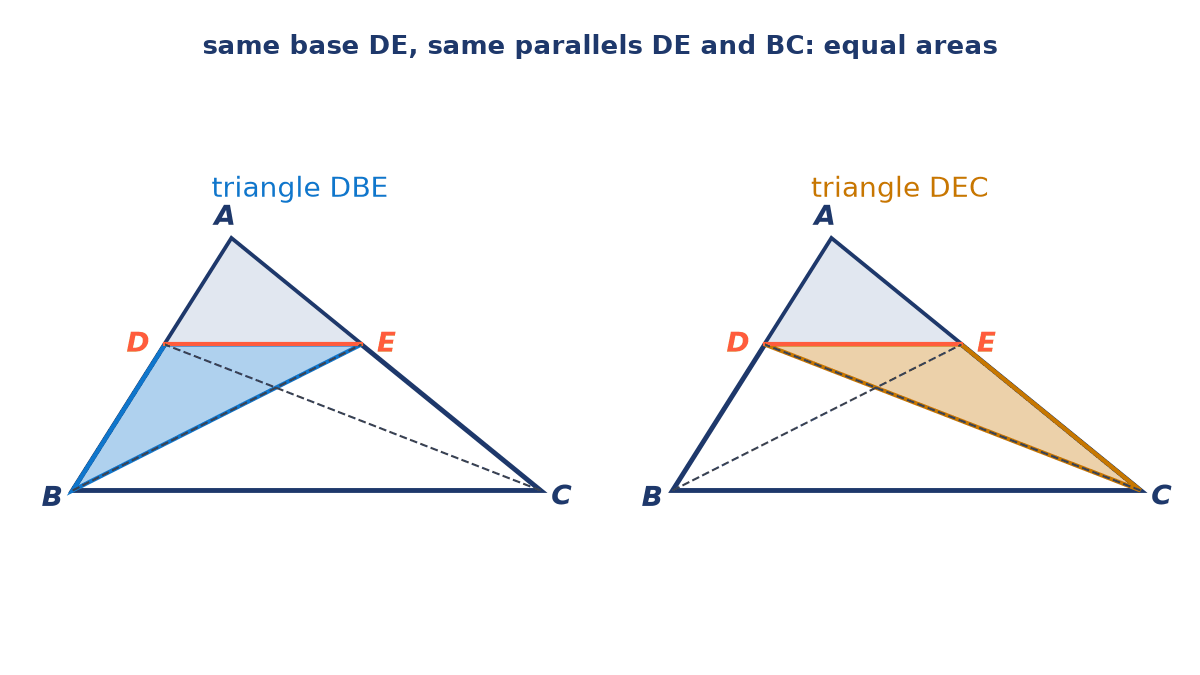
Now look at DBE and DEC. They sit on the same base DE and between the same parallels DE and BC, so their areas are equal. That makes the two left-hand sides above equal, and therefore
DBAD=ECAE
Triangles DBE and DEC have equal areas
This proof can come in the exam. The step that carries everything is the last one: same base, same parallels, equal areas. Remember that and the rest follows.
Equivalent forms
Starting from DBAD=ECAE and adding 1 to both sides, you also get
DBAB=ECACandABAD=ACAE
Any of these is fine. Just pick the one that uses the lengths you've been given.
The converse
If a line divides two sides of a triangle in the same ratio, then it is parallel to the third side.
So if you are asked to prove that DE∥BC, all you need to do is work out DBAD and ECAE and show they are equal.
Using the theorem
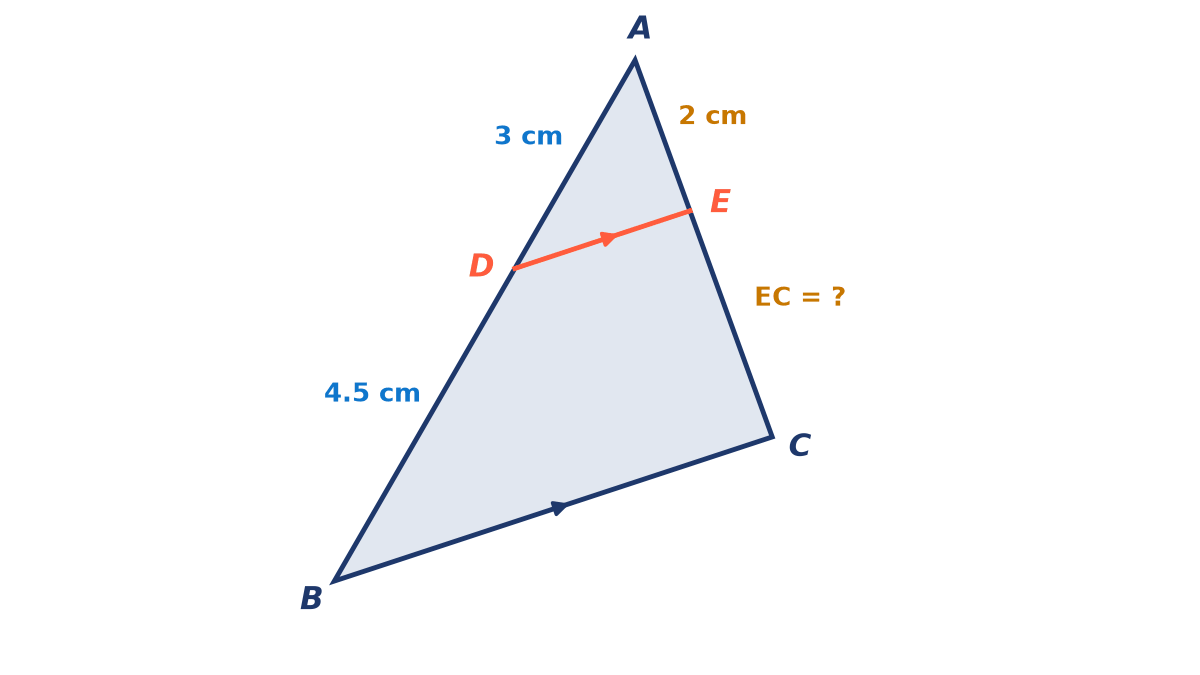
Example 1. In △ABC, DE∥BC, AD=3 cm, DB=4.5 cm, AE=2 cm. Find EC.
x+2x=x+4x+1. Cross-multiplying, x(x+4)=(x+1)(x+2), so x2+4x=x2+3x+2, which gives x=2.
Check: 42=63 ✓.
Example 3. In △PQR, S lies on PQ and T on PR with PS=4, SQ=6, PT=6, TR=9. Is ST∥QR?
SQPS=64=32 and TRPT=96=32. They match, so by the converse, ST∥QR.
Example 4.AD=2, DB=3, AE=3, EC=4. Is DE∥BC?
32=43, so the lines are not parallel.
A construction it justifies
Say you want to divide a segment AB in the ratio 3:2. Draw a ray from A at any angle and mark off 5 equal steps along it, ending at a point A5. Join A5B. Then through the third mark A3, draw a line parallel to A5B, meeting AB at C. The theorem tells you CBAC=A3A5AA3=23.
Dividing AB in the ratio 3 : 2
Practice
In △ABC, DE∥BC; AD=1.8, DB=5.4, AE=1.6. Find EC.
DE∥BC; AD=4, AB=10, AC=15. Find AE.
DE∥BC; AD=2x, DB=x+3, AE=3x, EC=2x+3. Find x.
In △ABC, D is on AB and E on AC with AD=5, DB=7, AE=10, EC=14. Is DE∥BC?
In △XYZ, P is on XY and Q on XZ with XP=3, PY=5, XQ=4, QZ=6. Is PQ∥YZ?
ABCD is a trapezium with AB∥DC, and its diagonals meet at O. Prove that OCAO=ODBO.
Answers
Show answers
5.41.8=EC1.6, so EC=1.81.6×5.4=4.8.
Use ABAD=ACAE: 104=15AE, so AE=6.
x+32x=2x+33x. Cross-multiplying, 2x(2x+3)=3x(x+3), so 4x2+6x=3x2+9x, then x2−3x=0 and x(x−3)=0. So x=3; we reject 0 because it would make the lengths zero.
75 and 1410=75 are equal, so yes.
53 and 64=32 are not equal, so no.
Through O, draw EO∥DC with E on AD. Then EO∥AB as well. In △ADC, EO∥DC gives EDAE=OCAO. In △DAB, EO∥AB gives EADE=OBDO, that is, EDAE=ODBO. Putting the two together, OCAO=ODBO.
Test yourself
The Basic Proportionality Theorem, Quiz
Five questions on the Basic Proportionality Theorem. Pick one answer for each.