Meeting the quadratic
An equation in which the highest power of the unknown is is called a quadratic equation. Quadratics turn up whenever areas, speeds and "one more than" puzzles get involved. We'll pin down the standard form, learn to spot a quadratic even when it's in disguise, write one down from a situation described in words, and check whether a given number is a root.
Standard form
A quadratic equation in is any equation that can be written as
where , , are real numbers. The condition really matters: if the term disappears and the equation is only linear.
On the other hand, or may happily be zero. is quadratic with , and is quadratic with .
Recognising a quadratic in disguise
Don't judge an equation by its looks. Bring everything to one side and simplify, and only then decide.
Example 1. Is a quadratic equation?
Expand: , so . Yes, , , .
Example 2. Is a quadratic equation?
Expand: , so . The terms cancel each other out! So no, this is linear, with the single solution .
Example 3. Is a quadratic equation?
The terms cancel: . Yes, quadratic, , , . Multiply through by if you prefer a positive leading coefficient: .
Forming a quadratic from a situation
This is the skill that carries the most marks. Choose a letter for the unknown, translate each sentence into algebra, and rearrange into standard form.
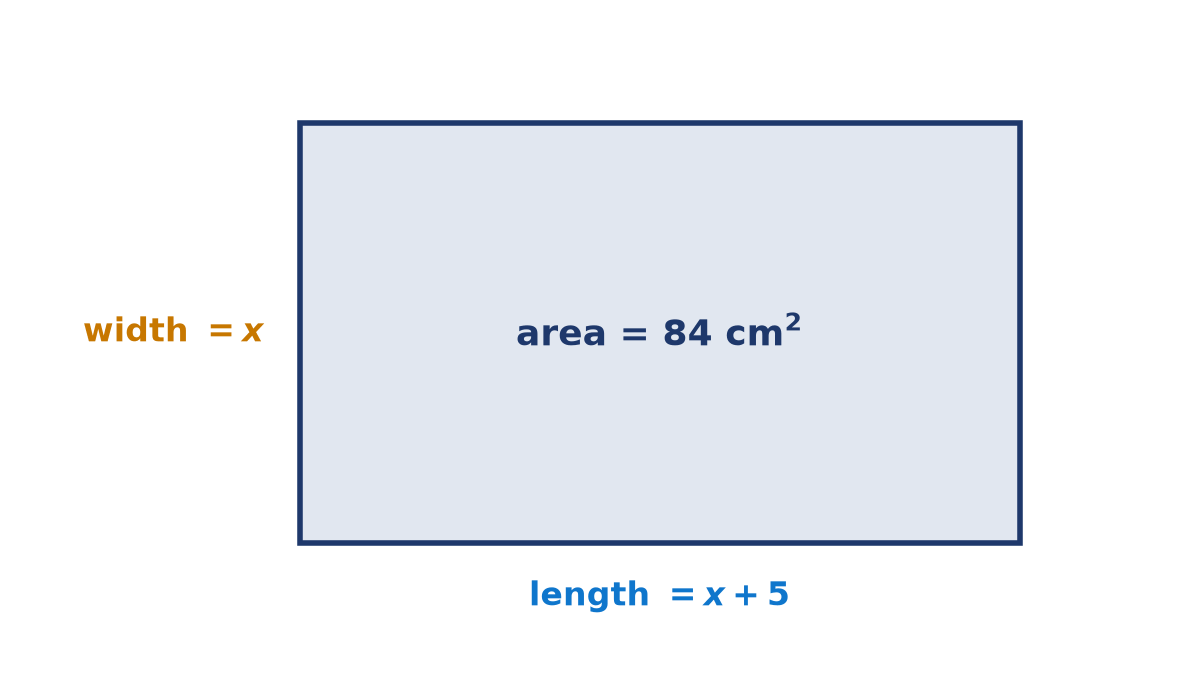
Example 4. A rectangle's length is cm more than its width, and its area is cm². Form the equation.
Width , so length . Area: , i.e. .
Example 5. The product of two consecutive positive integers is .
Smaller integer , the next is : , so .
Example 6. A number added to its reciprocal gives .
Number : . Multiply by : , so .
Example 7. A train travels km at a uniform speed. Had the speed been km/h more, the journey would have taken hour less.
Speed km/h. Time at speed is ; at speed it is . The difference is :
Multiply by : , so , giving .
Remember, the equation is not yet the answer. Solving it comes later; for now the skill is forming it correctly.
Checking a root
A number is a root of if substituting it gives . The roots of the equation are the same thing as the zeroes of the polynomial .
Example 8. Is a root of ? Is ?
. Yes. . No.
And since a quadratic polynomial has at most two zeroes, a quadratic equation has at most two roots.
Practice
- Which are quadratic equations? (a) ; (b) ; (c) ; (d) .
- Write in standard form: .
- Check whether and are roots of .
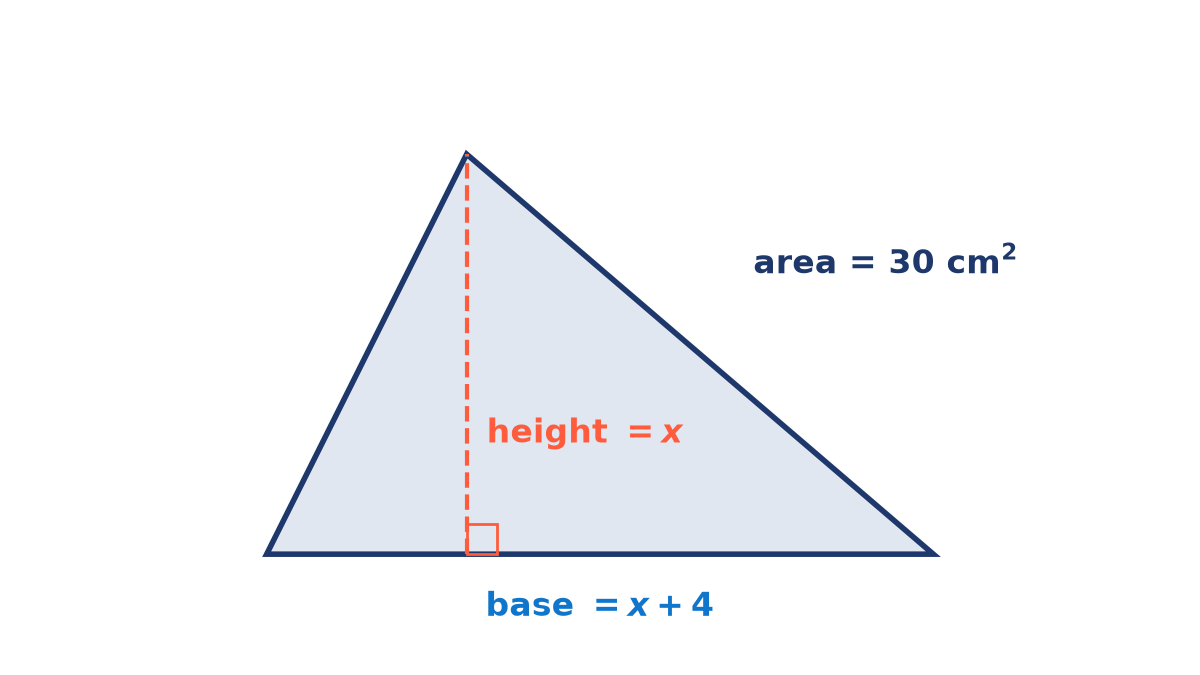
- Form the equation: the base of a triangle is cm longer than its height, and its area is cm².
- Form the equation: a two-digit number's digits multiply to , and the tens digit is more than the units digit.
- Form the equation: a shopkeeper buys articles for ₹ . If each cost ₹ less, she could have bought more for the same money.
Answers
Show answers
- (a) Yes, . (b) Expands to : linear, no. (c) : yes. (d) Multiply by : : yes.
- , so .
- ✓ root. ✓ root. Both are roots.
- Height , base : , so .
- Units digit , tens digit : , so .
- Cost per article ₹ , number bought . Then . Multiply by : , so , i.e. .