A product is zero only when a factor is zero. Splitting the middle term, rearranging before factorising, the special shapes with a missing term or a perfect square, and rejecting the root that does not fit the question.
Lesson 3 of 6
4 min read
9 practice questions
The shortcut
If a quadratic expression factorises, the equation is as good as solved, because a product is zero only when one of its factors is zero. Here we put the familiar technique of splitting the middle term to work on solving equations, including ones that need rearranging first, and word problems where one root has to be thrown out.
The principle
If p×q=0, then p=0 or q=0. There's simply no other way to multiply two numbers and get zero. So once ax2+bx+c is written as a product of two linear factors, setting each factor to zero gives a root.
Splitting the middle term
To factorise ax2+bx+c, look for two numbers whose product is ac and whose sum is b. Use them to split bx into two terms, and then factor by grouping.
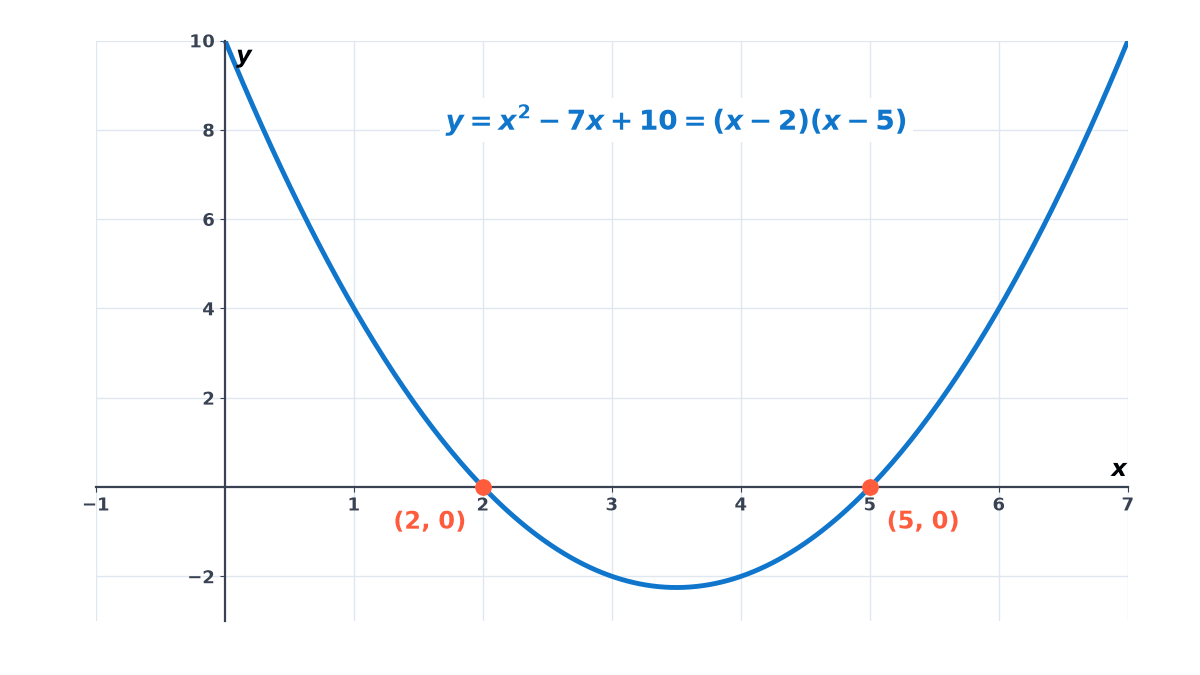
Example 1. Solve x2−7x+10=0.
ac=10, b=−7. Two numbers with product 10 and sum −7: −2 and −5.
x2−2x−5x+10=x(x−2)−5(x−2)=(x−2)(x−5)
So x−2=0 or x−5=0: the roots are 2 and 5. Check: 4−14+10=0 ✓, 25−35+10=0 ✓.
The roots 2 and 5 are where the graph crosses the x-axis
Example 2. Solve 3x2+10x−8=0.
ac=−24, b=10. Product −24, sum 10: 12 and −2.
3x2+12x−2x−8=3x(x+4)−2(x+4)=(3x−2)(x+4)
Roots: x=32 and x=−4. Check x=−4: 48−40−8=0 ✓.
Example 3. Solve 2x2−9x+9=0.
ac=18, b=−9. Product 18, sum −9: −3 and −6.
2x2−3x−6x+9=x(2x−3)−3(2x−3)=(2x−3)(x−3)
Roots: 23 and 3.
Rearrange first
Be careful: factorising only works on an expression equal to zero. x(x−3)=10 does not mean x=10 or x−3=10, because a product equal to 10 tells you nothing about its factors. Zero is special; ten is not.
Example 4. Solve x(x−3)=10.
x2−3x−10=0. Product −10, sum −3: −5 and 2. (x−5)(x+2)=0, so x=5 or x=−2.
Special shapes
No constant term.x2−6x=0 factorises as x(x−6)=0, giving roots 0 and 6. Resist the temptation to divide through by x; that quietly throws away the root x=0.
No middle term.4x2−25=0 is a difference of squares: (2x−5)(2x+5)=0, roots ±25.
A perfect square.x2+8x+16=(x+4)2=0 has the single repeated root x=−4.
No constant term, no middle term, and a perfect square
Word problems: reject what does not fit
Example 5. The product of two consecutive positive odd integers is 99. Find them.
Smaller x, next odd integer x+2: x(x+2)=99, so x2+2x−99=0. Product −99, sum 2: 11 and −9. (x+11)(x−9)=0, so x=9 or x=−11.
The question says positive, so we reject −11. The integers are 9 and 11. Check: 9×11=99 ✓.
Make it a habit to test each root against the wording. A negative length, a fractional number of people, or a speed that makes a time negative may be a root of the equation, but it is not an answer to the question. The algebra doesn't know the story; you do.
Practice
Solve by factorisation.
x2−9x+20=0
x2+3x−28=0
2x2+7x+3=0
6x2−x−2=0
x2−5x=0
9x2−16=0
(x+2)(x−1)=18
Two consecutive positive integers have a product of 210. Find them.
The altitude of a right triangle is 3 cm less than its base, and the hypotenuse is 15 cm. Find the base.
Practice question 9: base x, altitude x - 3, hypotenuse 15 cm
Answers
Show answers
(x−4)(x−5)=0: x=4,5.
Product −28, sum 3: 7,−4. (x+7)(x−4)=0: x=−7,4.
ac=6, sum 7: 6,1. 2x2+6x+x+3=2x(x+3)+1(x+3)=(2x+1)(x+3): x=−21,−3.
ac=−12, sum −1: −4,3. 6x2−4x+3x−2=2x(3x−2)+1(3x−2)=(2x+1)(3x−2): x=−21,32.
x(x−5)=0: x=0,5.
(3x−4)(3x+4)=0: x=±34.
x2+x−2=18, so x2+x−20=0=(x+5)(x−4): x=−5,4.
x(x+1)=210, so x2+x−210=0=(x+15)(x−14). Reject −15. The integers are 14 and 15.
Base x, altitude x−3: x2+(x−3)2=225, so 2x2−6x−216=0, i.e. x2−3x−108=0=(x−12)(x+9). Reject −9. Base 12 cm (altitude 9 cm; check 144+81=225 ✓).
Test yourself
Solving by Factorisation, Quiz
Five questions on solving quadratics by factorisation. Pick one answer for each.