Twelve questions by factorisation, equations that need rearranging, ones with a repeated root, ones where cancelling would lose a root, then word problems on numbers, fields, reciprocals and speeds, each with the rejected root explained.
Lesson 4 of 6
3 min read
How to use this set
Here are twelve questions, and every one of them gives way to factorisation. The first eight are plain equations, and each is a little more awkward than the one before. The last four are word problems. When you do a word problem, form the equation, solve it, and then tell me in one sentence which root answers the question and why the other one doesn't. That one sentence is where examiners give or take away marks, so never skip it.
Section A: Equations
x2−11x+30=0
x2+2x−35=0
3x2−14x+8=0
4x2+4x−3=0
5x2−20=0
x2=7x
3x+x3=2, for x=0
(x−3)2=2(x−3)
Section B: Word problems
Two consecutive positive even numbers have squares that add up to 164. What are the numbers?
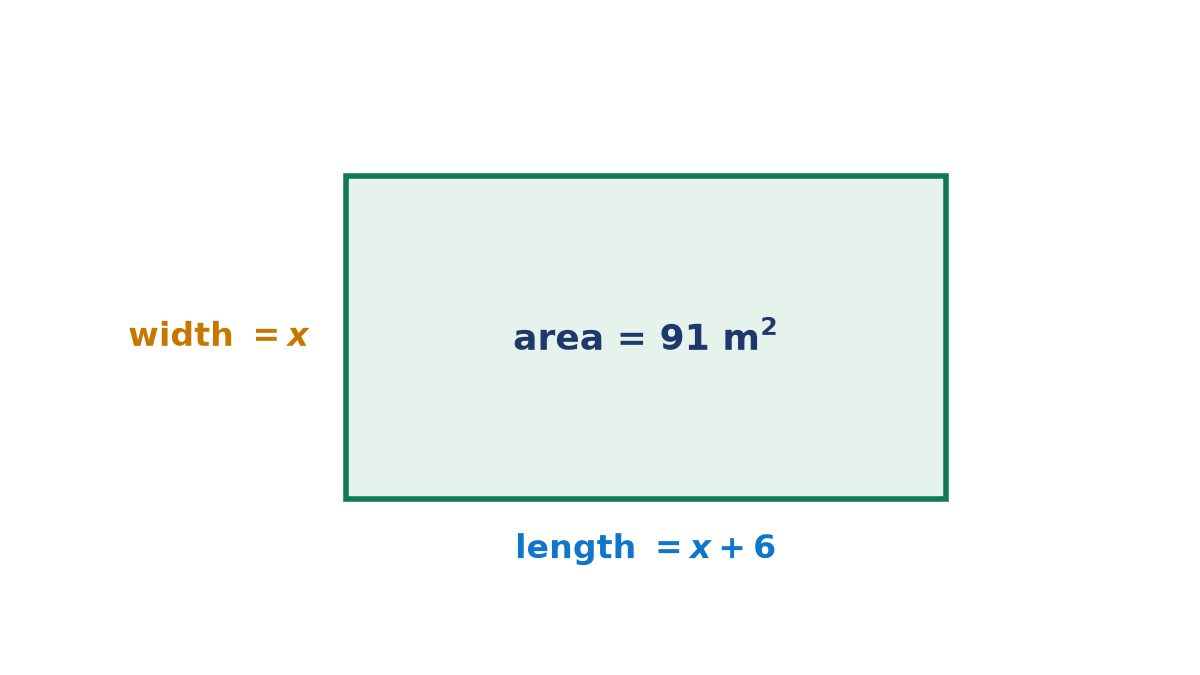
A rectangular field is 6 m longer than it is wide, and its area is 91 m². Find its dimensions.
When a number is added to its reciprocal, you get 310. Find the number.
A car covers 180 km at a steady speed. Had it gone 15 km/h faster, the trip would have taken 1 hour less. What was its speed?
Question 10: width x, length x + 6, area 91 square metres
Answers
Show answers
We need product 30 and sum −11, which gives −5,−6. So (x−5)(x−6)=0 and x=5,6.
Product −35, sum 2: the pair is 7,−5. Then (x+7)(x−5)=0, so x=−7,5.
Here ac=24 and the sum is −14, so split with −12,−2. 3x2−12x−2x+8=3x(x−4)−2(x−4)=(3x−2)(x−4), giving x=32,4.
Now ac=−12 with sum 4, so use 6,−2. 4x2+6x−2x−3=2x(2x+3)−1(2x+3)=(2x−1)(2x+3), giving x=21,−23.
Take out the common factor first: 5(x2−4)=5(x−2)(x+2)=0, so x=±2.
x2−7x=x(x−7)=0, so x=0,7. (If you had divided by x, the root 0 would have quietly disappeared.)
Multiply through by 3x: x2+9=6x, so x2−6x+9=(x−3)2=0. There is just one root, x=3.
Bring everything to one side: (x−3)2−2(x−3)=0, so (x−3)(x−3−2)=(x−3)(x−5)=0 and x=3,5. (Cancelling x−3 from both sides is tempting, but it throws away the root 3.)
Call the smaller number x; the next even number is x+2. Then x2+(x+2)2=164, so 2x2+4x+4=164, which is x2+2x−80=0=(x+10)(x−8). We reject −10 because the numbers must be positive. So the numbers are 8 and 10. Check: 64+100=164 ✓.
Let the width be x, so the length is x+6. Then x(x+6)=91, giving x2+6x−91=0=(x+13)(x−7). A length can't be −13, so reject it. The width is 7 m and the length 13 m.
We have x+x1=310. Multiply by 3x: 3x2+3=10x, so 3x2−10x+3=0. With ac=9 and sum −10, split using −9,−1. (3x−1)(x−3)=0, so x=3 or x=31. Both work, and that makes sense: each is the reciprocal of the other, and each satisfies the equation.
Let the speed be x. Then x180−x+15180=1. Multiply by x(x+15): 180(x+15)−180x=x2+15x, so x2+15x−2700=0. We want product −2700 and sum 15, which gives 60,−45. (x+60)(x−45)=0. A speed can't be −60, so the speed is 45 km/h. Check: 45180=4 h and 60180=3 h, exactly one hour less ✓.
Test yourself
Factorisation: Practice, Quiz
Five questions on factorisation practice. Pick one answer for each.