Ten questions on deciding whether an equation is quadratic, writing it in standard form, checking and finding roots, and translating situations about areas, numbers and speeds into equations. Full answers.
Lesson 2 of 6
3 min read
How to use this set
Ten questions on recognising quadratic equations, writing them in standard form, checking roots and, most important of all for marks, turning a situation into an equation. In each word problem, say what your letter stands for before you write the equation, and stop as soon as the equation is in standard form. You aren't asked to solve anything here.
Section A, Recognising and rearranging
Decide whether each is a quadratic equation: (a) x2+2x=5; (b) (x−3)(x+3)=2x2−9; (c) x2+x21=4; (d) (x+2)3=x3−4x.
Write in standard form and state a, b, c: 3x(x−2)=4x+5.
Write in standard form: xx+1=x+2x, stating any values of x that must be excluded.
Section B, Roots
Is x=21 a root of 2x2+3x−2=0? Is x=2?
Find k if x=3 is a root of x2−kx+6=0. Then find the other root.
Show that x=3 is a root of x2−3=0, and name the other root.
Section C, Forming equations
The sum of a number and its square is 56.
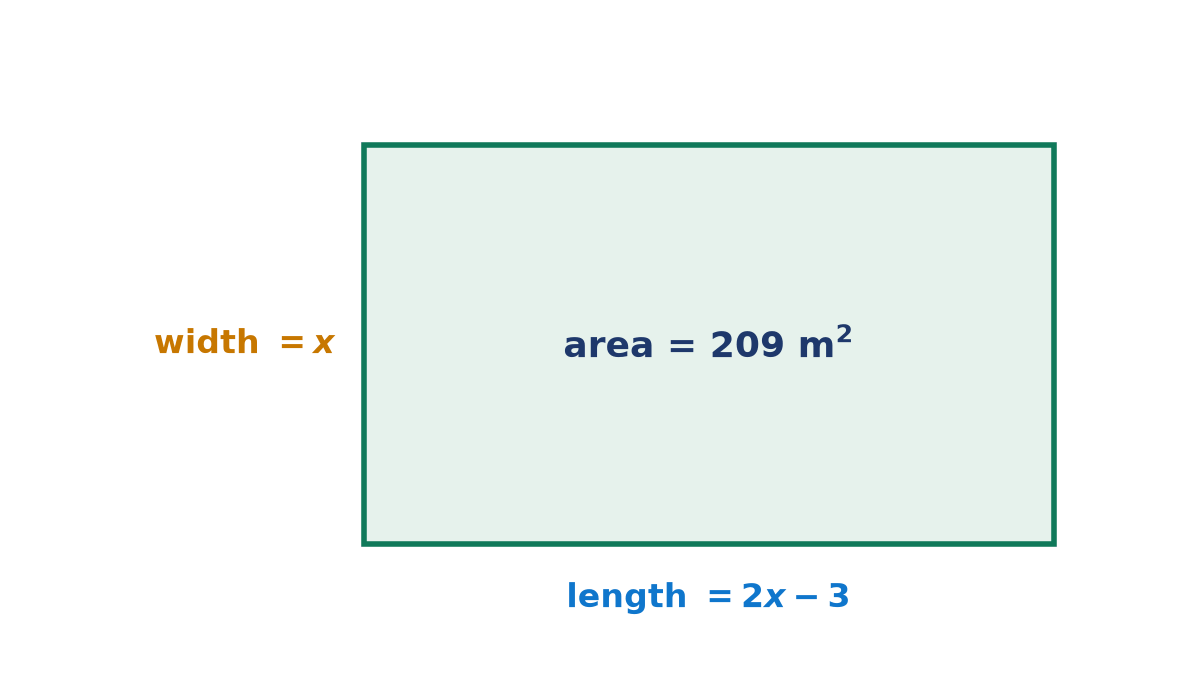
A rectangular plot's length is 3 m less than twice its width, and its area is 209 m².
Two positive numbers differ by 4 and the sum of their squares is 136.
A bus covers 240 km at a uniform speed. If the speed had been 8 km/h less, it would have taken 1 hour more.
(a) No, x is not a power of x with a whole-number exponent, so this is not a polynomial equation. (b) x2−9=2x2−9 gives x2=0: yes, quadratic (with b=c=0). (c) No, the x21 term makes it degree 4 after clearing: x4−4x2+1=0. (d) x3+6x2+12x+8=x3−4x gives 6x2+16x+8=0: yes.
3x2−6x=4x+5, so 3x2−10x−5=0; a=3, b=−10, c=−5.
Exclude x=0 and x=−2. Cross-multiply: (x+1)(x+2)=x2, so x2+3x+2=x2, giving 3x+2=0. Surprise: this is linear, not quadratic, because the x2 terms cancelled. The single solution is x=−32.
2(41)+23−2=21+23−2=0 ✓, so 21 is a root. 2(4)+6−2=12=0, so 2 is not.
9−3k+6=0 gives k=5. Then x2−5x+6=(x−2)(x−3), so the other root is 2.
(3)2−3=3−3=0 ✓. The other root is −3, since (−3)2=3 too.
Number x: x+x2=56, so x2+x−56=0.
Width x, length 2x−3: x(2x−3)=209, so 2x2−3x−209=0.
Smaller number x, larger x+4: x2+(x+4)2=136, so 2x2+8x+16=136, giving x2+4x−60=0.
Speed x km/h: x−8240−x240=1. Multiply by x(x−8): 240x−240(x−8)=x(x−8), so 1920=x2−8x, i.e. x2−8x−1920=0.
Test yourself
Recognising and Forming Quadratics: Practice, Quiz
Five questions on standard form, roots and forming quadratics. Pick one answer for each.